
If you play Dwarfs in Total War: Warhammer 3, you’ll be managing ages, grudges, and a slow but powerful economy. You’ll learn how to run their core loop, pick your legendary lord, build the Deeps, and use Underways safely. This guide gives you the breakdowns, steps, and bonuses for every main lord, plus tables and screenshots for fast reference.
Quick answer
| What | Answer |
|---|---|
| Age of reckoning length | 15 turns |
| Forge currency | Oathgold |
| Deephold requirement | High King's Decree |
| Underway risk | Interception can wipe the army |
| Thorgrim bonus | 75% leadership aura size |
| Ungrim focus | Slayers |
| Belegar penalty | 50% upkeep increase until Karak Eight Peaks is captured |
| Malakai adventure count | Seven adventures |
Learn the Dwarf campaign loop
Dwarf campaigns balance constant expansion with deep settlement development. Your main mechanics include Ages of Reckoning, the Great Book of Grudges, Oathgold and the Forge, the Deeps, Underways, and Commandments.
The main loop rewards you for fighting — settling grudges is critical for bonuses, and expansion pressure comes from the Age of Reckoning timer. Dwarven armies are slow but exceptionally tough, designed to win defensive battles and grind down enemies over time. Most runs involve picking battles that grant high grudge values and investing steadily in infrastructure. The faction’s challenge lies in managing deadlines (ages), targeting grudge-rich opponents, and scaling up trade and income without becoming overextended.
Manage Ages of Reckoning and the Great Book of Grudges
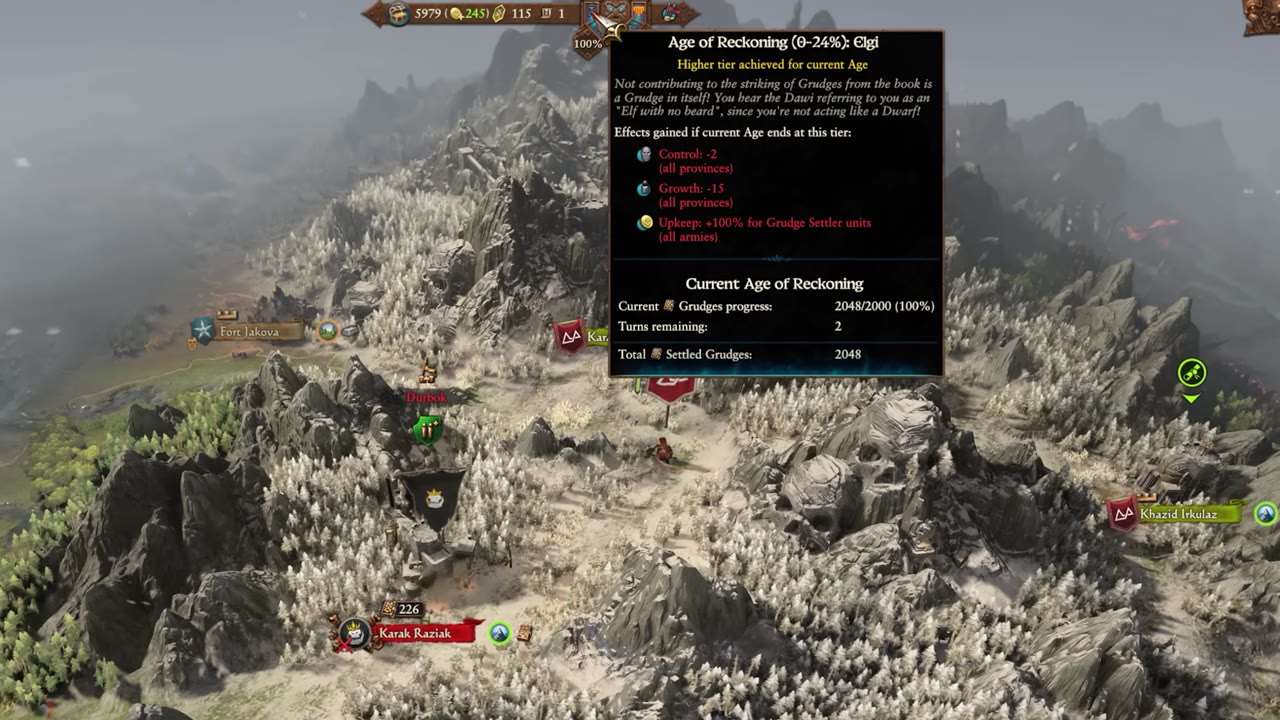
Each Age of Reckoning lasts 15 turns. Every hostile army or settlement accumulates a grudge value based on what they've done to Dwarfs: fighting, raiding, or seizing territory. Engaging these targets in combat adds their grudge score to your settled value for the current age.
Settling grudges unlocks tiered rewards at the end of each age: control, growth, and upkeep penalties or bonuses; unique grudge units (like instant regiments of renown); and even temporary free armies. The more grudges you settle, the bigger the payout.
You can delay moving on to the next age, but it increases the cost for future ages — this is a tool for catching up, but not for resting easily.
The Great Book of Grudges features:
- Legendary Grudges: quest-like objectives with major rewards.
- Legendary Lords tab: long-term confederation targets.
- Grudge Settlers page: breakdowns of unique grudge units.


Use Oathgold, the Forge, and the Deeps well
Oathgold is the secondary currency, earned from post-battle loot, certain buildings, mission rewards, and more. The Forge uses Oathgold to craft gear and runes for lords and heroes, creating stat boosts and special abilities.
Some items and runes require tradeable resources, which you obtain by upgrading resource buildings or trading with other factions. If you craft an item you don’t need, recycle it for a chunk of Oathgold—the rarer the item, the higher the rebate.
To build a Deep (a specialized underground settlement), you first need a High King's Decree. These decrees are limited and typically acquired by upgrading existing Deep locations via research or skills (notably from Thorgrim). Any major settlement can host a Deep, but the process costs both gold and Oathgold, and can take a significant number of turns.
Once the Deep is started, its building menu appears and grants branching structures with boosts: increased income, options to pause Ages of Reckoning, corruption cleanup, and other powerful effects. Deeps at locations like Skavenblight, Karak Eight Peaks, and Zharr-Naggrund offer extra bonuses related to their lore.


Move safely through the Underways and choose the right Commandments
The Underways allow your army to tunnel beneath mountains and rough terrain, speeding up movement and letting you avoid normal paths. However, moving through the Underways near enemy armies risks interception. If intercepted, you’re forced into a defensive battle, and losing it will result in your army being destroyed outright.
Commandments offer four province-wide bonuses to help shape your campaign:
- Venerate the Ancestors: improves control and clears corruption.
- High King’s Tributes: boosts gold and Oathgold income.
- Masters of Steel and Stone: speeds recruitment and lowers cost.
- Empower the Guilds: accelerates growth, reduces construction prices, and boosts trade.


Follow the core Dwarf campaign priorities
Dwarfs demand patience early on: their economy and army roster are costly, especially before trade and resource upgrades kick in. Focus on resource buildings, which can reach tier 4 and create large trade income later in the campaign.
The constant pressure from Ages of Reckoning means you need to keep fighting or risk penalties. If your armies are depleted or settlements vulnerable, use the pause age option to buy recovery time.
Mountain regions fit Dwarf defensive tactics and align with most legendary grudge objectives—aim to control these and use terrain advantage. Build toward the long-term quest rewards set in the Great Book (like global Underways and artifact unlocks).
When investing in the Deeps, prioritize locations where you can defend them easily: losing a Deep is much costlier than losing a regular settlement. Early-game armor and powerful crafted items can offset your units’ numerical disadvantage, especially when combined with strong defensive formations.
Play Thorgrim Grudgebearer for diplomacy and sturdy front lines
Thorgrim Grudgebearer is the all-rounder. He can confederate or ally with other Dwarfs reliably, making him the favorite if you want to unite the Dwarf holds. His faction gains extra High King’s Decrees, so expanding into the Deeps is faster and easier.
Army bonuses include increased recruit rank for Hammers, lower upkeep for Longbeards and Hammers, and extra resistance for Hammers. Commandments under his banner are more powerful, and his aura size boosts leadership, helping your lines hold under pressure.
Thorgrim’s central starting location supports trade with the Empire and Southern Realms, allowing him to snowball a strong economy. Plan to spam Hammers and prioritize upgrades, focusing on diplomacy and economic growth.

The bonus is currently listed as 75% leadership aura size — not flat leadership. If a patch changed it, trust the value shown in-game.
Play Ungrim Ironfist for a Slayer-heavy army
Ungrim Ironfist is built for speed and Slayer spam. He recruits Slayers cheaper and builds Slayer-related structures for less. Infantry units under his command are faster, and Slayers specifically enjoy reduced upkeep, higher attack, and better staying power.
His campaign favors aggressive expansion with multiple Slayer armies. Lord skills let you push the Slayer bonuses even further, making them formidable against high-damage opponents. With a central mountain position, Ungrim is well-placed for wars with Chaos Dwarfs or Vampire Counts.

Play Belegar Ironhammer around Karak Eight Peaks
Belegar Ironhammer starts with a harsh penalty: his faction’s upkeep is increased by 50% until Karak Eight Peaks is captured. His opening army includes four ancestral heroes—two Thanes, a Master Engineer, and a Runesmith—all immortal and ethereal.
His position and bonuses encourage a direct rush for Karak Eight Peaks, backing up with Underways and siege boosts, plus extra leadership against ancestral rivals. Capturing the peaks removes the penalty and unlocks unique buildings with strong buffs.

Use Grombrindal, Thorek, and Malakai around their unique campaigns
Each of these legendary lords changes the campaign flow:
| Lord | Unique Features | Starting Location | Army/Faction Bonuses | Strategy Highlights |
|---|---|---|---|---|
| Grombrindal | Picks 1 of 4 buffs at turn 3 & every 25 turns; extra melee damage vs Elves; can reinforce from twice the distance | Mountains of Nagarond | Confidence buffs; hard-to-break backline | Target Elves, use buffs for best timing |
| Thorek | Artifact/crafting quest; earns/spends Oathgold faster; bonus exp/upkeep for Rune Lords | Southlands | Powerful runic magic, faster forging | Prioritize artifacts and expansion/trade |
| Malakai | Seven adventures; starts with Gotrek & Felix; army recruits from Spirits of Grungi airship | Norsca | Artillery/war machine boosts, adventure rewards | Push adventures, empower artillery, recruit on the move |


Also worth knowing
- Grudge mechanics and Deeps often conflict. The campaign pressure from ages and grudges rewards constant expansion, while investing in Deeps and upgrade chains favors a tall, defensive playstyle. Balancing both can be difficult in one campaign.
- Malakai’s Spirits of Grungi airship cannot be intercepted. Unlike normal Underways movement, Malakai’s recruitment and army moves use the airship mechanic, making him safer and able to initiate attacks freely.
- Thorgrim is a classic favorite. Many players choose Thorgrim for their first runs, as he’s one of the original lords, offers fast confederation, and is straightforward economically.
- Belegar’s campaign is especially tough but rewarding. His “reclaim the home” quest is harder than most, but is valued for clarity and satisfaction once the peaks are retaken.
Frequently asked
How do Dwarf grudge mechanics work?
Enemies and settlements generate grudges based on how they have treated Dwarfs, such as fighting them or taking territory. Settling those grudges during a 15-turn Age of Reckoning raises the reward tier and can unlock faction effects, grudge units, and even temporary free armies. The system rewards picking high-grudge targets and pushing battles aggressively.
What is the best Dwarf lord for a beginner?
Thorgrim Grudgebearer is the safest all-round pick because he has strong diplomacy, easy confederation options, and extra tools for expanding into the Deeps. He also benefits from empowered Commandments and extra High King's Decrees, which makes his campaign economy and territory growth straightforward. If you want a clearer thematic goal, Belegar and Malakai are stronger but more specialized starts.
Are the Deeps worth building?
Yes, but they are a long-term investment rather than an early cash solution. They require a High King's Decree, gold, oathgold, and time, and they can provide powerful income and faction bonuses. They are especially valuable in safer locations where you can protect the investment.
Read next
Total War: Warhammer 3 Nurgle Guide: Plagues, Recruitment and the Cycle of Decay
This plan covers Nurgle’s campaign mechanics, corruption economy, plague crafting, and the three playable Nurgle factions. It is aimed at players who want a practical overview of how to start, expand, and use each faction’s unique strengths.
Total War: Warhammer 3 High Elves Guide: Patronage, Influence and the Intrigue Game
This plan covers the shared High Elf mechanics in Immortal Empires and how each legendary lord changes the campaign plan. It is for players who want to choose a lord, understand the faction systems, and know what to prioritize early.
Total War: Warhammer 3 Lizardmen Guide: Geomantic Web, Rites and Blessed Spawnings
A practical early-to-late campaign plan for Kroq-Gar and the Last Defenders, focused on surviving the opening wars, building efficient armies, and scaling into a Stegadon-heavy late game. It is for players who want a clear path through the faction’s early economy, unit choices, heroes, and research priorities.
Total War: Warhammer 3 Greenskins Guide: Waaagh!, Scrap Upgrades and Da Best Start
This guide covers the core Greenskin campaign mechanics and how they shape expansion, army building, and faction choice. It is for players who want a practical overview of the major lord starts and what each one is best at.