
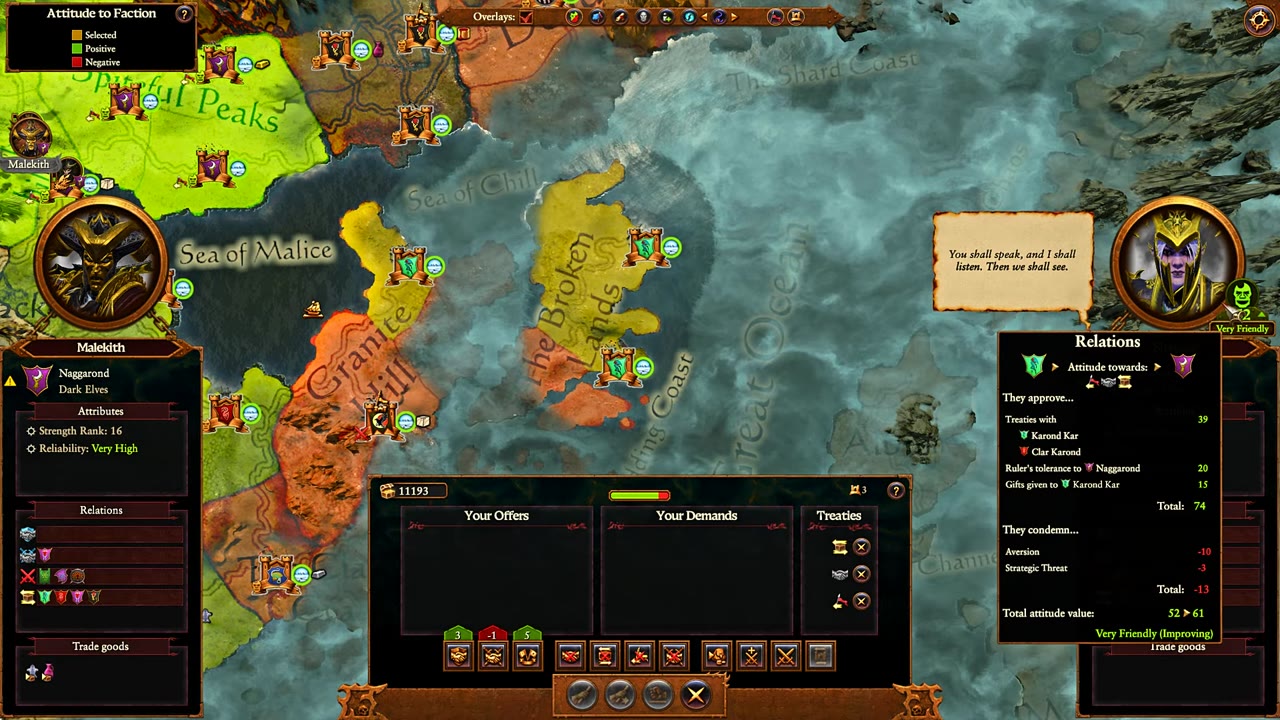
When confederating factions in Total War: Warhammer 3, you need to balance diplomatic relations, faction strength, and timing. Absorbing minor and major factions depends on their current status in the campaign, whether they're expanding or collapsing, and your own strategic position. Here you'll find the specific factors, penalties, and methods to confederate efficiently without slowing your expansion.
Quick answer
| What | Answer |
|---|---|
| Main factors | relations, faction strength, and whether the target is losing territory |
| Relation cap | 150 |
| Territory penalty duration | 7 turns |
| Minor-faction cost | -40 relations with same race |
| Threaten downside | hurts reliability |
Read the confederation score correctly
To confederate a faction, start by understanding which factors matter:
- Diplomatic relations are the primary positive influence. Treaties such as trade agreements, aggression pacts, and military access all contribute to improving relations. The effects of these agreements can be tracked on the diplomacy panel, but their usefulness caps out at a value of 150. Beyond this, having more treaties doesn't further increase your chances.

- Military and defensive alliances do not directly amplify confederation chances like the treaties above, but they are relevant for timing. When you form a defensive alliance, confederation checks will update on the next end turn, potentially shifting willingness if campaign events alter strength or territory.

- Faction strength is a critical number. If your faction's strength is much higher than the target, especially when the target is losing armies or territory, your confederation proposal becomes more attractive. A faction on the verge of collapse, with few provinces or devastated armies, is much easier to absorb than one still winning wars.

If a faction is actively expanding, its willingness to join you shrinks sharply. If it's losing regions or armies—especially to overwhelming opposition—your chances rise. Balance your treaties and monitor the target's campaign situation before making the move.
Use a collapsing minor faction first
Minor factions are the most straightforward to confederate if they’re already facing collapse. Follow these steps to make the process effective:
- These are the easiest targets to confederate 2:53
- Good relations matter but strength is decisive 3:23
- A weakened faction will accept confederation if you are much stronger.
- Confederating a minor faction imposes a -40 relations penalty with other factions of the same race, which can affect future diplomacy, especially with races like Dark Elves that dislike each other 3:23.

If you pick a minor faction on the verge of extinction, you can often confederate them without involving yourself in their wars. This saves you military effort and bypasses risky campaign distractions.
Break a major faction before asking for confederation
Major factions seldom accept confederation unless they're losing badly. To make a major faction ready for absorption, restructure the campaign conditions:
- Factions that are winning and taking territory refuse confederation 4:20.
- Friendly relations can help, but only up to a certain point 4:50.
- Encourage conflicts with strong enemies to weaken the target 5:19.
- If the faction recently captured a region, a seven-turn penalty applies that blocks confederation 5:19.
- Selling provinces avoids the penalty that comes with territory gains 7:42.
- Sometimes a faction must be nearly destroyed before it will confederate 9:09.


Winning territory themselves triggers a 7-turn penalty window where confederation becomes impossible for the target, so avoid giving them a chance to conquer new regions if possible. Trading territory or selling provinces gets around this penalty, but any gains increase the target's overall faction strength.
Keep the target weak if you want the long game
If you plan to confederate a faction later, make sure it stays weak and boxed in:
- Territory is key. The fewer provinces and settlements a faction possesses, the lower its faction strength, improving your confederation odds when the moment comes.
- Trap rivals in single provinces. Remove nearby rivals and limit expansion to keep the target boxed into one area. This way, it can't build strength or recruit fully.
- Campaign difficulty affects the target. Factions on higher difficulties may hold on through AI bonuses, but confining them to one province caps their expansion and makes confederation more likely.
- Monitor legendary lords. If they continue to win battles or trade regions, they're harder to absorb. Wait until their campaign stagnates or they lose key armies.

Factions trapped with minimal territory are much less resistant, but make sure you don't destroy them completely—a wiped-out faction can't be absorbed until it's revived.
Decide when confederation is worth the cost
Confederation isn't always a net benefit. Consider the costs and risks before forcing it:
-
Confederating at the wrong time can slow your expansion. If you take on a faction that's still dealing with major wars, you may be dragged into more conflicts than you want.
-
Campaign complexity increases with alliances. Dragging a target into multiple wars may break their resistance, but also creates a diplomatic mess for you.
-
Threatening is a last resort. Using the Threaten option can push a weak faction to confederate, but it damages your reliability score, making future diplomacy harder. This tactic is most useful when you're confident you won't need allies or trade afterwards.
-
Strong targets require patience. If a faction keeps winning wars or trading territory, confederation can take dozens of turns. Sometimes waiting is best—let them become isolated and weakened before making your move.
Evaluating whether confederation is right for your campaign depends on timing, the relative power balance, and how much diplomatic fallout you’re willing to manage.
Also worth knowing
- Military alliance plus request army may outweigh faction strength in confederation calculations. This is debated and lacks a clear answer—some players report success when borrowing armies just before confederating.
- Confederating a major faction can be much harder than expected. For example, Hellebron often refuses to confederate unless she is nearly wiped out, regardless of your strength or relations.
- Threatening a target on the verge of death can force confederation. If relations and conditions are right, using the threaten mechanic can break the deadlock, but only use it when reliability loss won’t hurt you.
- Vassals may still be able to confederate other factions. If you’re playing as a vassal, it’s possible to absorb other factions, though this is not well documented.
- Breaking alliances by overloading a faction with wars can trigger confederation. Once relations climb high enough and reliability drops, alliances may break, opening the confederation option.
- Some players report confederation only becomes available when a faction is wiped out and later revived. This situation is rare but can occur, especially with stubborn major factions.
Frequently asked
What actually makes a faction willing to confederate?
High diplomatic relations help, but they are only part of the calculation. Faction strength matters a lot, and a target that is losing wars or territory becomes much easier to absorb. If the target is still expanding or surviving comfortably, confederation is much harder.
Does a military alliance help or hurt confederation?
A military alliance does not directly count as a positive confederation factor in the same way trade agreements, aggression pacts, and military access do. It can still be useful for timing because the confederation check is recalculated when the end turn is clicked. The downside is that allies usually share more enemies, which can make your campaign messier.
Why does confederating a minor faction sometimes make other same-race factions harder to absorb?
Confederating a faction applies a diplomatic penalty with other factions of that race. That means taking one minor faction can make the rest less friendly, so the order you absorb them in matters. It is often better to pick the one that is closest to collapse first.
Is threatening a good way to force confederation?
It can work, but it reduces reliability. That makes it a risky tool if you still need allies, trade, or smooth diplomacy afterward. Use it only when the immediate gain is worth the diplomatic damage.
Read next
Total War: Warhammer 3 Vassals Guide: Are They Worth It, Tribute and Rebellions
A practical breakdown of how to secure vassals and confederations through settlement trades, military pressure, and diplomacy value. It is aimed at players who want to bend major factions to their side instead of wasting time on weak minor vassals.
Total War: Warhammer 3 Hero-Only Campaign: How Far Heroes Alone Can Carry You
Plan a hero-only campaign around factions that can grow hero capacity quickly, with Skaven and Throt as the core example. The sections focus on early survival, hero recruitment, settlement expansion, and when the strategy starts to fall apart.
Total War: Warhammer 3 Campaign Expansion Guide: Provinces, Public Order and When to Stop
Learn how to expand by provinces instead of scattering settlements across the map. This plan covers when to commit to a full province, when to hold a broken province, and when to slow down for public order, defense, and income.
Total War: Warhammer 3 Economy Guide: Make Money Fast
This plan covers the main ways to generate income in Total War: WARHAMMER III, from taxes and trade to diplomacy, battles, raiding, and settlement actions. It is for players who want a practical breakdown of which income sources are passive, active, or faction-dependent.