
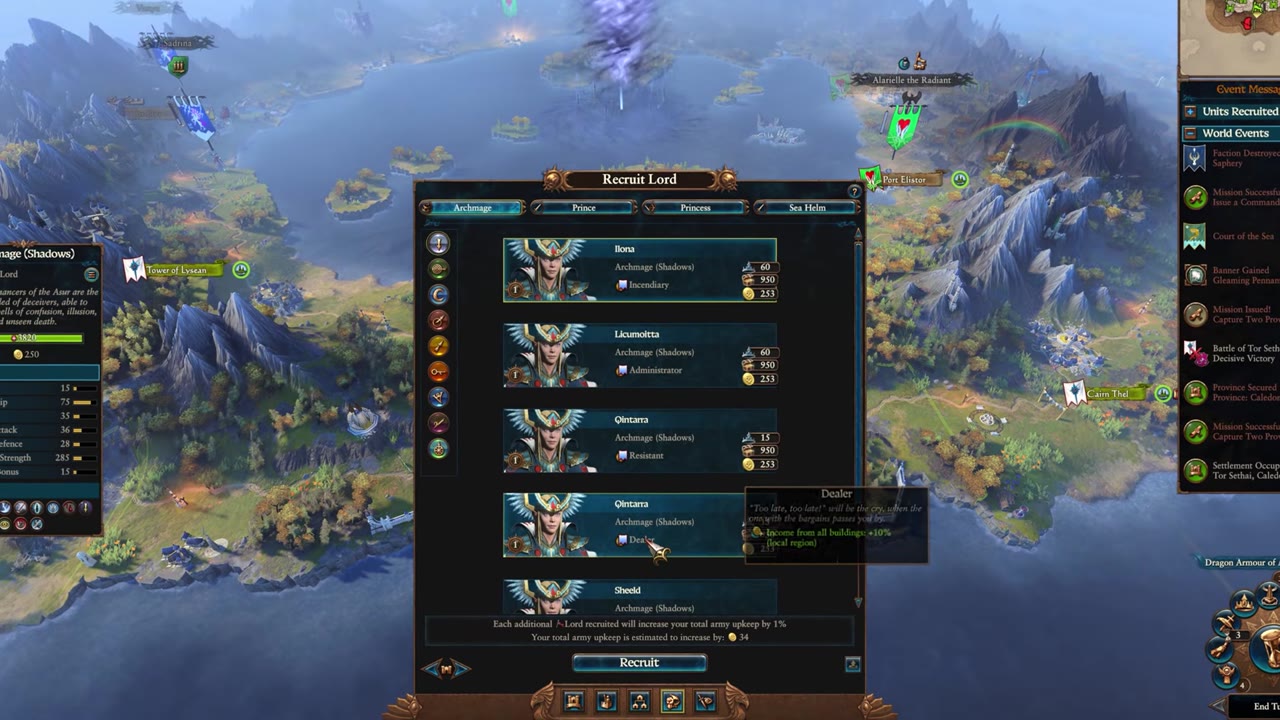
Choose a High Elf legendary lord, understand the faction's core resources and mechanics, and plan your campaign priorities. This guide covers the newest shared High Elf systems in Immortal Empires and highlights how each major lord offers a distinct playstyle, helping you decide where to start and what to focus on for maximum impact.
Quick answer
| What | Answer |
|---|---|
| Core resource | Influence |
| Seat cap | Phoenix King favor |
| Rite count | Four base rites |
| Tyrion mechanic | Champion of Ulthuan |
| Teclis mechanic | Secrets of the White Tower |
| Alarielle mechanic | Defender of Ulthuan |
| Imrik mechanic | Dragon taming |
| Aislinn mechanic | Outposts and dragon ships |
- Rite count may vary. The number of rites available can change between patches and faction choices. Check your campaign before spending resources.
Understand the shared High Elf systems
Influence is the backbone of every High Elf campaign. You earn it from buildings, battles, quests, and faction events. This resource fuels multiple systems: spend Influence for Intrigue at Court to manipulate faction relations, for recruiting lords and heroes with stronger traits, and for claiming Patron of the Realms seats. When hiring lords, invest at least 15 Influence per option to avoid negative traits.

Intrigue at Court lets you intervene in diplomacy, turning allies against rivals or smoothing your alliances. The Patron of the Realms system allows you to use spare lords and Influence to claim seats scattered across the map. Each seat gives bonuses both to the lord and your faction, and you can upgrade seats twice for greater rewards. You can even contest seats already held by other High Elf factions, but expect relations penalties if you do.

The number of seats you can hold depends on your Phoenix King favor. This favor rises through victories against foreign races, patronage positions, and maintaining high relations with other High Elf factions. The maximum favor is tied to the number of High Elf settlements on Ulthuan, so unifying the donut is a key strategic goal.
- Phoenix King favor now rewards fighting foreign races, not fellow High Elves. When in doubt, check the in-game prompt and tooltips instead of guidance from previous patches.
Confederation is unlocked by owning a faction's seat at tier three and reaching at least tier five favor, regardless of diplomatic relations. If a legendary lord's faction has already been wiped out, you can still recruit the lord once requirements are met.
High Elves also have access to rites—temporary faction-wide buffs gained by spending gold. Each rite grants bonuses for a limited duration and has a cooldown, so time their use around important wars, development pushes, or massive battles.

Build around Tyrion’s campaign
Tyrion leads Lothern and is usually the most beginner-friendly High Elf lord. His unique Champion of Ulthuan mechanic provides two action sets: air actions and alliance actions. Air actions empower armies and settlements, summon temporary forces, reset movement range through specific research, and let you borrow target armies for support. Alliance actions supply stronger buffs, deal direct damage to enemies, and boost entire provinces—but require alliances or confederation with other High Elf legendary lords.

Tyrion earns extra Influence from battle and enjoys strong recruitment buffs for infantry and cavalry. His army pays half upkeep for weaker units and gets recruitment rank boosts for favored picks, allowing for flexible, cost-effective forces. Securing the Shrine of Khaine fits naturally into his route, enhancing his roster and campaign options.
His campaign rewards players who clear Ulthuan, farm Influence, and use Champion of Ulthuan actions for continuous buffs. Tyrion's starting position is focused, active, and forgiving, making it an ideal entry for new players looking for classic High Elf gameplay.
Use Teclis for caster power and allied units
Teclis leads the Order of the Loremasters and operates with the Secrets of the White Tower system, using Scrolls of Knowledge instead of Influence. Scrolls accumulate from High Elf and caster battles and can be spent in the White Tower for repeatable and single-use actions.

Repeatable actions grant temporary access to cataclysmic magic, strengthen your armies, or weaken enemy forces. Single-use actions can add powerful lords to your recruitment pool, permanently reduce spell costs, or boost caster recruit rank. If you enjoy maximizing caster stacks and hero abilities, this system is designed for you.
Teclis’s campaign offers a dual start: after taking your first province, you can confederate Saphrey and teleport to Ulthuan, stay in your current position, or reject the confederation offer for extra cash and scrolls. Players often abandon Dons Landing after teleporting, as holding both regions can be financially taxing early on.
His army gains cheaper Swordmasters and Phoenix units, as well as extra Winds of Magic for battle. Teclis is especially strong when fielding allied units at reduced upkeep, building magic-heavy armies, and controlling decisive battles with unique spells and abilities. However, his campaign becomes risky if you play too passively; losing control of Ulthuan ("the donut") early means a much tougher path forward.
Keep Ulthuan safe with Alarielle
Alarielle, the Everqueen, leads the Avalon faction and is tasked with keeping Ulthuan under High Elf control. Her Defender of Ulthuan mechanic penalizes the faction as foreign powers occupy settlements in Ulthuan, applying economic debuffs proportional to the number and depth of occupied locations.

Clearing Ulthuan of invaders provides economy boosts and light army buffs, which continue to grow the longer the donut remains secure. Invocation of Lileath offers caster upgrades, Winds of Magic recovery, improved magic items, and attrition effects on foreign armies in misted regions. Greater Invocation of Isha boosts overall military power and adds regeneration for Tree Spirit units.
Alarielle enjoys cheaper Intrigue at Court (making diplomatic manipulations easier), especially strong Handmaidens and Sisters of Avelorn, and rapid bonuses for newly occupied provinces. Her campaign is optimal for players who want to focus on border security and consolidate Ulthuan before expanding, strengthening both economic and military fronts with persistent homeland control.
Play Alith Anar as a strike-and-ambush faction
Alith Anar, the leader of Nagarythe, operates with the Marked for Death mechanic. Every 20 turns, you receive three assassination targets—enemy lords marked for death. Eliminating them within the timer grants gold, Influence, and temporary bonuses.

Invocation of Morathi summons a unique hero able to assassinate lords without fail, simplifying harder high-value targets. His armies are built around unique movement stances: Stalking enables normal movement and attacks, with a chance to trigger ambush battles (though at a slightly lower base ambush success rate), and Shadow Realm Pathways allow safe, undetected movement across obstacles, minus attack capability.
His armies recruit quickly, can move farther in special stances, and make heavy use of shadow skirmisher units for stealth and ambush flexibility. The entire campaign is focused on stealth, assassinations, and tactical ambushing—a high-mobility style that rewards opportunistic strikes, target prioritization, and avoidance of direct, drawn-out fights.
Grow Avelorn through upgrades and blessings
Avelorn's campaign uses the hidden city mechanic powered by Warden Supplies, gained by raising Greenskin settlements and actions like capturing enemy lords. Upgrading Avelorn gives the faction more Influence, increases unit buffs, and expands Mistwalk capacity.

Choose upgrades that provide tangible benefits for your current situation, as holding off for future unlocks can leave you missing critical bonuses. Each upgrade grants Lileath's blessings, filling the Mist of Yvresse meter and unlocking powerful region and eventually faction-wide effects.
As the Mist grows, the capital region gains expanding abilities—eventually spreading to all of Ulthuan. The Waystone unlocks passive effects like movement range, ambush success, recruitment speed, and magic reserves, all scaling with further upgrades. Invocation of Lileath increases attrition for foreign armies in misted regions, enhances ambush success rates, and adds a stealth ability to your armies.
The campaign allows for a dual start: after capturing your first settlement in the Badlands, you can choose to abandon Yvresse for cash and growth, or retain it for Influence and control. Deciding which path to take doesn't block any mechanics but determines how quickly you can capitalize on your resources. Early priorities are boosting leadership, defense, and fear bonuses against Greenskins, and enjoying immunity to wasteland attrition, vital for aggressive badlands expansion.
Use Imrik’s dragons to dominate the early game
Imrik of the Knights of Caledor specializes in dragon taming. Ten turns into his campaign, you'll receive a marked spot on the map—interacting with it presents four options: consult (spend gold for buffs), bargain (spend gold for Influence), challenge (start a quest battle to unlock the dragon), or leave it for later.

Dragon encounters repeat every 20 turns, stacking opportunities to tame powerful units. The Greater Invocation of Vaul provides strong army-wide buffs and additional breath-attack uses for all dragons, making them even more devastating. Invocation of Eldrazor is a double-edged sword: it damages relations with other High Elves but significantly boosts lords, heroes, and Dragon Princes.
Imrik enjoys reduced upkeep and faster recruitment for dragons and Dragon Princes, allowing for rapid expansion and powerful, dragon-centric armies. His campaign loop is simple—seek out dragons, win quest battles, reinforce your forces with monstrous power, and conquer at speed.
Run Aislinn’s outposts, colonies, and dragon ships
Aislinn’s High Elf Sea Patrol employs a unique settlement approach. Instead of standard occupation, most settlements are turned into outposts gifted to other High Elf factions. These outposts create a mini-settlement with limited slots for defense and income buildings—spending gold and Elven Trade currency.
He can establish a limited number of true Elven colonies, increasing productivity through specialized infrastructure or dragon ship supplies (currency needed for upgrading dragon ships). Dedication is a progression mechanism with three tracks: colony, outpost, and dragon ship, each unlocking buffs as you invest.

Every dedication makes further investments in that track costlier, so spreading upgrades across the tracks brings more rewards initially. Hitting two, four, or six dedications in a track increases income and capacity for colonies and dragon ships.
Dragon ships function as moving armies and mobile settlements, recruiting your roster on the go and buffing themselves or nearby armies. Growth (earned per ship) and dragon ship supplies (generated in colonies) fuel their upgrades—focus on maxing out your first ship before starting a second, since resources are scarce early.

Aislinn’s sea rules include immunity to sea attrition, fast use of sea lanes, seamless transitions between water and land, and unique landing stances for immediate assaults. Ranged units, monsters, and ships gain powerful sea bonuses or reduced upkeep. Sea navigation is optimized, so prioritize dragon ships and colonies to maximize campaign strength.
Also worth knowing
- Eltharion is valued for city-builder campaigns and excels at crushing Greenskins. Some players prefer Alarielle as the most well-rounded leader with bonuses for uniting Ulthuan.
- Tyrion can confederate quickly. With the current mechanics, Tyrion often unites the High Elves by turn 50 or sooner, especially with heavy Influence farming.
- Teclis's campaign punishes passive play. If you wait too long with Teclis, Ulthuan may fall ("the donut will be gone") before you can intervene.
- Aislinn confederation can overload you with armies. Confederating as Aislinn doesn't always bring enough income or settlement support, potentially leaving you unable to afford new troops.
- Dragon ships cannot recruit cavalry locally. To add cavalry to dragon ship armies, you must use global recruitment.
- Confederation requires DLC. You cannot recruit a legendary lord through confederation if you lack the required DLC for that character.
- Manual outpost sales are often more profitable. Selling settlements manually can earn more than relying on dilemma-based offers.
- High-tier Influence trait rolls are abundant. The Influence system now makes rolling for powerful traits on lords and heroes very easy, often leading to an oversupply of elite options.
Frequently asked
What should I do first in a High Elf campaign?
Secure your starting province and start farming Influence as early as possible. Influence drives confederation, court manipulation, and better lord and hero traits, so it is the most important shared resource to build around. After that, prioritize whichever lord mechanic your faction uses so you are not floating resources without a plan.
How do High Elf confederations work now?
High Elf confederation is tied to seat ownership and Phoenix King favor. At tier three on a faction’s seat and with at least tier five favor, confederation becomes available regardless of relations. If the faction has already been wiped out, the legendary lord still becomes available in the recruitment pool.
Are rites worth using early?
Yes, but only when the cooldown and duration line up with something important. The four base rites can boost magic, economy, army power, or anti-corruption, so they are strongest when timed around wars, settlement development, or a major push. Wasting them on low-impact turns reduces their value a lot.
Which High Elf lord is easiest for beginners?
Tyrion is the safest beginner choice because his campaign stays focused on Ulthuan, Influence, and strong infantry and cavalry recruitment. His setup is straightforward and his starting position keeps the campaign busy without demanding that you manage too many separate systems at once. Imrik and Aislinn are much more specialized and swingy.
Read next
Total War: Warhammer 3 Kislev Guide: Ice Court vs Orthodoxy and the Motherland
This guide covers Kislev’s 6.1 campaign rework in Immortal Empires, including the new political balance, Devotion, Invocations, Atamans, and Ice Court training. It is for players who want a practical overview of how each Kislev faction plays and what to prioritize early.
Total War: Warhammer 3 Dark Elves Guide: Black Arks, Slaves and No Global Recruitment
This guide covers the early campaign, core army choices, hero roles, Malekith’s skill path, Black Arks, technology, and the slave economy for Dark Elf play in Immortal Empires. It is aimed at players who want a practical opening plan and the main systems that make Dark Elf campaigns work.
Total War: Warhammer 3 Khorne Guide: Skarbrand, Blood Hosts and Skulls
A practical campaign plan for playing Skarbrand and the Exiles of Khorne in Immortal Empires. It focuses on battlefield control, leveling, settlements, blood hosts, skull spending, diplomacy, and nonstop expansion.
Total War: Warhammer 3 Nurgle Plagues Guide: Symptoms, Spreading and the Rework
This plan covers the main campaign changes in the Nurgle rework: plagues, cyclical buildings, recruitment, the army ability, and the updated tech tree. It is for players who want a quick, practical breakdown of what changed and what to prioritize first.