
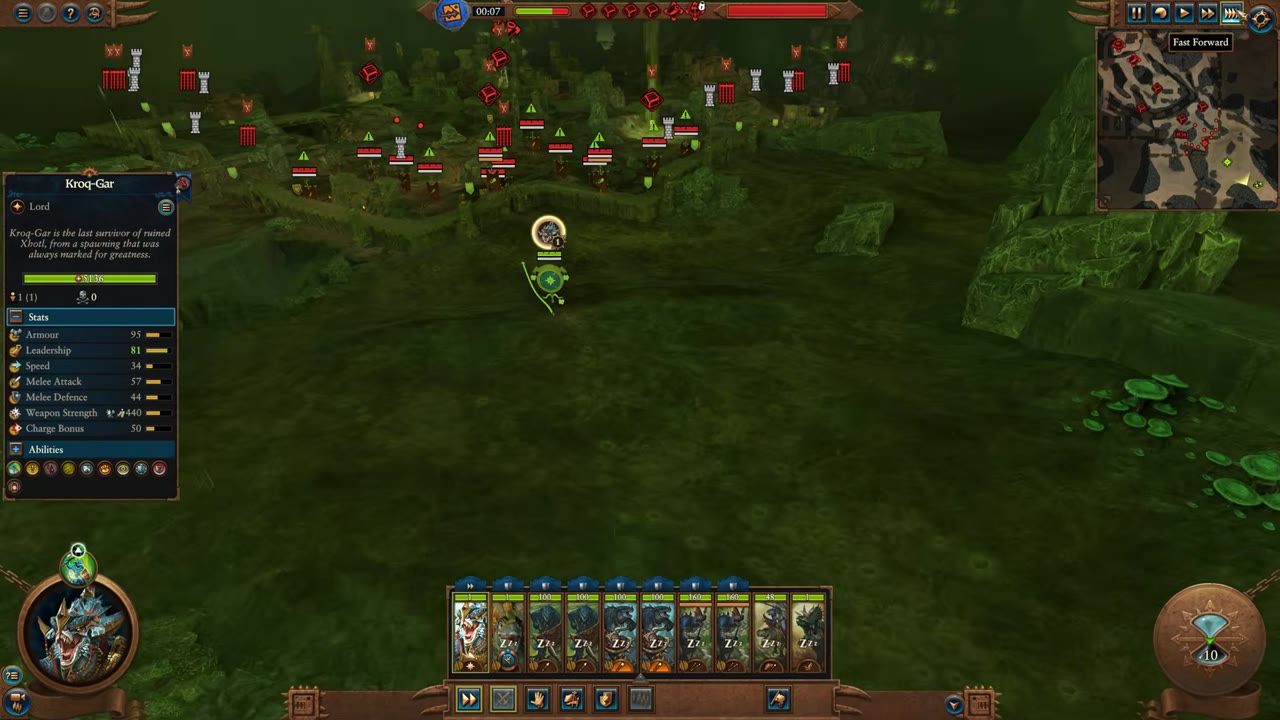
Master Kroq-Gar and the Last Defenders with an efficient campaign plan: win the early wars against the Skaven, build practical armies, maximize your economy, and scale into a late-game monster stack. This guide walks through the best strategic choices at each phase—recruitment, heroes, blessed units, tech, and infrastructure—culminating in a Stegadon-heavy force that can steamroll any opponent.
Quick answer
| What | Answer |
|---|---|
| Best early army core | Saurus front line plus Skink Cohorts with Javelins |
| Best early research | Tablet of Spawning |
| Best blessed units early | Blessed Saurus Warriors with shields and Blessed Kroxigors |
| Best hero priority | Saurus Scar-Veterans |
| Best economic growth building | Skink Forevellers, later Kroxigor Labor District |
| Best late-game unit | Stegadons |
| Best late-game lord | Lore of Life Slann |
Survive the opening war with the Skaven
Take decisive steps in the first battles to secure your province and avoid an unfavorable early conflict. Use distraction and efficient unit deployment to break into the settlement, and plan your admin moves to set up your economy and hero base as soon as you claim Teotiqua.
- Skink Priests provide early support and can draw tower fire during sieges 1:01.
- This draws enemy units away from Kroq-Gar’s planned breach 1:30.
- Send Saurus Warriors with clubs, ideally blessed, through the opening 1:59.
- Perfect vigour and improved stats make them ideal frontliners 2:20.
- Keep your Stegadon moving and charging to maximize kills 2:27.
- Attach this hero next turn for extra melee power and trait bonuses 2:56.
- Boosts lord recruitment rank by +4, gives spawning sequence, and increases spawning pool capacity 3:25.
- If you wait, another major faction may pick a fight with you 7:15.


Build cheap armies that still hit hard
Kroq-Gar’s armies start strong but tend to be underfilled because Lizardmen units are expensive. The best approach is to use a Saurus front line and fill out numbers with Skink Cohorts with Javelins. The javelin version costs about half an unshielded Saurus Warrior and carries a ranged attack and shield, making them far more useful than regular Skinks or Skink Skirmishers.
Avoid Skink Skirmishers: their range and damage are poor, and they lack any shield, so they are easily killed by enemy missile units. Red-Crested Skinks are only worth recruiting if you need anti-armour, such as when fighting Dwarfs or other heavily armored opponents; otherwise, their lack of shields and higher price makes them a poor choice for general battles.
Chameleon Skinks and Chameleon Stalkers are specialized: they are expensive, micro-intensive, and lack the efficiency needed for Kroq-Gar’s campaign, though they excel in others focused on skink-based play. Feral Cold Ones look like an early cavalry option but are not recommended—they’re slow, rampage quickly, and do not perform nearly as well as Scar-Veterans on Carnosaurs.
The simplest setup for the first armies is Saurus Warriors (either clubs or spears for holding the frontline) and Skink Cohorts with Javelins for rear and flanks. This lets you efficiently pad out your numbers and maintain aggression, all while conserving gold for later upgrades and hero recruitment.

Use blessed units efficiently
Blessed units are enhanced versions of normal troops purchased with spawning sequence—a limited strategic resource. Early in the campaign, use sequence to purchase multiple strong units rather than saving for a single expensive monster. The following table compares the best options for efficient sequence use:
| Unit | Key Upgrades / Traits | Early Game Value | Special Synergy |
|---|---|---|---|
| Blessed Saurus Warriors (Shields) | Perfect vigour, higher weapon strength; 63 Armor, 75 Leadership, 52 Speed, 34 Melee Attack, 36 Melee Defence, 111 Weapon Strength, 20 Charge Bonus | Top-tier frontline infantry, especially strong against Skaven | Holds the line, immune to fatigue; especially valuable for sustained battles |
| Blessed Kroxigors | Massive charge bonus, causes terror | Essential for breaking early Skaven enemies | Skinks near Kroxigors gain fear immunity, boosting morale if supporting each other |
| Blessed Sacred Kroxigors | +40 Armor, 55% missile block, all-around protection | Durable against missile-heavy foes, strong against large or chaff | Reliable anti-infantry and high armor lets them tank Skaven slingers |
| Blessed Ancient Stegadons | Damage-over-time ranged attack | Best when sequence is abundant, not early | Great for mass damage when Stegadons are core of the army |
| Regular Blessed Skinks | Improved health stats over normal | Good for padding out emergency armies | Should only be used if sequence allows or army needs extra numbers |

Sequence is scarce early, but increases steadily as you build Geomantic Locus structures and use the Alignment of War commandment. Make your first purchases count—blessed Saurus Warriors and Kroxigors are exceptional for early wars. Later, use sequence for Stegadons and other monsters when your economy supports them.
Build around heroes instead of forgetting them
Heroes are the backbone of Kroq-Gar’s late-game strength and deserve careful investment and infrastructure planning. The main hero priority is Saurus Scar-Veterans, as they scale extremely well: when mounted on Carnosaurs, they are nearly unkillable, can equip weapons and ancillaries, and receive a 1% weapon strength boost per level that adds up significantly by late-game.
Scar-Veterans also benefit from barracks investments—higher-tier Saurus barracks grant increased hero recruitment rank, letting you recruit them pre-mounted and ready. These heroes replace the need for recruiting Feral Carnosaurs (which rampage and lack gear options).
Support heroes should not be forgotten:
- Skink Priests: Offer Lore of Beasts or Heavens and can mount Stegadons (standard, Ancient, or Engine of the Gods). The priest is a mobile artillery piece or massive AoE spellcaster.
- Skink Chiefs: Improve casualty replenishment rate and can also mount Stegadons, helping recovery and mobility.
- Skink Oracles: Cast Lore of Life, increase campaign movement range, and come with a Troglodon mount. They are more fragile but perfect for armies without a Slann.
- Trait priority: Pompous is valuable, since it reduces enemy leadership in the region—always pick this trait when available for Scar-Veterans or lords.
A typical army will field two or three Scar-Veterans plus one of each of the supporting hero types. This setup maximizes campaign efficiency and both battlefield impact and movement.

Fix the early economy before it collapses
Kroq-Gar’s economy is unstable early and only becomes robust after growth and tier upgrades. Occupying settlements instead of sacking preserves infrastructure and lets you reach higher tiers faster. Sacking is only worth it after researching Sequence of Annihilation, and even then often better to occupy.
The main economic structures are Skink Forevellers, which provide early income, and the Kroxigor Labor District at tier three, which offers a significant financial boost. Multipliers from Geomantic Locus (+12%), Ziggurat of the Old Ones (+12%), and Loadstones in minor settlements (+8%) stack up, with the Alignment of Crafting commandment adding another 10% when paired with the maximum Geomantic Web modifier.
Growth buildings and commandments are essential: reaching tier four unlocks Stegadons and other late-game units, so always prioritize city growth. Ports are weak (only 300 gold per turn at tier five), so do not rely on them.
Trade agreements, gold resources, and post-battle loot help support the economy—consider negotiating with Dwarfs, if they are not hostile, to stabilize income before your settlements mature. Sacrificial Altars of Sotek increase post-battle loot (up to 8% faction-wide). Temporary deficits are acceptable if ongoing battles supply loot; never let the treasury dry out completely or forces will desert.

Manage province commandments carefully: swap to the construction-speed commandment the turn before a building upgrade completes, then switch back to growth for optimal efficiency.
Set priorities for the mid and late game
Mid and late campaign goals revolve around expanding settlement tiers and researching key technologies. The most critical technology is Determining the Great Plan: when researched, owning a province capital at tier four or above removes climate penalties for all local settlements, allowing expansion into wastelands previously unsuitable for Lizardmen. This tech also grants campaign movement range after victories, accelerating conquests and loot.
Skink Priests can accelerate research by stealing technology from enemy cities—this is only advisable against factions you intend to fight. Maintain a focus on growth so settlements hit tier four quickly and unlock elite units and economic multipliers.
The Alignment of War commandment aids sequence generation, but it comes at the cost of income from other edicts. When growth is less urgent, switch to this commandment as needed. The Geomantic Pylon building also provides income modifiers and sequence generation.
Only one tier-five Geomantic Locus is needed to unlock the best commandments, although the boost is not substantial. By prioritizing province development and infrastructure first, then focusing on late-game unit unlocks, you avoid long-term bottlenecks and guarantee a smooth transition into monster stacks.
- Removes climate penalties and increases movement range 34:42.
- Tier four and five unlocks make everything else possible 36:09.
- Rapid research lets you unlock key technologies sooner 35:40.
- Switch edicts tactically between growth/income and sequence based on need 24:35.
- Key building for maximizing economy and sequence 31:22.
- Unlocks the highest province edicts 31:51.
- Infrastructure comes first for sustainable scaling 34:13.

Spam Stegadons in the late game
Once your settlements reach tier four, the campaign turns into a monster stack plan. Stegadons become available and should be the anchor of almost every army—they have strong siege attacks, they do not rampage, and are highly resilient against both infantry and missile threats.
Stack Stegadons around a Lore of Life Slann lord. The Lore of Life Slann can heal them, use Dwellers Below for mass infantry damage, and deploy a 20% ward-save force-field within a 150 m radius—making the whole blob nearly unbreakable. Second-generation Slanns increase spell intensity by 40%, maximizing healing output.
Scar-Veterans remain important: include two or three in each stack for anti-large coverage and melee support. Blessed Ancient Stegadons provide damage-over-time ranged attacks similar to poisoned wind mortars, chipping away at enemy blobs. Regular Skink Priests and Chiefs on Stegadons can supplement the firing line.
This mass Stegadon composition is the Lizardmen’s strongest late-game configuration, able to overwhelm almost any enemy through healing, physical resilience, and destructive power.


Also worth knowing
- The opening is highly aggressive. Several experienced players note the early war plan here is more hostile than usual—expect tough fights and rapid expansion demands.
- Fear and terror mechanics are a boost if combined. Skinks gain immunity to fear from being near Kroxigors, which improves army morale and makes the synergy even stronger than outlined above.
- Optimize commandments for faster construction. To shave turns off building upgrades, switch to the construction-speed commandment the turn before a structure completes, then revert to growth; this can reduce waiting time across your provinces.
- Solar Engines provide perfect vigour. Including a Solar Engine in your army means nearby units retain perfect vigour, which keeps your front line effective in longer battles.
- Temple Guard can lock in your Slann for added safety. Place Temple Guard around your Slann for a defensive formation; Kroxigors mixed in further improve resistance to cavalry charges.
- Fighting the southern Skaven and recruiting enough units prevents immediate invasion. If you recruit 6–8 units in Teotiqua, the southern Skaven will raid instead of attacking, buying time to deal with them on your terms.
Frequently asked
What early units should I recruit as Kroq-Gar?
Saurus Warriors should hold the line, and Skink Cohorts with Javelins should fill the rear and flank. Regular Skinks, Skink Skirmishers, and Feral Cold Ones are poor value for this campaign and are not worth prioritizing. Red-Crested Skinks are only worth it when early anti-armour damage is needed, such as against Dwarfs.
Are blessed units worth saving for later?
No. Spawning sequence is a limited resource early, but blessed units are meant to be spent, not hoarded. The strongest approach is to buy multiple strong blessed units when you can, instead of saving everything for one expensive monster.
Which hero should I build around first?
Saurus Scar-Veterans are the top priority because they scale extremely well and can ride Carnosaurs. Skink Priests, Skink Chiefs, and Skink Oracles are also useful, but the Scar-Veteran line is the most important hero investment for Kroq-Gar.
What should I do with settlements and the economy?
Occupy most settlements rather than sacking them, then grow them into higher tiers so you can unlock income multipliers and late-game infrastructure. The faction makes money through city growth, percentage-based modifiers, trade, and post-battle loot, not through early sacking.
Read next
Total War: Warhammer 3 Greenskins Guide: Waaagh!, Scrap Upgrades and Da Best Start
This guide covers the core Greenskin campaign mechanics and how they shape expansion, army building, and faction choice. It is for players who want a practical overview of the major lord starts and what each one is best at.
Total War: Warhammer 3 Khorne Guide: Skarbrand, Blood Hosts and Skulls
A practical campaign plan for playing Skarbrand and the Exiles of Khorne in Immortal Empires. It focuses on battlefield control, leveling, settlements, blood hosts, skull spending, diplomacy, and nonstop expansion.
Total War: Warhammer 3 Chaos Dwarfs Guide: Labour, Outpost vs Factory and the Hellforge
A practical plan for starting and scaling a Chaos Dwarf campaign, with early targets, economy priorities, army roles, and expansion tools. It is for players who want a clearer first pass through the faction’s systems and a stronger opening campaign.
Total War: Warhammer 3 Vampire Counts Guide: Raise Dead, Bloodlines and Army Building
This guide covers the opening moves, economy, lord leveling, army composition, healing, and timing for a Vampire Counts campaign in Immortal Empires. It is aimed at players who want a practical plan for Vlad and Sylvania instead of scattered faction tips.