
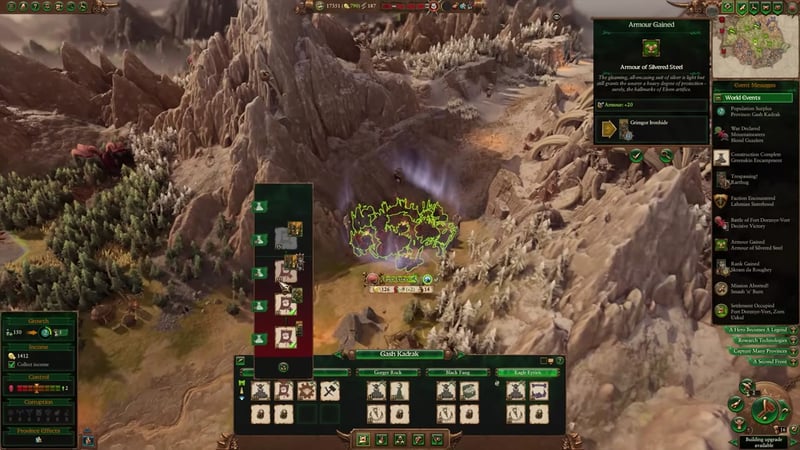
When fighting Chaos Dwarfs in Total War: Warhammer 3, you can stabilize your provinces, trap their underground movement, and bring the right units to counter their elite armies and massive garrisons. This guide covers campaign and battle strategies to keep your territory secure and your armies prepared for the main threats Chaos Dwarfs pose.
Quick answer
| What | Answer |
|---|---|
| Main campaign threats | corruption, underways, huge capital garrisons, elite late-game armies |
| Corruption fix | use corruption-reducing Lord or hero skills, then clear provinces with buildings and commandments |
| Underways answer | bait them into movement and use ambush stance near vulnerable settlements |
| Capital garrisons | bring multiple armies and scout with heroes before attacking |
| Early-game armies | cheap hobgoblin stacks are easier to kill than they look |
| Battle plan | focus one threat at a time with anti-armour ranged, fast units, artillery, cavalry, and magic |
Stabilize your provinces first
Provinces bordering or recently conquered from Chaos Dwarfs will quickly collect their corruption, causing attrition for your armies and control problems for your settlements. Address this early to prevent your campaign from snowballing into chaos.
- Use Lord or hero skills that reduce corruption or increase provincial control.
- If attrition is too high, move through their territory in a stance that avoids it—such as standard campaign movement or raiding when it's safe.
- Once you capture a settlement, prioritize constructing buildings that reduce corruption. Apply commandments to reinforce control and cleanse remaining corruption.
- Over time, replace Chaos Dwarf corruption with your own province's cleansing infrastructure and control-boosting structures.

Trap their underground movement
Chaos Dwarfs use the underways to move in and out of mountain terrain, bypassing choke points and unintentionally outmaneuvering slow armies. This can make them surprisingly hard to intercept unless you adjust your approach.
- Some factions have Lord skills for improved underways detection. If available, prioritize these to spot Chaos Dwarfs trying to sneak past.
- Otherwise, bait their underways movement by forcing them to flip-flop between two sides of a mountain, creating openings for an ambush.
- Use ambush stance near vulnerable settlements. These are prime targets for Chaos Dwarfs' underways jumps—set traps where they're likely to land.
- Catching them in the underways means, if you win, the army will be wiped out without a retreat.

Prepare for their garrisons
Chaos Dwarf capitals have some of the largest garrisons in the game. Even in the mid game, you will need multiple armies to take them down. These garrisons include high-tier troops and many units, making direct assaults costly if you underestimate them.
Scout garrisons with heroes before approaching a capital. Use hero abilities and the settlement preview panel to check unit types and total numbers. Do not engage unless you're certain your force is large enough and tailored to the threats inside. Chaos Dwarf capitals are vital to their economy and campaign progress, so expect the AI to defend them fiercely.

Taking the main Chaos Dwarf capital, Zharr Naggrund, can pay out up to 60,000 gold on a successful sack. Prepare accordingly for both the difficulty and the reward.
Read their armies before you attack
Early Chaos Dwarf armies are often filled with cheap hobgoblin units, which can appear intimidating but are relatively easy to defeat with proper scouting. These units lack powerful stats and armor, but their numbers and appearance may fool players into over-preparing or avoiding the fight.
As the campaign progresses, the AI can field elite units rapidly—much sooner than a human player typically could. End-game Chaos Dwarf armies are stacked with expensive, tough units that require dedicated counters. You have less time than you expect before their armies become significantly harder to confront. Monitor their army composition with hero scouting and make decisions based on actual unit quality.

Hobgoblin Archers are an early-game threat because they deal fast, high damage and resist return fire better than expected. Dedicate some attention to them even if other hobgoblin units are not as dangerous.
Build the right battle counters
Chaos Dwarfs bring several types of threats at once: tanky front lines, powerful ranged infantry, exceptional artillery, monsters and monstrous cavalry, and potent magic. Your army should counter each with the right unit type.
| Chaos Dwarf threat | Effective counter | Notes |
|---|---|---|
| Tough front lines | Tankiest infantry for your faction | Hold them in place while ranged and magic do the work; terrain and sightlines help mitigate their approach damage. |
| Ranged infantry (e.g., Fireglaives, Blunderbusses) | Armor-piercing ranged units, fast cavalry, monsters | Target them early; sustained pressure is better than cycle charging. |
| Artillery (Dreadquakes, Iron Daemon) | Fast armor-piercing cavalry/monsters, artillery snipers | Keep your own artillery protected; their guns can shut it down quickly. Little Grom (Kislev) is noted as a strong counter. |
| Monsters/monstrous cavalry | Bonus vs. large cavalry/monsters, armor-piercing ranged | If available, large monsters help tie down their gunners and backline. |
| Magic | Buffs, debuffs, anti-magic heroes | Shadow magic excels at armor-piercing and debuffing enemy lines; Life, Beasts, Heavens also strong (Bretonnia access). |

Kislev and Bretonnia are especially effective counters: Kislev can outrange Chaos Dwarfs and snipe their artillery, while Bretonnia uses fast cavalry, flying units, and strong magic to dismantle elite stacks.
Focus one threat at a time
In battle, Chaos Dwarfs pose several threats simultaneously. Spreading your attacks across multiple key targets is ineffective and risks letting elite units operate unchecked. Instead, prioritize one danger at a time until it is neutralized.
- 6:50
- Artillery on infantry clumps; ranged on large targets
- Extra post-battle value—Chaos Dwarfs are slow, so exploit this.

Deleting one threat at a time preserves your army and keeps Chaos Dwarf elite units from causing outsized losses during the fight.
Also worth knowing
- Chaos Dwarf capital sacks are extremely lucrative. Zharr Naggrund can pay out up to 60,000 gold on a successful sack—it's hard to overstate how valuable this is for your campaign.
- Their garrisons and mid-game armies are unusually strong against standard Dwarf factions. Be prepared for a challenging fight even with several armies.
- Bretonnia is almost uniquely effective at countering Chaos Dwarfs. Their cavalry, flying knights, anti-large units, and access to Life, Beasts, and Heavens magic make elite Chaos Dwarf stacks much easier to handle.
- Kislev is a strong matchup. Kislev outranges Chaos Dwarfs, and Little Grom can snipe their artillery, giving a clear advantage in ranged duels.
- Ogres should avoid Chaos Dwarfs early. Ogres lack enough anti-large units to deal with Chaos Dwarf monsters and artillery; wait until you can field a late-game roster before taking them on.
- Hobgoblin Archers are dangerous in the early game. They deal fast damage and resist return fire—do not underestimate them compared to other hobgoblin units.
- Chaos Dwarfs' spells and artillery will cost you units, even in a good fight. Assume high casualties in battle and plan to chase down retreats.
Frequently asked
How do you beat Chaos Dwarfs on the campaign map?
Reduce corruption with Lord or hero skills, then clear contaminated settlements with buildings and commandments until the province is cleansed. If attrition is a problem, move through their territory in a stance that avoids it, such as campaign movement or raiding when it is safe. Their underground movement can also be punished by baiting it and trapping them with ambush stance near vulnerable settlements.
What counters Chaos Dwarf artillery in battle?
Fast units with armor-piercing and anti-large damage are the cleanest answer because they can reach and remove the artillery quickly. Flying or very mobile threats can also help if they can survive the approach. If you have your own artillery, keep it protected because Chaos Dwarf guns and Dreadquakes can shut it down fast.
What should I bring against their elite armies?
Tanky front lines, armor-piercing ranged units, fast cavalry, and a spellcaster are the core pieces. The plan is to hold their front line in place, delete dangerous ranged and monster threats one by one, and use magic to blunt their toughest units. A Shadow wizard is especially strong because armor-piercing damage and debuffs work well into high-armor armies.
Are Chaos Dwarf capitals worth attacking early?
Yes, but only with more force than you think you need. Their capital garrisons are unusually large and can require multiple armies even in the mid game. Scouting first saves time and avoids walking into a defense you cannot crack yet.
Read next
How to Beat the Skaven in Total War: Warhammer 3
This guide explains how to counter Skaven on the campaign map and in battle, with an emphasis on scouting, leadership pressure, and shutting down their ranged threats. It is aimed at players who struggle to pin Skaven down before they ambush, flood, or overwhelm an army.
Total War: Warhammer 3 Counter Guide: How to Beat Flying Units, Cavalry and Monsters
This guide breaks enemy armies into unit archetypes and shows the most reliable way to counter each one. It is for players who want a simple matchup reference instead of memorizing dozens of individual units.
How to Counter Cavalry and Anti-Large Units in Total War: Warhammer 3
This guide compares elite anti-large infantry across three matchups: cavalry, monstrous infantry, and a single-entity monster. It is for players who want to know which infantry units trade best into large targets and which ones stay useful after the fight.
Total War: Warhammer 3 Nurgle Guide: Plagues, Recruitment and the Cycle of Decay
This plan covers Nurgle’s campaign mechanics, corruption economy, plague crafting, and the three playable Nurgle factions. It is aimed at players who want a practical overview of how to start, expand, and use each faction’s unique strengths.