
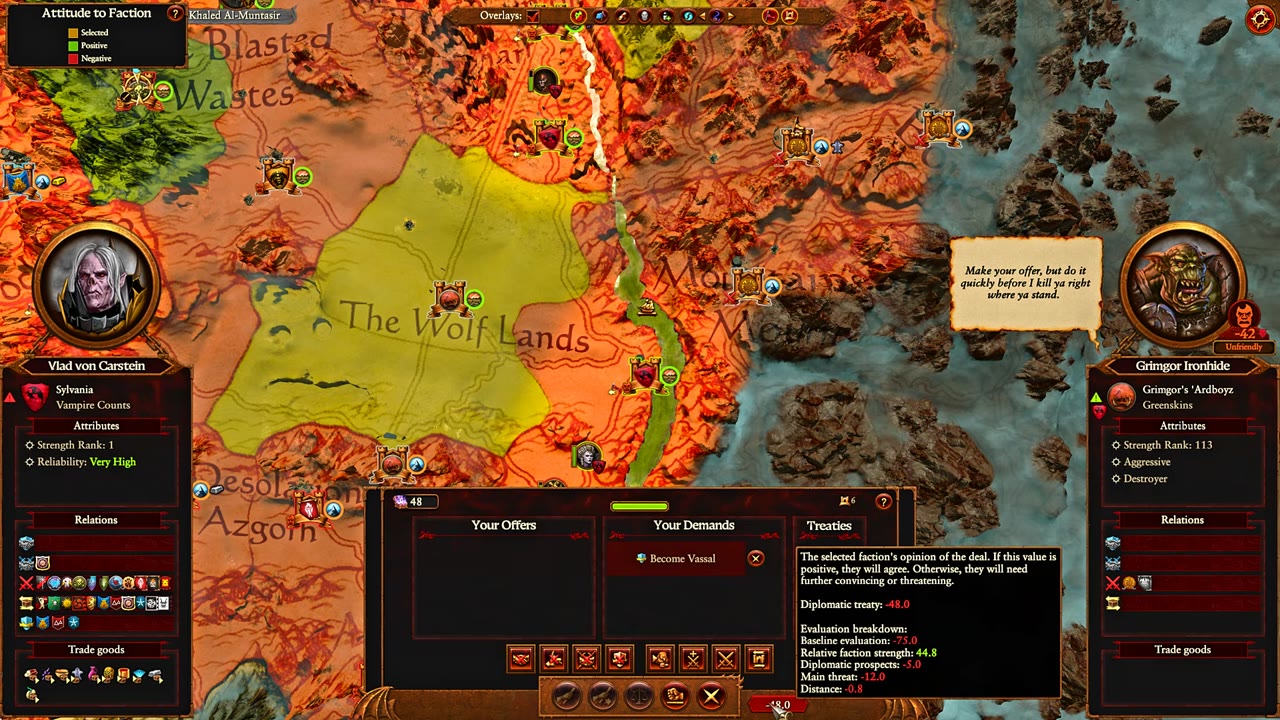
If you want to vassalize or confederate major factions in Total War: Warhammer III, you can apply pressure through managed settlement trades, military dominance, and careful diplomacy. Factions with low army strength, high territorial losses, or specific region desires are far more likely to submit. Avoiding alliances with potential vassals and repeatedly trading the right settlements are key strategies that let you reliably sway even powerful targets.
Quick answer
| What | Answer |
|---|---|
| Main method | Trade valuable settlements, weaken the target, and keep your own power higher than theirs. |
| Best settlement value | Military buildings, especially barracks, are worth more than ordinary economy buildings. |
| Why alliances can hurt | Allies add strength to the target’s side and can make vassalization harder. |
| Weak target cue | A faction with no armies and low balance of power is much easier to vassalize. |
| Early vampire count route | Take Asylen on turn 1, Templehof on turn 2, Zufbar on turn 4, then Grand Peak. |
| Relationship trick | Repeated trades improve diplomatic relations over time, even if the settlement value is equal or lower. |
Check whether a faction can be persuaded
Diplomatic deals succeed most often when you understand a target's vulnerability. The success of vassalization and confederation offers depends on several values shown directly in the diplomacy screen:
- Baseline evaluation sets the fundamental willingness for a faction to accept, and is influenced by strategic strength and relations.
- Diplomatic prospects indicate how likely the AI is to consider deals based on your relationship, recent trades, and war history.
- Main threat is a modifier tied to perceived power — being much stronger than the target can intimidate or persuade them, and makes them easier to sway.
- Strength rank compares armies, provinces, and sometimes allies. The further your rank is above theirs, the better.
A target that has lost all their armies and holds few settlements is much easier to persuade. Look for factions whose balance of power has collapsed, signifying massive losses. When the diplomacy screen shows no standing forces, a single lord, or reduced territory, the chances for success greatly improve.


Trade settlements that the target actually wants
Settlement trading is the most reliable way to unlock high-level diplomatic deals. Not all settlements are equal in the eyes of the AI: military infrastructure is valued far above economy or raw territory.
- Military buildings are the single strongest bargaining chip. Barracks (especially tier 1) are both cheap to build and rapidly add diplomatic value.
- Special buildings—including race-specific landmarks—can be even more valuable and sometimes hard-coded for particular factions.
- Offering a full province (all regions) is more persuasive than trading single settlements, as the AI prefers cohesive territory.
- Repeat trades (swapping settlements over several turns) stack up diplomatic improvements and pave the way for later agreements.


The best approach is to capture territory, build barracks or special military buildings, then trade the settlements for value. Both repeated trades and offering what the faction truly wants (military assets or full provinces) improve relations and make confederation/vassalization more likely.
Weaken the target before asking for the deal
When the goal is submission, reducing the target's economic and military power is essential. Here are the most effective steps to weaken a faction and make diplomacy work:
- Trading key settlements away strips tens of thousands of gold 4:50
- Bankrupting stops recruitment and construction 5:48
- No armies means much higher acceptance chances 3:53

Avoid alliances that inflate the target’s power
Military alliances and defensive pacts make diplomacy more difficult by increasing the perceived strength of the target. When you ally with a faction you want to vassalize or confederate, the game calculates your combined strength, making the deal harder:
- Allying with a target increases their faction's perceived power in negotiations. Your armies, provinces, and vassals boost their diplomatic standing.
- Even when relations are high, alliances can backfire—vassalization may become impossible as the target's power ranking rises.
- Military allies, especially strong ones, are factored into the AI's strength assessment—even if not fully shown in the visible strength rank. Thus, a faction with weak actual armies but strong allies may appear much tougher.
- Vassals and allies are not always completely reflected in the rankings, but the game factors them in as hidden modifiers that impact diplomacy success.

If your goal is to absorb or control a faction, avoid allying with them. Maintaining direct power and offering valuable settlements is more effective than boosting their bargaining position with your own resources.
Use faction-specific land priorities
Some regions carry special weight for certain factions, whether through hard-coded preferences, starting provinces, or unique landmarks. Properly identifying these priorities greatly increases a deal's value.
- Factions often prioritize their original provinces (the region they start in), and will bend further for them.
- Kislev factions, as an example, strongly value areas like Layer of the Troll King and Praag, even more than higher-tier settlements or traditional economic assets.
- Landmarks or race-specific buildings multiply a region's diplomatic worth, often outweighing generic military or economy buildings.
- Some regions are coded for attraction—trading these to the right faction can unlock vassalization against all odds.

Before negotiating, identify which provinces the target faction will fight hardest for. Offer their priority territory, and bolster its value with barracks or special buildings if possible.
Follow an early vampire count route that unlocks vassals
Opening moves matter: the specific conquests in the early turns unlock diplomatic advantage for vampire count factions. This step-by-step path reliably sets up vassal deals:
- Barracks add extra diplomatic value for the trade 18:33
- Warring these factions helps maintain non-negative relations 19:13

Turn captured provinces into better diplomacy
Diplomacy is a snowball: each good deal makes the next easier. Trading settlements—especially those with military value—will raise diplomatic relations several turns after the deal.
- The relation meter climbs after settlement trades 23:05
- Full diplomatic value may not appear until the following turn 24:24
- Repeat deals raise relations, regardless of absolute value 23:31

This technique is essential: even if the settlement value is equal or slightly less, the repeated relationship bonus accumulates and unlocks high-level diplomatic deals.
Prefer strong vassals over many weak ones
Not all vassals are equally useful. Minor factions typically provide little military or economic power, while larger vassals generate income, defend borders, and win wars.
- Minor factions and most Lord factions are weak and unprofitable.
- Minor dark elf factions are a rare exception—they can offer more income than most others.
- Having a few vassals with substantial territory is far better than keeping many small, ineffective ones.
- Prioritize major factions as vassals—they contribute more economic value and military strength in the long run.
Building your campaign around strong vassals instead of dozens of minor ones keeps your border secure and lets you focus on expansion rather than micromanagement.
Also worth knowing
- Barracks are the top settlement asset for trading. Military buildings grant more diplomatic value than economy or resource structures, making barracks the best ordinary choice. Special buildings and landmarks can override even barracks for particular factions.
- For best results, avoid alliances, break the target’s strength, then trade desired territory. A common practical sequence for reliable vassalization is: 1) no alliances with the target, 2) offer key settlements, 3) drain armies and economy, and 4) propose vassalization.
- This method can snowball entire campaigns. It is possible to vassalize most factions if you follow the trading and weakening process, especially on higher difficulty or with aggressive expansion.
- Players making repeated trades often strip enemy resources, incite proxy wars, and fund rival factions. The strategy works, but beware that it can spawn unpredictable wars or empower enemies.
- The vassal system can be inconsistent. After you secure vassals, they may behave erratically—sometimes refusing war calls or acting hostile, regardless of success during negotiation.
- Vassalization options aren’t always offered for every campaign setup. Some factions, game rules, or mods may affect whether the vassalize action even appears.
- Vassal reliability is a separate challenge. Securing a vassal is just step one—keeping them loyal and responsive is unpredictable, and sometimes impossible.
Frequently asked
Do you need to ally with a faction before you can vassalize it?
No. Alliances can actually make the target harder to sway because your own strength gets folded into theirs. Direct trade deals, battlefield pressure, and reducing their economy are more reliable.
What kind of settlement is best to trade for vassalization?
Military settlements are the strongest bargaining chips, especially ones with barracks or special buildings. Full provinces also carry more weight than a single region, and some factions value their starting province or race-specific landmarks very highly.
Does high relationship alone make vassalization easy?
No. Good relations help, but faction strength, military losses, economy, and the value of what you offer matter more. A weak faction can still refuse if the diplomatic modifiers are bad enough, and a strong faction can still be persuaded if the deal is valuable enough.
Is it better to have many minor vassals or a few strong ones?
A few strong vassals with meaningful territory are usually better. Minor factions often bring little economic or military value, while larger vassals can hold borders, fight wars, and generate more useful income.
Read next
Total War: Warhammer 3 Confederation Guide: How to Confederate, Cooldowns and Penalties
Confederation depends on diplomacy, faction strength, and the current war state. Use the right mix of relations, pressure, and timing to absorb minor and major factions without wrecking your own campaign pace.
Total War: Warhammer 3 Campaign Expansion Guide: Provinces, Public Order and When to Stop
Learn how to expand by provinces instead of scattering settlements across the map. This plan covers when to commit to a full province, when to hold a broken province, and when to slow down for public order, defense, and income.
Total War: Warhammer 3 Economy Guide: Make Money Fast
This plan covers the main ways to generate income in Total War: WARHAMMER III, from taxes and trade to diplomacy, battles, raiding, and settlement actions. It is for players who want a practical breakdown of which income sources are passive, active, or faction-dependent.
Total War: Warhammer 3 Siege Guide 2026: How to Attack and Defend Settlements
This guide covers a fast settlement-siege tactic built around drawing defenders away from the victory point and capturing it with a small mobile force. It is for players who want to end sieges quickly, especially when autoresolve or prolonged assaults are undesirable.