
Expand your empire efficiently in Total War: Warhammer III by targeting and capturing complete provinces, stabilizing new territories, and using spare settlements for defense or diplomacy. Learn when it's worth holding a broken province, how to build income and fortify borders before moving forward, and how to avoid common expansion mistakes that lead to instability or wasted resources.
Quick answer
| What | Answer |
|---|---|
| First goal | Take your first province |
| Province size | Usually 2 to 4 settlements |
| When to stop expanding | After one province at first |
| Broken province risk | No buildings for public order, growth, or income |
| Defense options | Armies or garrison buildings |
| Early expansion warning | Do not take stuff too quickly |
Capture your first province
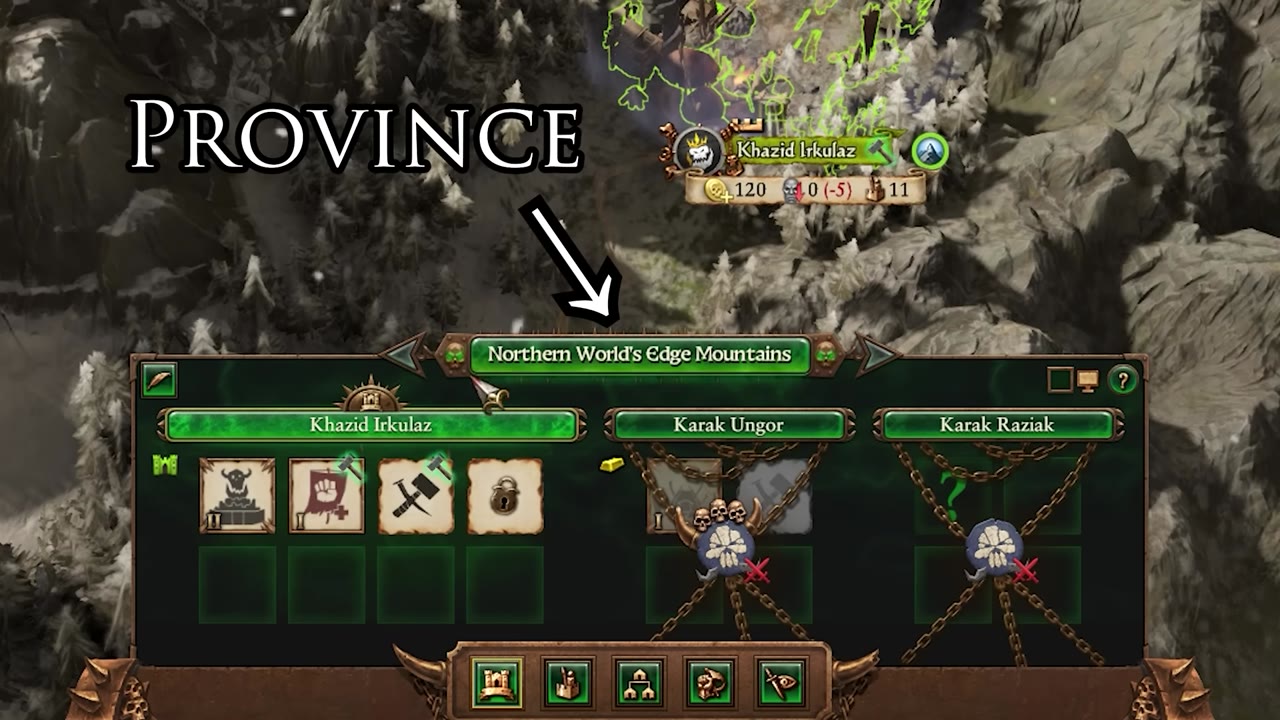
The first step in any campaign is to capture your entire starting province. Provinces typically contain two to four settlements, but some — like Kislev — can have just one. For Azag, the starting province is Northern World's Edge Mountains, which includes Khazid Irkulas, Carrick Ungor, and Karak Raziak. Capturing all settlements in your province lets you unlock province-wide commandments, boosts income and control, and creates a unified defensive region.
- Identify your starting province and list its settlements.
- Take each settlement in your province until you control the whole region.
- Unlock the province commandment to gain additional bonuses.

Choose your next direction from victory goals
Once you secure your first province, your next move should be shaped by your campaign's victory objectives. Most campaigns are flexible, allowing expansion in any direction. However, reviewing the victory conditions panel will help you prioritize regions that advance your main goals, such as capturing key provinces or sacking settlements listed for victory. For Azag, the short campaign goal sends you west and northwest, while the main or long campaign goal may require pushing elsewhere. Expanding in a direction unrelated to victory targets is fine for sandbox play, but for efficient progression, align your expansion with required provinces.

Finish one province before starting the next
Avoid creating broken provinces by committing to capture a full region before moving on. For example, moving into Peak Pass means conquering Karak Kadrin, Nash Wax Layer, and any other settlements that complete the province. Leaving one settlement behind keeps the province incomplete, allowing enemies to reclaim their territory and denying you province commandments and bonuses. Bounce from province to province, taking one complete region at a time before expanding further.
The number of settlements needed to complete a province can change with patches. Always check the province details in your current game before planning expansion — video or third-party numbers may be outdated.
- Select a target province adjacent to your conquered land.
- Take all settlements in the new province, not just one or two.
- Ensure the province is unified before assigning resources or armies to your next target.

Use a broken province only when it has a purpose
Holding a broken province — one where you only control part of the region — can sometimes be worth it. This usually happens when the remaining settlements are too difficult or expensive to take early on, such as when powerful garrisons or full enemy stacks occupy them. A broken province can't support public order, growth, or income buildings efficiently and is harder to defend, often leading to rebellion or lost settlements. However, a single settlement in a partial province can serve as an early warning against enemy advances, buying you time to reinforce or prepare for attack. If an enemy takes the settlement easily, it was only a signal point and not a significant loss.

If you want to hold a random settlement in a broken province, you can stop tax collection there to reduce public order loss. This increases the chance of controlling the settlement longer, especially when it isn't making much income.
Use spare settlements in diplomacy
If you capture a settlement you don't intend to develop or defend, use it strategically in diplomacy. These settlements can be traded to other factions in exchange for alliances, non-aggression pacts, or direct payments. This reduces the number of simultaneous wars you face and acts as a buffer between you and potential enemies. Offering an unwanted settlement can help an ally secure their region, leading to safer borders for your empire.

Developing a settlement before trading increases its diplomatic value and can yield better trade deals or alliances. Use the balance offer button in diplomacy to quickly reach the maximum gold you can receive in a deal.
Slow down before over-expanding
Rapid expansion often leads to provinces that are underdeveloped and hard to defend. Newly captured regions may only have growth or basic buildings, with little income and no army support. If you rush ahead without building defenses and stabilizing public order, enemy forces can easily recapture your settlements, resulting in wasted effort and resources. Expansion should be gradual, allowing time for provinces to build income, reinforce defenses, and improve control before moving your armies elsewhere. If you expand too quickly, you will face rebellions and counterattacks, losing ground as fast as you take it.

Build income, public order, and defense before moving again
Stabilize each new province before advancing. Problems with public order can trigger rebellions, costing you control and resources. Defenses can be created by stationing armies or by building garrison improvements to strengthen settlement protection. Income generated from upgraded provinces funds armies, buildings, and growth. After capturing a new province, spend several turns upgrading key buildings and defenses. Prioritize defense buildings in exposed settlements that are likely targets for enemy attacks.
- Allows faster province development
- Protects settlements from counterattacks
- Prevents rebellion
- Focus on south or border regions most vulnerable
- Let province stabilize

Use a small army to hold the border
A low-cost army can secure the border of a newly acquired or broken province. This holding force, typically made from cheap units (like goblins), adds a layer of protection while you develop income and growth buildings. As the province stabilizes, build public order improvements next to keep rebels at bay. Even a broken province with a missing settlement can grow and deny resources to enemies, provided you commit some defensive effort.

Also worth knowing
- Stop tax collection for public order. Untaxing a random settlement in a broken province reduces public order loss and makes it easier to hold, especially when it has low income.
- Trading settlements increases diplomatic flexibility. Developed settlements trade for more value; use the balance button in diplomacy for maximum quick deals.
- Allied camps and settlement trades enable unique armies. Trade settlements to allies for access to their recruitment pools and faction bonuses.
- Completing provinces for allies secures safer borders. If you gift settlements to an ally, they benefit and your border becomes less vulnerable.
- Sacking or razing avoids unmanageable provinces. When capturing a settlement will create a broken province you cannot stabilize, sack or raze for immediate gains and deny resources to enemies.
- Eliminate enemies early to avoid future defense needs. Removing threats before moving on reduces the need for constant defensive armies.
- Diplomatic value scales with province development. Upgrading a settlement before trading increases what you receive from deals.
- Broken provinces deny enemy resources. Even if the province is hard to use, holding part of it stops the enemy from generating income or resources there.
See also: Five Campaign Habits That Sink Your Warhammer 3 Run — campaign
Frequently asked
Should I always complete a province before moving on?
No. Completing the whole province is usually the cleanest option, but a broken province can still be worth holding if the remaining settlements are too hard to take early or if you only want the position for now. The key is to know whether the partial hold gives you money, safety, or diplomatic leverage before you commit more armies.
When is it worth keeping a random settlement instead of finishing the province?
Keep it when the remaining settlements are too expensive or dangerous to capture early, or when the single settlement gives you vision and warning against enemy movement. It can also be useful as a bargaining chip in diplomacy or as a buffer that slows an enemy advance. If it is costing too much to defend and build, abandon the idea and move on.
What problems come from expanding too fast?
Fast expansion usually creates three problems: public order drops, settlements are harder to defend, and your income cannot support the new land. That leads to rebellions, enemy counterattacks, and provinces that never become self-sustaining. Slower expansion gives time to build income, defenses, and growth before pushing again.
Can a partial province still be useful?
Yes. A partial province can serve as a watch point, a temporary buffer, or a trade piece in diplomacy. It becomes a bad choice when it cannot support buildings, public order, or protection, because then it drains attention without giving enough back.
Read next
Total War: Warhammer 3 Economy Guide: Make Money Fast
This plan covers the main ways to generate income in Total War: WARHAMMER III, from taxes and trade to diplomacy, battles, raiding, and settlement actions. It is for players who want a practical breakdown of which income sources are passive, active, or faction-dependent.
Total War: Warhammer 3 Vassals Guide: Are They Worth It, Tribute and Rebellions
A practical breakdown of how to secure vassals and confederations through settlement trades, military pressure, and diplomacy value. It is aimed at players who want to bend major factions to their side instead of wasting time on weak minor vassals.
Total War: Warhammer 3 Settlement Building Guide: Growth vs Income and Build Order
This guide explains how settlement stats, building priorities, and province layout work together in Total War: Warhammer 3. It is for players who want a practical way to develop provinces without wasting slots or slowing their campaign.
Total War: Warhammer 3 Confederation Guide: How to Confederate, Cooldowns and Penalties
Confederation depends on diplomacy, faction strength, and the current war state. Use the right mix of relations, pressure, and timing to absorb minor and major factions without wrecking your own campaign pace.