
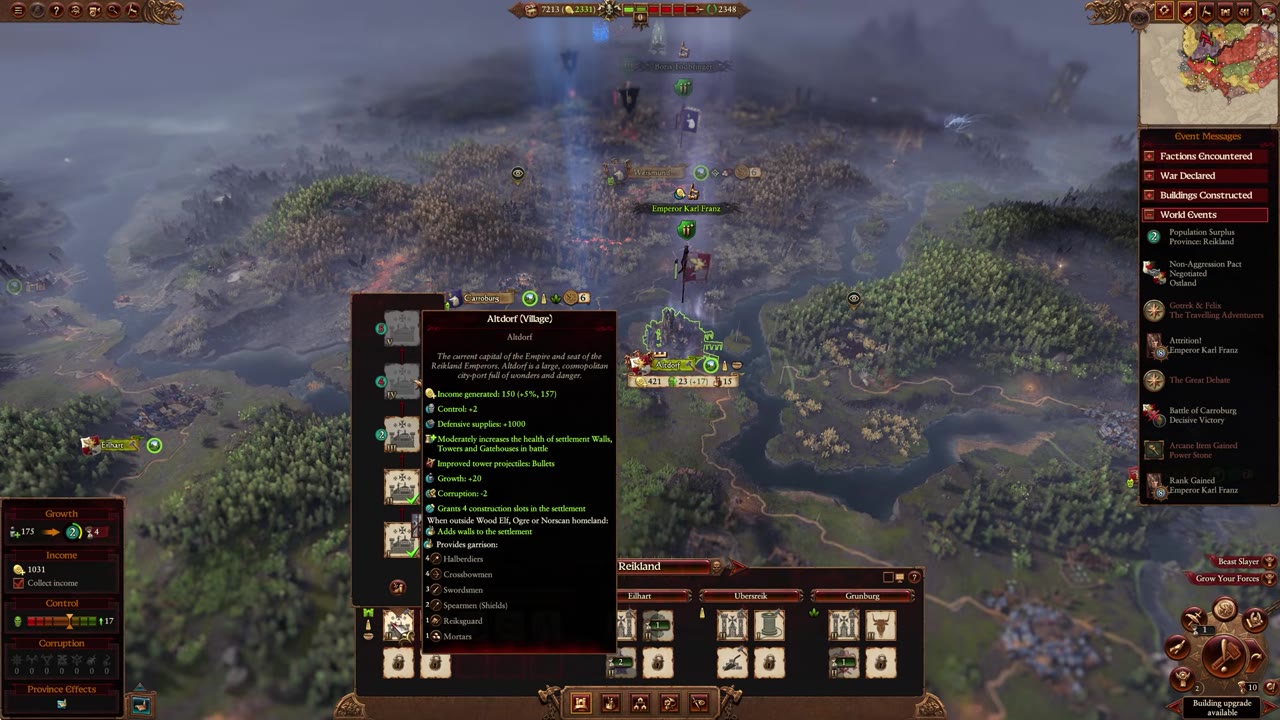
With these strategies, you can reliably generate gold in Total War: WARHAMMER III through provinces, trade, diplomacy, battles, and tactical actions. You'll know which sources scale passively and which require active engagement, letting you grow your income and fund larger armies or faster expansion.
Quick answer
| What | Answer |
|---|---|
| Main passive income | Taxes from provinces and buildings |
| Best growth lever | More settlements and higher tier settlements |
| Trade income source | Trade resource buildings plus trade deals |
| Diplomacy cash trick | Use deal balance to extract extra gold |
| Battle income | Post battle loot and captives |
| Raiding income | Income based on the foreign province you stand in |
Build up your province income
Most of your reliable income comes from provinces and the buildings you construct within them. Taxes are collected every turn from each settlement, with income increasing as settlements grow or more are acquired. Expanding your territory is the main lever for gradual income growth: each additional settlement increases your overall gold intake and lets you build more infrastructure.
Upgrading settlements to higher tiers unlocks additional building slots and raises their base income. Higher-tier settlements also allow for more advanced economic structures, which add flat gold bonuses or other effects such as reduced recruitment costs, increased post-battle loot, or upkeep reduction. Coastal settlements offer harbors, often with gold income and further economic bonuses.
Trade resource buildings can be valuable — they generate resources that enable trade (discussed in the next section) and may provide economy-related perks. However, whether they are worth building depends on your faction's trade opportunities and partners.
Many factions have commandments (province-level edicts) that can boost tax income or other economic factors. When you need extra gold, consider swapping out growth or recruitment commandments for those that boost passive income.

Turn trade into a major income source
Trade income starts slow but can scale dramatically with the right setup. Here’s how to maximize it:
- These produce resources which can be exported once you have trade deals. 2:00
- Trade deals are established through diplomacy and rarely break unless war is declared. 2:29
- The more resources and partners, the higher the gold income from trade.
- Some factions, such as Greenskins and Skaven, cannot participate in trade. 2:58
- Look for lord skills, commandments, or hero traits that boost trade income, though these are less common than tax bonuses.

Use diplomacy to squeeze out extra gold
Diplomacy is an often-overlooked source of small but steady income. Nearly every diplomatic interaction allows you to add gold to either side to balance the deal. Use the deal balance function when signing non-aggression pacts, establishing trade agreements, joining wars, forming alliances, or peace treaties. Even minor gold adjustments can add up over time.
Demanding gold outright from weaker factions is an option but can turn relations hostile or provoke war if refused. When joining another faction’s war for a payment, choose wars against distant enemies to avoid depleting resources fighting campaigns that may cost more than the payout.
Vassals are a special case — if you subjugate another faction, they'll pay you a share of their income each turn. While this sounds attractive, vassals are often fragile and require protection, making them less effective unless your faction has unique bonuses synergizing with vassal mechanics.

Earn money from battles and settlements
Choosing your actions after battles and settlement captures can generate immediate gold rewards. Work through these options for maximum profit:
- The amount depends on enemy strength and game stage. Avoid excessive losses, as replacements eat into your profits. 5:23
- Some lords have skills giving extra post-battle rewards.
- This option often appears after battles and gives cash for captives, sometimes with trade-offs.
- Sacking gives a large one-time payment. If you intend to occupy later and can rebuild, this is a strong option. 6:20
- Looting retains more of the settlement’s progress compared to sacking.
- Raising is best when sacking has no value left or when you want to eliminate the settlement.


Cash in on quest battles and other rewards
Quest battles are unique encounters tied to legendary lords or campaign objectives. These battles often provide valuable items, gold, and special effects as rewards. Completing them is a good choice when the payout exceeds the investment of armies and movement required. If the quest does not cost you more than the reward, pursue it for both economic and strategic gains.
Other campaign quests, such as secondary objectives, also grant gold. Evaluate these missions based on reward size versus the opportunity and resource cost of completing them.
Use raiding when the province can support it
Raiding allows your armies to earn gold by occupying enemy or neutral provinces. The amount earned depends on the province’s own income; richer areas offer better returns. Raiding requires your army to remain stationary, and if the raiding income is less than the unit upkeep, this stance is not worthwhile.
Raiding imposes several drawbacks: reduced movement range, replenishment, and increased battle exhaustion. It also makes your army more vulnerable to attacks, so only use raiding when nearby enemies are absent or unlikely to strike.
Raiding is especially effective in high-income regions and for factions that have skills boosting raiding rewards, such as Beastmen or Greenskins. Additionally, raiding reduces local control in the target province, which can destabilize enemy territory.
Also worth knowing
- Sea loot is an alternative income source. You can find treasure floating at sea or through events, offering gold without occupying territory.
- Trade resource buildings are not always valuable. Their usefulness depends on how many trade partners your faction can secure; check the trade screen in the economy overview to see if another resource will actually increase your income.
- You can sell settlements for extra cash. Trading settlements to another faction can produce a quick payout, especially when territory is less important than gold — for example, as the Wood Elves. If you want to maximize profit, you can sell a settlement for their treasury and follow up with war when their coffers are depleted.
- Vampire Coast trade acts mainly as a diplomatic tool. For this faction, trade resources are more useful for securing agreements and influence than for direct cash income.
Frequently asked
What is the fastest way to make money early in Total War: WARHAMMER III?
Early on, taxes from provinces and buildings are the most reliable source, because they start producing income immediately and scale as settlements grow. Trade can become huge later, but it usually begins weak and needs more partners and resource buildings before it overtakes taxes.
Are trade resource buildings always worth building?
No. They are strongest when your faction has many trade partners and the resource will actually convert into more trade income, but some factions or map positions get little value from them. The trade screen and economy overview are the best place to check whether another resource is worth the slot.
Is sacking better than occupying a settlement for money?
Sacking gives a big immediate payout, which can be worth doing if you want cash right now. Occupying is better for long-term income because it preserves the settlement and lets you build it up, while looting sits between the two and keeps some progress intact.
When is raiding worth using?
Raiding is worth it when the province income is high enough to beat the army’s upkeep and there are no nearby enemies ready to punish you. It is especially strong for factions that have skills supporting it, but it becomes risky because the army loses movement, replenishment, and battle readiness.
Read next
Total War: Warhammer 3 Campaign Expansion Guide: Provinces, Public Order and When to Stop
Learn how to expand by provinces instead of scattering settlements across the map. This plan covers when to commit to a full province, when to hold a broken province, and when to slow down for public order, defense, and income.
Total War: Warhammer 3 Vassals Guide: Are They Worth It, Tribute and Rebellions
A practical breakdown of how to secure vassals and confederations through settlement trades, military pressure, and diplomacy value. It is aimed at players who want to bend major factions to their side instead of wasting time on weak minor vassals.
Total War: Warhammer 3 Settlement Building Guide: Growth vs Income and Build Order
This guide explains how settlement stats, building priorities, and province layout work together in Total War: Warhammer 3. It is for players who want a practical way to develop provinces without wasting slots or slowing their campaign.
Total War: Warhammer 3 Confederation Guide: How to Confederate, Cooldowns and Penalties
Confederation depends on diplomacy, faction strength, and the current war state. Use the right mix of relations, pressure, and timing to absorb minor and major factions without wrecking your own campaign pace.