
🎯 The core idea
The PoE2 endgame is one loop: put a Waystone in the map device, clear the map, kill the boss, take the Waystones it drops and go one step further across the Atlas. Everything else hangs off that loop. The Precursor Fortress gives your Atlas passive points, Tablets add content, league mechanics give gear and currency, and the pinnacle bosses are where the quest lines end. Learn the loop first; the rest can wait.
- free costs nothing
- cheap small cost
- setup needs preparation
- grind pays off slowly
- skip the thing to stop doing
Version note: Written for 0.5.x, reviewed 2026-11-17 — node names, point counts, Waystone tier numbers and quest steps below are from the 0.5 endgame. At the 1.0 release on 11 December 2026 the Atlas passive tree is being rebuilt: creators who watched the ExileCon reveal report roughly 70 bigger nodes, with points coming from marked Fortress maps, gateways, towers and bosses instead of every map, plus direct travel to mechanic hubs. GGG's own announcement confirms Acts 5 and 6 and the Conquerors of Wraeclast league, whose commanders can run maps for you with your Waystones and Tablets. Expect the Fortress and Atlas tree sections to change; the map loop itself stays.
How the Atlas works after the campaign

free When the campaign is done you wake up in the Ziggurat Encampment and Doryani introduces the Atlas: one huge, effectively endless map of Wraeclast. Each circle on it is a map, and the dotted lines between them are the roads you can travel. A blue node is one you can reach right now; once you complete it, it turns green and cannot be run again, so progress always pushes outwards.
Clicking a node shows the map's name and its biome (forest, swamp, mountain, desert, water or grass, plus cities). The biome decides which layouts can appear there, and many of them are reworked campaign zones. What a node does not decide is difficulty: that comes from the Waystone you put in. This is the first idea to get right in any PoE2 endgame guide: the place sets the layout and the Waystone sets the level.
Some nodes are special. Precursor Towers reveal a big circle of the Atlas around them when completed, and the first tower you finish raises the Precursor Fortress, the main quest hub, just north of where you started. Corrupted regions, Citadels, unique maps and mechanic hubs show up as you reveal more ground.
Waystones: tiers, rarity and revives

free PoE2 waystones are single-use keys. Put one into the map device at the selected node, press Activate and six portals open around the device. Those portals are your lives for the map: leaving and coming back is free, but each death uses one up, and when none are left the map is gone.
Waystones run from tier 1 to tier 16, and the tier sets the area level, which sets monster level and the item level of drops. According to poe2wiki.net the area level is 64 plus the tier:
| Waystone tier | Area level | Notes |
|---|---|---|
| 1 | 65 | First maps after the campaign |
| 6 | 70 | Atlas content starts asking for this tier |
| 11 | 75 | The comfortable gearing tier (see below) |
| 15 | 79 | Highest tier that drops normally |
| 16 | 80 | Only by corrupting a tier 15 Waystone |
Like gear, Waystones come in normal, magic and rare. Each modifier makes the map harder but adds rewards such as item rarity, pack size, monster rarity or more Waystone drops. The cost is lives: the wiki puts revives at six with no modifiers, dropping by one for each modifier down to none at six or more. A fully rolled six-modifier Waystone gives you exactly one attempt. Since 0.5.0 a Waystone also has to be identified before the device accepts it.
skip Don't put six modifiers on a Waystone your character can barely clear. One death ends the map and loses the key.
Map bosses and the objectives panel

free Inside a map, the panel at the top right lists what the map contains: the boss objective and any optional content such as league mechanics. To finish most maps you reach the end and kill the map boss behind an orange checkpoint.
MyleSwi points out the main trap. Once you step into the boss arena you can't leave until the boss dies, and if you die there the rest of the map is emptied out and the boss comes back at full health. Finish any optional content you care about first, then go into the arena.
free AsmodeusClips adds the most useful habit for early endgame progression: unless you are farming one mechanic on purpose, run straight to the boss. Map bosses are where Waystones come from, the Atlas passives that make side content rewarding aren't allocated yet, and every extra minute spent on optional encounters slows down unlocking them.
Tablets and how to unlock their slots

setup After your first tower, the map device shows three extra slots next to the Waystone. These take Tablets, items that add content to a map: Abyss, Breach, Delirium, Expedition, Ritual and Temple tablets add their mechanic, the Irradiated tablet raises monster level by one, and the Overseer tablet empowers the map boss. Each normal tablet has 10 uses.
The slots open based on how many modifiers your Waystone has. The wiki's numbers match the video:
| Waystone modifiers | Tablet slots | Cheap way to get there |
|---|---|---|
| 1–2 (magic) | 1 | Orb of Transmutation, then Augmentation |
| 3–5 (rare) | 2 | Add a Regal Orb, or use an Alchemy Orb |
| 6 | 3 | Alchemy, then Exalted Orbs until full |
Remember that every modifier also costs a revive, so the third slot means a one-life map. Tablets themselves can be magic at first; the Atlas passives Reverse Transcription and Partial Translation let you make them rare, up to four modifiers.
One 0.5 rule changes how you should think about slots: each empty tablet slot adds a chance for random mechanics to appear in the map. Fill every slot and you only see the content your tablets add. If you don't care about any mechanic yet, leaving slots empty is fine.
Waystone sustain and the tier 11 breakpoint

setup Running out of Waystones is the classic new-player stall. Three things keep you supplied:
- Map bosses. AsmodeusClips explains that ordinary map bosses drop Waystones of the map's own tier, while Powerful bosses (a separate icon on the node) can drop one tier higher. Hilda's first master passive, Mighty Prey, gives map bosses a 25% chance to become Powerful, which is why he takes it before anything else.
- Atlas passives. Pathkeepers (15%) and Atop the World, Archaeological Interest and Valuable Paths (10% each) all raise the quantity of Waystones dropped by map bosses, per the wiki. Eons of Domination unlocks Overseer Tablets, which make the boss of a normal node stronger and more rewarding.
- Doryani's shop. He sells up to 10 Waystones at tier 1 or one tier below the highest tier you've completed. Buy a few spares of the tiers your quests ask for so a bad run doesn't push you back down.
skip The biggest mistake AsmodeusClips sees is rushing to tier 15 on a weak character. Tier 11 is area level 75, and he argues that items from that level already roll most of the modifier tiers a progressing character needs; the jump to the best rolls needs item level 82, which normal tier 15 drops don't reach anyway. Gearing in tier 11 while you finish quests is faster than dying in tier 15.
The Precursor Fortress and the main quest

grind The Fortress is the walled region north of the Ziggurat, and its quest, Legacy of the Precursors, is the main line of the endgame. You don't have to rush it, but it is where the main Atlas passive points come from. The wiki's layout gives the order of the big stops:
| Fortress area | Boss | What it opens |
|---|---|---|
| Ancient Gateway | — | Entry to the Fortress |
| The Burning Monolith | The Arbiter of Ash | First pinnacle fight |
| Eastern and Western Gateways | Precursor Refiner, Precursor Separator | The inner Fortress |
| Western and Eastern Enigma Chambers | Count Geonor, Doryani (Royal Thaumaturge) | Route to the halls |
| The Patriarch Halls | Phyx, Sentinel of the Spark | Drops the Origin Spark |
| The Matriarch Halls | Phya, Sentinel of the Cradle | Drops the Origin Cradle |
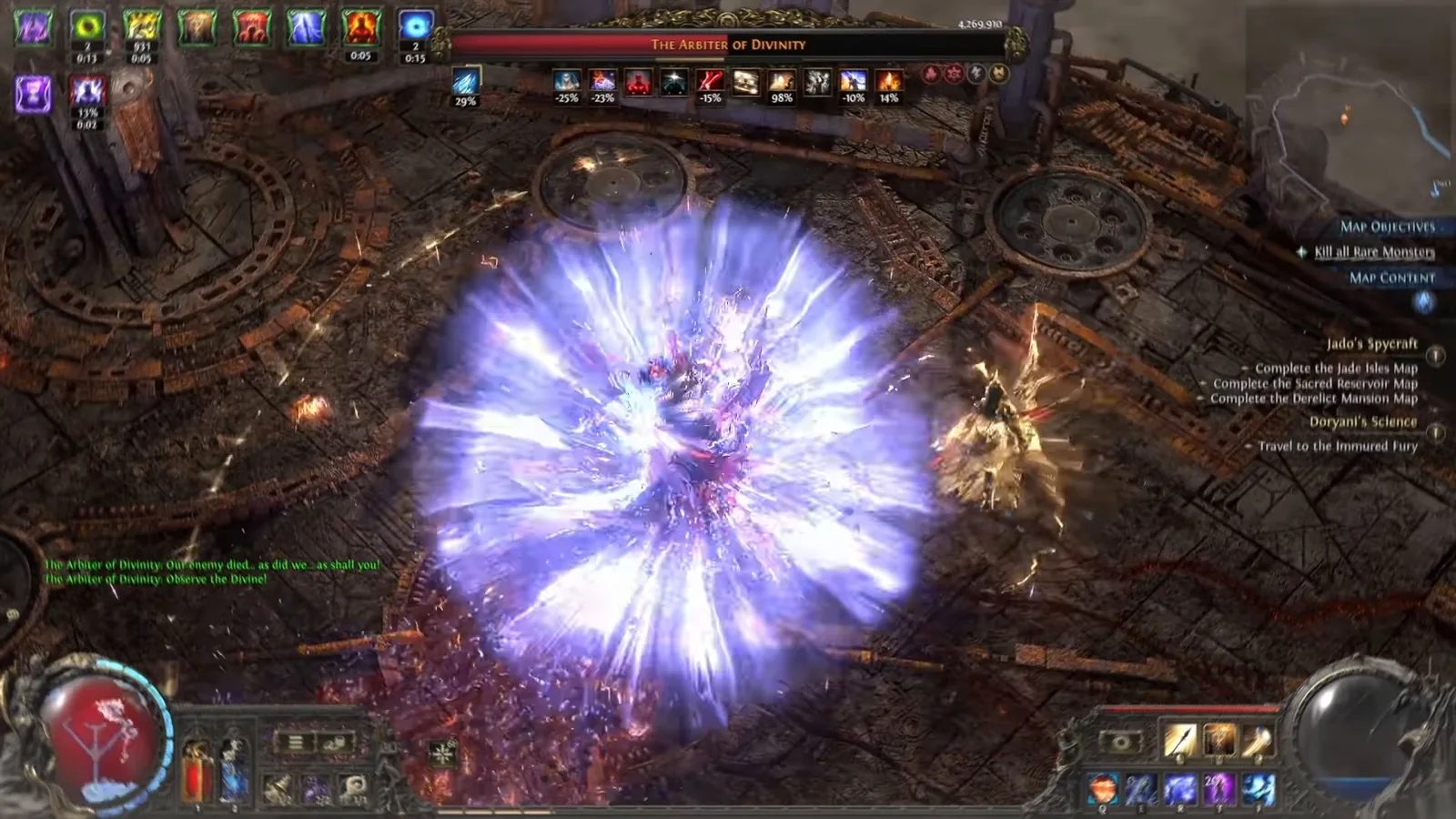
| The Origin Tower | The Arbiter of Divinity | Final Fortress boss |
AsmodeusClips' route is to take the shortest path between these objectives and ignore the ordinary Fortress maps along the way, because the endgame later completes those for you. He also mentions that some quest steps ask for minimum Waystone tiers (he names 6, 11 and 14), and that maps near the Burning Monolith carry guaranteed trial keys if you still need an ascendancy trial. Our PoE2 ascendancy trial guide covers those.
How you earn Atlas passive points

free Every map you complete inside the Fortress leaves a Precursor Relay after the boss. Touch it for one point on the main Atlas tree. Towers, gateways, Enigma Chambers and halls give more; patch 0.5.1 raised those rewards. Clearing a few hundred maps one by one would take a long time, and that is the point of the final boss.
When you beat the repeatable Arbiter of Divinity, the Fortress maps start completing themselves. The two sources describe this slightly differently. The wiki says the kill completes every Fortress map; AsmodeusClips shows it working region by region, using a Cardinal device around the Origin Tower after each kill (he counts five regions, about 40 points each), so he farms Origin Spark and Cradle sets for several kills. Either way, the Arbiter is how a normal player fills the main tree.
The smaller mechanic trees work differently. You earn their points by completing maps with that mechanic near its hub area, and each pinnacle boss kill adds 6 points. Expedition is the exception: its points only come from its bosses, 6 per boss.
The Atlas passive tree in PoE2

free The PoE2 Atlas passive tree is not the character tree; it changes your maps, not your character. The 0.5 version has one large main tree and a set of smaller trees for each mechanic along the bottom of the screen. The main tree covers general rewards (Waystone drops, rare and magic monsters, rarity, pack size), smaller encounters such as essences, strongboxes, shrines and rogue exiles, and biome bonuses.
Three rules make it less scary than it looks:
- You can take every node. With enough points the whole tree fits, so there is no build to plan, only an order.
- You can't respec. Points can't be removed. Multi-choice nodes let you switch their option any time, and the wiki confirms that is the only flexibility.
- Some nodes have conditions. Higher nodes only affect maps of a minimum area level, some sections unlock after specific bosses, and some mechanic nodes stay greyed out until that mechanic's quest boss is dead.
AsmodeusClips' early order is a good template: path through the Essence nodes, take Pathkeepers and Eons of Domination for Waystone drops and Overseer Tablets, then Valuable Paths and Archaeological Interest. After the Arbiter, take Reverse Transcription (rare tablets) and head for the top section. He also recommends Monster Effectiveness choices wherever your character can handle tougher monsters, since they raise drop quantity. If you are new to how passive trees work in general, our PoE2 passive tree guide explains the character side.
League mechanics you meet in maps

setup The optional objectives in a map are mostly league mechanics, older league content now built into the game. The first time you complete one, you get a quest and its hub appears on your Atlas. You can ignore any of them; nothing forces you to play Delirium if you hate it.
| Mechanic | What happens in the map | Main rewards (per the videos) | Hub and pinnacle boss |
|---|---|---|---|
| Abyss | Green cracks spawn packs; kill them to seal it, sometimes opening the Abyssal Depths | Basic currency, desecrated bones, omens | Well of Souls; Vessel of Kulemak |
| Breach | Touch the hands; kill monsters to keep the breach stable, then kill its rares | Hiveblood and wombgifts for jewellery and currency | Monastery of the Keepers; Xesht, We That Are One |
| Delirium | Walk through the mirror; fog makes the map harder the deeper you go | Liquid Emotions for amulet anoints and jewels | The Withered Hollow; The Raven Trickster |
| Expedition | Place explosives over markers and detonate | Currency, logbooks, uncut gems, Waystone chests | Ruins of Kingsmarch; The Aberration |
| Ritual | Kill packs, activate altars, earn tribute, spend it on rewards | Unique items and omens | Caer Tarth; The Bodach |
| Temple | Charge Ancient Beacons, then build and run your Vaal Temple | Vaal currency for corrupting items | Atziri's Temple; Atziri, the Red Queen |
Two tips that save time. Ritual tribute is lost when the map closes, so spend it, then offer what's left to the King in the Mists before you leave. And while you are doing a mechanic's quest, don't run that mechanic's tablet: it adds more of it to every map, which makes each quest step slower.
Which mechanics to farm first

cheap You don't need every mechanic. Pick the ones that fix your character's weak points. AsmodeusClips' order for a progressing character:
- Abyss early for raw crafting currency that any build can use.
- Expedition when you need supplies quickly, since it's easy to farm without investment and can refill your Waystones from its chests.
- Breach for rings, amulets and especially belts, often a new character's weakest slot.
- Delirium briefly, to unlock amulet anoints, then leave its harder maps until last.
- Ritual and Temple later, for unique items, omens and Vaal currency rather than direct power.
He finishes the main Fortress first, then Ritual, Temple and Delirium in that order, because Delirium's later steps need maps above 100% deliriousness, which are much harder. For what to do with the currency these mechanics drop, see our PoE2 currency guide.
Atlas Masters: Doryani, Hilda and Jado

setup The three Atlas Masters each have a quest line that unlocks a set of 12 toggleable passives. Only one Master is active at a time, and you can swap Masters and their passives freely. Once a Master's quest is done you can run four of the twelve.
| Master | How to unlock | What the passives focus on |
|---|---|---|
| Hilda | Visit her campsite south-west of the start, then hunt Great Beasts | Harder, richer bosses and rare monsters; Mighty Prey for Powerful bosses |
| Doryani | Clear a Corrupted Nexus, then cleanse more | Waystone modifiers and exploration; Stitch the Flesh adds a revival |
| Jado | Complete an Anomaly map, then all of them | Unique items, strongboxes and unusual map content |
Corrupted regions are worth knowing for Doryani: their maps have far more monsters, and killing the boss at the Corrupted Nexus cleanses the region so its maps give extra currency. One correction to the main video: MyleSwi's captions call the third Master "Zana", but both the wiki and AsmodeusClips name him Jado (Jado's Spycraft), unlocked through Anomaly maps.
PoE2 pinnacle bosses and the Arbiters

grind PoE2 pinnacle bosses sit at the end of each quest line. Each one has a one-time quest version (the wiki lists level 79 for most, 74 for the Arbiter of Ash) and a repeatable version around level 82 that needs keys.
- The Arbiter of Ash in the Burning Monolith needs three Crisis Fragments from Citadel bosses. On the quest, one fragment is already in place, so the two Enigma Chambers are enough.
- The Arbiter of Divinity at the top of the Origin Tower is the main Fortress finale. Combine the Origin Spark and Origin Cradle at the forge in the tower to make an Origin Core, then take it to the top. The wiki notes unlimited respawns in his regular version. Spark and Cradle drop from the Patriarch and Matriarch Halls, which you can also find out on the open Atlas (look for an orange beam; they usually spawn as a pair). Players also sell them, but AsmodeusClips suggests farming them because you need to explore anyway.
- The mechanic bosses (Vessel of Kulemak, Xesht, The Raven Trickster, The Bodach, Atziri, The Aberration) each end their mechanic's quest and give 6 points on that mechanic's tree.
setup Both creators advise finishing your ascendancy before the final fights and not attempting them while the regular maps around you still feel dangerous. The Arbiter of Ash can be beaten with a weaker character if you learn his attacks, but most players are better off gearing in tier 11 first.
A simple endgame progression order

free Put together, a first-time endgame progression looks like this, mostly following AsmodeusClips:
- Run your first maps, open the map device in your hideout and complete the first tower to raise the Fortress.
- Detour to Hilda's camp for Mighty Prey, then path through the Fortress objectives only, rushing map bosses.
- Spend early Atlas points on Waystone drops and Overseer Tablets, and stay at tier 11 while you gear.
- Clear a Corrupted Nexus for Doryani, unlock Delirium anoints and push one or two mechanics that help your build.
- Finish the ascendancy, then collect Spark and Cradle and beat the Arbiter of Divinity for the bulk of your Atlas points.
- Fill the rest of the tree, finish the mechanic trees you care about and complete the other Masters.
None of this is mandatory. MyleSwi's point is that you can explore the Atlas at your own pace and still progress, and the order above is only the fastest route to a full tree.
Read next
- Path of Exile 2 beginner guide: the whole game in order, from the first act to maps
- Path of Exile 2 1.0 release: what changes in the endgame on 11 December
- Best PoE2 endgame builds: builds that clear high-tier maps and bosses
- PoE2 defense guide: the defences that keep you alive in tier 15 maps
- Path of Exile 2 game hub for every guide on the game
How this guide was fact-checked
The map loop, portals, boss-arena rules, tablet slots, league mechanic walkthroughs and Masters overview come from the main source video, Path of Exile 2's Endgame is ACTUALLY Not That Difficult - A True Beginner's Guide by MyleSwi (uploaded 9 September 2026, during 0.5). The progression route, Waystone sustain advice, tier 11 breakpoint and mechanic priorities come from the backup video, THE ULTIMATE PATH OF EXILE 2 ENDGAME PROGRESSION GUIDE by AsmodeusClips (uploaded 13 June 2026). Waystone tiers and area levels, revive counts, tablet slot rules, Atlas tree rules, Waystone passives, Fortress layout, Master unlocks and pinnacle boss requirements were checked on poe2wiki.net (Waystone, Tablet, Atlas Passive Tree, Atlas Master, Precursor Fortress, boss pages). 1.0 details come from GGG's Steam announcement of 6 November 2026 and our 1.0 release guide.
Corrections and notes:
- MyleSwi's captions name the third Atlas Master "Zana"; the wiki and AsmodeusClips call him Jado, unlocked by Anomaly maps.
- AsmodeusClips says Expedition has no Atlas tree. That was true when he recorded; the wiki now lists an Expedition tree whose points come only from its bosses, 6 each, and patch 0.5.5 added the Expedition Tablet.
- AsmodeusClips' captions call the Ritual hub "Kirac's"; the wiki places The Bodach's effigy in Caer Tarth. MyleSwi's captions say "Ruins of Kaldor" for the Runes of Aldur league.
- The wiki says the Arbiter of Divinity completes the Fortress maps; AsmodeusClips shows region-by-region completion with about 40 points per region. We give both and attribute the numbers to him.
- The "25% of bosses become Powerful" figure is confirmed on the wiki as Hilda's Mighty Prey. Normal-versus-Powerful boss Waystone tiers, minimum quest tiers (6, 11, 14) and the item level 75 gearing argument come from AsmodeusClips only.
- MyleSwi's 60-charge cap for Temple beacons was not confirmed on the wiki, so we left it out.
What this guide doesn't answer
- Builds for mapping and bosses. Which builds clear fastest is a separate question; see the builds guide above.
- Each mechanic in depth. Temple room layouts, Delirium escalation and Breach's Genesis Tree each need their own guide.
- Waystone crafting for profit. Juicing strategies with omens and corruption change every league.
- Boss fight mechanics. We name where each pinnacle boss is and what it needs, not how to dodge every attack.
- The 1.0 Atlas tree. Its full node list isn't public yet; this guide will be updated after the 1.0 patch notes.
Frequently asked
How do I start the endgame in Path of Exile 2?
Finish the campaign and Doryani introduces the Atlas in the Ziggurat Encampment. Put a Waystone into the map device on a reachable (blue) node, clear the map and kill its boss. Completing your first Precursor Tower raises the Precursor Fortress north of the Ziggurat, which holds the main endgame quest and your Atlas passive points.
How many revives do PoE2 Waystones give?
A map opens six portals, and each death uses one. Every explicit modifier on the Waystone removes one revive, so a Waystone with six or more modifiers gives no revives and you get a single attempt. Doryani's Stitch the Flesh passive adds one extra revival to your maps.
How do I unlock tablet slots in PoE2?
Tablet slots depend on your Waystone's modifiers: one slot with 1-2 modifiers (magic), two with 3-5 (rare) and three with 6. Transmutation and Augmentation open the first slot, a Regal or Alchemy Orb the second, and Exalted Orbs up to six modifiers the third. Empty slots add a chance for random mechanics instead.
How do you get Atlas passive points in PoE2?
Main tree points come from the Precursor Relay that appears after each map boss inside the Precursor Fortress, with extra points from towers, gateways, Enigma Chambers and halls. Beating the repeatable Arbiter of Divinity completes Fortress maps for you. Mechanic trees fill from maps near each mechanic's hub plus 6 points per pinnacle boss kill. The 1.0 release rebuilds this tree.
What Waystone tier should I farm in PoE2?
Tier 11 is a good place to gear up: it is area level 75, and many players progress faster there than by rushing tier 15 on a weak character. Use Mighty Prey, Overseer Tablets and the Waystone quantity passives (Pathkeepers, Valuable Paths, Archaeological Interest, Atop the World) to keep Waystones flowing, and buy spares from Doryani.
Read next
PoE2 Campaign Guide: Acts 1-4, Interludes and Boss Tips
An act-by-act Path of Exile 2 campaign guide for Acts 1-4 and the three Interludes: the bosses that kill new players, permanent quest rewards worth the detour, and when to swap gems and gear before maps.
PoE2 Trade Guide: Currency Exchange, Price Checks, Filters
How trading works in Path of Exile 2: the Currency Exchange, instant buyout through Merchant's Tabs and The Market, the official trade site and how to price check items without underselling. It also covers setting up a loot filter online and choosing a NeverSink strictness on FilterBlade.
PoE2 Defense Guide: Resists, Armour, Evasion and ES
Why Path of Exile 2 characters get one-shot and how to layer resistances, armour, evasion, energy shield and Runic Ward so it stops happening. Built on Arkk's defence video and checked against the wiki, with the resistance penalty and armour tables.
PoE2 Beginner Mistakes: 13 Fixes Every New Player Needs
Thirteen common Path of Exile 2 beginner mistakes, from neglected resistances and risky sprinting to missed quest passive points and unread support gems, each with the fix. Checked against the poe2wiki and official 1.0 news.