
🎯 The core idea
Path of Exile 2 looks overwhelming, but a new player only needs a few habits to get through the campaign: start a softcore trade character in the current league, pick the class whose fantasy you like, take the recommended gems, upgrade your weapon and flasks often, and chase life and elemental resistances on gear. Everything else (crafting, trading, the endgame) can wait until the basics click.
- free costs nothing
- cheap small cost
- setup needs preparation
- grind pays off slowly
- skip the thing to stop doing
Version note: Written for 0.5.x, reviewed 2026-11-17 — PoE2 is in Early Access (Runes of Aldur league, Forbidden Rites event). The 1.0 release on 11 December 2026 is announced to make the game free-to-play, add Acts 5 and 6, add the Shadow and Duelist classes, start the Conquerors of Wraeclast league, overhaul the passive tree and rebalance support gems. Early Access characters move to a separate Early Access Standard league. Class counts and menus below may shift.
This Path of Exile 2 beginner guide is built from Lolcohol's 68-minute "Path of Exile 2 Beginner Guide" (August 2026, recorded in the Runes of Aldur league) and MyleSwi's "Path of Exile 2 is ACTUALLY Not That Difficult" (January 2026), checked against Grinding Gear Games' announcements and the community wiki. It follows a fresh character from the league screen through the first act and points to the systems you will meet later.
League vs Standard, SSF and Hardcore

free The first screen after "Create" asks two questions: which league, and which game mode. Standard is the permanent realm where characters are never reset. The challenge league is temporary: roughly every four months a new one starts, everyone begins at level 1 with an empty stash, and the league brings its own new mechanic. When it ends, your characters and items move to the matching permanent league, so nothing is deleted.
For the PoE2 league vs Standard question, both videos give the same answer: start in the current challenge league. The economy is fresh, items you find are worth more, more players are trading, and most guides and filters are written for it. Standard has years of accumulated items and much less going on for a new player.
The mode checkboxes sit under each league:
| Mode | What changes | Who it suits |
|---|---|---|
| Softcore trade (default) | You can party, trade and respawn after death | Almost every first character |
| SSF (Solo Self-Found) | No parties, no trading, no market; you only use what you find or craft | Players who want a self-contained challenge |
| HC (Hardcore) | One death moves the character to the softcore version of that league for good | Players who already know the fights |
| HC SSF | Both restrictions together | The hardest way to play |
skip Don't start in PoE2 SSF or PoE2 Hardcore. SSF gives no extra rewards (the wiki is explicit about this) and takes away the market that covers gaps in your gear. You can move an SSF character into the trade league later, but never the other way. Hardcore punishes exactly the mistakes a first run is made of: MyleSwi notes the game has many ways to kill you outright while you are still learning. Treat both as second-character goals.
Your first class and the difficulty curve

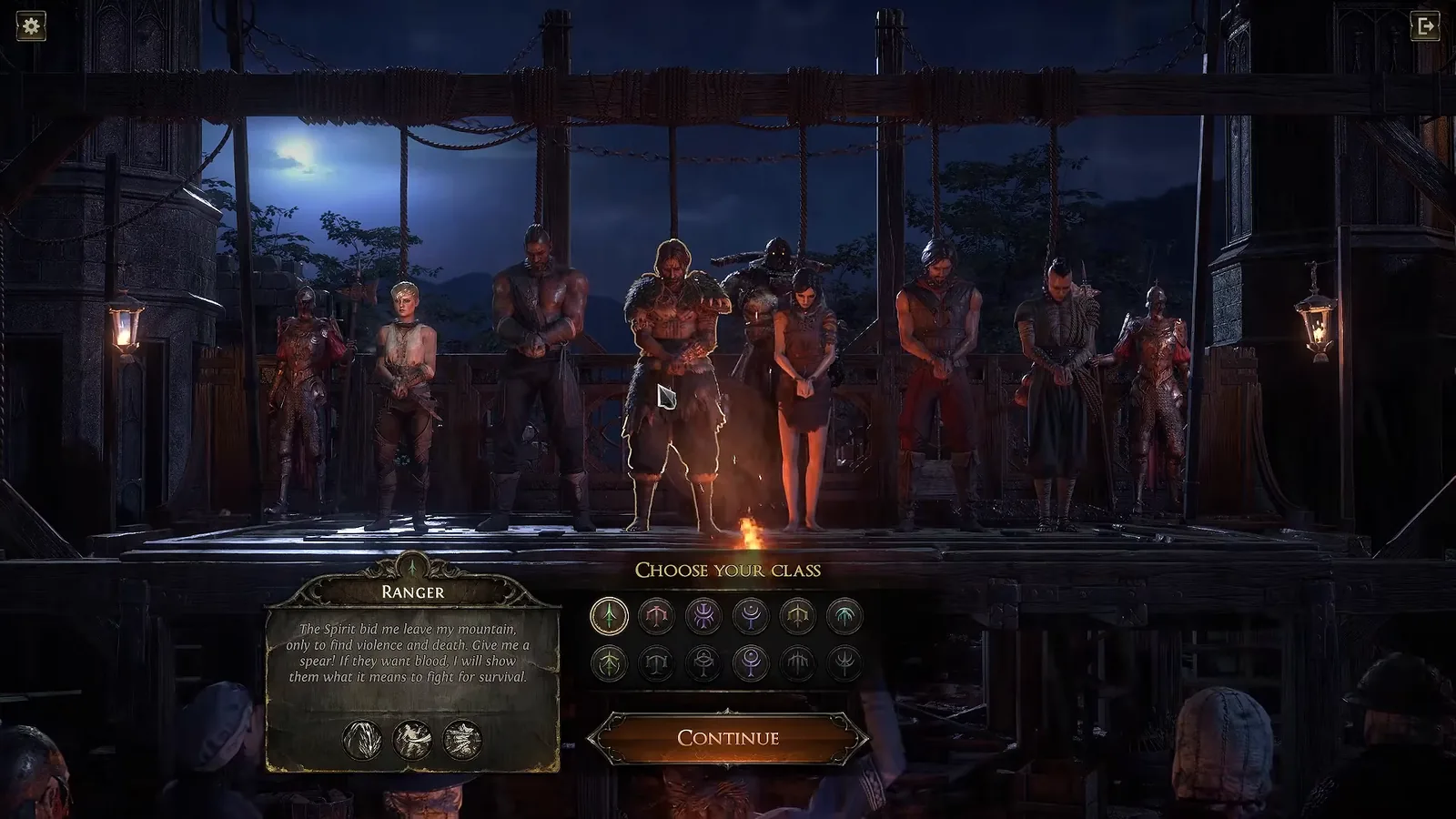
free Clicking a class on the character screen plays a short preview of the skills it tends to use. Pick on fantasy, not on tier lists: if a shape-shifting Druid or a grenade-throwing Mercenary looks fun, play that. Classes in PoE2 decide where you start on the passive tree and which ascendancies you can unlock later; they do not lock skills or gear. A Witch can use a crossbow and a Mercenary can cast spells, as long as the attribute requirements are met. If you want a side-by-side comparison, our guide to the poe2 best class for beginners covers every class and ascendancy.
So, is Path of Exile 2 hard? The campaign is tougher than most action RPGs: bosses have telegraphed heavy attacks (they flash red with an audio cue before them), regular packs hit harder than you expect, and there is no big green arrow telling you which item is better. But the systems are learnable, the game gives you recommended gems at every step, and the tooltips explain themselves. MyleSwi's whole argument is that it is "not that difficult" once you stop trying to learn everything at once. Our PoE2 tips for new players boil down to this: learn one system per act.
You can make several characters per account, so a first class that doesn't click is not a lost investment.
Dodge roll, flasks and checkpoints

free You choose WASD or click-to-move when you wake up on the beach; Lolcohol recommends WASD to take strain off your mouse hand, and you can switch later under Options, Input. Controllers are supported too.
- Dodge roll (Space): a quick roll that avoids most hits during the animation. Use it on every boss telegraph.
- Sprint (hold Space): faster movement, but being hit while sprinting knocks you down and you cannot act until you get up. Don't sprint into unexplored packs.
- Life and mana flasks: each drink uses charges, and charges come back from kills and from the well in town. Your first life flask is weak; Lolcohol shows a level 10 flask recovering more than four times as much as the starter one, so swap to every new flask tier you find.
- Checkpoints: touching one refills life, mana and flasks, and you can teleport between checkpoints in the same zone. When you die you respawn at the last checkpoint, but monsters in the area come back with you.
- Town portal: a button on the bottom bar takes you to town at any time.
Most active skills cost mana, and mana regenerates slowly, so the mana flask matters more early on than it looks.
Skill gems come from items, not your class

free In PoE2 your skills are items. Your first weapon grants a basic attack, an early chest gives your first skill gem (or an off-hand item, with the gem in a later chest), and press G to open the skills panel where gems are socketed and assigned to your hotbar. The panel also shows a damage-per-second readout for each skill.
The main source of new skills is the Uncut Skill Gem. Right-click one and a cutting window opens, sorted by weapon type, with your class's usual weapon selected first. Each skill has a short video preview, so you can see what it does before committing. Higher-level uncut gems unlock higher tiers of skills, and an uncut gem can also be used to level a skill you already have, which raises its damage noticeably.
skip Don't browse every tab of the cutting window on your first character. Lolcohol's advice is to stick to the recommended column: you can build a working character from those alone, and opening the full list is where most new players get overwhelmed. Weapon-specific skills also need that weapon equipped (Lightning Arrow needs a bow), while some skills work with anything.
Support gems and extra sockets

cheap The small circles next to each skill are support sockets. Uncut Support Gems are cut the same way; the window shows the selected skill and a list of recommended supports. A support changes how that skill works: Multishot fires extra projectiles at reduced damage, Magnified Area grows the area without adding damage, Fire Attunement adds fire at the cost of cold and lightning.
Things that trip new players up:
- Each support has a colour tied to an attribute (red strength, green dexterity, blue intelligence), and the more supports of a colour you use, the more of that attribute you need.
- Some supports raise the mana cost of the skill they support.
- Numbered supports are not always strictly better. MyleSwi points to Rapid Attacks III, which adds attack speed but deals much less damage. Read before you engrave.
- Every skill starts with a couple of support sockets and can reach five. The extra sockets come from Jeweller's Orbs (Lolcohol's narration calls them "jewel sockets"; the item shown is a Jeweller's Orb), applied from the inventory onto the gem.
Spirit and permanent buffs

setup Spirit is the third resource after life and mana. It is reserved, not spent: you switch on a persistent buff, a permanent minion or a trigger skill, and it holds a slice of your Spirit for as long as it is active. Characters start with no Spirit. The first chunk comes from the King in the Mists in Act 1, who drops the Gembloom Skull (the wiki lists it at +30 Spirit) and an Uncut Spirit Gem. Later campaign bosses give more, and sceptres and some gear add Spirit too.
Lolcohol socketed Wind Dancer on a Mercenary, a buff that stacks evasion and blasts enemies back when you are hit. Almost every build runs at least one Spirit skill, so when an uncut Spirit gem drops, cut something from the recommended list and turn it on.
Reading the passive tree without panic

free Every level gives a passive point, and the first time you open the tree is the moment many players quit. The tree is shared by all classes; your class only sets the starting point. Strength (life, armour, melee) sits at the bottom left, dexterity (projectiles, evasion, speed) at the bottom right, intelligence (spells, energy shield) at the top, with hybrid areas in between.
| Node | Looks like | What it does |
|---|---|---|
| Small passive | Small circle | A minor bonus such as increased projectile damage |
| Attribute node | Small travel node | Pick strength, dexterity or intelligence |
| Notable | Larger circle | A bigger bonus that matches the small nodes leading into it |
| Keystone | Large ornate node | A big upside with a real downside (Unwavering Stance stops light stuns but disables dodge roll and sprint) |
| Jewel socket | Empty socket | Holds a jewel with its own modifiers |
The trick both videos share: zoom in. Look only at the notables near your current path, pick the one that helps your main skill or survival, walk to it, then pick the next. The search box highlights nodes for a word like "projectile" or "life". Hold Alt over any tooltip to see underlined keywords explained, which is the fastest way to learn the game's vocabulary. Mistakes are cheap: the Hooded One in town refunds passive points for gold that scales with level. Build guides are fine if you prefer them, but Lolcohol suggests trying the first run without one.
Item rarity and the basic currency orbs

cheap Items come in four rarities: normal (white, no modifiers), magic (blue, up to two), rare (yellow, up to six) and unique (orange, fixed special modifiers). Magic and rare drops must be identified with a Scroll of Wisdom before you can see or use them; vendors sell them for a little gold, and the Hooded One identifies everything for free once you meet him.
Currency orbs upgrade gear step by step:
| Orb | Does |
|---|---|
| Orb of Transmutation | Normal to magic, one modifier |
| Orb of Augmentation | Adds a second modifier to a magic item |
| Regal Orb | Magic to rare, adds a modifier |
| Exalted Orb | Adds a modifier to a rare, up to six |
| Artificer's Orb | Adds a rune socket |
Base types also improve as you go: a later crossbow base rolls higher base damage than the one you start with, and later modifiers roll higher tiers. Lolcohol's gambled crossbow more than doubled his grenade damage over a plain white one, which is why the weapon is the first slot to upgrade. Runes go into sockets for bonuses such as added damage on weapons or resistances on armour. The magic vendor's Disenchant option turns unwanted magic and rare items into orb shards, and the salvage bench later turns quality and socketed items into quality currency and Artificer's shards. Uniques are not automatically better than a good rare; read them.
How to tell if an item is an upgrade

free There is no power score, so compare numbers yourself:
- Weapon: equip it and watch the damage number next to your skill in the skills panel (G). Lolcohol's grenade went from 19 to 29 to 44 across three crossbows. It is not perfectly accurate, but it is the best quick check, and the arrow beside it opens a full breakdown.
- Body armour and helmet: open the character sheet (C) and compare life, armour, evasion or energy shield, and resistances. Life plus resistances usually beats a bigger defence number alone.
- Gloves: attack builds love "adds damage to attacks"; spell builds ignore it, because spells are not attacks.
- Boots: movement speed is worth a lot, both for travel and for getting out of danger. Many players take speed boots over tankier ones early.
- Belt, rings, amulet: life, resistances, attributes, and on belts flask effect and extra charm slots. Rings and amulets carry an implicit modifier even when white, which can fix a resistance or attribute gap on its own.
Skill tags matter here. Hover a skill with Alt and you'll see tags like Attack, AoE, Projectile or Grenade. Anything on the tree or gear that boosts a tag your skill has will help it; melee damage does nothing for a projectile skill without the Melee tag.
Staying alive: life, armour and resistances

setup The three base defences match the attributes: armour (strength) reduces physical damage from hits, evasion (dexterity) gives a chance to avoid a hit entirely, and energy shield (intelligence) is an extra pool that takes damage before life and recharges when you stop taking hits. Hybrid gear gives a mix.
Resistances reduce elemental and chaos damage by their percentage, and the default cap is 75%: with 0% you take a 100-damage fire hit in full, with 50% you take 50, with 75% you take 25. You cannot cap them early, but by the end of the campaign fire, cold and lightning should be close to it. Chaos is harder to find and less urgent; sitting low on chaos while the other three are capped is normal.
Lolcohol's three defensive habits for the campaign:
- Add life on gear steadily (he suggests roughly 250 to 300 more per act as a personal target).
- Pick up a bit of armour early, even on a caster, because most Act 1 enemies hit with physical damage.
- Push resistances up whenever a gear swap allows it.
Charms are the automatic layer: they fill from kills and fire on a condition, such as a burst of lightning resistance when a lightning hit lands, or freeze immunity when you are frozen. Belts provide the charm slots. Bosses marked with a plus on the world map (U) drop permanent rewards; Lolcohol's first one gave +10% cold resistance, and others give passive points, Spirit or life.
Town vendors, respec and the stash

cheap Every town has the same set of services:
- Blacksmith: martial weapons and armour for gold. Selling identified items pays more than unidentified ones.
- Magic vendor: wands, staves, sceptres, flasks, Scrolls of Wisdom and Disenchant.
- Gambler: unidentified items of a chosen type. Lolcohol calls it a last resort because gold runs out quickly.
- The Hooded One: free identification and passive refunds for gold.
- Well, waypoint, stash: refill flasks, fast travel between waypoints you've found, and store items. The stash is shared between all characters in the same league.
Vendor stock partly refreshes when you level, so a quick town trip after a level-up can turn up an upgrade when drops are dry. The first act also introduces league mechanics in the world: special encounters that spawn a wave of monsters for extra loot. They are hard but generous, so do them when you see one.
Ascendancy classes and how you unlock them

setup Ascendancies are subclasses with their own small tree, and they are where builds get their signature power, such as the Deadeye node that makes skills fire an extra projectile. Each class has its own ascendancy options; you pick one the first time you complete an Ascension Trial. There are four tiers of trials, each giving two points, for eight in total.
Your first chance is in Act 2: the boss Balbala in the Traitor's Passage drops a Djinn Barya that opens the Trial of the Sekhemas, a multi-room run with a boss at the end. From Act 3 the Trial of Chaos offers a second route. Higher-level Baryas and Ultimatum items show whether they will grant new points. The trials are demanding, so you don't need them the moment they unlock, but don't put them off for long. The full walkthrough is in our poe2 ascendancy trial guide.
Loot filters and trading

setup By the end of the campaign the ground is covered in items you'll never use. A loot filter hides the junk and highlights what matters. MyleSwi's route takes about a minute: on the official Path of Exile website, open Item Filters, switch the game to Path of Exile 2, follow one of NeverSink's filters (regular or semi-strict), then pick it in the game options under the item filter dropdown and save. Stricter versions hide more as you progress. FilterBlade is where you customise the same filters. Both creators call a filter close to mandatory by the endgame.
Trading happens through the in-game market (Lolcohol opens it with the / key and believes it unlocks around Act 4). You search an item, travel to the seller's hideout, and pay their listed price. You don't need trading to finish the campaign; when you're ready, our poe2 trade guide covers the market, the currency exchange and price checks.
Common terms glossary

free The words you will see in chat, guides and tooltips:
| Term | Meaning |
|---|---|
| DPS | Damage per second; the skills panel shows a per-skill figure |
| Crit | A critical strike: a hit that deals bonus damage, based on critical hit chance and critical damage bonus |
| Ailments | Effects applied by hits: ignite (fire damage over time), freeze, chill, shock, bleeding, poison |
| Spirit | The reserved resource that powers persistent buffs, permanent minions and triggers |
| League | A temporary season with a fresh economy and a new mechanic; ends by merging into Standard |
| Standard | The permanent league where characters are never reset |
| SC / softcore | Default mode: you respawn after death |
| HC | Hardcore: one death moves the character out of the hardcore league |
| SSF | Solo Self-Found: no trading or parties |
| Ascendancy | Your subclass and its small passive tree |
| Uncut gem | An item you cut into a new skill, support or Spirit gem, or use to level one |
| Implicit | A fixed modifier on an item base, present even on white items |
| Tags | Labels on skills (Attack, Spell, Projectile, AoE) that decide which bonuses apply |
| Mapping / endgame | The post-campaign Atlas, run with Waystones |
Read next
- PoE2 beginner mistakes: the habits that cost new players the most time
- PoE2 skill gems: supports, Spirit gems and how to level gems in depth
- PoE2 passive tree: planning a route and respeccing cheaply
- PoE2 defense guide: resistances, armour, evasion and energy shield in depth
- Path of Exile 2 1.0 release: what changes on 11 December 2026
- Path of Exile 2 game hub for every guide on the game
How this guide was fact-checked
- Official announcements (Steam news for PoE2): the 1.0 date (11 December 2026), free-to-play, Acts 5 and 6, the Shadow and Duelist with their ascendancies, the Conquerors of Wraeclast league and the passive tree, support gem and Mercenary changes come from Grinding Gear Games' "Full Release on December 11" post. The Forbidden Rites FAQ confirms the Duelist is not in 0.5.5 and that Runes of Aldur runs until 1.0.
- poe2wiki.net: league types, the roughly four-month challenge league cycle, Hardcore moving dead characters to the softcore league, SSF giving no extra rewards and allowing one-way migration, Early Access characters moving to Early Access Standard at 1.0, Spirit sources (Gembloom Skull +30 from the King in the Mists), ascendancy points (four trials, two points each, eight total) and passive node types.
- From the videos' own screens: controls, the cutting windows, support gem examples, vendor functions, item rarities and orbs, the DPS comparisons, the 75% resistance cap shown on the character sheet, charms and the loot filter setup.
- Corrections to Lolcohol's video: he says Path of Exile 2 "will have 12 characters at launch"; 12 is the planned total. Early Access 0.5 has eight classes, and 1.0 adds the Shadow and Duelist for ten. He also says all classes currently have three ascendancies for 36 total; the wiki lists 22 available, with 36 planned. The auto-captions name the league "Ruins of Valder"; it is Runes of Aldur. His "Temple of Chaos" is the Trial of Chaos. A third ascension route he mentions as possible in future (a Trial of the Ancestors) is not confirmed for 1.0 in the announcements, so it is left out. The support-socket items are Jeweller's Orbs, not "jewel sockets".
- Corrections to MyleSwi's video: it was recorded in the Fate of the Vaal league (0.4) and mentions a paid Early Access price; the game goes free-to-play at 1.0, and the current league is Runes of Aldur.
- Not independently confirmed: the exact market unlock point (Lolcohol hedges on Act 4) and the 250 to 300 life-per-act target, which is his personal rule of thumb. Both are attributed to him above.
What this guide doesn't answer
- Which build to play: builds come after the 1.0 patch notes, since class reworks and support gem rebalancing will reshuffle them.
- The endgame Atlas, Waystones and pinnacle bosses: a separate topic covered in our endgame guide.
- Crafting beyond the basic orbs: Essences, Omens and advanced crafting are covered in the currency and crafting guide.
- A zone-by-zone campaign route: held until 1.0 adds Acts 5 and 6.
- Shadow and Duelist details: they are not playable until 11 December 2026, so this guide doesn't describe them beyond the announcement.
Frequently asked
Is Path of Exile 2 hard for new players?
The campaign is harder than most action RPGs: bosses hit hard (they flash red with an audio cue before big attacks), and there is no power score telling you which item is better. It becomes manageable once you learn one system at a time: take the recommended skill and support gems, upgrade your weapon and flasks often, dodge roll through telegraphs and push life and fire, cold and lightning resistances up as you go.
Should I play the league or Standard in PoE2?
Start in the current challenge league. Everyone begins fresh, the economy is new, items are worth more and most guides and loot filters target it. When a league ends, your characters and items move to the matching permanent league, so nothing is lost. Standard is permanent and never resets, but has far less going on for a new player.
Should my first PoE2 character be SSF or Hardcore?
No. Solo Self-Found removes trading and parties and gives no extra rewards, and you can only migrate an SSF character to trade, never back. Hardcore moves your character to the softcore league on the first death, which punishes the mistakes every first run makes. Play softcore trade first and try SSF or Hardcore on a later character.
What is Spirit in Path of Exile 2?
Spirit is a reserved resource for persistent buffs, permanent minions and trigger skills. Characters start with none; the first boost comes from the Gembloom Skull dropped by the King in the Mists in Act 1, along with an Uncut Spirit Gem. More comes from later campaign bosses, sceptres and gear. Turning a Spirit skill on reserves part of your Spirit until you turn it off.
What changes for new players at PoE2 1.0?
The full release on 11 December 2026 makes Path of Exile 2 free-to-play, adds Acts 5 and 6, adds the Shadow and Duelist classes, starts the Conquerors of Wraeclast challenge league, overhauls the passive tree and rebalances support gems. Early Access characters move to a separate Early Access Standard league, so 1.0 is a clean starting point for new players.
Read next
PoE2 Campaign Guide: Acts 1-4, Interludes and Boss Tips
An act-by-act Path of Exile 2 campaign guide for Acts 1-4 and the three Interludes: the bosses that kill new players, permanent quest rewards worth the detour, and when to swap gems and gear before maps.
PoE2 Trade Guide: Currency Exchange, Price Checks, Filters
How trading works in Path of Exile 2: the Currency Exchange, instant buyout through Merchant's Tabs and The Market, the official trade site and how to price check items without underselling. It also covers setting up a loot filter online and choosing a NeverSink strictness on FilterBlade.
PoE2 Beginner Mistakes: 13 Fixes Every New Player Needs
Thirteen common Path of Exile 2 beginner mistakes, from neglected resistances and risky sprinting to missed quest passive points and unread support gems, each with the fix. Checked against the poe2wiki and official 1.0 news.
PoE2 Best Class for Beginners: Every Class and Ascendancy
Which Path of Exile 2 class and ascendancy a new player should pick, judged on range, defences, button count and cost rather than ladder popularity. Covers all eight classes, a 0.5 ascendancy tier list and what 1.0 changes.