
🎯 The core idea
Every crafting orb in Path of Exile 2 does one small, predictable thing to an item's modifiers: upgrade its rarity, add a modifier, remove one, swap one, or reroll the numbers. Learn the prefix and suffix limits, read your items with Alt, and the orbs stop being a lottery. Keep Divine and Exalted Orbs for trading, and spend the cheap orbs on your own gear while you level.
- free costs nothing
- cheap small cost
- setup needs preparation
- grind pays off slowly
- skip the thing to stop doing
Version note: Written for 0.5.x, reviewed 2026-11-17 — PoE2 is in Early Access (Runes of Aldur league, Forbidden Rites event). The 1.0 release on 11 December 2026 is announced to bring the Conquerors of Wraeclast league with a new crafting material that reforges gear, plus a passive tree overhaul and support gem rebalance. The core orbs below have worked the same way all through Early Access, but minimum modifier levels, drop sources and which systems are switched on (Alloys, the Recombinator) can change in the 1.0 patch notes.
This PoE2 currency guide is built from Lolcohol's 38-minute "Crafting for Noobs: Path of Exile 2 Edition" (May 2026), checked against Grinding Gear Games' patch notes on Steam and the in-game item text as listed on PoE2DB. It explains what each orb does, which ones a new player should spend or keep, and walks through one basic craft. When you are ready for expensive projects, our PoE2 body armour crafting guide and energy shield helmet crafting guide take it from there.
Prefixes, suffixes and implicit modifiers

free Everything crafting touches is an explicit modifier, the lines in the middle of an item's tooltip. Above them sits the implicit modifier, which comes with the base item itself and stays no matter how you craft (a talisman's flammability line, a belt's armour line). Some items also carry an enchantment at the top, added by corruption or by socketing an augment.
Explicit modifiers come in two kinds, and every modifier is always one or the other:
| Usually a prefix | Usually a suffix |
|---|---|
| Flat added damage ("Adds 9 to 11 Cold Damage") | Resistances |
| Percent increased physical, spell or elemental damage | Attributes (Strength, Dexterity, Intelligence) |
| Maximum life and maximum mana | Attack and cast speed |
| Armour, evasion, energy shield and Spirit | Critical hit chance and critical damage bonus |
| Movement speed on boots | Plus levels to skills |
You don't need to memorise this. Hold Alt over any item and the tooltip labels each line as prefix or suffix, with its tier on the right. After a few hours the common ones become obvious.
Item rarity sets how many modifiers fit

Rarity decides how many explicit modifiers an item can carry, and that is the rule most orbs are built around:
| Rarity | Explicit modifiers | Notes |
|---|---|---|
| Normal (white) | none | Can still have an implicit; this is a crafting "base" |
| Magic (blue) | up to 1 prefix and 1 suffix | Two modifiers at most |
| Rare (yellow) | up to 3 prefixes and 3 suffixes | Six modifiers at most; can have fewer |
| Unique (orange) | fixed set | Doesn't follow prefix and suffix rules |
The limit is why prefixes and suffixes exist at all: a body armour can't stack four resistances, and a weapon can't roll five different damage lines. It also tells you when an orb is worth using. If a magic pair of boots already has a prefix, an Orb of Augmentation can never add movement speed (a prefix), so don't spend one hoping for it. If the boots only have a suffix, movement speed is possible.
Modifier tiers and item level

The Alt view also shows a tier next to each modifier: T1 is the best, and the lowest tier depends on how many tiers that modifier has. Each tier rolls inside a fixed range, shown in brackets on the tooltip.
Item level decides which tiers can appear. Monsters drop items close to the area's level, so a body armour from an early zone can only roll low tiers of life, while one from the endgame can roll anything from the lowest tier to the highest. That is why a top-tier modifier needs a high item level base, and why players sell white bases with high item level to crafters. Lolcohol's example uses third-party data showing the best life tier on body armour needs item level 80 and the best percent physical damage tier on a crossbow needs 82; check a mod database before an expensive craft, because these thresholds are not shown in game.
skip Don't worry about item level while levelling. It matters for endgame crafts, not for an Act 2 crossbow.
Base types decide the mod pool

The mod pool is the list of modifiers an item can roll, and the item's base type sets it. Weapons can't roll armour and armour can't roll increased physical damage. For armour, the attribute matters:
- Pure Strength armour gives armour and can only roll Strength as its attribute suffix.
- Pure Dexterity armour gives evasion and rolls Dexterity.
- Pure Intelligence armour gives energy shield and rolls Intelligence.
- Hybrid bases (Strength/Intelligence and so on) combine both pools, so they can roll armour and energy shield, Strength and Intelligence.
Weapons are less strict, but a Strength mace still can't roll Dexterity. Inside the pool each modifier also has a weight: some lines are common, others rare. Percent increased physical damage is one of the rare ones, which is why a weapon with it costs more. Sites such as Craft of Exile and PoE2DB list every pool and weight, since the game doesn't.
Transmutation, Augmentation, Regal and Alchemy

cheap These four orbs move an item up the rarity ladder and are the ones you will find most often:
| Orb | What it does |
|---|---|
| Orb of Transmutation | Normal item becomes magic with 1 modifier |
| Orb of Augmentation | Adds a modifier to a magic item that has room |
| Regal Orb | Magic item becomes rare, keeping its modifiers and adding 1 |
| Orb of Alchemy | Normal or magic item becomes rare with 4 random modifiers |
The usual cheap path is Transmutation, then Augmentation if the first roll is good, then Regal. Alchemy is the shortcut when you only want a random rare to look at. Transmutation and Regal also drop as shards that combine into full orbs, and a Scroll of Wisdom identifies unidentified drops.
Exalted Orb, Chaos Orb and Orb of Annulment

These three do the main work on rare items:
- Exalted Orb adds one new random modifier to a rare item with an open slot. "Exalt slamming" an item with two prefixes is a gamble on the third prefix.
- Chaos Orb removes one random modifier from a rare item and adds a new random one. Unlike the original Path of Exile, it doesn't reroll the whole item.
- Orb of Annulment removes one random modifier from a magic or rare item, good or bad.
A Chaos Orb or Annulment can hit the modifier you wanted to keep, so use them on items where most lines are bad. For the PoE2 exalted orb question new players ask most: yes, it is also the everyday trade currency, so every Exalted Orb you spend is one you could have used to buy a finished item. The PoE2 chaos orb is worth less on its own but still trades well.
Divine Orb: better numbers, same tier

skip The PoE2 divine orb rerolls the numbers of every modifier on an item within their current ranges. It never changes a modifier's tier, never adds or removes a modifier. A tier 3 physical damage line stays tier 3 and only moves inside its bracket; in the video, one Divine moved a fire damage roll up and another moved physical damage down.
Divine Orbs are rare and are the high-value trade currency, so don't spend them on levelling gear. Use them only on a finished item whose numbers are low, or sell them and buy upgrades.
Greater and Perfect orbs raise the floor

Transmutation, Augmentation, Regal, Exalted and Chaos Orbs each have Greater and Perfect versions. They work the same way but only roll modifiers at or above a minimum modifier level (a tier's own level requirement), which cuts out the weak low tiers:
| Orb family | Greater | Perfect |
|---|---|---|
| Transmutation and Augmentation | 44 | 70 |
| Regal, Exalted and Chaos | 35 | 50 |
A tier 1 modifier that appears below that level can still roll. In Lolcohol's crossbow example, a Perfect Orb of Transmutation raised the chance of hitting increased physical damage from about 0.1% to about 2.2%, because most of the competing low modifiers left the pool. Better odds, still no guarantee.
Essences and modifier groups

setup Essences are the closest thing to a guaranteed craft. A normal or Greater Essence upgrades a magic item to rare and adds one guaranteed modifier (Essence of the Body adds maximum life, Essence of Abrasion adds flat physical damage to weapons). A Perfect Essence works on a rare item instead: it removes a random modifier and adds its guaranteed one.
Essences also teach the modifier group rule: an item can only have one modifier from each group. Try Essence of the Body on an item that already has maximum life and the game refuses with "This item already has a mod of this type." Remove the life line first, or pick an item without it.
Abyss desecration: Jawbones, Ribs and the Well of Souls

From Act 2 you will meet Abyss pits and their bone currency, which desecrates a rare item: it adds a hidden modifier that you reveal later, picking one of three options.
| Bone | Item it works on |
|---|---|
| Jawbone | Rare weapons and quivers |
| Rib | Rare armour |
| Collarbone | Rare amulets, rings and belts |
Gnawed bones only work on items up to item level 64, Preserved ones on any level, and Ancient ones roll a minimum modifier level of 40. Reveal the modifier at the Well of Souls; the video reaches it at the end of the Lightless Passage, off the Mastodon Badlands in Act 2. If the item is already full, desecration removes a random modifier to make room, so use it while there is an open slot. Desecrated modifiers include special lines (such as the Amanamu, Kurgal and Ulaman modifiers) that ordinary orbs can't roll.
Omens steer your next orb

An Omen sits in your inventory, right-click it to activate, and it changes the next matching orb you use. A few worth knowing early:
| Omen | Effect on the next use |
|---|---|
| Omen of Sinistral / Dextral Exaltation | Exalted Orb adds only a prefix / only a suffix |
| Omen of Greater Exaltation | Exalted Orb adds two modifiers |
| Omen of Sinistral / Dextral Annulment | Orb of Annulment removes only a prefix / only a suffix |
| Omen of Whittling | Chaos Orb removes the lowest-level modifier |
| Omen of Sinistral / Dextral Necromancy | Desecration adds only a prefix / only a suffix |
| Omen of the Liege, Sovereign or Blackblooded | Weapon or jewellery desecration guarantees an Amanamu, Ulaman or Kurgal modifier |
The auto-captions call the Amanamu omen the "Omen of the Leech"; its in-game name is the Omen of the Liege. Most Omens are worth more than a casual player should spend on levelling gear, so sell them early and use them once you craft for the endgame.
A basic craft, start to finish

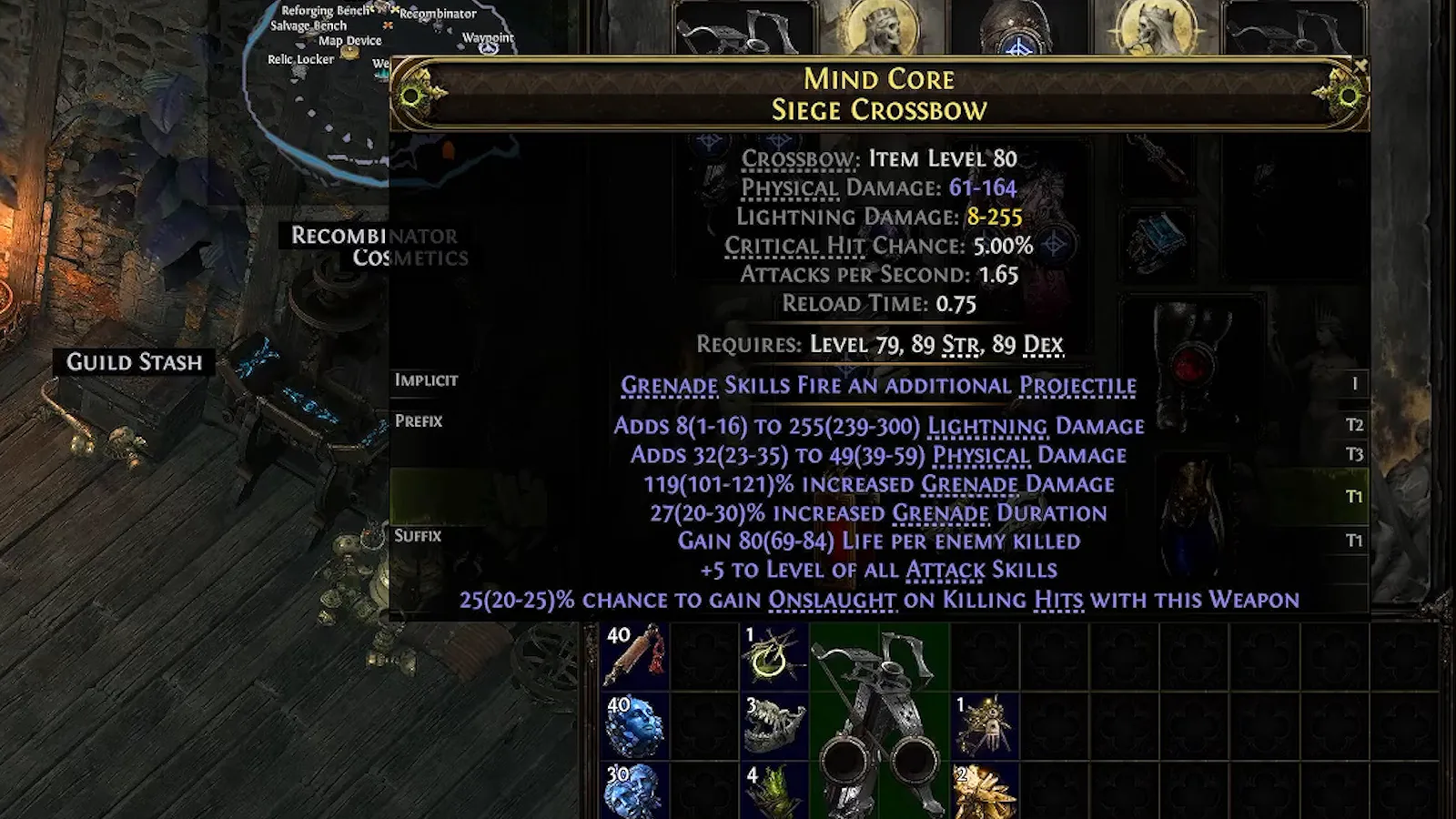
grind Lolcohol's worked example is a grenade crossbow, and the order of operations is the lesson:
- Base: a white Siege Crossbow at item level 80 or higher, so high tiers can roll.
- First prefix: Perfect Orb of Transmutation until it hits a good damage prefix (tier 2 flat lightning damage).
- Second prefix: Greater Essence of Abrasion upgrades it to rare with guaranteed flat physical damage.
- Third prefix: Preserved Jawbone with Omens active that force a prefix and an Amanamu modifier, revealed at the Well of Souls for increased grenade damage and duration.
- Fill the suffixes: Omen of Greater Exaltation plus a Perfect Exalted Orb adds two modifiers at once.
- Swap in the suffixes you want: Perfect Essences of Battle (plus levels to attack skills) and Haste (Onslaught on kill). Because the suffixes are full and the essences add suffixes, they can only remove a suffix, so the three prefixes are safe.
That last trick is the most useful idea in PoE2 crafting for beginners: finish one side, then fill the other, so anything that has to make room can only remove from the side you don't care about yet. Finish with quality from Blacksmith's Whetstones and augments in the sockets.
What to keep, spend or sell

free The rest of the currency tab is utility. Use these freely on your own gear:
| Currency | What it does |
|---|---|
| Blacksmith's Whetstone | Quality on a martial weapon |
| Arcanist's Etcher | Quality on a wand, staff or sceptre |
| Armourer's Scrap | Quality on armour |
| Gemcutter's Prism | Quality on a skill gem |
| Glassblower's Bauble | Quality on a flask |
| Artificer's Orb | Adds an augment socket to a martial weapon, wand, staff or armour |
| Lesser / Greater / Perfect Jeweller's Orb | Sets a skill gem to 3 / 4 / 5 support sockets |
| Orb of Chance | Turns a normal item into a random unique, or destroys it |
| Vaal Orb | Modifies an item unpredictably and corrupts it, so it can't be changed again |
A simple rule for a first character: spend Transmutation, Augmentation, Regal, Alchemy and quality currency on your own upgrades; keep Exalted, Chaos and Divine Orbs and sell Omens and spare Essences you won't use. Jeweller's Orbs for your main skill are the one valuable item worth spending early (see our PoE2 skill gems guide). To swap currencies or buy gear, read the PoE2 trade guide. Before a craft that costs real money, practise it for free in the Craft of Exile emulator.
Read next
- Path of Exile 2 beginner guide: league, gems, passive tree and the first act
- PoE2 body armour crafting guide: fracturing and endgame chest crafts
- PoE2 energy shield helmet crafting: a cheap practice craft and a high-end one
- PoE2 trade guide: pricing, trading and loot filters
- PoE2 endgame guide: Atlas, Waystones and where high item level bases drop
- Path of Exile 2 game hub for every guide on the game
How this guide was fact-checked
- Official patch notes (Steam news for PoE2): 0.5.0 added 13 Alloy currencies (unlocked through Remnant encounters after Farrow's quest in Act 2), disabled the Recombinator and removed the Omen of Recombination, made Fracturing Orbs need Atlas passive specialisation, split Vaal Infusers into four item types and added a Reforging Bench to the Trial of the Sekhemas. 0.5.4 added the Orbs of Sacrifice. The 1.0 announcement (7 November 2026) names the Conquerors of Wraeclast league and its new reforging material.
- In-game item text (as listed on PoE2DB): the effect of every orb, shard, bone and Omen named above, the Greater and Perfect minimum modifier levels (44 and 70 for Transmutation and Augmentation, 35 and 50 for Regal, Exalted and Chaos), Alchemy's four modifiers, the Jeweller's Orb socket counts and the bone item level limits. poe2wiki.net answered with a bot check, so it was not used.
- From the video's own screens: the Alt view with prefix and suffix labels and tiers, the rarity limits, the "already has a mod of this type" message, the Well of Souls reveal, the Divine Orb rerolls and every step of the crossbow craft.
- Corrections to the video: it was uploaded on 20 May 2026, just before 0.5.0. It calls Alloys a next-league feature; they arrived in 0.5.0. It mentions the Recombinator as a crafting system; 0.5.0 disabled it. The captions' "Omen of the Leech" is the Omen of the Liege.
- Attributed, not independently confirmed: the modifier weights and item level thresholds (82 for top physical damage on a crossbow, 80 for top body armour life) come from the third-party sites shown in the video, and the levels granted by the Perfect Essence of Battle are left out.
What this guide doesn't answer
- Prices: currency values change daily per league, so check the market rather than a fixed table.
- Fracturing, Alloys, Catalysts and Liquid Emotions: endgame or league systems, covered in the crafting guides linked above.
- Advanced mod blocking and meta-crafting: beyond a beginner guide; the body armour guide shows one example.
- Waystone and Tablet crafting: an endgame topic with its own rules.
- The 1.0 reforging material: not playable until 11 December 2026, and GGG hasn't published how it works yet.
Frequently asked
What does an Exalted Orb do in PoE2?
An Exalted Orb adds one new random modifier to a rare item that still has an open prefix or suffix slot. A rare item holds at most three prefixes and three suffixes, so a full item can't be exalted. Exalted Orbs are also the everyday trade currency, so spend them on items that are close to finished.
What is the difference between a Chaos Orb and a Divine Orb in PoE2?
A Chaos Orb removes one random modifier from a rare item and adds a new random one, so it changes which modifiers the item has. A Divine Orb keeps every modifier and only rerolls their numbers within each modifier's current tier range. Divine Orbs are rarer and are the high-value trade currency.
Can a Divine Orb upgrade a modifier to a higher tier?
No. A Divine Orb rerolls the numeric values of all modifiers inside their existing ranges, and the tier never changes. To get a higher tier you need to replace the modifier, for example with a Chaos Orb, an Orb of Annulment followed by an Exalted Orb, or a Perfect Essence.
Which currency should a PoE2 beginner spend and which should they keep?
Spend Orbs of Transmutation, Augmentation, Regal and Alchemy plus quality currency such as Blacksmith's Whetstones and Armourer's Scraps on your own gear while levelling. Keep Exalted, Chaos and Divine Orbs for trading or finished items, and sell Omens and Essences you won't use. Jeweller's Orbs for your main skill are worth spending early.
What do Greater and Perfect orbs do in Path of Exile 2?
They work like the normal orb but only roll modifiers at or above a minimum modifier level, removing weak low tiers. In 0.5 Greater and Perfect Transmutation and Augmentation use levels 44 and 70; Greater and Perfect Regal, Exalted and Chaos Orbs use 35 and 50. A tier 1 modifier below that level can still roll.
Read next
PoE2 Body Armour Crafting: ES, Evasion & Mana Chests
A step-by-step Path of Exile 2 body armour crafting guide: which item level 82 three-socket bases to buy, how to open and fracture them, the order of work around a fracture, blocking junk modifiers at the Well of Souls, and four finished chests worth 399 to 680 Divines.
PoE2 Energy Shield Helmet Crafting: Cheap to 600+ ES
A step-by-step Path of Exile 2 energy shield helmet crafting guide: which tiara base and item level to buy, a cheap practice method, the desecration and Mark of the Abyssal Lord tricks, Flux resistance fixes, and anointing Zarokh's Gift.
PoE2 Campaign Guide: Acts 1-4, Interludes and Boss Tips
An act-by-act Path of Exile 2 campaign guide for Acts 1-4 and the three Interludes: the bosses that kill new players, permanent quest rewards worth the detour, and when to swap gems and gear before maps.
PoE2 Trade Guide: Currency Exchange, Price Checks, Filters
How trading works in Path of Exile 2: the Currency Exchange, instant buyout through Merchant's Tabs and The Market, the official trade site and how to price check items without underselling. It also covers setting up a loot filter online and choosing a NeverSink strictness on FilterBlade.