
You will be able to build plagues efficiently, distinguish which Nurgle buildings use gold or infections, speed up unit recruitment with cycle rushing, and understand the new tech tree division. This overview covers every main mechanical change in the Nurgle campaign rework, making your early-game decisions smoother and your mid-game growth more effective.
Quick answer
| What | Answer |
|---|---|
| Plague creation | Choose three directly connected symptoms on the web |
| Plague modifiers | Infection can modify spread chance, duration, and immunity |
| Military building cost | 200 infections for basic military, 400 for advanced |
| Rush cycle cost | 50 infections basic, 100 advanced |
| Cycle time | 4 turns basic, 6 turns advanced |
| Recruitment | Units recruit instantly at low HP from the pool |
| Army ability targets | 5 enemies or 5 allied units |
Set up plagues from the symptom web
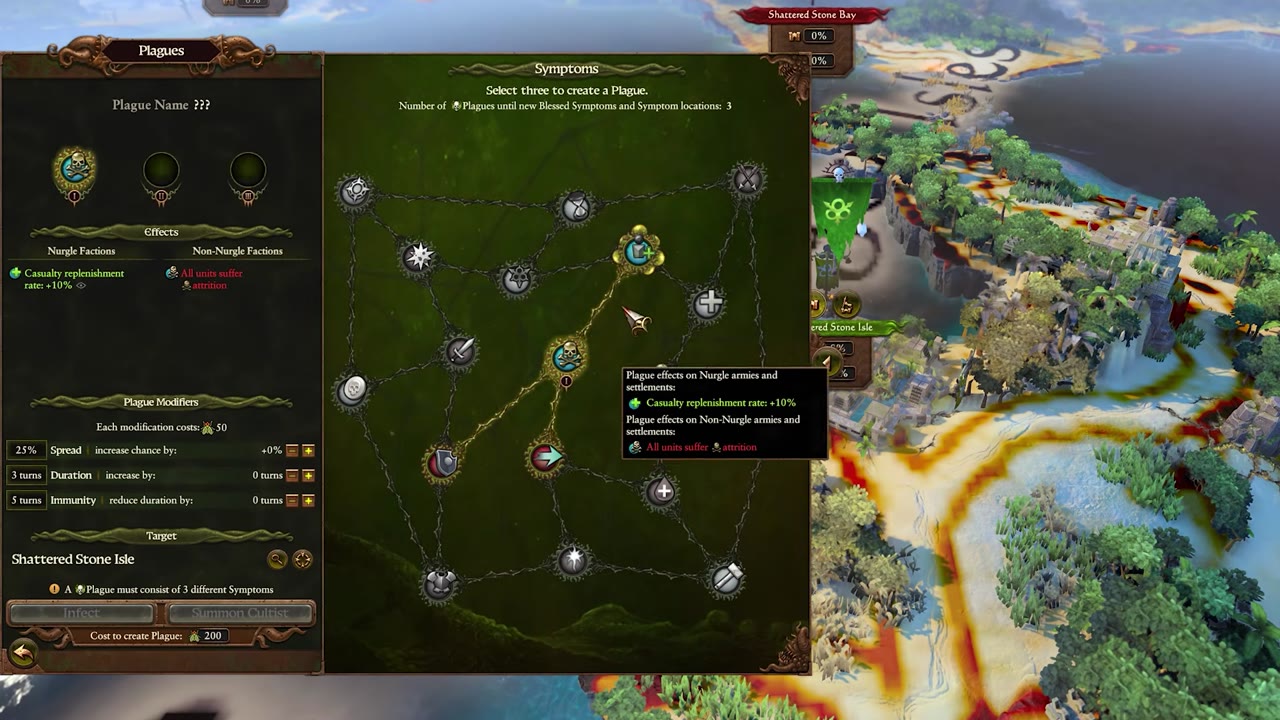
Plague creation now uses a web-based system rather than a fixed symptom list. Every playthrough generates the web differently, but the core mechanic remains: you pick three directly connected symptoms to build your plague. Initially, you start from a single node; as you use more symptoms, they become available as new starting points for later plagues.
Rarely, a symptom may become "blessed," giving it a stronger effect. This lasts for just one plague, after which it reverts to normal.
After your three picks, you can spend bonus infection resources to modify three aspects:
- Spread chance: increase how likely the plague passes to new targets
- Duration: add turns to how long the target suffers effects
- Immunity: set how long non-targets stay immune after the plague expires
Immunity especially matters—after one plague ends, its targets can't get another copy for the set duration. This prevents stacking plagues repeatedly on the same army or settlement.
Plagues can be cast on your own armies and territories, or spread with plague cultists. Cultists use a hero action to infect foreign targets. The cultist action now costs the same as infecting your own army or settlement, so infecting enemy armies is a practical option rather than hoping your plague spreads.


Build settlements without relying on cyclical economy buildings
Settlement construction for Nurgle is now divided cleanly between economy/infrastructure and military buildings. Economy and infrastructure buildings operate like standard buildings—pay gold for construction without any infection resource or cycle involvement. This shift removes the old frustrating rise-and-fall pattern from your income and makes early-game expansion more predictable.
Military buildings, however, remain cyclical and still use infection points for construction. Basic military buildings require 200 infections, while advanced military buildings cost more. The rework aims to make these prices manageable so you can keep expanding without draining your economy.

The advanced military building cost is not consistent everywhere. The game lists advanced military buildings at 600 infections—if you see 400, a patch may have changed it or the values may be outdated. Always check the cost before committing your infections.
Economy buildings now grow settlements and boost income steadily, letting you plan for gold expenses without cycle disruption. Upgrading military buildings—basic or advanced—now only consumes infections. This ensures you can build up your money-generating structures independently and push for unit unlocks with infections as you need them.
Use cycle rushing and settlement tiers to unlock units faster
Military buildings still follow the cycle system: progressing through stages unlocks new units for recruitment. You can accelerate a cycle (rush) or let it complete at its normal pace. Each cycle stage adds more units to the recruitment pool—the main way to expand armies.
Basic military cycles can be rushed for 50 infections, or take 4 turns per stage if left alone. Advanced military cycles cost 100 infections to rush, or 6 turns per stage by default.
However, not all stages unlock immediately. Basic military buildings need your settlement at size 3 to pass stage 4. Advanced military buildings require:
- Settlement size 3 to get past stage 2
- Settlement size 4 past stage 4
- Settlement size 5 past stage 6
This ties higher unit unlocks to settlement upgrades—so timing expansions and spending infections wisely is critical.

- 1:29
- Size 3 for basic, sizes 3–5 for advanced
Recruit units from the pool and heal them back up
Recruitment mechanics for Nurgle remain unique. You recruit units instantly from a pool, but they enter your army at low HP. To bring your new units up to fighting strength, spend a turn or two in your own territory to replenish their health. The "Pestilent Growth" unholy manifestation is useful here—activate it to restore recruited units' health much faster.
Recruitment cost and the initial HP of recruited units both benefit from high Nurgle corruption. Spreading corruption is now a direct economic upgrade—it cuts unit costs and reduces replenishment time, letting you get armies back in action much faster.
With replenishment skills or bonuses on your lords and heroes, your newly recruited armies may be ready to move in a single turn's rest in friendly territory, making Nurgle one of the fastest re-raising factions in the game.

Use the army ability on more targets
The Nurgle army ability preserves its three-tier format, each tier unlocked by the usual mechanics (often research or status effects in battle). Every tier affects up to five units, making its effects broad and flexible.
Here's the breakdown:
| Tier | Effect | Target Type | Max Targets |
|---|---|---|---|
| Speed/Charge | Reduces speed and charge | Enemy units | 5 |
| Healing | Restores HP over time | Allied units | 5 |
| Damage DoT | Damages via poison/rot | Enemy units | 5 |
The new display sits on the side of the screen and tracks the number of affected units, filling status bars as enemies are debuffed (especially by poison). Unlike before, triggering the bar is based on enemy units status, not your own losses.
Each tier activates via its required triggers—research or battlefield status effects.
Navigate the new split tech tree
Nurgle's tech tree is now split between Faction and Military sections for clearer navigation. The Faction branch covers non-battle improvements: growth, income, corruption, commandments, plague bonuses, and similar effects. Techs in this branch cost infections but generally offer steady campaign-wide upgrades.
Military techs focus entirely on battle readiness. Units and characters are split into infantry, small monsters, and large monsters, with further subdivisions (for example, demonic vs. non-demonic infantry). Upgrades cover stats and combat capabilities.
Each technology has an infection cost, so you must balance spending between settlement upgrades, plague creation, and tech almost every turn. The tree uses a traditional branching layout, with easy navigation—no endless scrolling for late-game tech.

Also worth knowing
- Economy buildings now being non-cycle fixes early-game difficulty. You can build stable gold income and growth infrastructure without the old unpredictable cycle, making the early Nurgle campaign much easier to manage.
- Manifestations and cult buildings were not changed in the rework. Some older frustrations—such as the limitations of cult buildings or unholy manifestations—are still present.
- The old symptom icons are gone. While the new web system is more flexible, some players miss the unique visuals of the original disease symptoms.
- Four-turn cycles can still feel slow. If you want the recruitment pool to refresh more quickly, there’s no way around the four-turn minimum for basic cycles—plan infections and settlements accordingly.
- Kugath remains less distinctive than other Nurgle lords. The mechanical changes haven’t made Kugath’s bonuses or playstyle clearer, so players wanting more special features for him may still be left wanting.
Frequently asked
Do Nurgle economy buildings still cycle?
No. Economy and infrastructure buildings are now normal buildings with standard gold costs instead of being tied to the cycle. That makes early settlement development steadier and removes the constant rise-and-drop pattern from the economy side.
How do Nurgle plagues work now?
Plagues are built from three symptoms chosen from a web of connected symptoms. After that, extra infections can be spent to change spread chance, duration, and immunity turns. Some symptoms can also become blessed for one plague before returning to normal.
Can Nurgle recruit faster than before?
Yes. Units are recruited from a pool and arrive instantly at low health, and higher corruption raises the starting health and lowers the recruitment cost. With replenishment bonuses, armies can be ready again very quickly.
What changed in the Nurgle tech tree?
The tech tree is split into faction and military sections. The faction side covers non-battle bonuses like growth, corruption, income, commandments, and plagues, while the military side focuses on unit and character buffs split by infantry, large monsters, and small monsters.
Read next
Total War: Warhammer 3 Nurgle Guide: Plagues, Recruitment and the Cycle of Decay
This plan covers Nurgle’s campaign mechanics, corruption economy, plague crafting, and the three playable Nurgle factions. It is aimed at players who want a practical overview of how to start, expand, and use each faction’s unique strengths.
Total War: Warhammer 3 High Elves Guide: Patronage, Influence and the Intrigue Game
This plan covers the shared High Elf mechanics in Immortal Empires and how each legendary lord changes the campaign plan. It is for players who want to choose a lord, understand the faction systems, and know what to prioritize early.
Total War: Warhammer 3 Lizardmen Guide: Geomantic Web, Rites and Blessed Spawnings
A practical early-to-late campaign plan for Kroq-Gar and the Last Defenders, focused on surviving the opening wars, building efficient armies, and scaling into a Stegadon-heavy late game. It is for players who want a clear path through the faction’s early economy, unit choices, heroes, and research priorities.
Total War: Warhammer 3 Chaos Dwarfs Guide: Labour, Outpost vs Factory and the Hellforge
A practical plan for starting and scaling a Chaos Dwarf campaign, with early targets, economy priorities, army roles, and expansion tools. It is for players who want a clearer first pass through the faction’s systems and a stronger opening campaign.