
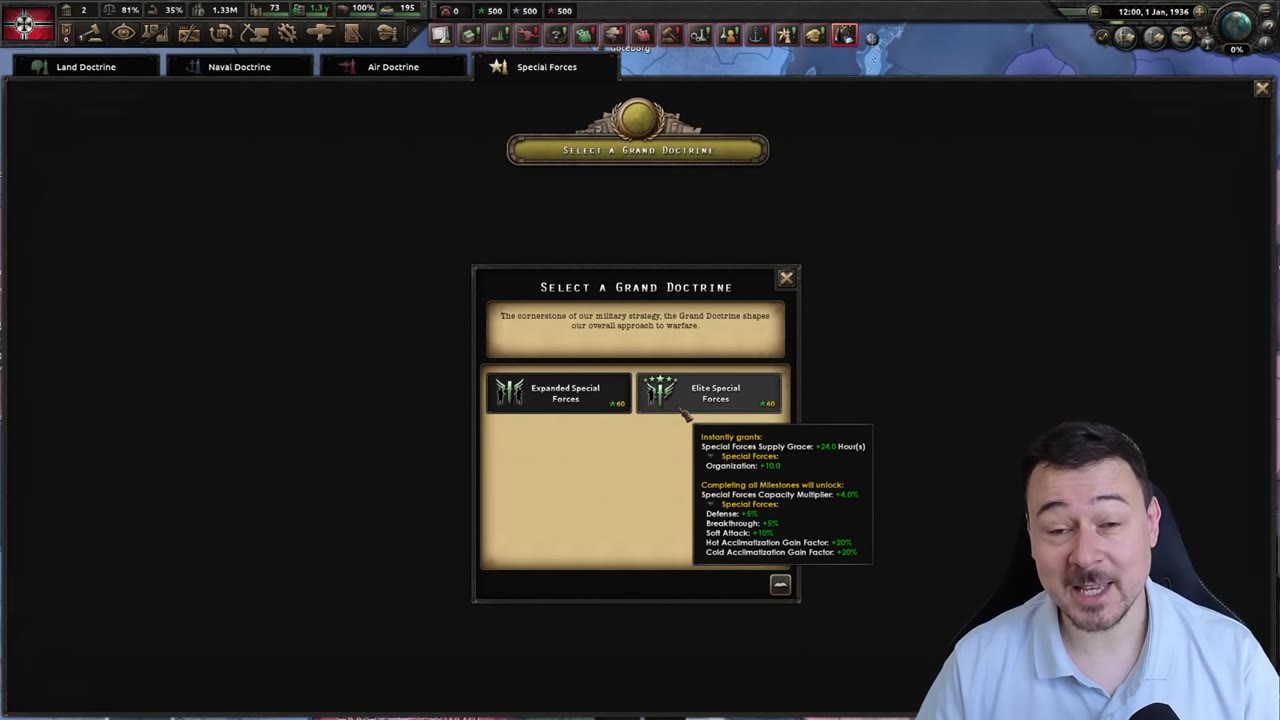
Special forces now run on one grand doctrine plus a sub-doctrine for each special forces type you commit to, and the branches are nowhere near equal in value. This guide ranks every option, gives the numbers each one actually grants, and sets out the three picks that cover almost any campaign. You will also know which perks you can realistically unlock before the war ends, which is what decides most of these choices.
Quick answer
| What | Answer |
|---|---|
| Best grand doctrine | Elite Special Forces |
| Best sub-doctrine | Cold Weather Specialists, under mountaineers |
| Second sub-doctrine | Expeditionary Units, under marines |
| Best paratrooper pick | Concentrated Drops |
| Elite opening bonus | 24-hour supply grace and +10 organization, immediately |
| Combat width reduction | Cold Weather Specialists only |
| Cap contribution | -50% after three Cold Weather Specialists perks |
| Weakest marine pick | Marine Commandos |
Choose Elite Special Forces as your grand doctrine
The grand doctrine is a single choice made once, and it decides whether you get more special forces or better ones. Elite gives you better ones, and it gives them to you on the spot.

| Compared on | Elite Special Forces | Expanded Special Forces |
|---|---|---|
| Granted on selection | 24-hour supply grace, +10 organization | +4% special forces capacity multiplier |
| Second grant | — | Special forces division training time -20% |
| Milestone rewards | +10% soft attack, +5% breakthrough, plus a capacity multiplier | +5% soft attack, +5 organization |
| Pays off when | you want divisions that win fights | you want a large raw division count |
The +10 organization 1:55 is the strongest single line on that table. Regimental companies give you more to bolt onto a template, and most of what you bolt on lowers organization, so a higher starting figure buys you room to build the template you wanted rather than the one your org budget allowed.

Expanded's opening 4% capacity multiplier reads better than it plays. As a minor country, 4% of a small cap is often zero extra divisions until very late in a run. As a major, you rarely have a shortage of special forces slots to begin with, so the multiplier solves a problem you do not have. Its second grant, -20% special forces division training time, changes nothing about how the divisions perform.

Expanded is worth it in one case: when the plan is genuinely built on volume and you are not reducing cap contribution instead. A communist China run on that path reached a special forces cap of 270 3:51. Outside that, take Elite.
Follow the recommended doctrine order
Three picks cover almost every campaign, with two substitutions for specific army builds.
- better divisions, immediately
- soft attack, org and combat width 14:58
- naval invasion bonuses apply army-wide
- replaces Cold Weather Specialists 15:27
- replaces Expeditionary Units
- the second rarely lands in time
You only get two sub-doctrines. Every type you commit to is a type whose mastery you have to fill, and mastery is slow — spreading across mountaineers, marines, paratroopers and rangers leaves you with the opening perk on all of them and the good perks on none.
Pick between the two mountaineer sub-doctrines
Cold Weather Specialists is the best sub-doctrine in the system, not only the best mountaineer one, and the snow theming undersells it badly. What matters is the stat block, not the terrain on the label.
| Compared on | Cold Weather Specialists | Elevate the Mountaineers |
|---|---|---|
| Combat width | -0.2 on mountaineers, the only such perk anywhere in special forces | none |
| Soft attack | +15% on mountaineers (5% all special forces, 10% mountaineers) | +20% on line artillery when Recon Rangers are used |
| Organization | +15 | — |
| Cap contribution | -50% after three perks | -25% from the branch opener |
| Terrain | snow | mountains |
| When the payoff arrives | first perks | late perks |

The cap perk is the one people miss. Every branch grants -25% cap contribution for its unit type at the start; Cold Weather Specialists grants a second -25% on its second perk 5:48. Three perks in, your mountaineers cost half what they should against the cap, which is how you field a real mountaineer army on Elite without any capacity multiplier at all.

Elevate the Mountaineers is not a bad branch, it is a specific one. Take it when your divisions run line artillery: it is the path that pays extra breakthrough from support artillery and +20% soft attack on line artillery through Recon Rangers, and that bonus applies to plain infantry carrying Recon Rangers too. Against that, its unit design cost perk lands after three perks, by which point your templates are designed and the discount is dead money.

If you go that way, build a 15-width mountaineer template — 15 takes the lowest terrain penalties in the game — and add support artillery, Recon Rangers and a couple of infantry guns 7:15. It is a cheap template that reaches respectable soft attack without a tank line.
Pick between the two marine sub-doctrines
Expeditionary Units wins on its first perk alone, and it is worth a slot even in a campaign where you never build a marine division.
| Compared on | Expeditionary Units | Marine Commandos |
|---|---|---|
| First perk cost | 60 army XP, 60 navy XP, 60 mastery | branch opener |
| First perk grants | +2 division capacity per naval invasion, +1 invasion plan, -5 naval invasion prep time, -25% marine cap contribution | jungle bonuses for pioneers, -25% marine cap contribution |
| Cap contribution total | -50%, reached early | -50%, reached at full mastery |
| Later perks | supply grace, soft attack, organization, air superiority, shore bombardment, invasion planning, +10% special forces attack | +2 invasion plans, extra breakthrough, amphibious armour bonuses, landing without a harbour |
| Who benefits | the whole army | marine divisions only |

The naval invasion bonuses are army-wide, not marine-only 9:39. More divisions per invasion, an extra plan and five days off the preparation timer change how every landing you ever run behaves, whatever is loaded onto the transports. That is why this branch is the default second pick.

Marine Commandos front-loads two narrow things — jungle bonuses on pioneers, and marines that can land and leave coastal provinces without a harbour — and back-loads everything worth having. Its two extra invasion plans and its breakthrough perk are genuinely strong, and they sit at the end of a branch you will probably not finish.
Pick between the two paratrooper sub-doctrines
Sabotage Parties has the better stat line and Concentrated Drops has the better perks, because paratroopers are not a unit you win fights with.
| Compared on | Concentrated Drops | Sabotage Parties |
|---|---|---|
| Second -25% cap contribution | immediately after the first | on the final perk of the branch |
| Signature effect | drops reduce the organization of every enemy division in the target state | drops damage military factories, civilian factories and infrastructure |
| Peak soft attack | lower | +20% at full mastery, the highest of any special forces branch |
| Early supply | — | extra paratrooper supply grace right away |
| Best for | taking the ground you dropped on | punishing an enemy economy |

Paratroopers are used to snipe victory points or seize a harbour so the real army can land 11:35. A branch that improves the drop is worth more to that job than a branch that improves the fight afterwards, and the +20% soft attack at the far end of Sabotage Parties assumes a full mastery bar you are unlikely to fill.
The cap timing settles it on its own. Concentrated Drops reaches -50% paratrooper cap contribution almost immediately; Sabotage Parties reaches it on the last perk. Paratroopers eating your special forces cap is the usual reason a paratrooper plan quietly dies, and only one of these branches fixes it in time to matter.
Pick between the two ranger sub-doctrines
This is the closest pair in the system, which is also the problem — neither branch pulls far enough ahead to justify spending a slot on rangers instead of mountaineers.
| Compared on | Jaeger Traditions (forest) | Jungle Training |
|---|---|---|
| Opening terrain | forest, common on most fronts | jungle, rare and usually avoidable |
| Early perks | cap contribution, soft attack, organization | jungle bonuses, then forest bonuses, soft attack, defense, organization |
| Support artillery and Recon Rangers | breakthrough | — |
| Supply | — | supply use -0.03, the lowest of any special forces, and +36h supply grace |
| Other standouts | strong urban bonus; final perk gives breakthrough, soft attack and organization together | +10% special forces attack, on the very last perk |

Take the forest branch by default. Forests turn up on nearly every front; jungles turn up on a few and can usually be walked around. Note that where the mountaineer equivalent pays soft attack on its support artillery and Recon Rangers perks, this branch pays breakthrough — useful, but less so on units you are mostly attacking infantry with.

Jungle Training's supply numbers are real and worth having on a long push into bad terrain. Discount the supply grace slightly if you took Elite Special Forces, since you already hold 24 hours of it 13:32; the -0.03 supply use stands on its own.
The wider question is whether rangers earn the slot. Even in a jungle theatre there are mountains and hills on the same map, and mountaineers tested better across that mix 14:29. Rangers are a specialist answer to a front that is genuinely forest end to end.
Keep your special forces cap under control
Elite Special Forces gives you no capacity multiplier when you pick it, so the size of your special forces army comes from the other side of the equation: making each division count less against the cap.
Every sub-doctrine opens with -25% special forces cap contribution for its own unit type. The branch then decides when — or whether — you get the second one.
| Branch | Reaches -50% cap contribution |
|---|---|
| Cold Weather Specialists | third perk |
| Expeditionary Units | first perk |
| Concentrated Drops | immediately after the opener |
| Sabotage Parties | final perk of the branch |
Three of the four recommended branches halve their unit's cap cost early, and that stacking is what makes Elite viable for a large army rather than a handful of elite divisions. Expanded's 4% multiplier at the start and another 4% after all milestones is a smaller effect than a doubled cap reduction on the units you actually build.
Cap reduction only applies to the unit type its branch covers. Two sub-doctrines means two discounted types — a third type of special forces pays full price against the cap no matter how many doctrines you have taken.
Plan around slower mastery and the second milestone
Mastery accumulates more slowly than it did before the rework, and that single change reorders the whole ranking. A perk at the end of a branch is worth what you can realistically reach, not what the tooltip says.
The second milestone requires completely filling mastery for two different special forces types. Treat it as out of reach and plan for the first one 3:23. On Elite that is not a consolation prize: the first milestone gives a capacity multiplier plus breakthrough and soft attack, all of which apply to divisions you already have in the field.
This is the reason Cold Weather Specialists, Expeditionary Units and Concentrated Drops rank where they do. Each puts its cap reduction and its combat stats in the first two or three perks. Branches judged on their finished tree — Sabotage Parties' +20% soft attack, Marine Commandos' invasion plans — score well on paper and deliver nothing in the campaign where you actually needed them.
Also worth knowing
- Mountaineers plus rangers turns Recon Rangers into a terrain engine. Both branches load bonuses onto that support company, and any division can carry it — a cheap way to get terrain performance in a country that cannot afford the facility investment behind flame tanks or helicopters.
- Concentrated Drops also cuts the transport plane space factor. Fewer transport planes per drop means the first drop happens sooner, which matters more than the stat sheet suggests when you are racing a front line.
- The first milestone can land much earlier than expected. Three 20-width mountain divisions filled it for Germany before the Spanish Civil War ended, and countries with a lot of mountaineer capacity — historical Poland can run around 20 mountain divisions — fill it faster still.
- Cap reduction plus the Tip of the Spear army spirit removes the case for Expanded entirely. Stack both and the capacity multiplier is solving a problem you no longer have.
- The combat width perk is only -0.2. It is still the only one in the system, but it is a thin edge, not a transformation — take Cold Weather Specialists for the soft attack, organization and cap reduction, and treat the width as a bonus.
- Some countries make rangers genuinely correct. Finland and a French line holding the early German push are forest fronts end to end, and rangers outperform there.
- Paratrooper cap reduction stacks with focus trees. In Kaiserreich, Russia can pair -50% paratrooper cap contribution from its focus tree with -50% from masteries, at which point paratroopers can stand in for regular infantry.
- Sabotage Parties has an exploit-adjacent use. Drop a single paratrooper division onto an enemy tile and halt the attack order, and you force a defensive battle on their soil. Single-battalion drops and throwaway marine landings also pull AI divisions off other fronts and cost them their entrenchment.
Continuous exercise and recon support companies are reported to generate mastery as well, slowly, but the rate has not been pinned down — do not build a doctrine plan around it until it has.
Frequently asked
Do I need Thunder At Our Gates for the new special forces doctrines?
The special forces doctrine rework arrived in the large free patch released alongside Thunder At Our Gates, so the system itself is part of the base game update. Players running with no DLC at all have reported the new doctrine branches showing as unavailable, so if the tree does not appear, check your DLC and game version before anything else.
Is the second special forces milestone worth going for?
Usually not. The second milestone requires filling mastery on two different special forces types, and mastery now accumulates more slowly than it did before the rework, so a second completion rarely lands in a useful timeframe. Plan around the first milestone and treat anything beyond it as a bonus. On Elite Special Forces the first milestone alone gives a capacity multiplier plus breakthrough and soft attack, which is the part worth chasing.
Should I take mountaineers or rangers?
Mountaineers, in almost every campaign. Mountains and hills turn up on nearly every front, while jungles are rare and easily avoided, so ranger terrain bonuses go unused far more often. Rangers still have a place on forest-heavy fronts, such as Finland or a French defensive line, but they struggle to justify the doctrine slot against mountaineers.
Which special forces use the least supply?
Rangers on the Jungle Training branch. That branch cuts supply use by 0.03, the lowest of any special forces type, and adds 36 hours of special forces supply grace. The supply grace overlaps with the 24 hours that Elite Special Forces already grants, so the saving is smaller than it looks if you took Elite as your grand doctrine.
Can special forces doctrines buff my regular infantry?
Yes, in two ways. The Recon Rangers support company picks up terrain bonuses from both the mountaineer and ranger branches, so stacking those doctrines loads a cheap support company that any division can carry, which suits countries that cannot afford flame tanks or helicopters. Separately, the naval invasion bonuses on Expeditionary Units apply to your whole army, so the branch is worth taking even if you never build a marine division.
Read next
HOI4 Meta Division Templates and Tank Designs
The division templates that competitive Hearts of Iron IV play settles on under the regimental support system, with exact battalion counts, regimental and support company slots for line-holder infantry, infantry bricks, shield infantry, marines, SPGs and heavy tank destroyers. It also covers the tank module layouts those divisions rely on, for players who can already open the division designer and want the compositions rather than an explanation of it.
HOI4 HQ Support Companies: The Best Army HQ Setup
Army headquarters give a general's whole army a set of commander bonuses, and only four support slots decide which ones. This guide ranks every HQ support company, names the three that belong in almost every HQ, and shows the proximity setting that keeps a general from being captured.
HOI4 Regimental Support Companies, HQs and Special Forces Doctrine
A new update puts a regimental support company slot into division templates, adds deployable army headquarters with their own support staff, and collapses the special forces doctrine branches into single paths. Covers which support company to slot for each air situation, how to build and position an HQ, and which doctrines and XP upgrades are worth taking, for players who already design their own divisions.
HOI4 Division Templates After the Thunder Rework
Concrete division templates and tank designs for the reworked division designer: how wide to build, which support companies to fit and in what order, and what to put in a tank, a garrison and an army HQ. Written for players who already know the division designer and want current numbers rather than an explanation of the interface.