
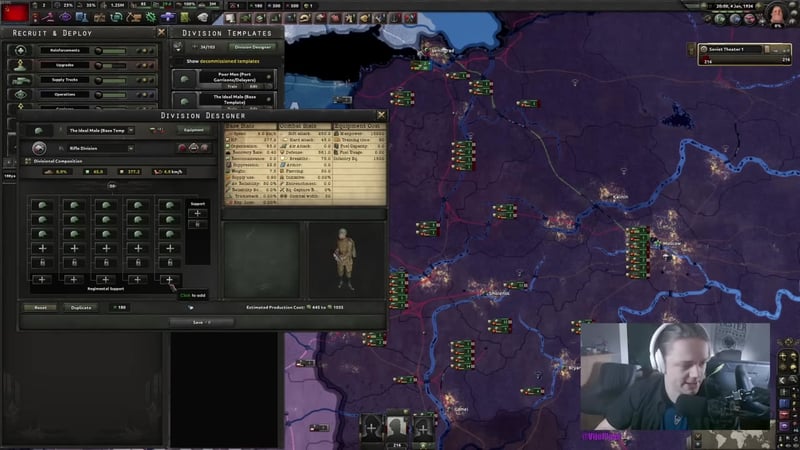
Price a Hearts of Iron IV division before you build it: production units, manpower and combat width for every common template, from a budget line holder to a medium armor core. Each formation gets an S to C rating tied to one job, so you can match the army to the factories you actually have.
Quick answer
| What | Answer |
|---|---|
| Line holder | Nine battalions: 900 rifles, 9,000 manpower |
| Support cost | +263 production units (125 engineers, 42 artillery, 96 anti-air) |
| Armor core | Six tank and nine motorized battalions, width 30 |
| Terrain widths | 60 forest, 50 mountains, 70 plains and hills, 80 urban |
| Training time | Infantry and motorized 90, mechanized 120 |
Give every division one job before adding battalions
Before you open the division designer, write the template's job as one sentence: hold this river, break this part of the front, or follow the tanks and secure the supply route 2:58. If you cannot finish that sentence, another battalion is not the next thing to buy. Giving the divisions you already have a better-suited task is often the cheaper fix.
The job decides which stats matter. Organization and hit points are two different kinds of staying power, and the battalions you add move them in different directions. A basic infantry battalion brings 60 base organization and 25 hit points; a line artillery battalion brings 0 organization and 1.6 hit points 3:26. That does not make artillery bad. Adding firepower and thinning out the infantry foundation are separate decisions with separate consequences.
Defense is the protective stat while a division defends; breakthrough does that job while it attacks 4:24. A division with strong defense and little breakthrough holds comfortably and stalls the moment you order it forward. The hit rules show why concentrated attack matters: attacks a division still has defense against have a 90% base avoidance chance, and attacks it has no defense left for have 60%. Those are rule inputs, not a prediction of battle damage.
Hardness and armor come from the same vehicles but are separate mechanics. Hardness shifts how much of an enemy's soft attack versus hard attack lands on you. Armor asks whether the enemy can pierce you at all. Compare division-level values against the enemy you actually face, not one tank design against one gun tooltip.
When an attack stalls, work down this list before buying anything 17:21:
- Equipment strength. An under-equipped division fails whatever its template says.
- Supply, and fuel where the division uses it.
- Terrain and the direction of attack.
- The enemy's hardness, armor and air support.
Only after that decide between more firepower, a different specialist, a better-supported operation, or a route around the position.
Match division width to the terrain
Combat width is the space a division takes up in a battle. Each terrain type sets a base width, and every additional attacking direction widens it 6:49.

| Terrain | Base width | Clean fit |
|---|---|---|
| Forest | 60 | Two 30-width divisions |
| Mountains | 50 | Two 25-width divisions |
| Plains and hills | 70 | Plus extra attacking directions |
| Urban | 80 | Plus extra attacking directions |
The templates priced on this page come out at these widths:
| Formation | Width |
|---|---|
| Nine infantry, with or without support companies | 18 |
| Nine mountaineers | 18 |
| Supported nine infantry plus one line artillery | 21 |
| Supported eight infantry plus three line artillery | 25 |
| Six medium tank plus nine motorized | 30 |
Pick the terrain and role you expect first, then check that the resulting division is affordable and works 7:17. A neat width does not make up for missing equipment or a poor attack plan, and rebuilding a whole army to make one number tidy wastes factories you need elsewhere.
Price a line holder and its support companies
All prices here assume first-level rifles at half a production unit each, with no national, design or industrial-organization modifiers. Six infantry battalions need 600 rifles and 6,000 manpower and cost 300 production units: a smaller division for quiet ground or a very tight equipment budget. Nine battalions need 900 rifles and 9,000 manpower and cost 450 8:45.
The three usual support companies on top of a nine-infantry core:
| Support company | Equipment | Production units |
|---|---|---|
| Engineers | 10 extra rifles, 30 support equipment | 125 |
| Support artillery | 12 artillery pieces | 42 |
| Support anti-air | Anti-air guns | 96 |
| All three | 263 |

How the holding and assault variants compare:
| Template | Production units | Manpower | Width |
|---|---|---|---|
| Nine infantry | 450 | 9,000 | 18 |
| Nine infantry + engineers, support artillery, support anti-air | 713 | 9,900 | 18 |
| The above + one line artillery battalion | 797 | 10,400 | 21 |
| Eight infantry + three line artillery + the same support | 915 | 10,400 | 25 |
Adding one line artillery battalion to the supported division costs 24 artillery pieces, 500 manpower and three width 12:37. It takes line space, needs replacement guns when it takes losses, and changes the division's organization and supply demand. It is not a support company with a bigger picture.
The eight-infantry, three-artillery version is for a limited, deliberate offensive where you cannot afford armor 15:56. Replacing its artillery and manpower losses is part of its price, so pick the battle carefully. If the first attempt turns into a grind, stop and rethink the operation instead of issuing another attack order.
A single support company looks cheap in the designer. Across 24 divisions, plain nine-infantry cores total 10,800 production units and the supported version totals 17,112: an extra 6,312. The engineers alone need 720 support equipment and 240 extra rifles, and the anti-air needs 576 guns. Changing every template during a shortage leaves the whole army under-equipped.
Keep basic holding divisions on quiet sectors and give the heavier package only to ground under real pressure 12:07. Where there is no meaningful enemy air threat, the anti-air company is the first one to cut.
Choose regimental and support companies by cost
A regimental support slot opens only when a column holds three battalions, and a template has up to five columns 13:34. How you arrange the battalions therefore decides which regimental choices you get. Divisional support companies use their own separate slots.
| Company | Slot | Equipment | Production units |
|---|---|---|---|
| Infantry gun company | Regimental | 6 artillery pieces | 21 |
| Heavy weapons company | Regimental | 30 rifles, 5 support equipment | 35 |
| Motorized heavy weapons company | Regimental | 30 rifles, 5 support equipment, 5 trucks | 47.5 |
| Support artillery | Divisional | 12 artillery pieces | 42 |
| Logistics company | Divisional | 20 support equipment, 10 trucks | 105 |
| Maintenance company | Divisional | 25 support equipment | 100 |
| Field hospital | Divisional | 30 support equipment, 20 trucks | 170 |
| Signals company | Divisional | 20 support equipment, 10 trucks | 105 |
These prices leave out manpower and the research each company needs 29:43. Infantry guns and support artillery use the same artillery equipment, but two infantry gun companies do not reproduce one support artillery company: organization, supply demand and stat adjustments all differ 15:00.
To choose, duplicate the template, add the company, and compare the finished divisions under the same technology and doctrine. Logistics earns its slot where cutting supply demand matters, mostly for expensive forces in crowded areas. Maintenance earns it where recovering valuable equipment justifies the cost. An empty slot is not a reason to fill it.
Cost out medium, motorized and mechanized formations
A useful starting point for armor is six medium tank battalions plus nine motorized infantry battalions, 30 width at base 18:18. It needs 300 medium tanks, 900 rifles, 315 trucks and 13,800 manpower before any support companies.

Tank price depends entirely on your design. At an illustrative 12 production units per tank, the 300 tanks cost 3,600 and the whole core costs 4,837.5 19:44. Every three production units you add to the tank design adds 900 to that bill, so a better tank can mean fewer complete divisions on the day the war starts.
| Core (before support) | Equipment | Production units |
|---|---|---|
| Nine infantry | 900 rifles | 450 |
| Nine motorized infantry | 900 rifles, 315 trucks | 1,237.5 |
| Nine mechanized infantry | 900 rifles, 360 mechanized vehicles at 8 each | 3,330 |
| Six medium tank + nine motorized | 300 medium tanks at 12 each, 900 rifles, 315 trucks | 4,837.5 |
Tank battalions do not all hold the same number of vehicles: 60 light tanks, 50 medium tanks or 40 heavy tanks 21:37. Compare battalion prices, not single-vehicle prices.
Motorized infantry buys mobility, not a better line holder 22:03. A motorized division parked on a quiet front for the whole campaign is mobility you paid for and never used, and it still needs fuel and replacement trucks. Mechanized infantry adds protection and combat value at a much larger equipment bill 23:00.
Light tanks already in your stockpile can still fill a supporting role, so do not scrap them just because medium tanks exist. When you upgrade a mobile force, do it in stages: make a separate template, build up its equipment, and convert selected divisions without stripping the rest of the army.
Spend specialist capacity only on a planned operation
Special forces capacity caps how many specialist troops your country can field, and it is part of every specialist's price 24:26. Spend it on a campaign where it changes the outcome.
| Specialist | Per battalion | Nine-battalion core, before support | Extra requirement |
|---|---|---|---|
| Ordinary infantry (for reference) | 50 production units | 450 production units, 18 width | — |
| Mountaineers | 140 rifles, 1,000 manpower, 70 production units | 630 production units, 18 width | Mountain fighting that ordinary infantry cannot handle |
| Marines | 150 rifles, 1,000 manpower | 1,350 rifles, 675 production units (225 more than infantry) | A port or supply source and follow-up divisions |
| Paratroopers | — | 9,000 manpower, 585 production units | Transport aircraft, aircraft research, air support, suitable air conditions |
Mountaineers carry mountain and hill bonuses, but adding unsuitable battalions and heavy extras can dilute them. Check the terrain tooltips on the finished division rather than trusting the name.
A marine landing that wins the first province and is then cut off is an expensive failure. Before building marines, know which port or supply source will feed them and which divisions follow them in. Paratroopers need a target worth taking and a way to relieve them after they land; their modest equipment bill hides the transport fleet behind it.
Research paratroopers around an actual operation 26:50, not first in the hope of finding a use for them later.
Schedule research, factories and training
Production cost is not calendar time. Work backward from the date the operation needs to start, and use these base values to see which stage is slowest.
| Stage | Base value, before modifiers |
|---|---|
| Research | 110 days per research cost unit |
| 1936 infantry equipment (cost one and a half units) | 165 days |
| 1939 improved infantry equipment | 220 days |
| 1939 artillery equipment | 110 days |
| Marine or paratrooper research | 220 days each |
| Military factory output | 3.5 production units per day |
| Training: infantry and motorized | 90 |
| Training: mechanized and many supports | 120 |
| Training: paratroopers | 150 |
| Training: medium tank battalions | 180 |
At 50% efficiency and no other modifier, one factory supplies 1.75 production units a day and five supply 8.75 33:03. At that steady rate, 900 first-level rifles costing 450 take about 51.4 days, and three factories turn out 12 artillery pieces in 8 days. Training values are unit definitions, not calendar days for a whole division, so do not add them up across battalions.
- 110 days per cost unit · 31:38
- rifle factories cannot fill an anti-air shortage
- 3.5 per factory per day at base
- infantry 90, mechanized 120, medium tanks 180 · 34:01
- a design that arrives after the decisive battle solves nothing
Scale the army to your industry
Before converting any part of the army, duplicate the template, price the conversion, and read the equipment deficit 35:28. A limited conversion gives you a complete improved force sooner than a universal change that leaves every division half-equipped.
Limited industry
- 36:27
- deploying every rifle leaves no margin for the first losses
- an infantry assault group, or mountaineers where mountains are the obstacle
Choose achievable objectives and avoid full-front attacks. Preparation, terrain and supporting forces make a small offensive budget count.
Strong industry
- 37:23
- not just the initial equipment list · 37:52
- if armor cannot reach the front with fuel, another tank battalion is not the fix
If the breakthrough succeeds but the gap collapses behind it, improve the follow-up and holding divisions rather than the tanks.
Tier ratings for every formation
Each letter applies only under the condition beside it. S is an exceptional fit for a stated specialist job, A a strong practical choice, B useful with real compromises, and C needs a narrow reason or a bigger budget 1:31.

| Tier | Formation | Condition |
|---|---|---|
| S | Mountaineers | Mountain fighting the campaign cannot avoid |
| S | Marines | A contested amphibious job |
| A | Six or nine infantry | Budget line holding, matched to the frontage and threat 39:37 |
| A | Supported nine infantry | Holding where engineers, artillery and anti-air justify their bill |
| A | Medium armor + motorized | A concentrated breakthrough with fuel, supply and replacements 40:42 |
| A | Motorized infantry | Exploitation and mobile support |
| A | Mechanized improvement | A valuable mobile role your industry can equip and replace |
| A | Cavalry | Low-cost occupation duty |
| B | Supported nine infantry + one line artillery | General-purpose compromise |
| B | Eight infantry + three line artillery | A limited assault |
| B | Paratroopers | A planned airborne opportunity |
| C | Tiny guard division | A seriously contested port |
| C | Broad mechanization | During serious equipment shortages |
| C | New heavy armor formations | A budget general-purpose army |
The same technology can earn two letters. Mechanization is A for a well-equipped mobile force and C as a blanket conversion for an army that cannot supply its basics. Occupation duty and port defense are separate jobs, even though both get called garrisons: cavalry is rated for the first, the tiny guard for the second.
Frequently asked
How much does a nine-battalion infantry division cost in HOI4?
Nine infantry battalions need 900 rifles and 9,000 manpower. With first-level rifles at half a production unit each, the core costs 450 production units before any support companies. Adding engineers, support artillery and support anti-air raises the total to 713 production units and 9,900 manpower.
Is it worth adding engineers, artillery and anti-air to every infantry division?
Usually not. The three companies add 263 production units to each division, and across 24 divisions that is 6,312 extra production units. Equip them on the divisions facing real pressure, and skip anti-air where there is no meaningful enemy air threat.
Why can a division that defends well struggle when it attacks?
Defense is the protective statistic when a division is defending, while breakthrough serves that purpose when it is attacking. A formation with strong defense but little breakthrough can hold ground comfortably and still stall when ordered to push. Check the combat panel before deciding what to buy.
Read next
HOI4 Tank Designs and Templates 2026
This plan covers tank technology priorities, practical tank variants, and the division templates they fit into. It is for players who want a clear path from research and design choices to usable armored divisions.
HOI4 Meta Division Templates and Tank Designs
The division templates, tank designs, air designs and ship designs that work best after the Thunder at Our Gates update and its Regimental Companies, in both the open beta and the live version. It is for players who want a short list of builds to copy instead of testing every combination.
HOI4 Special Forces Doctrines: Every Branch Ranked
The Thunder At Our Gates patch replaced the special forces doctrine system with one grand doctrine choice and a pair of sub-doctrines for each special forces type, and the branches are nowhere near equal. This guide ranks every option, gives the numbers behind each pick, and sets out the path to take for a standard special forces army.
HOI4 HQ Support Companies: The Best Army HQ Setup
Army headquarters give a general's whole army a set of commander bonuses, and only four support slots decide which ones. This guide ranks every HQ support company, names the three that belong in almost every HQ, and shows the proximity setting that keeps a general from being captured.