
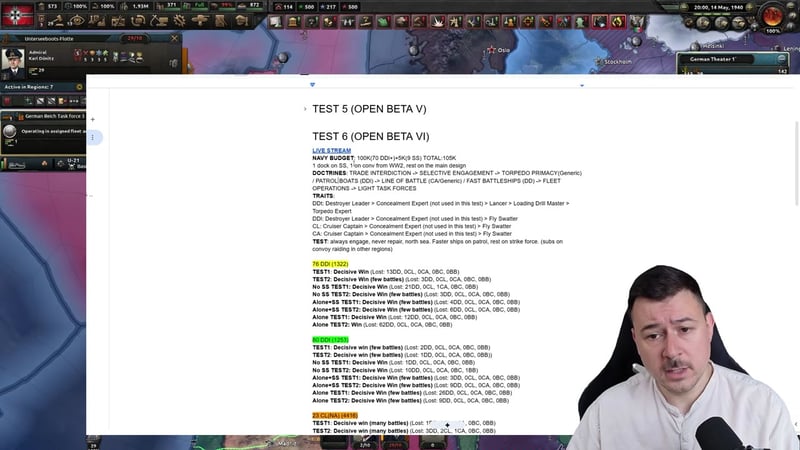
The naval rework changed which fleets win, and cheap hulls in bulk now beat a small, well-equipped one. This guide gives you the task force orders to set before you build anything, the two ship designs worth putting every dockyard on, the destroyer-to-cruiser ratio that tested best, and an honest answer on whether your country can still invade the UK.
Quick answer
| What | Answer |
|---|---|
| Best ship | Torpedo destroyers, with light attack destroyers a close second |
| Budget needed | Around 100,000 IC wipes the Royal Navy by 1940 |
| Fleet mix | Four destroyers per cruiser |
| Cruiser spam | Roughly 26 light attack light cruisers on the same budget, which is not enough alone |
| Strike force | Do not engage can no longer be selected on strike force |
| Submarines | A short-lived distraction only, because strike forces ignore them in transit |
| Naval invasions | Harder: the AI holds dominance with never repair, do not engage |
HOI4 navy rework explained: what actually changed
The navy everyone calls "reworked" is not one patch. It is a run of changes across the 1.17 cycle, from November 2025 into March 2026, and Thunder at Our Gates (patch 1.19, 10 June 2026) sits on top of that rather than replacing any of it. That matters for reading advice as much as for playing: a fleet build posted in October 2025 predates the whole thing, and one posted in May 2026 is current on the combat maths but knows nothing about ship captains.
The change with the longest reach is the doctrine system. Patch 1.17 replaced the existing doctrine trees for army, navy and air with the subdoctrine-and-mastery system, so every naval doctrine order written before 20 November 2025 describes a tree the game no longer has. That single line invalidates more old navy advice than any ship stat in the list below.
The naval changes, patch by patch
| What changed | Before | After | Patch |
|---|---|---|---|
| Naval dominance control ratio | 66% | 60% | 1.17.1 |
| Minimum chance to hit in a naval battle | 0.05% | 2% | 1.17.4 |
| Maximum hit profile, which is what big guns fire against | 80 | 70 | 1.17.4 |
| Admiral level feeding naval hit chance, plus the Coordination bonus | both applied | both removed | 1.17 |
| Naval doctrine | the old naval tree | subdoctrines with mastery milestones | 1.17 |
| Destroyer surface visibility buff in the Patrol Boats and Light Task Forces subdoctrines | larger | reduced to -5% | 1.17.2 |
| Naval gun hit chance bonuses from MIOs | applied incorrectly | applied correctly | 1.17.3 |
| Maximum monthly mastery gain | 50 | 40 | 1.17.4 |
| Task forces already in combat | topped up from the reserve fleet | no longer reinforced from it | 1.17.4 |
| Strike forces and repairs | — | allowed to repair while in harbour | 1.17.4 |
| Naval invasion caps | one global cap on divisions, planning time scaling with the division count | caps per invasion plan, planning time independent of it | 1.17 |
| Warscore from sunk ships | full contribution from sunk IC | halved | 1.18 |
Read the first three rows together and the destroyer result the rest of this guide measures stops looking like an opinion. A minimum hit chance of 2% means every gun on every hull lands something no matter how badly outmatched it is, so the side with more guns collects more of that floor. Admiral level no longer adds hit chance, so the veteran who used to make a small fleet punch above its weight does not. And the accuracy cap moved in the big guns' favour rather than against them:
Increased chance to hit for big guns by decreasing the maximum hit profile from 80 to 70.
Together those push the same way: quality bought at the cost of hull count buys less than it used to, and a large hull that presents a big target has to earn its place against ships that do not.
What Thunder at Our Gates changed about the navy
Patch 1.19 is an expansion patch, and its naval content is character and detail rather than combat maths. Nothing in it reverses the 1.17 rebalance, which is the useful thing to know before you go looking for a new meta that is not there.
- Ship captains. Naval vessels now carry captains you can decorate with medals and promote into admirals, with 8 historical captains added in both bookmarks for every major country — and for Australia.
- More ways for a ship to be hurt. New critical states include a Leaking Pressure Hull, a Jammed Torpedo Tube, Broken Diesel Engines, a Shortcircuited Radar and a Fire Direction Breakdown, among others.
- The Mediterranean got harder for the Axis. UK naval dominance there was increased, explicitly to make British naval invasions work better, so an Italian plan built on an older patch has less room than it did.
- The AI stopped flying empty decks. It is now better at filling its carriers with aircraft, reusing older airframes rather than leaving hangars empty.
- Blockades. Joining a faction clears naval blockades between faction members, and the exploit that let a subject blockade its own overlord is gone.
What the patch notes do not confirm
Two claims in this guide come from watching the game rather than from a changelog, and they deserve to be separated from the rows above.
- Strike force losing "do not engage". The published patch history carries no line removing that option from strike force. The order panel in this guide's source footage is the evidence for it, and that is a fair thing to build on — but it is footage, not a patch note, so check the panel in your own build before you plan a whole fleet around it.
- The size of the torpedo nerf. The live patch history records the minimum naval hit chance moving to 2% in 1.17.4. A widely reposted open-beta note puts the same constant at 0.5%, which is the opposite direction of travel. One of those is a beta build that did not ship as written, and only the tooltip in your own install settles which.
Accurate as of patch 1.19.2, released 30 June 2026, and checked on 22 August 2026 against the Hearts of Iron 4 Wiki's version history. If your game is on something later, re-read the two rows above before you commit an industry to them.
Set your fleet orders before you build
Two rule changes land before you lay down a single hull. Strike force no longer offers do not engage as an option 1:01, and torpedo hit chance has been cut significantly. The old disengage-spam routine that let a small fleet farm dominance is gone with it.
Set the fleet up like this, in this order:
- Reference split: 105,000 IC — 100,000 surface, 5,000 submarines
- They find the enemy; they are not meant to hold the line
- Do not engage is no longer selectable here
- 2:00
- Ships that trickle home to dock are ships not holding a sea zone

The naval AI has been improved and given better starting designs. A build that cleared the North Sea in an older patch is not a safe benchmark — retest it before you commit an entire industry to it.
Pick the ship you will spam
Four designs carry the current meta, and the ranking between them is closer than the gap between all of them and doing nothing. Every cruiser here is fitted without armour: the lower production cost buys more hulls, and the extra hulls are worth more than the protection you gave up.
| Design | Role | Why it ranks there |
|---|---|---|
| Torpedo destroyer | Your default spam | Slight edge in combat, slightly cheaper, and the biggest beneficiary of mastery perks |
| Light attack destroyer | The insurance policy | Performs nearly identically, and survives a future torpedo nerf |
| Light attack light cruiser, no armour | Support hull | Good in a mixed fleet, badly outnumbered on its own |
| Light attack heavy cruiser, no armour | Back line and pride of the fleet | Best protected, but you can afford the fewest of them |
Destroyers win on one stat above all others: hit profile. It is currently the most important number in naval combat, and destroyers have the lowest of any hull. That, not their gun or torpedo output, is why a wall of them survives engagements that shred a smaller cruiser force 9:12.


Torpedo destroyers scale better with naval mastery perks, which sounds like a tiebreaker until you check how many you actually unlock. Wiping the entire Royal Navy in a run unlocked zero. Treat perks as a rounding error and pick on cost and hit profile instead.
Build numbers before you build quality
Every test pointed the same direction: more ships won more often, even when each individual ship was worse. Spend a naval budget on hull count first and technology second.
The clearest demonstration is spending one budget two ways. Poured entirely into light attack light cruisers, it bought around 26 hulls, which barely challenged the Royal Navy once the starting fleet was removed 7:47. The same budget in destroyers bought far more hulls and performed better across the board — with no submarines and no starting German fleet, the destroyers alone still carried their engagements.


At around 100,000 IC you can wipe the Royal Navy in 1940 with no special projects and no particular technologies — good doctrines, sensible orders and a lot of hulls. The reverse does not work. A small budget spent heavily on techs and special projects does not reproduce that result, because the thing you are short of is ships.
That is the honest cost of this strategy. It is not a clever design that punches above its weight; it is an industrial commitment, and the ranking of designs only matters once you can afford the numbers.
Mix cruisers into a destroyer fleet
Cruisers are not bad ships. They are ships you cannot afford enough of. On their own they take heavy damage and are usually wiped after a few battles, and heavy cruisers fare worse than light cruisers for exactly one reason: you have fewer of them.
Paired with destroyers they change completely. Aim for roughly four destroyers per cruiser 11:06. A mixed fleet at that ratio beats either cruiser type alone by a wide margin, and it scales better into the late game, when your numerical advantage stops being the deciding factor and 700 torpedo destroyers stop making sense.

Heavy cruisers have two advantages once mixed in. They sit in the back line, so the screening destroyers absorb the punishment first, and one of them can be your pride of the fleet — which is what unlocks the line of battle subdoctrine. With mastery perks effectively unreachable, line of battle is the strongest thing in that section, so designating a pride is worth doing deliberately rather than by accident.

Light cruisers answer with throughput. You can assign 10 dockyards to a light cruiser line against 5 for heavy cruisers, so the same investment arrives sooner and in greater numbers. They take more damage and you lose more of them, but they are replaced faster. Over a whole run the difference narrows; in the first year of the war it is decisive.

If the war starts early, build light cruisers. If you have time to accumulate and want a durable pride of the fleet, build heavy cruisers. Both work at the four-to-one ratio.
Know what submarines still do
Basic submarines survive longer than they did in the previous live version, which is a low bar — they still die far faster than they once did. The real problem is not their survivability, it is that they no longer do the job people build them for.
Enemy strike forces now ignore submarines while moving to a target 6:50. Parking a submarine screen in the path of a Royal Navy strike force does not pull it off course any more; it sails past and your submarines die to whatever finds them. As a distraction they buy a short window and nothing more.

One submarine build is still genuinely strong: fleet submarines with anechoic tiles, which drain enemy fuel and destroy convoys about as well as submarines ever did.
The anechoic tile build needs two special projects and a large amount of rubber. That puts it out of reach of most minor nations, and out of reach of any major that has not already planned its research around it. If you are reading this deciding whether to start submarines from scratch, the answer is usually no.
Decide whether to build battleships or carriers
Capital ships are a different budget conversation, not a bigger version of the same one. Neither of them fixes a fleet that lacks hulls.
| Ship | What it actually buys | Build it when |
|---|---|---|
| Battleship / battlecruiser | Mostly anti-air | You need AA a destroyer and cruiser build can largely do without, especially in single player |
| Carrier | Strong output, at a much larger tech cost plus aircraft production | You already have a working fleet — the UK, the US, Japan |
| More destroyers | Hull count, low hit profile | Every other case, and always first |
Anti-air is the honest reason to consider battleships, and a destroyer-and-cruiser fleet can mostly ignore anti-air, which makes skipping them the more cost-effective choice in single player. Carriers are good ships that punish you for building them early: the tech investment is large, you need an aircraft production line beside it, and the AI is particularly aggressive against carriers 13:31. They pay off on top of a good fleet, never instead of one.
What to rebuild or scrap after the naval rework
Most of what a rebalance costs you is not ships, it is habits. Hulls already in the water are nearly always worth keeping — a mediocre destroyer still occupies a slot in a screening line — so the expensive decisions are the dockyard queue and the half-dozen settings nobody revisits between patches. Work down this list once, then stop thinking about it.
- free costs nothing but a click
- cheap a small change to the queue
- setup needs a research or doctrine decision
- grind pays back slowly, over the run
- skip the habit to drop outright
- Changed in 1.17.1
- Changed in 1.17
- Fixed in 1.17.3
- Changed in 1.17
- Changed in 1.17.2
- Changed in 1.17.4
- Changed in 1.17.4
- Changed in 1.17.4
This section is about what to change now the rules have moved. For the designs and ratios themselves — the current destroyer template, heavy versus light cruiser, what limits a carrier deck, and how many screens a capital ship wants — that is the HOI4 navy guide, which is written to survive a patch rather than to react to one.
Plan around harder naval invasions
The single biggest change is not a ship stat. The AI now sets its own task forces to never repair, do not engage — the same trick players used to break the Channel open, turned around.

The consequence is that the Royal Navy can gain and hold naval dominance without ever fighting you 3:57. To take dominance back you must detect those patrols, catch them, force an engagement, and destroy them — against ships whose orders are to refuse the fight. Patrols you cannot even see are enough to keep your naval invasion from triggering.
If your invasion arrow refuses to fill and you cannot find an enemy fleet anywhere in the zone, this is why. There is no fleet to sink and no error message — the invasion simply never becomes available.
What that means for your run depends entirely on your industry. A major power such as Germany can still build enough hulls to clear the Channel and invade the UK easily. A minor power that cannot outbuild the Royal Navy is locked out, and that is the intended outcome rather than a bug to wait out.
The fix most often proposed is a limited-scale raid: an option that lets a small force attempt a landing, possibly gated behind marines, with success granting a harbour rather than a full beachhead. It does not exist in the game today. Plan around the current rules, not around that.
How the naval meta moved, and who it moved against
The direction of travel across the whole cycle is one sentence: the navy stopped being a hero-unit problem and became an industrial and positional one. Every removed multiplier pointed the same way — away from the one great ship with the one great admiral, and towards how many hulls you can float and how much of a sea zone they can hold. That is why a guide can honestly recommend spamming a cheap destroyer and still be describing a rebalance rather than an exploit.
| Who you are | Direction | Why |
|---|---|---|
| A power with dockyards to spare | Better off | A 2% floor on hit chance and a lower dominance threshold both pay out per hull, and you have the hulls |
| An Axis plan running through the Mediterranean | Worse off | UK naval dominance there was raised in 1.19 specifically to make British invasions work |
| Anyone who built around a star admiral | Worse off | Admiral level stopped feeding naval hit chance, and the Coordination bonus went with it |
| Anyone keeping a deep reserve fleet | Worse off | Task forces in combat are no longer reinforced from reserve, so the pool behind the fleet does nothing for the fight |
| Anyone who learned one doctrine order by heart | Worse, then better | The old tree is gone, but subdoctrine mastery lets a cheap specialised fleet reach a real payoff |
| Anyone farming warscore by sinking ships | Worse off | The contribution from sunk IC was halved in 1.18, so a naval war buys less of the peace conference |
Naval dominance and naval supremacy are two different numbers
These get used interchangeably in comment threads and they are not the same thing, which is worth pinning down before you read any advice about either. Naval dominance is a control ratio in a sea zone, and it now needs 60% rather than 66% — that is the number the AI is chasing when it parks patrols you cannot find, and the number you are contesting when you go looking for them. Naval supremacy is the separate figure your ships generate for a region, which is what an invasion actually reads; the HOI4 navy guide works through what each mission contributes to it and what a raiding fleet gives up.
The practical consequence of the dominance change is small and free: a fleet that was a few points short of holding a zone on an older patch may hold it now with nothing added. Check the number before you conclude you need more ships.
Also worth knowing
- A spotting task force can beat do-not-engage patrols. One cruiser built for detection and set to do not engage itself can find the patrols you cannot see, at which point the rest of the fleet can engage them. This is the practical counter to the dominance problem, and it costs one hull.
- The destroyer results do not transfer to minor nations. A fleet of 84 light attack destroyers as Australia in 1941 was destroyed by the Royal Navy despite near-identical ship stats. The design is fine; the hull count is not. This is a question of industry, not of ship design.
- Naval supremacy can be lopsided the instant war begins. Declaring on the UK as Denmark showed 12,000 supremacy against 2,500 on the spot. Where the sea cannot be contested, paratroopers seizing a port outright are the more reliable route.
- Check your naval MIO choice against production output. Deschimag reaches up to 15% production output through its upgrades, which is roughly 87 destroyers instead of 80 for the same industrial investment — a real alternative to picking Blohm & Voss for hull spread and hit profile.
- A cheap battleship is a more durable pride of the fleet than an unarmoured heavy cruiser. A heavy battery, fire control, an engine and the best armour available still secures the doctrine bonus, and unlike an armourless cruiser it does not get shredded by heavy attack. Losing your pride of the fleet loses the bonus with it.
- Farm naval doctrine experience before the war. Select the whole fleet and set it to convoy raiding during peacetime.
- Convoy raiding submarines get stuck. A submarine battle against a convoy can run for in-game days, which leaves the submarines revealed long enough for a strike force thousands of kilometres away to sail over and sink them. It is a large part of why submarine raiding underperforms in practice.
- Achievement runs are affected too. A great many achievements require capitulating or occupying the UK, and there is still no way to white peace out of a war with them — so the harder invasion is not only a minor-nation problem.
Frequently asked
Can a minor nation still naval invade the UK in HOI4?
Realistically no, and that is intended. The Royal Navy now sets its own task forces to never repair and do not engage, so it holds naval dominance without ever fighting you, and you cannot trigger an invasion until you detect, catch and sink those patrols. Major powers with a large industrial base can still build enough hulls to clear the Channel, but a small country that cannot outbuild the Royal Navy is locked out.
Are submarines worth building in HOI4 now?
Only for a specific job. Basic submarines survive a little longer than they did before the rework, but enemy strike forces ignore them while moving to a target, so they cannot pull a large fleet off course and they die quickly once caught. A dedicated fleet submarine build with anechoic tiles is still very good at draining fuel and sinking convoys, but it needs two special projects and a lot of rubber, which puts it out of reach for most countries.
Should I spam destroyers or build capital ships for naval supremacy?
Spam destroyers first. Numbers decide naval battles more than quality does, and destroyers are the cheapest way to get a lot of hulls with a low hit profile. Capital ships are worth adding only once the destroyer core exists and the industrial budget is large, and carriers in particular are a good investment only for a country that already has a working fleet.
Do light attack destroyers work for a minor nation?
The results do not transfer cleanly. Players running the same light attack destroyer design as a smaller country report fleets of 80 or more being destroyed by the Royal Navy in 1941, because the enemy still outnumbers and outranges them even when the individual design is identical. The design is sound, but it only wins when the hull count is high enough, which is a question of industry rather than ship stats.
Which naval doctrine subtree is best right now?
Line of battle is the strongest pick when mastery perks are out of reach, which they usually are, since wiping an entire enemy navy can still unlock none of them. Line of battle requires a pride of the fleet, so designate a heavy cruiser or a battleship for the role. Beyond that, any doctrine that reduces cost or raises production output is worth more than one that improves individual ship quality.
What changed in the HOI4 naval rework?
It is a run of patches across the 1.17 cycle rather than one update. Naval dominance now needs a 60% control ratio instead of 66%, the minimum chance to hit in a naval battle was raised to 2%, admiral level and the Coordination bonus no longer feed naval hit chance, and the old naval doctrine tree was replaced with subdoctrines and mastery milestones. Together those push the meta towards hull count and away from a small elite fleet led by a star admiral.
Did Thunder at Our Gates change the naval meta?
Not the combat maths. Patch 1.19 added ship captains you can decorate with medals and promote into admirals, a longer list of critical ship states, and an AI that fills its carrier decks properly, none of which reverses the 1.17 rebalance. The one line that moves a plan is increased UK naval dominance in the Mediterranean, added to make British naval invasions work better, which costs an Axis player room in that theatre.
Do I need to rebuild my fleet after the naval changes?
Usually not the ships, only the habits. Hulls already in the water still fill a screening line, so the expensive decisions are the dockyard queue and the settings nobody revisits between patches. The naval doctrine tree was replaced outright in 1.17, naval gun hit chance bonuses from MIOs were being applied incorrectly until they were fixed in 1.17.3, and task forces already in combat no longer draw reinforcements from the reserve fleet. Audit those three before you scrap anything.
Is naval dominance the same as naval supremacy in HOI4?
No, and mixing them up makes patch advice hard to read. Naval dominance is a control ratio in a sea zone, and since patch 1.17.1 it takes 60% rather than 66%. Naval supremacy is the separate value your task forces generate for a strategic region, and it is the figure a naval invasion checks before it will launch.
Read next
HOI4 Meta Division Templates and Tank Designs
The division templates that competitive Hearts of Iron IV play settles on under the regimental support system, with exact battalion counts, regimental and support company slots for line-holder infantry, infantry bricks, shield infantry, marines, SPGs and heavy tank destroyers. It also covers the tank module layouts those divisions rely on, for players who can already open the division designer and want the compositions rather than an explanation of it.
HOI4 Special Forces Doctrines: Every Branch Ranked
The Thunder At Our Gates patch replaced the special forces doctrine system with one grand doctrine choice and a pair of sub-doctrines for each special forces type, and the branches are nowhere near equal. This guide ranks every option, gives the numbers behind each pick, and sets out the path to take for a standard special forces army.
HOI4 Division Templates After the Thunder Rework
Concrete division templates and tank designs for the reworked division designer: how wide to build, which support companies to fit and in what order, and what to put in a tank, a garrison and an army HQ. Written for players who already know the division designer and want current numbers rather than an explanation of the interface.
HOI4 Navy Guide 2026: Fleet Composition and Ship Design
One destroyer template currently wins naval combat on its own. Here is that template, plus the systems underneath it — screening ratios, missions, doctrines, MIOs — so you can build the next meta template yourself when this one gets patched.