
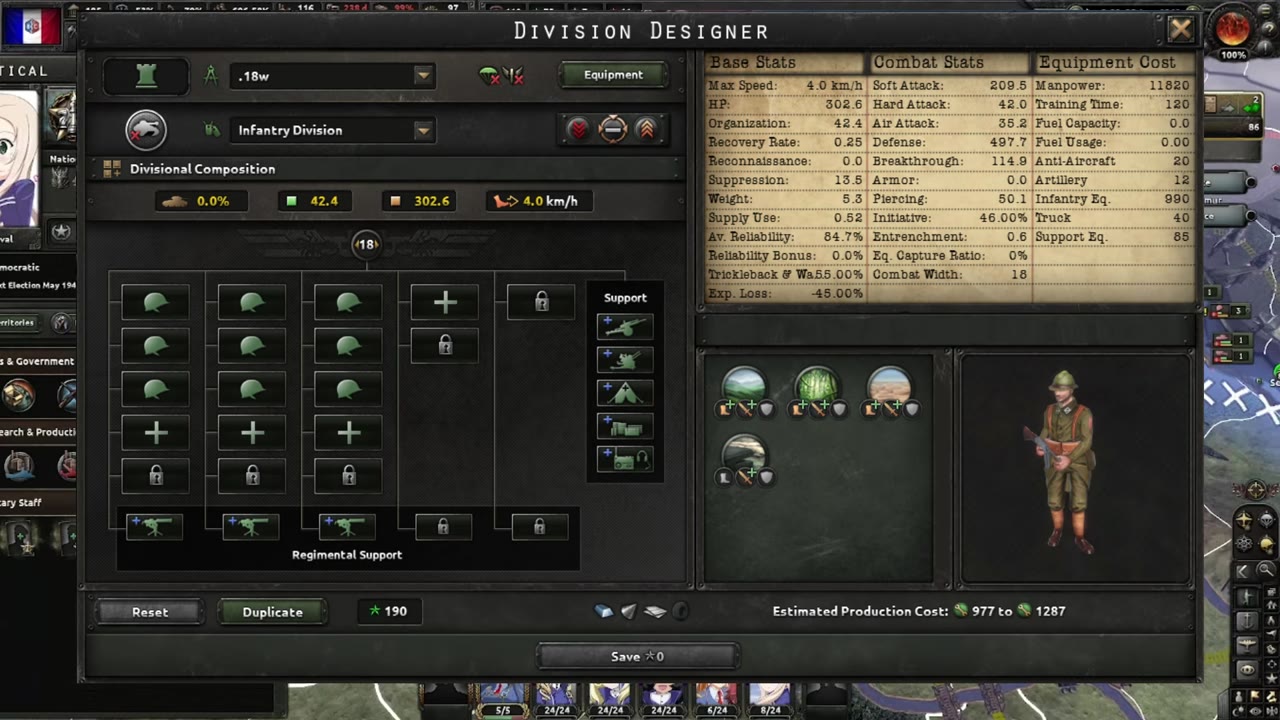
You can build every division template competitive Hearts of Iron IV play currently settles on, with the exact battalion counts and regimental support slots for each. You also get the tank module layouts those divisions depend on — SPGs, heavy and medium tank destroyers, and the two support-company tanks that sit inside almost all of them. Where a cheap variant exists, it is here too, so you can field these before your industry is ready for the full version.
Quick answer
| What | Answer |
|---|---|
| Line holder | 9 infantry battalions, 3 heavy weapons companies, with artillery, AA, hospital, logistics and signal support |
| Infantry brick | 18 infantry battalions with 3–4 heavy weapons companies and 1–2 anti-air |
| Shield infantry | 18 infantry battalions and 3 anti-tank, with 4 heavy weapons companies and 1 anti-tank as regimental support |
| Mountain marines | 7 marines and 12 mountaineers, plus 4 heavy weapons companies and 1 anti-tank |
| Mech marines | 11 marines, 5 amtracks and 3 motorized anti-tank |
| SPG division | 11 SPGs and 8 camels, with camels interchangeable with mechanized |
| Heavy TDs | 11 heavy tank destroyer battalions and 8 mechanized, plus 3 heavy TDs and 2 heavy weapons companies in regimental support |
| Flame tanks | Always a medium chassis, never light or heavy |
This page is the list of specific meta template families and the tank designs that sit inside them; for the general rules on division width, regiment count and the order to fill support slots in, see HOI4 division templates after the Thunder at Our Gates rework.
Pick the right division for the job
Six template families cover almost every job an army has. Pick by the job first, then build the template — a division that is excellent at holding a line is a waste of factories if what you needed was something to take a beach.
| Division | Line battalions | Use it for |
|---|---|---|
| Line holder infantry | 9 infantry | Filling gaps and holding static line as a tank nation. Cheap, very high defence, not meant to attack. |
| Infantry brick | 18 infantry | Defending, battle-planned attacks and holding coasts. The default for a nation with no armour. |
| Shield infantry | 18 infantry + 3 anti-tank | Entering a defensive battle ahead of your tanks so the tanks keep their equipment and strength. |
| Mountain marines | 7 marines + 12 mountaineers | Shore, river, amphibious and mountain bonuses in one division. |
| Mech marines | 11 marines + 5 amtracks + 3 motorized anti-tank | Taking a landing and holding it until tanks arrive. |
| SPG division | 11 SPGs + 8 camels | Single player mainly. Works in multiplayer, rarely seen there. |
| Heavy tank destroyers | 11 heavy TDs + 8 mechanized | Multiplayer. Very high hard attack, with enough soft attack to still chew through infantry. |
The split between the two infantry sizes is the one people get wrong most often. Nine battalions is a filler unit you build dozens of; eighteen is a division you expect to win a battle 0:40. Building the nine-battalion version as your main army gives you a front line that holds and never advances.
Build the line holder infantry
This is the cheapest useful division in the game. It exists so a tank nation can cover the frontage its armour is not standing on, and its defence stat is high enough that the AI breaks itself against it.
- the defence comes from here
- order is not fixed — swap these around freely

The support company slots are interchangeable. If you are short on one piece of equipment, reorder or drop a company rather than abandoning the template.
There is a cheaper version worth knowing before your industry is running: switch off support equipment and the division keeps most of its stats 0:31. The defence and manpower barely move; what disappears is the equipment bill.

If you find yourself attacking with line holders, you have built the wrong template for the job. They have very little attack by design — the whole point is that they cost almost nothing to replace when they are pushed.
Build infantry bricks for defence and battle plans
Eighteen infantry battalions, three to four heavy weapons companies and one to two anti-air in the regimental support slots. Anti-tank can go into those slots too if you expect armour. The number of anti-air companies is decided entirely by how much enemy air you expect: one against a weak air force, two against a real one.
Support companies are heavy artillery, hospital, logistics, artillery and signal. Heavy artillery is optional — it is the most expensive thing in the list, and switching its equipment off keeps some of the stats while removing most of the cost.

For single player the build changes in one place. Take the heavy weapons companies out of regimental support and put four or five infantry guns in instead 1:19. Heavy weapons buy defence, and against the AI you do not need it — you need attack, and infantry guns give you more of it per slot than anything else at that price. The second anti-air is rarely worth its slot in single player either; spend it on another infantry gun.

The support companies stay the same in both versions.
Build shield infantry to protect your tanks
Shield infantry exists to be committed to a defensive battle before your armour is. Tanks that sit in a defensive fight lose equipment and organisation they cannot replace quickly; infantry that costs a fraction as much can absorb that fight instead and leave the tanks intact for the counter-attack.
The full build is 18 infantry battalions and 3 anti-tank battalions, with 4 heavy weapons companies and 1 anti-tank in regimental support. Support companies are hospital, logistics, recon with rangers, signal and engineers.

Three anti-tank battalions is a large amount of anti-tank equipment to keep in production, and this is where the template most often fails in practice — the divisions sit at partial equipment for months because the line cannot fill them. The cheaper version fixes that: run 2 anti-air and 1 anti-tank in place of the three anti-tank battalions, and switch the anti-air equipment off 1:57. You keep all 18 infantry battalions, the 4 heavy weapons companies carrying the defence, and 1 anti-tank for hard attack.

Build the expensive version only when your anti-tank line can actually keep these divisions supplied. A full-strength cheap shield division beats an understrength expensive one every time.
Build mountain marines and mech marines for landings
Two divisions, two jobs. Mountain marines are a general-purpose special forces division that happens to be good at landing; mech marines are built to take a beach and survive on it.
Mountain marines are 7 marines and 12 mountaineers. Marines give terrain bonuses on shores, rivers and other amphibious tiles; mountaineers are the strongest special forces battalion in the game and bring the mountain bonuses. Mixing them means one division covers the beach and the ridge behind it, which is usually the same battle. Regimental support is 4 heavy weapons companies and 1 anti-tank. Support companies are pioneers, light recon (breakthrough-maxed — see the design below), super-heavy artillery, hospital and a medium flame tank.

Mech marines are 11 marines, 5 amtracks and 3 motorized anti-tank 3:05. The amtracks can be swapped for mechanized if that is what you have in production. Regimental support is a heavy weapons company, for breakthrough and defence. Support companies are pioneers, light recon tank, heavy artillery, hospital and a flame tank.

Mech marines are not a breakout division. Their job ends the moment your tanks and shield infantry are ashore — plan the landing so that follow-up exists, because a beachhead held by mech marines alone eventually gets pushed back into the sea.
Build SPG and heavy tank destroyer divisions
These are the two armoured templates, and they belong in different games.
The SPG division is 11 SPG battalions and 8 camels. The camels can be switched out for mechanized, and camels are genuinely good if that is what your nation has 3:45. For regimental support, heavy weapons motorized is the easy option; medium or heavy tank destroyers there are stronger and cost more. Support companies are light recon, flame tank, assault engineers, logistics and hospital. This is mainly a single-player template — SPGs bring enormous soft attack against an AI that fields infantry, and much less against a human who fields armour.

The heavy tank destroyer division is 11 heavy TD battalions and 8 mechanized, with 3 more heavy TDs and 2 heavy weapons companies in the regimental support slots — so the real tank destroyer count is fourteen, not eleven. Support companies are light recon, a flame tank on a medium chassis, assault engineers, logistics and hospital. This is the multiplayer pick: very high hard attack against the armour you will actually be fighting, and enough soft attack that it does not stall against infantry.

Design your SPGs and tank destroyers
The templates above are only as good as the vehicles in them. Three designs cover all of it, and they differ by what stat they are pushing.
| Module slot | SPG | Heavy tank destroyer | Medium tank destroyer |
|---|---|---|---|
| Turret | — | Three-man turret | Three-man turret |
| Main gun | Improved Howitzer II | High-velocity cannon | High-velocity cannon |
| Radio | Radio III | Radio | Radio |
| Extra slots | 2 small cannons | 3 small cannons | 2 small cannons + easy maintenance |
| Reliability | Easy maintenance | — | Easy maintenance |
| Tracks | Interleaved road wheels | Interleaved road wheels | Interleaved road wheels |
| Engine | Standard | Diesel | Standard |
| Armour clicks | 4 in single player, more in multiplayer | As many as possible | As many as possible |
| Pushing | Soft attack | Hard attack, then breakthrough | Hard attack, cost |
SPGs max soft attack. Improved Howitzer II is the gun, Radio III buys breakthrough, two small cannons fill the remaining slots, easy maintenance raises reliability and drops production cost so you can mass-produce them, and interleaved road wheels add more breakthrough. Stop at four armour clicks in single player: it keeps the cost and resource draw down, and breakthrough does not decide single-player battles. In multiplayer breakthrough does matter, so go past four.

Heavy tank destroyers prioritise hard attack, because most of what they meet is armour, and then breakthrough, because breakthrough decides how quickly you knock an opponent out of a battle. Three-man turret, high-velocity cannon, radio, three small cannons, interleaved road wheels, diesel engine, as many armour clicks as you can afford, and exactly enough engine clicks to reach 4 km/h 5:51. A heavy cannon substitutes for the high-velocity cannon perfectly well — you trade a little hard attack for some soft attack.

Medium tank destroyers are the same layout with one fewer small cannon. Put easy maintenance in the freed slot: better reliability, cheaper tank. Skip the diesel engine — a medium TD's reliability is already high enough that the upgrade buys nothing you will notice.
Design the flame tank and light recon tank
Both of these live in support companies, and both are designed to max breakthrough rather than attack. They add stats to the division rather than fighting on their own.
Always build flame tanks on a medium chassis. Never a light, never a heavy. The design is a three-man turret, a flamethrower, a radio for breakthrough, extra ammunition storage twice, armour skirts, interleaved road wheels and a petrol-electric engine. The two ammunition storage modules are placeholders — swap either one out for anything that gives more breakthrough as soon as you research it.
A flame tank's reliability looks alarming in the designer. It does not matter. Division reliability is the average across the whole template, and one flame tank sitting in a support company moves that average almost not at all.
The light recon tank is breakthrough-maxed the same way: three-man turret, a flamethrower for breakthrough, the highest radio you have, extra ammunition storage, armour skirts, an autoloader, interleaved road wheels, standard engine, standard armour plates, and as many armour clicks as you can fit 7:19.
Neither design changes by division type. The flame tank in a marine division is the same tank as the flame tank in a tank division, and the same is true of the light recon tank — build each one once and reuse it everywhere.
Also worth knowing
- A medium turret beats a heavy one on heavy TDs until 1943. Until Advanced Tank Destroyer Artillery is researched and High Velocity Cannon III is available, the High Velocity Cannon II counts as a medium-turret module — so fit a medium three-man turret. It is cheaper and better, at 24 breakthrough against the heavy three-man turret's 20. Switch to the heavy turret when the 1943 gun arrives.
- Doctrine changes which sizes are correct. These templates are all maximum-size, and part of why they work is the size itself. With the artillery combat-width reduction doctrine you can run artillery as a brigade line instead, and 18, 25, 30 and 32-width divisions are all valid when they are designed around the doctrine you are actually grinding. Pick the doctrine first, then the width.
- 10-width divisions are dead; 12-width still has one job. Current reinforcement and supply rules kill 10-widths outright. A 12-width infantry division with engineers, support anti-air and anti-air as regimental support still works as a port-defence cycle stack — six to ten of them rotating on a port will hold it.
- Split your MIOs and refit an existing chassis. Splitting military industrial organisations across separate production lines, and refitting an early tank chassis rather than starting a new line for a new one, is the difference between a handful of tanks at war start and a real stockpile. This is usually the actual answer to "how do I afford these divisions".
- Nine tanks and nine mechanized is a reasonable alternative split. Instead of eleven and eight, running the armour and mechanized at nine each picks up the mechanized-related bonuses. Worth testing against your own doctrine before committing a production run.
Frequently asked
How do I afford to produce these divisions?
The cheap variants exist for exactly this problem: the line holder and the cheaper shield infantry switch off support equipment and keep most of their stats, which cuts the equipment bill sharply. On the industry side, splitting military industrial organisations across separate lines and refitting an early tank chassis rather than starting a new one keeps efficiency high and is what makes a large tank stockpile possible by war start. Camels and mechanized are interchangeable in the SPG template, so the cheaper of the two is a valid pick when factories are tight.
Is the flame tank in a marine division the same as the one in a tank division?
Yes. The flame tank design does not change by division type: it is always built on a medium chassis, never a light or a heavy, and it is breakthrough-maxed with a three-man turret, flamethrower, radio, two extra ammunition storage modules, armour skirts, interleaved road wheels and a petrol-electric engine. The same applies to the light recon tank, which is also breakthrough-maxed wherever it appears.
How much anti-air do infantry bricks need?
One or two anti-air companies, decided by how much enemy air you expect to face. In single player one is usually enough, and the slot is better spent on infantry guns to push attack up. Against a serious air force the second anti-air earns its place.
Which turret should a heavy tank destroyer use before 1943?
Until Advanced Tank Destroyer Artillery is researched and High Velocity Cannon III is available, the High Velocity Cannon II counts as a medium-turret module, so a medium three-man turret fits. That is both cheaper than the heavy three-man turret and better, giving 24 breakthrough against the heavy turret's 20. Switch to the heavy turret once the 1943 gun is in.
Read next
HOI4 Infantry Templates 2026
This guide covers how to build offensive and defensive infantry templates in Hearts of Iron IV, including doctrine choices, support companies, and when infantry is worth using at all. It is aimed at players who want practical division setups that perform in multiplayer and single-player alike.
HOI4 Tank Designs and Templates 2026
This plan covers tank technology priorities, practical tank variants, and the division templates they fit into. It is for players who want a clear path from research and design choices to usable armored divisions.
HOI4 Doctrines Guide 2026
This guide helps players choose doctrine paths in Hearts of Iron IV by role, with separate recommendations for grand, infantry, artillery/support, armor, and operations doctrines. It is aimed at players who want a fast tiered overview of which doctrine fits tanks, infantry, defense, or niche builds.
HOI4 Special Forces Doctrines: Every Branch Ranked
The Thunder At Our Gates patch replaced the special forces doctrine system with one grand doctrine choice and a pair of sub-doctrines for each special forces type, and the branches are nowhere near equal. This guide ranks every option, gives the numbers behind each pick, and sets out the path to take for a standard special forces army.