
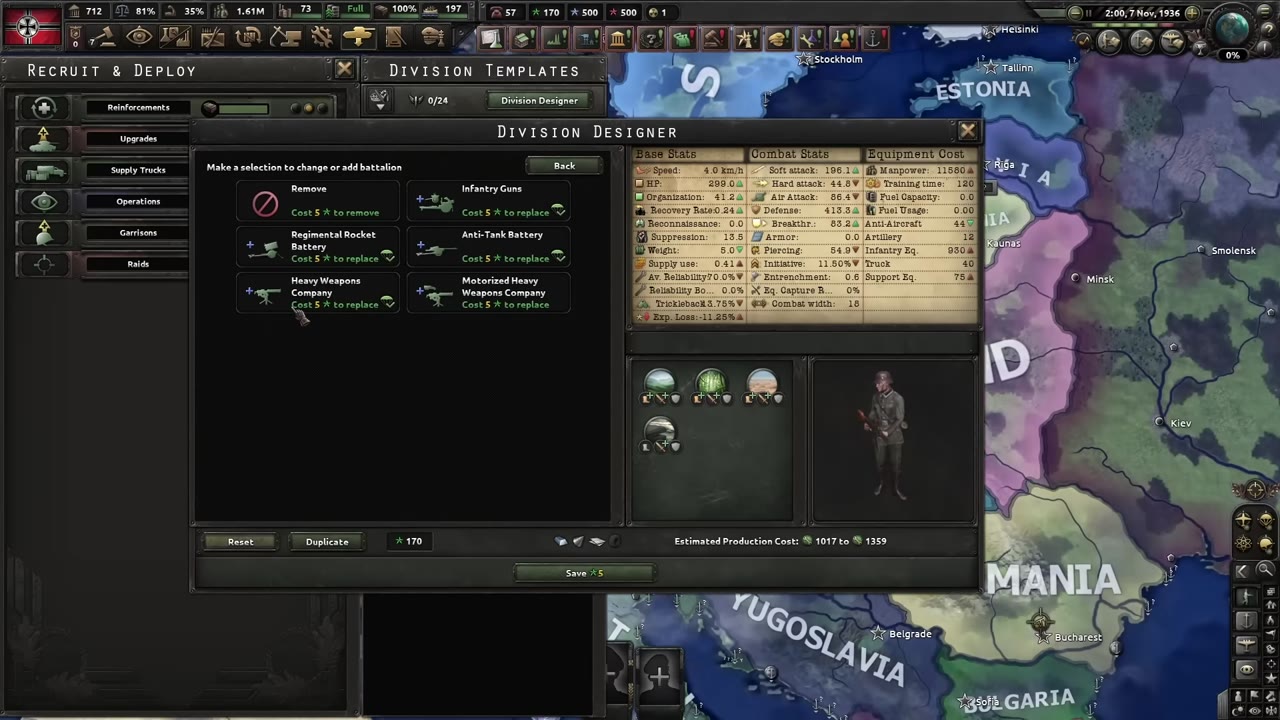
Division templates now carry a regimental support company on every line of three battalions, armies can deploy a headquarters onto the map with its own support staff, and the special forces doctrine has lost its branching paths. This covers which regimental company to slot for each air situation, how to build a headquarters and where to park it, and which doctrines and XP upgrades still repay the cost.
Quick answer
| What | Answer |
|---|---|
| Support slot | One regimental support company per line of three battalions |
| Infantry, no air | Anti-air — 112 air attack on a defensive template |
| Infantry, green air | Heavy weapons company |
| Tanks, red air | Anti-air plus heavy SPAA — 209 air attack |
| Best HQ staff | Headquarters staff, for 20% leader skill bonuses |
| HQ distance | One tile behind the front, for minus 5% planning |
| Special forces | Mountaineers and marines only — skip rangers and paratroopers |
| Amtrac XP | Production cost, and nothing else |
This page covers the regimental support slot, the army headquarters and the special forces doctrines rather than the templates themselves; for the division widths and templates these companies are slotted into, see HOI4 division templates after the Thunder at Our Gates rework.
Add a regimental support company to every line
Stack three battalions into a single line and that line unlocks one regimental support company 0:02. With fewer than three, the slot stays greyed out. That is the only change to template design itself — everything else in the designer behaves as it did.
Infantry, cavalry and motorised all draw on the same list of seven: infantry guns, regimental rocket battery, anti-tank battery, heavy weapons company, motorised heavy weapons company, anti-air, and the flame option. In practice you will use three of them.

Because the slot is per line rather than per division, a template built as one wide block gets a single company while the same battalions split into three lines get three. Lay the template out with the slots in mind before you fill it.
Choose infantry support companies by air situation
The pick is decided by who owns the sky above the front, not by what the division is for.
| Situation | Regimental company | What it buys |
|---|---|---|
| No air cover | Anti-air | 112 air attack on a defensive infantry template — enough to shred CAS on its own |
| Green air | Heavy weapons company | Heavy defence, decent breakthrough, good soft attack, and cheap |
| Mountaineers | Motorised heavy weapons company | More breakthrough than the non-motorised version, at the same slot cost |
Anti-air is the pick whenever nobody is covering you 0:32. One slot is the whole cost of that 112.

Under green air the anti-air is dead weight, and the heavy weapons company is the better trade — the breakthrough it adds does not matter on a defensive line, but the defence and soft attack do. For mountaineers, take the motorised variant instead 1:01; the only reason is the extra breakthrough.

For normal infantry and special forces alike, the shortlist is those three. The rocket battery, infantry guns and anti-tank battery do not beat them in any of the three situations above.
Rebuild tank templates around support battalions
Existing armoured templates were built as solid blocks, which now earns them one support battalion instead of several. Rebuild them line by line.
- each line then gets its own support battalion slot
- heavy tank destroyer for a heavy build, medium tank destroyer for a medium one
- hard attack is what that build is short of
- 209 air attack · 1:30

The red-air build is the one that changes how the battle goes. Five air-defence templates in a single combat put over 500 air attack into it, which melts close air support faster than it can do damage.

Deploy and design an army headquarters
A headquarters is assigned to an army, generates command power, and applies its modifiers to everything under that army.
- 3:27
- filler that keeps the HQ alive; their stats are irrelevant
- the slots are empty until you do

If the headquarters is destroyed, the general attached to it goes with it. The line battalions exist for exactly that reason, and it is why the distance setting below is worth thinking about rather than leaving on its default.

Pick HQ support companies and a distance
Three of the four HQ support slots have an obvious answer. Only the last one is a real decision.
| Slot | Take | Why |
|---|---|---|
| 1 | Headquarters staff | 20% leader skill bonuses, which is a large pile of flat stats for one slot |
| 2 | Maximum planning | Close to automatic on any army that will sit still before attacking |
| 3 | Reduced supply consumption | Free relief on any front where supply is tight |
| 4 | Situational | Special operations coordination for special forces, division experience gain or hospital group staff to grind generals, forward air controller under red air |

The abilities attached to some of these are mostly not worth reading twice. Exploit breakthroughs is the one to avoid outright: plus 40% strength damage taken in exchange for minus 10% org loss while moving. Defense in depth is the exception 4:54 — flat extra entrenchment, which pays off on a line you intend to hold rather than one you intend to move.

The headquarters also changes planning indirectly, through how far it sits from the front. Take the setting that lets you place it yourself and put it one tile back 5:23: that costs minus 5% planning, the cheapest of the trade-offs on offer, and a headquarters you keep an eye on rarely gets caught at that range.

Skip naval merits and captain promotions
Sinking enemy ships in a battle now earns merits for the ships that took part. A merit costs 30 political power and buys something on the order of minus 5% naval fuel consumption — on one single ship 5:52. That is political power spent on a rounding error.
Captains can also be promoted to admirals, the same way generals are promoted. Grinding a good admiral directly gets you a better one for the same time and none of the political power, so neither feature deserves a place in a plan.
Choose the special forces doctrines that still work
The doctrine opens with two choices — more special forces, or better ones — and then gives you one mountaineer pick and one marine pick with no branching path underneath.
| Choice | Take | Note |
|---|---|---|
| Opening | Better special forces | The special forces cap can be exploited anyway, so quantity buys nothing unless you are avoiding the exploit |
| Mountaineer | One doctrine, no branch | The old path choice is gone 6:51 |
| Marine | One doctrine, no branch | Same structure as the mountaineer side |
| Rangers | Skip | Heavily nerfed by the new doctrine |
| Paratroopers | Skip | Not worth the cap space under it |

Mountaineers and marines are the only two special forces still worth the cap. If you have ranger or paratrooper divisions in production, that production is better spent on the two that survived.
Spend XP and doctrine on what still matters
Amtracs — the amphibious mechanised variant — can now be edited in the variant designer the way mechanised can. Production cost is the only upgrade worth XP on them 7:19. Armour, reliability and engine all cost XP and change nothing you will notice in a battle.

Dispersed operations is the new land doctrine, and it functions as an anti-air focused option. It works, and it does help against enemy aircraft, but grand assault, desperate defense and deep battle all beat it in a normal campaign 7:48. Air power was cut hard in the same update, which takes away most of the reason to build a doctrine around surviving it.
Also worth knowing
- Do not retool an entire army around these air attack numbers. Values in the hundreds per division read as untested, and a hotfix trimming them is the outcome most players are expecting. Build the templates for the war you are in now.
- The anti-air meta cancels itself out. Everyone stacks air attack, CAS stops being flown, players quietly drop the anti-air again, and CAS comes back. Where you sit in that cycle should decide whether the slot goes to anti-air or heavy weapons.
- Bombers are safer on logistics strikes than over the front. A defender fielding this much air attack for one support slot kills close air support quickly; missions that do not require loitering above enemy divisions keep the airframes alive.
- A headquarters on the map is a target for the enemy too. The front line system handles them badly, and generals get captured in bulk when a line is mismanaged — including yours if you push the HQ forward and stop watching it.
- Support artillery and support anti-air make paratroopers un-paradroppable. If you were slotting either into a paratrooper company, the division loses the one thing it was built to do.
- The empty space below the support slots is not usable. The template UI shows room for two or three more companies; there is no way to fill it.
Frequently asked
Are these air attack numbers going to stay this high?
A single defensive infantry template with regimental anti-air reaches 112 air attack, and a tank template with anti-air and heavy SPAA reaches 209, so a handful of divisions in one battle can stack well over 500. Numbers on that scale are the sort a balance hotfix usually revisits, and a lot of players expect them to be cut. Build the templates for the fight in front of you rather than committing an entire army's production to them.
Is CAS still worth building?
Close air support is very exposed while divisions can field this much anti-air for a single support slot, because losses climb fast over any front where the defender has slotted anti-air. Logistics strikes and other missions that do not require loitering over enemy divisions are a safer use of the same airframes. If nobody in a game is running anti-air, CAS becomes strong again, which is why the situation tends to swing back and forth.
What happens if a headquarters division is destroyed?
The general attached to it is lost with it, which is the main risk of putting one on the map. The line battalions in an HQ template exist only to keep it alive and their stats do not matter otherwise. Keeping it about one tile behind the front line costs only 5% planning and makes capture unlikely as long as it is watched.
Is the dispersed operations land doctrine any good?
It works as an anti-air focused doctrine and does help against enemy aircraft, but it does not beat grand assault, desperate defense or deep battle for a normal campaign. Air power is already weaker after the changes to air attack, which removes most of the reason to take a doctrine built around surviving it. Treat it as a niche pick rather than a default.
Read next
HOI4 Infantry Templates 2026
This guide covers how to build offensive and defensive infantry templates in Hearts of Iron IV, including doctrine choices, support companies, and when infantry is worth using at all. It is aimed at players who want practical division setups that perform in multiplayer and single-player alike.
HOI4 Tank Designs and Templates 2026
This plan covers tank technology priorities, practical tank variants, and the division templates they fit into. It is for players who want a clear path from research and design choices to usable armored divisions.
HOI4 Meta Division Templates and Tank Designs
The division templates that competitive Hearts of Iron IV play settles on under the regimental support system, with exact battalion counts, regimental and support company slots for line-holder infantry, infantry bricks, shield infantry, marines, SPGs and heavy tank destroyers. It also covers the tank module layouts those divisions rely on, for players who can already open the division designer and want the compositions rather than an explanation of it.
HOI4 Special Forces Doctrines: Every Branch Ranked
The Thunder At Our Gates patch replaced the special forces doctrine system with one grand doctrine choice and a pair of sub-doctrines for each special forces type, and the branches are nowhere near equal. This guide ranks every option, gives the numbers behind each pick, and sets out the path to take for a standard special forces army.