
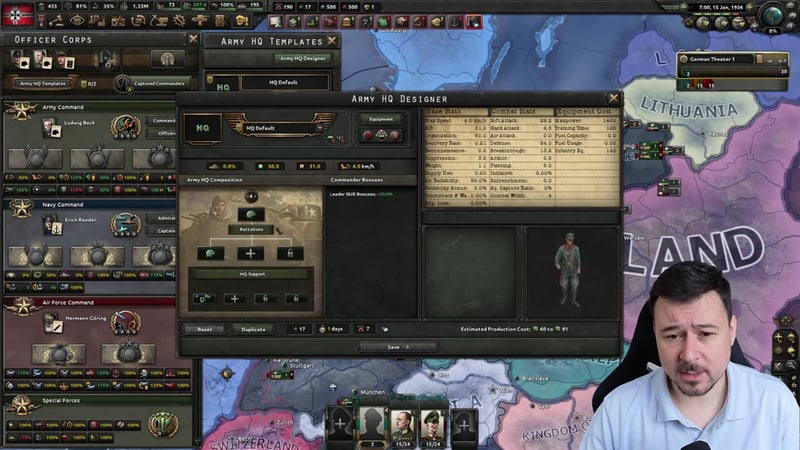
An army headquarters hands a general's entire army a set of commander bonuses, and four support slots decide which ones. This page names the three companies that belong in almost every HQ, matches the fourth slot to the job the general actually has, and sets the proximity that stops him being captured.
Quick answer
| What | Answer |
|---|---|
| Always take | Headquarters staff, forward air controller, logistics |
| Free slot | Recon staff for a defensive general |
| Proximity | Proximity 1, which costs minus 5% from army HQ distance |
| What matters | Only the commander bonuses; the HQ division's own stats do nothing for the army |
| Combat width | 8, the maximum an HQ division can reach |
| Capture risk | Guaranteed if the HQ is encircled or overrun |
| Best buffs | Logistics: minus 5% supply consumption and general max army size plus two |
| Never click | The logistics ability: strength damage taken plus 40% |
| Divisions per HQ | 24 under one general, 26 with logistics; past that his bonuses and XP shrink |
| Army group | Has no HQ of its own — each army inside it deploys one |
Set up an army HQ division
The template question answers itself once you know the numbers. An HQ division is capped at 8 combat width 1:29, so it cannot be given good combat stats no matter what you put in it, and it is not meant to fight. Deploy it and leave it alone.
- the unit appears on the map a couple of days later
- most countries start with this exact composition
- raises production cost; keeps the division alive if it is accidentally engaged
- so the HQ keeps pace instead of trailing
- heavy tanks alone add 1.36 supply use, plus fuel and equipment production
- capture is a chance in any battle and a certainty in an encirclement

Once it lands, the general is a real unit standing on the map, with a position an enemy can reach 1:58. That is the whole reason the rest of this page exists.

Supply use is the one stat here that can hurt the rest of your army, because supply taken by the HQ is supply the fighting divisions do not get. Infantry and motorized battalions add none of it, so the cheap template is also the correct one.

Winning a fight with an HQ still risks the general. Losing one guarantees his capture. There is no template that changes this — the fix is positioning, not battalions.
Choose a proximity setting that keeps the general alive
Proximity is set in the battle plan controls, and the number is how many tiles back from the front line the general stands. Only that distance is measured: the arrows drawn between the HQ and its divisions look like they matter and do not, so a general parked far from a particular division loses nothing for it 4:51.
| Setting | Where he stands | What it costs | Use it when |
|---|---|---|---|
| Proximity 0 | On the front line, at a spot the game picks | Nothing — bonuses apply in full | Never, unless you are watching him |
| Proximity 1 | One tile back | Minus 5% army HQ distance on his divisions | Always, as the set-and-forget default |
| Proximity 2–3 | Two or three tiles back | More of the same distance penalty | You are buying safety you already had at 1 |
| Free | Wherever you place him by hand | Nothing, if you place him off the line | You want proximity 0's full bonuses and will manage him yourself |

Proximity 0 is the trap. The bonuses are at full strength there, which reads as free value, but the game chooses where on the front he stands and you have no say in it. Free control gives you the same full bonuses with the placement in your hands — it just costs attention every time the line moves.
Proximity 1 is the answer for almost every general. The general should never be engaged, and the entire bill is a single minus 5% line labelled army HQ distance on the divisions he leads.

Read an HQ support company the right way
Every HQ support company tooltip shows two blocks, and only the lower one is about your army. The commander bonuses at the bottom apply to every division the general commands. Everything above them — defense, breakthrough, soft attack and the rest — applies solely to the 8-width division he personally leads, the one you have just decided will never fight. Comparing companies on those numbers ranks them by a quality none of them will ever use.

Some companies also unlock an army ability, and that ability is part of the company's value — sometimes most of it, and in one case a reason to be careful. Read both parts before you slot anything.
There is a second cost that never appears in the tooltip. Slotting the HQ version of a company you do not otherwise use — military police, signal — means researching that company purely to unlock its HQ variant. A company you already research is worth several percent more than an equally strong one you do not 12:35.
The full HQ support company list
Eleven HQ support companies exist and four slots take them, so the HQ support company list below is the whole decision. Read the commander bonuses column and nothing else: HQ combat width is capped at 8 whatever you slot, which is the game saying plainly that the division is not the point.
| HQ support company | Commander bonuses | Ability it unlocks |
|---|---|---|
| Headquarters staff | Leader skill bonuses +20% | — |
| Logistics & service staff | Supply consumption -5%, general max army size +2 | Exploit Breakthroughs |
| Forward air controller | Damage reduction against CAS +5%, air superiority bonus in combat +5%, airborne invasion preparation time -5% | — |
| Recon staff | Recon +10%, terrain traits XP gain +20% | Defense in Depth |
| Signal and intelligence staff | Max planning +3%, recon while entrenched 10%, enemy operative capture chance 10% | Rotating Reserves |
| Hospital group staff | Division experience gain +10%, chance to get sick or wounded in combat -25% | Stockpile Medical Supplies |
| Engineer staff | Invasion defense +5%, fort damage from combat +20% | Prepare Fallback Positions |
| Maintenance planning staff | Division attrition -10%, equipment capture ratio factor +2% | — |
| Military police staff | Division speed +5% | — |
| Special operations coordination | Special forces attack +5%, special forces non-combat out of supply -10% | — |
| Naval liaison | Amphibious invasion speed +5%, marine supply grace +24h, shore bombardment +15% | — |
Five of them unlock a commander ability, and those are the five the ability tooltips name exactly: Reconnaissance Staff, Signal & Intelligence Staff, Hospital Group Staff, Engineer Staff and Logistics & Service Staff. An ability is greyed out until the matching company is sitting in a deployed HQ, so the company and the ability are one decision, not two.
Most of the list is the HQ version of a company you already know, and that is where the real price hides. The recon company HQ variant is recon staff, and almost every country researches recon anyway. The signal company HQ variant is signal and intelligence staff, which is only cheap if signal is already in your division templates. The military police HQ company follows the same rule: no military police anywhere in your army means a research slot spent on one line of division speed.
Fill the three slots every HQ should have
Three of the four slots need no thought after the first time. Fill them in this order and move on.
- available from the start in every country; scales attack, defense, breakthrough, planning and supply reduction together
- needs only support equipment, so it is unlocked from turn one
- take it on every general who can have it
Logistics earns the top spot on supply alone. Supply decides whether an offensive moves at all, so cutting consumption by 5% across an entire army is worth more than any percentage on a stat sheet. Max army size plus two is the second half: a good general's bonuses now cover two more divisions than they did, for nothing.

The forward air controller looks weak on paper because its three bonuses never all fire at once. That is exactly why it is reliable: hold air superiority and the plus 5% combat bonus is working; lose it and you are taking enemy CAS, so the plus 5% damage reduction is working instead. One of the two is always paying out, and the entry price is support equipment.

Headquarters staff is a single line — plus 20% leader skill bonuses — and it multiplies everything the general already gives: attack, defense, breakthrough, planning, supply reduction. It grows with him, so it is weakest on a general you created last month and strongest on the one who has led since 1936. Treat it as a slot you never empty rather than one you fill 17:26.

Pick the fourth slot for the job the general has
The last slot should never sit empty, and there is no single right answer for it — match it to what that general is leading. Recon staff is the default for a defensive general, and it is usually unlocked already, which several of the alternatives are not.
| Company | Commander bonuses | Take it when |
|---|---|---|
| Recon staff | Recon +10%, terrain traits XP gain +20% | Defensive generals, and any general you want farming terrain traits fast |
| Special operations coordination | Special forces attack +5%, special forces non-combat out of supply -10% | The general is leading special forces — then it is mandatory |
| Naval liaison | Amphibious invasion speed +5%, marine supply grace +24h, shore bombardment +15% | You have one dedicated naval-invasion general; strong buffs, one user |
| Signal and intelligence staff | Max planning +3%, recon while entrenched 10%, enemy operative capture chance 10% | You already research signal — the last two bonuses do nothing |
| Hospital group staff | Division experience gain +10%, chance to get sick or wounded in combat -25% | Armoured armies you want gaining experience |
| Maintenance planning staff | Division attrition -10%, equipment capture ratio factor +2% | High-attrition theatres — the Soviet Union above all |
| Engineer staff | Invasion defense +5%, fort damage from combat +20% | You are attacking forts, which you mostly should not be |
| Military police staff | Division speed +5% | A fast armoured army, if you already research military police |
Recon's terrain trait figure is the one worth building around. Plus 20% stacks with theater training on grand battle plan for plus 40% total 14:30, which turns trait farming on a new general from a campaign-long project into something you notice happening.

Two entries in that table are ranked lower than their numbers suggest, for the same reason. Signal's plus 3% max planning is genuinely strong, and military police's plus 5% division speed applies to the whole army; both cost you a research slot on a company you would not otherwise touch. If signal is already in your division templates, move it up several places.
The best HQ support companies, ranked
The two sections above build a correct HQ in order. This is the same answer as a tier list, for when you are staring at four empty slots and want to fill them.
| Tier | Companies | What puts them there |
|---|---|---|
| Take on every general | Logistics, headquarters staff, forward air controller | Army-wide effects, and all three are unlocked early or already |
| The default fourth slot | Recon staff | Researched anyway, feeds terrain traits, and carries the entrenchment ability |
| Right for one job only | Special operations coordination, naval liaison, hospital group staff, maintenance planning staff | Excellent on the general whose job matches, dead weight on every other |
| Only if the research is already done | Signal and intelligence staff, military police staff | The bonuses are real; the research slot is the price |
| Rarely | Engineer staff | Fort damage pays only while you are attacking forts |
So the best HQ support companies are not a matter of taste for three of the four slots, and the argument only ever concerns the fourth. Judge a candidate for it on two questions: does this general's army actually do the thing the company is about, and do I already research the ordinary version of it?
Use the HQ abilities that help and never click the one that does not
Four of these companies unlock an army ability. Two are worth having, one is worth having only on a specific day, and one should never be pressed.
| Ability | Effect | Duration | Verdict |
|---|---|---|---|
| Recon staff | Max entrenchment +3, planning -50% | Infinite | Excellent on a front you intend to hold indefinitely |
| Signal — rotating reserves | Reinforce rate +6% | 7 days | Real value in long battles, which mostly means multiplayer |
| Hospital | Casualty trickle back +4% | 14 days | Only before an offensive you know will be costly |
| Engineer — prepare fallback positions | Entrenchment speed +6 | — | Marginal |
| Logistics | Org loss when moving -10%, plan preparation decay rate -20%, strength damage taken +40% | Infinite | Never activate it |
The recon ability is the reason to give a defensive general that slot even if you never farm a terrain trait. Flat plus 3 max entrenchment for as long as you like, at the cost of half your planning, is a straight trade of offense for defense — perfect where you have already decided to stand still and hold.
Reinforce rate governs how quickly reserve divisions fill the gaps when engaged divisions run out of organisation. Against the AI your divisions usually win before that matters; against a human, running dry mid-offensive is the normal outcome, which is where signal's plus 6% for a week earns its slot 11:10.
The logistics ability reads as two small positives and then hands your army strength damage taken plus 40%. It is infinite, so there is no waiting it out. Take the logistics company for its commander bonuses and never touch the ability button.

Army group HQ vs army HQ
An HQ belongs to an army, and that single fact answers most of the army group HQ vs army HQ confusion. You deploy the general who commands an army; the HQ is that army's unit; the game holds the two together tightly enough that an army with a deployed HQ cannot be disbanded at all, and changing that army's commander waits until the HQ has been withdrawn.
An army group is the field marshal's formation — up to five armies, or seven with the Expert Delegator trait — and what he contributes to them is himself. His skill levels and traits reach every army under him at half strength, while his personality traits pass down with no penalty at all. Everything Thunder at Our Gates added here is an army HQ: the designer is the Army HQ Designer, the deployment belongs to an army, and the armies inside a group each field their own, with their own four companies chosen for what that army is doing.
| Question | Army HQ | Army group |
|---|---|---|
| Who is deployed | The general commanding that one army | Each army in the group deploys its own; the group has none |
| Where the bonuses come from | The four HQ support companies you slot | The field marshal's own skill levels and traits |
| How much of it arrives | In full, to every division in the army | At half strength, to every army in the group |
| How much it covers | 24 divisions under one general, 26 with logistics | Five armies, seven with Expert Delegator |
The abilities behave the same way, and they are priced per battalion: 0.1 command power for Defense in Depth and Exploit Breakthroughs, 0.12 for Prepare Fallback Positions and Rotating Reserves, and 0.22 for Stockpile Medical Supplies. A big formation therefore pays more for the same ability than a small one, which is a quiet argument for keeping armies near the division cap rather than well past it.
Holding shift while assigning a commander to an army also starts deploying his HQ, so the template you designed goes out without a second trip to the army panel.
HQ level up guide: raising the general who runs it
This is the part of an HQ level up guide people mean when they ask: the general, not the division. Headquarters staff multiplies bonuses he already has, so plus 20% of a level 2 general is nearly nothing and plus 20% of a level 7 general is why that slot never empties. Levelling him is part of the HQ setup, not a separate hobby.
A new general starts at skill level 1, with about a one-in-twenty chance of arriving at level 2 instead. The experience each level asks for climbs steeply — 100 for the first, 10,000 for the ninth — so the early ones happen by themselves and the late ones have to be arranged.
- past 24 divisions his bonuses and his experience gain are both reduced proportionally
- experience from a single battle decays the longer it runs, and it is shared out when several generals fight it together
- terrain traits XP gain +20%, and +40% stacked with theater training on grand battle plan
Two things look like they belong on that list and do not. Hospital group staff's division experience gain +10% is the division's experience — it buys army experience and better templates, not a faster general. And promotion runs the other way: making a general a field marshal costs command power and temporarily costs him a skill level, so promote the general you have finished levelling rather than the one you are still working on.
Also worth knowing
- Proximity does nothing without a real front line. An army given only a fallback line keeps its HQ up at the front and the general keeps getting captured. Draw an actual front line first, then set proximity.
- Deploying HQs costs command power, and it comes out of the same pool as promoting a field marshal. Decide which you want before you spend it.
- An HQ left on the front line bleeds manpower continuously. It joins fights its stats cannot win, and casualties accumulate quietly enough that a war can look far more expensive than it is until you check where the losses are coming from.
- A motorized or armoured HQ outruns the infantry army it belongs to, visibly shuffling up and down the front as it repositions. Cosmetic, but a reason to match the HQ's speed to its army rather than maximising it.
- In multiplayer, a slightly beefier HQ pays for itself against rear-line paradrops, holding just long enough for real reinforcements to arrive. In single player that scenario barely comes up.
- Encircled generals can be pulled out, and the AI disbands its own rather than lose them, which makes achievements that require capturing a named enemy general very hard to complete.
Whether every HQ commander bonus is currently applying as written is still an open question among players. If a bonus looks like it is not showing up on your divisions, you are not the only one asking.
Frequently asked
Why does my general keep getting captured in HOI4?
A deployed army HQ is a real division on the map, and every fight it joins carries a chance the general is captured; that chance becomes a certainty if the division is encircled or overrun. Proximity zero puts him on the front line at a random spot, which is the usual cause. Set proximity to one so he sits a tile behind the line, and accept the minus 5% army HQ distance penalty. Players also report that the army needs an actual front line drawn, not only a fallback line, before the HQ will hold its distance.
What is the point of an army HQ?
The HQ support companies you slot into it grant commander bonuses that apply to the general's entire army, not just to the small division he leads. That is where effects like minus 5% supply consumption, plus two max army size and plus 20% leader skill bonuses come from. The division's own combat stats are irrelevant, because it should never fight.
Should an HQ division use tanks or motorized battalions?
Motorized is worth it when the general leads a fast army, so the HQ keeps up instead of trailing behind. Infantry and motorized battalions add no supply use, while armoured battalions do: heavy tanks alone cost 1.36 supply, plus fuel and the equipment production. Since the HQ division is not meant to fight, paying supply for its stats steals from the troops that are.
Can I build a whole army out of 8-width HQ divisions?
There is no benefit in it. Each general leads exactly one HQ division, its combat width is capped at 8, and its stats affect nothing beyond itself. Extra battalions only buy enough hit points to survive an accidental engagement, which mostly matters in multiplayer.
How many divisions should be under one HQ in HOI4?
Keep the army at or under 24 divisions. Past that cap the general's bonuses and his experience gain are both reduced proportionally, so an oversized army makes the HQ you just built worth less and slows the levelling that would have made it worth more. Split into a second army rather than overloading one.
What is the difference between an army group HQ and an army HQ in HOI4?
An army HQ is a real unit: it belongs to one army, it is deployed with that army's general, and it carries the four support companies you slot into it. An army group has no HQ unit of its own — the field marshal is what it contributes. His skill levels and traits reach every army under him at half strength, and an army group holds up to five armies, or seven with the Expert Delegator trait.
How do you level up the general running an HQ in HOI4?
A new general starts at skill level 1, with roughly a one-in-twenty chance of arriving at level 2 instead, and the experience each level asks for climbs steeply — about 100 for the first and 10,000 for the ninth. That curve is why the early levels happen by themselves and the late ones have to be arranged. It matters because headquarters staff multiplies bonuses he already has, so the same slot is nearly worthless on a level 2 general and decisive on a level 7 one.
Read next
HOI4 Special Forces Doctrines: Every Branch Ranked
The Thunder At Our Gates patch replaced the special forces doctrine system with one grand doctrine choice and a pair of sub-doctrines for each special forces type, and the branches are nowhere near equal. This guide ranks every option, gives the numbers behind each pick, and sets out the path to take for a standard special forces army.
HOI4 Regimental Support Companies, HQs and Special Forces Doctrine
A new update puts a regimental support company slot into division templates, adds deployable army headquarters with their own support staff, and collapses the special forces doctrine branches into single paths. Covers which support company to slot for each air situation, how to build and position an HQ, and which doctrines and XP upgrades are worth taking, for players who already design their own divisions.
HOI4 Division Templates After the Thunder Rework
Concrete division templates and tank designs for the reworked division designer: how wide to build, which support companies to fit and in what order, and what to put in a tank, a garrison and an army HQ. Written for players who already know the division designer and want current numbers rather than an explanation of the interface.
HOI4 Infantry Templates 2026
This guide covers how to build offensive and defensive infantry templates in Hearts of Iron IV, including doctrine choices, support companies, and when infantry is worth using at all. It is aimed at players who want practical division setups that perform in multiplayer and single-player alike.