
When you start a campaign in Total War: Warhammer III, choosing your race sets the tone for your whole playthrough. This guide ranks all 24 races by their campaign strength, mechanics, economy, roster quality, and ease of use. You will be able to compare the best and worst factions, see why they land where they do, and quickly identify which ones are a good fit for your skills or playstyle.
Quick answer
| What | Answer |
|---|---|
| Total races | 24 |
| Bottom race | Daemons of Chaos |
| Top race | Wood Elves |
| Second place | Beastmen |
| Third place | Chaos Dwarfs |
| Strongest late-game faction type | Warriors of Chaos |
| Best undead mechanic | Raise Dead |
The ranking at a glance
The video numbers all 24 races on screen. Rows that carry a number take it from the video's own numbering; the rest are grouped into the bands the sections below use, in the order those sections present them.
| Placing | Race | Why it lands here |
|---|---|---|
| 1 | Wood Elves | Magical forests and deep roots let them ignore most settlements; one recruitment province supports several armies, so they snowball harder than any other race. |
| 2 | Beastmen | Free armies and herdstones give constant recruitment and replenishment, and hit-and-run razing rolls over opponents. |
| 3 | Chaos Dwarfs | Nearly "broken": elite infantry, devastating artillery, armaments upgrades, labour management and caravans, with an unstoppable economy past its slow start. |
| 4 | Greenskins | The Waaagh mechanic doubles army strength for free, so they outmuscle opponents without needing a large empire. |
| Strongest order factions | Empire | Strong economy, flexible diplomacy and alliances, and a broad roster that is devastating in all phases of battle. |
| 8 | Khorne | A campaign built around constant fighting: Blood Hosts for two of the three lords, a third who teleports between battles collecting buffs, and no weak lord in the faction. |
| Strongest order factions | Warriors of Chaos | Dark fortresses, gifts of Chaos and vassal creation; weak early, unstoppable late-game. |
| Strongest order factions | Dwarfs | Powerful trade plus Age of Reckoning and the Great Book of Grudges; highest armour and dominant ranged units, held back only by slow speed and small unit size. |
| Strongest order factions | Skaven | Cheat-orientated campaign: instant settlement growth, broken ambush stance, and every unit category strong. |
| Risen by rework or DLC | Nurgle | Stacking corruption in regions recruits full-health armies quickly, and the plague systems become hard to stop once rolling. |
| Risen by rework or DLC | Slaanesh | The rework plus fast, micro-intensive armies rewards players who master their charging tactics. |
| Risen by rework or DLC | Ogre Kingdoms | Camps enable flexible recruitment and faction bonuses anywhere on the map; a steeper learning curve, but a hard snowball. |
| 11 | High Elves | Buffed again in Tides of Torment, and the steadiest race to start on: strong start positions, good alliance options and simple mechanics behind strong infantry, excellent monsters and heavy ranged power — solid everywhere, but it never turns into a runaway. |
| Risen by rework or DLC | Norsca | Modernised systems lifted them; they now thrive on burning settlements and monster-focused armies. |
| Mid-tier | Kislev | Balanced and competent hybrid rosters, but the political system lacks depth and campaigns feel bland. |
| Mid-tier | Cathay | Compass, caravans and Bastion defence are present but not impactful; a small but potent roster on an unfinished foundation. |
| Mid-tier | Vampire Coast | Raise Dead and shipbuilding lift them above their undead peers, but the rest of their systems are fragile and their infantry mediocre. |
| Mid-tier | Vampire Counts | Melee and Raise Dead, though secondary mechanics fall short of the Coast's snowball — the ordering of the two can flip on preference. |
| Mid-tier | Tzeentch | Strong spellcasting and the Changing of the Ways, but the complexity keeps them just short of top-tier. |
| Bottom tier | Dark Elves | Rough economy, a gutted slave system and an "okay" roster leave little to do after Black Arks. |
| Bottom tier | Bretonnia | The peasant economy restricts troop choice, and the best knights need continual vows to avoid crippling upkeep. |
| Bottom tier | Tomb Kings | Free recruitment and upkeep, but hard caps on unit types and armies and a weak canopic-jar economy. |
| Bottom tier | Lizardmen | One of the largest rosters, but the Geomantic Web and Blessed Spawnings are underwhelming or forgotten. |
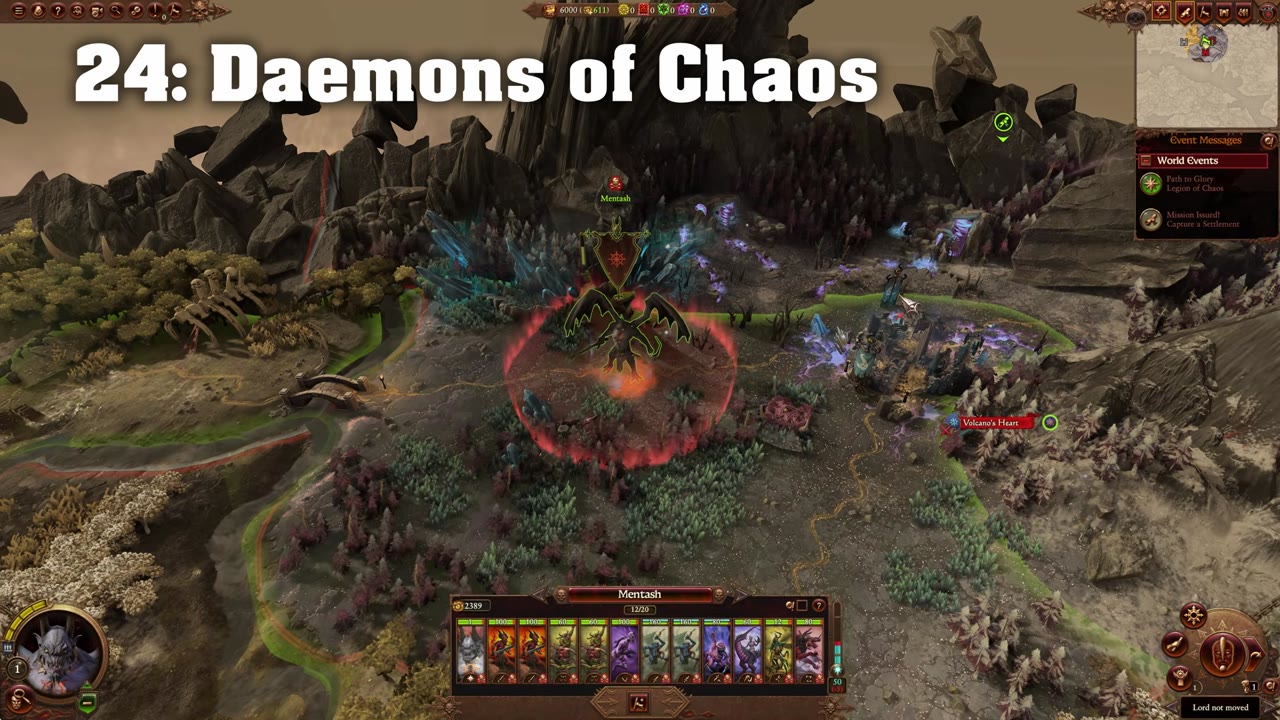
| 24 | Daemons of Chaos | No tech tree, no functional economy, and unlocking the roster demands conquering capitals and collecting glory tokens. |
Each band is covered in detail in the sections below.
Understand how the ranking is judged
This ranking considers several key factors: campaign strength, the uniqueness and effectiveness of faction mechanics, the quality and versatility of each race’s roster, and how easily a race snowballs into late-game dominance. Every race is judged as a whole faction, not on the strengths or weaknesses of a single legendary lord.
A powerful roster is important, but without solid campaign mechanics or a robust economy, the race will struggle to beat others in overall effectiveness. For example, factions with mediocre campaign systems may fall behind even if their unit choices are strong. Recent reworks and new DLCs can make a major difference, as newly updated mechanics push previously mid-tier factions up the list—these timing effects are reflected throughout the ranking. 0:02
Identify the weakest races and why they struggle
Weak factions at the bottom of this ranking share a lack of strong systems, are limited by outdated or unfinished mechanics, or suffer from awkward economies.
Daemons of Chaos sit lowest because they lack a proper tech tree, have no functional economy, and miss out on meaningful faction mechanics. Despite access to a large roster, unlocking these units demands conquering multiple capitals and collecting glory tokens, leading to a campaign that feels unrewarding. They offer mechanics from all four Chaos gods in theory but fail to deliver any that feel game-changing or unique.

Dark Elves rank near the bottom due to a rough economy, limited mechanics, and a roster that is merely "okay" rather than outstanding. Their slave system—the main unique feature—was gutted and now offers very little to drive the campaign forward. Many players find that after rushing construction or using Black Arks, there isn’t much else to do for meaningful progression, making the faction feel empty and overdue for a rework. 1:29
Bretonnia is also considered weak because the peasant economy system heavily restricts troop choice, and unlocking the best knight units requires continually completing vows (often tedious side quests) to avoid crippling upkeep costs. The combination of high potential gold and persistent gameplay limitations leaves the faction feeling clunky and unintuitive, especially for those trying to play flexibly. 2:27
Tomb Kings are another faction slipping down the ranks. They offer free recruitment and upkeep for armies, but are heavily capped in both unit types and total armies. Their campaign economy is mostly limited to canopic jars and a weak monetary system with slow construction acceleration. Their roster is decent, but hasn't kept pace with other races that benefited from recent updates and power spikes. 2:56
- Tomb Kings’ money mechanics: The video describes them as limited in money generation, but current builds show Tomb Kings do not require money for recruitment or upkeep. This may be a balance patch change—use in-game tooltips for the current rules before investing in a campaign.
Lizardmen round out the bottom tier. Although their roster is one of the largest, featuring strong monsters and many unit types, their core mechanics (like the Geomantic Web and Blessed Spawnings) are underwhelming or outright forgotten. Despite receiving numerous DLCs, their basic systems remain weak, leaving them overshadowed by more modernized factions. 3:54
- Faction mechanic caps and limits: If you plan to spend resources or time, check each cap in-game—some numbers and system limits may vary after patches or updates.
See which mid-tier factions are held back by clunky campaigns
Several races land in the middle of the ranking because their core systems are average, their mechanics are incomplete, or their faction kits feel awkward compared to more polished opponents.
Kislev is a prime example. They’re balanced and competent, featuring hybrid rosters and decent legendary lords, but their central political system (involving supporter mechanics and unique events) doesn’t offer much depth and fails to stand out. Kislev campaigns feel bland—solid, but not exciting—so the faction rarely rises above mid-tier status.
Cathay shares a similar fate. Its mechanics—such as the compass, caravan trade systems, and Bastion defence—are present but not impactful enough for long-term campaign strength. The faction’s roster is small but potent, with strong legendary lords, but the overall experience feels like an unfinished foundation when stacked up against other races with deeper kits.
The Vampire Coast stand above their undead peers almost entirely thanks to the Raise Dead mechanic and shipbuilding. Raise Dead lets you instantly replace lost armies at battle sites with powerful units, while shipbuilding gives you unique mobility on the campaign map. However, the rest of their systems are fragile, and their infantry is mediocre—making them heavily reliant on these two features for campaign success. 6:18
Vampire Counts, while still strong, focus mostly on melee and Raise Dead, but their secondary mechanics (such as blood kisses and vampire lord buffs) don’t quite match the Coast’s raise-dead-centric snowball potential. They're close enough to Coast in power that the ordering sometimes flips depending on preference.
Tzeentch enters this tier with strong spellcasting, manipulation of Winds of Magic, and barrier-focused armies. The “Changing of the Ways” system allows for clever campaign tricks, but is often overwhelming, with complex mechanics that make their campaigns feel unnecessarily complicated. The sheer depth can push away newcomers and leaves Tzeentch just short of top-tier status.
Learn which factions rise because of recent reworks or DLC
Recent updates and major DLCs often push previously middle-of-the-road races into higher tiers by giving them modernized systems and smoother snowballing potential.
Nurgle is a clear beneficiary of this trend. While their cyclical buildings require some learning, their real power comes from stacking corruption in regions to quickly recruit full armies with maximum health. Once their plague systems get rolling, Nurgle becomes hard to stop, offering strong self-empowerment and ways to weaken enemies.
Slaanesh received a noticeable boost from its rework. Each legendary lord offers a distinct twist on the faction, but overall campaign flow and their fast-moving, micro-intensive armies make them a force to be reckoned with. Players who master their charging tactics and unique mechanics can achieve tremendous power and momentum.
Ogre Kingdoms saw a major improvement after their DLC and rework. Camps now enable flexible recruitment and powerful faction bonuses anywhere on the map. Their legendary lords, especially the standout Greasus Goldtooth, drive both offensive power and unique playstyles. While their roster has a steeper learning curve, strong campaign mechanics now let skilled players snowball hard.

Similar modernizations lifted other Monogod and Chaos-adjacent factions, propelling them up the rankings once their core systems received attention. Updated mechanics simplified campaign management and boosted snowball potential, explaining prominent rises for races like Norsca, which now thrives on burning settlements and strong monster-focused armies.
Compare the strongest human and order factions
The top conventional empires are distinguished by robust economies, powerful rosters, and unique mechanics that make them hard to defeat. Here are the core strengths of these factions:
| Faction | Campaign Strengths | Roster Features | Notable Lords |
|---|---|---|---|
| Empire | Strong economy, flexible diplomacy and alliances, varied mechanics by lord. Simple but powerful main game systems. 13:14 | Broad roster covering cavalry, infantry, artillery, and great ranged options. Devastating in all phases of battle. | Karl Franz, Elspeth. Balthasar Gelt called out as very strong (see comments). |
| Warriors of Chaos | Methodical campaigns using dark fortresses, gifts of Chaos, vassal creation, and access to mortal/daemon units. Weak early, unstoppable late-game. 15:02 | Massive roster with options for every playstyle, strong lords. | Archaon, Be'lakor, others all highly effective. |
| Dwarfs | Powerful trade, high mobility in mountain settlements, late-game rewards (Age of Reckoning, Great Book of Grudges). Simple but ultra-tough in both campaign and battle. 15:32 | Highest armor, dominant ranged units, strong monsters. Only weaknesses: slow speed, small unit size. | Malakai the strongest; others are solid. |
| Skaven | Cheat-orientated campaign, instant settlement growth, broken ambush stance, wide options for alliances and manipulation. 16:20 | Huge roster; every unit category is strong. Legendary lords enable extreme tricks. | Ikit Claw, Queek, others all have game-changing mechanics. |


Finish with the factions that dominate by momentum and free power
The top four races earn their spots by unleashing enormous campaign momentum, stacking free power, and rewarding aggressive play with unbeatable mechanics:
Greenskins use their Waaagh mechanic to double army strength for free, easily outmuscling opponents without needing a large empire. Their melee-focused roster combines vicious monsters, powerful infantry, and effective magic, while legendary lords provide flexible bonuses. Waaagh armies are so strong that most factions cannot withstand the pressure once a Greenskin campaign gets going.
Chaos Dwarfs, introduced in a DLC, are described as nearly “broken” due to elite infantry, devastating artillery, powerful monsters, and armaments upgrades. Their economy, once past its slow start, becomes unstoppable. Unique mechanics like labor management and usable caravans add even more flexibility and strength, propelling them easily into the top three.
Beastmen take advantage of free armies and herdstones, enabling constant recruitment and replenishment without conventional costs. Their campaign revolves around hit-and-run devastation, enabling them to conquer and raze provinces while unlocking new units and upgrades. Legendary lords vary from strong to overpowered, and their sheer speed and size allow them to roll over any opponent.
Wood Elves are ranked first. Their campaign focuses on magical forests, letting them ignore most settlements and expand rapidly using deep roots (which enable teleportation and expansion). A single recruitment province can support multiple armies, while gold from other provinces funds further growth. Their roster supports devastating skirmishes, hit-and-run attacks, or solid melee lines paired with ranged power. Wood Elves’ economy, movement, and flexibility let them snowball harder than any other race, outpacing all competition after they get established.

Final ordering:
- Wood Elves
- Beastmen
- Chaos Dwarfs
- Greenskins
Also worth knowing
- Dark Elves may deserve a higher rank. Many players argue that Black Arks, easy replenishment near water, and strong legendary lords (like Lokhir, Malus, and Malekith) make them much stronger than listed, especially for map control and recruitment flexibility.
- Balthasar Gelt is stronger than suggested. Some comments highlight Gelt as almost on par with Karl Franz and Elspeth, especially after updates—consider him if you want a top-tier Empire campaign.
- Vampire Coast's placement is contested. Multiple commenters argue that Vampire Counts are at least equal to, if not stronger than, Vampire Coast—Raise Dead and shipbuilding are powerful, but Counts’ melee-focused playstyle extracts more value from the mechanic.
- Norsca has improved greatly. Recent updates are widely praised; Norsca’s spot in the top 10 is justified after their rework.
- Wood Elves as the strongest race is surprising, but most agree. Their forest economy and late-game snowball are extremely powerful, though some were not expecting them to land at the top.
Frequently asked
Why are Dark Elves so low in this ranking?
Their campaign is described as having a wonky economy, an okay roster, and very little beyond the gutted slave worker mechanic. The ranking treats them as a faction that feels empty right now rather than one that has strong enough systems to carry it. Several commenters push back hard on this, pointing to black arks, easy replenishment near water, and strong legendary lords.
Why are Vampire Coast above Vampire Counts?
Raise Dead and shipbuilding are the main reasons. Raise Dead lets them replace an army from a battle site almost immediately, and shipbuilding gives them strong mobility on the campaign map. Vampire Counts are still placed just behind them because they get more value from melee-focused use of Raise Dead, but the two are very close.
Why are Wood Elves number one?
Their forest-focused campaign is the key reason. They can settle magical forests, use deep roots to move around the map, and fund extra armies from a single recruitment province while everything else generates gold. Their roster also supports strong skirmishing and hit-and-run play, so they stay dangerous once they are established.
Is this ranking about campaign or multiplayer?
It is a campaign ranking. Some commenters note that several lower-ranked factions can be much stronger in multiplayer, but that is not the basis used here. The ordering is driven by campaign power, mechanics, and how easily each race snowballs.
Read next
Total War: Warhammer 3 Best Faction for Beginners: The Easiest Campaigns to Start With
This plan covers beginner-friendly campaign choices in Total War: Warhammer 3, with a focus on safe starts, manageable mechanics, and factions that teach core systems. It is aimed at new players who want an easier first campaign without making the game too trivial.
Total War: Warhammer 3 Campaign Difficulty Tier List: Easiest and Hardest Legendary Lords
A difficulty tier list for Legendary Lord campaigns in Immortal Empires, covering which starts are easiest, hardest, and most forgiving. It is aimed at players choosing a first campaign or comparing how different factions handle early pressure.
Total War: Warhammer 3 Lizardmen Guide: Geomantic Web, Rites and Blessed Spawnings
A practical early-to-late campaign plan for Kroq-Gar and the Last Defenders, focused on surviving the opening wars, building efficient armies, and scaling into a Stegadon-heavy late game. It is for players who want a clear path through the faction’s early economy, unit choices, heroes, and research priorities.
Total War: Warhammer 3 Greenskins Guide: Waaagh!, Scrap Upgrades and Da Best Start
This guide covers the core Greenskin campaign mechanics and how they shape expansion, army building, and faction choice. It is for players who want a practical overview of the major lord starts and what each one is best at.