
A Total War: Warhammer 3 army is twenty slots — one lord and nineteen units — and the gap between a stack that wins and one that dies is which jobs those slots cover. This Total War: Warhammer 3 army composition guide starts with the four ways to build one (balanced, counter, thematic and doomstack) and the unit roles they all have to answer, then gives the best army composition for each faction people ask about most: Karl Franz and Elspeth von Draken for the Empire, Archaon the Everchosen for the Warriors of Chaos, Miao Ying for Grand Cathay, and Tzarina Katarin and Boris Ursus for Kislev.
If you would rather drag unit cards into slots than read tables, the community Total War: Warhammer 3 army builder at wh3.ninja assembles a 20-unit army from any roster and shows which game or DLC unlocks each unit. It will also let you build a stack with no anti-large in it without a word of complaint, which is what the rest of this page is for.
Quick answer
| What | Answer |
|---|---|
| Main build types | Balanced, counter, thematic, doomstack |
| Five key roles | Infantry, armor, anti-large, anti-range, anti-air |
| Ranged protection | Two protecting units per one ranged unit |
| Mobility target | 30% to 50% mobility |
| Simple army size | Three or four unit types |
| Slots per army | 20 — one lord plus 19 units |
| Easiest rosters to compose | Empire, Grand Cathay, Kislev |
| Hardest rosters to compose | Vampire Counts, Khorne, Ogre Kingdoms |
Anti-large and anti-infantry unit roles: a quick guide
Every unit card in the game carries the same handful of role tags, and they are the whole vocabulary of army composition. A stack is balanced when each of these has an owner, and it is broken when one of them does not — because the enemy will eventually bring the thing you cannot answer.
| Role | What it is for | Who does it, by faction |
|---|---|---|
| Anti-infantry | massed, lightly armoured models | Greatswords (Empire), Chosen (Great Weapons) (Warriors of Chaos), Iron Hail Gunners (Grand Cathay) |
| Anti-armour | armoured infantry and armoured monsters | Handgunners and Nuln Ironsides (Empire), Streltsi (Kislev), Crane Gunners (Grand Cathay) |
| Anti-large | cavalry, monsters, lords, single entities | Halberdiers and Demigryph Knights (Halberds) (Empire), Tzar Guard (Kislev), Jade Warriors (Halberds) and Peasant Long Spearmen (Grand Cathay) |
| Anti-range | enemy archers, gunners and artillery | Chaos Warhounds and Chaos Furies (Warriors of Chaos), Ungol Horse Archers (Kislev), Pistoliers and Outriders (Empire) |
| Anti-air | flyers that would otherwise land on your guns | anything that shoots upward — Ice Guard (Kislev), Crane Gunners (Grand Cathay), Handgunners (Empire) — plus your own flyers, such as Great Longma Riders or Karl Franz on Deathclaw |
Anti-large and anti-infantry are the pair people mix up, and the mistake is expensive in both directions. Halberds and spears kill Demigryph Knights, Chaos Knights and dragons, and they are mediocre against a block of Chaos Marauders. Great weapons and gunpowder shred that block and bounce off a Terracotta Sentinel. Each is close to useless at the other's job, so an army needs both, in rough proportion to what the enemy actually fields — our counter guide goes unit by unit on that.
Which rosters are hard to compose is a separate question from which campaign start is hard, and it is the one that matters once you are already playing: a role a faction’s unit list simply does not contain has to be answered with positioning, magic or money instead.
| Tier | Factions | Why |
|---|---|---|
| Easy | The Empire (Karl Franz), Grand Cathay (Miao Ying), Kislev (Tzarina Katarin), Dwarfs (Thorgrim Grudgebearer) | every role has an owner inside the faction's own list, so a balanced stack is simply the right answer |
| Moderate | Warriors of Chaos (Archaon), Greenskins (Grimgor Ironhide), Beastmen (Taurox) | one role is thin, usually ranged, and the roster pays for it with speed, marks or ambush |
| Hard | Vampire Counts (Vlad von Carstein), Khorne (Skarbrand), Ogre Kingdoms (Greasus Goldtooth) | a role is missing outright — no missile units at all for the Counts, no spellcasters for Khorne, no flying units for the Ogres |
Missing a role is not the same as being weak. The Vampire Counts field no missile units and no artillery whatsoever, which is a serious problem against a Dwarf gunline and no problem at all once Vlad von Carstein and a wall of Grave Guard are in contact. What this tier really measures is how many decisions the roster makes for you: an Empire player chooses a composition, a Khorne player is handed one.
Line holder vs damage dealer vs flanker
The role tags say what a unit kills. These three say where it stands, and every slot in a working stack is one of them:
| Job | Reads like | Examples |
|---|---|---|
| Line holder | shield, high melee defence, high leadership, low damage | Armoured Kossars (Kislev), Jade Warriors (Sword & Shield) (Grand Cathay), Spearmen (Shields) (Empire), Chaos Warriors (Shields) (Warriors of Chaos) |
| Damage dealer | great weapons or armour-piercing, high melee attack, no shield | Greatswords and Carroburg Greatswords (Empire), Tzar Guard (Great Weapons) (Kislev), Chosen (Warriors of Chaos), Celestial Dragon Guard (Grand Cathay) |
| Flanker | speed in the seventies and up, a large charge bonus, poor sustained melee | Demigryph Knights (Empire), Gryphon Legion (Kislev), Jade Lancers (Grand Cathay), Chaos Knights (Warriors of Chaos) |
Line holders pin, damage dealers break, flankers finish. An army that is all line holders never kills anything before its ammunition and its leadership run out; an army that is all damage dealers loses its front rank in the first minute and gets rolled up from the side.
Choose a balanced starting army
A balanced army is the safest starting point for most factions and campaign situations, and it is easier to learn than a highly specialized build. Choosing it is a campaign decision rather than a battle one: what actually goes in the twenty slots is the section below this, and what keeps a balanced stack worth having across a campaign is the tech, the lord skills and the recruitment discipline in the checklist here.
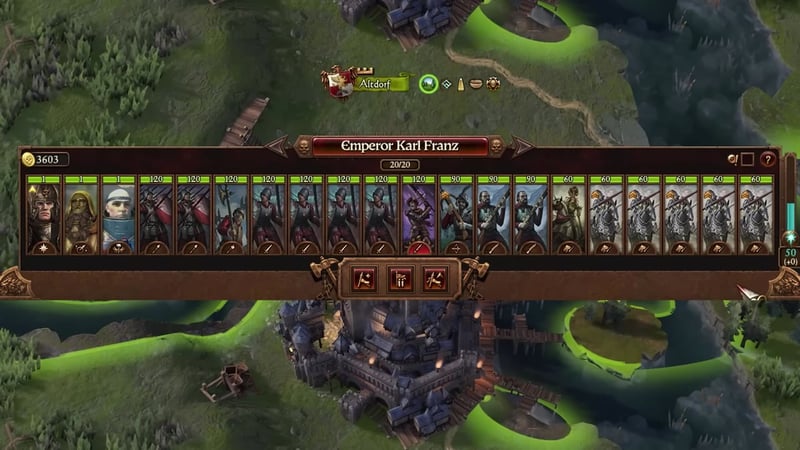
The roster screen below is Karl Franz's, the Empire being a faction that covers all five roles out of its own list.


- A balanced build is only available to a faction whose own list has an owner for every role — the tier table near the top of this page says which do. Where a role is missing outright, it has to be answered with positioning, magic or money instead.
- Anti-infantry, anti-armor, anti-large, anti-range, anti-air 1:30.
- Buff the largest unit categories first (typically infantry and cavalry), making your stack more efficient over the campaign 5:50.
- A balanced army is cheaper than rebuilding units for every opponent, lets you maximize tech investments, and helps you learn optimal matchups 10:14.
Best stack composition in Total War: Warhammer 3
If you want one answer to carry into any campaign, this is the best stack composition Total War: Warhammer 3 rewards most often — twenty slots, filled by job rather than by faction:
| Slots | Job | What goes in |
|---|---|---|
| 1 | Lord | mounted or flying wherever the faction offers it; your best single fighter and your leadership bubble |
| 1 | Hero | a caster, or a support hero such as a Warrior Priest, a Frost Maiden or an Astromancer |
| 5 | Line holders | shielded infantry that can stand still and be hit |
| 4 | Damage and anti-large | great weapons and halberds, split by what you expect to meet |
| 3 | Missiles | armour-piercing wherever the faction has it |
| 4 | Cavalry or flyers | the mobility budget: flanks, enemy artillery, rescues |
| 2 | Artillery or a monster | one guaranteed siege attacker lives here |
Three missile units against thirteen units that can protect them clears the two-to-one guideline further down this page with room to spare, which is the point: the template is deliberately light on shooters, because shooters are the slot everyone over-buys.
Four fast units plus a mounted lord is about a quarter of the army, which sits at the bottom of the 30% to 50% mobility band. Against Skaven, Beastmen or anyone else who chooses when the fight starts, trade a line holder and an artillery piece for two more fast units and accept the slower sieges.
The five sections below fill this same template with real units. Every one of them is these twenty slots moved around to fit what a particular roster actually has.
Build around the enemy you are facing
Counter armies are built to exploit or nullify an opponent's unique strengths and weaknesses. Instead of covering everything, tailor your roster to what you know you'll encounter—especially for tough wars or major campaign turning points.

- Pick units directly suited to their strengths: against Thorgrim Grudgebearer's Dwarfs that means armour-piercing for Ironbreakers and something fast enough to reach Thunderers and Organ Guns 13:08.
- If a faction cannot field the threat, drop the answer: Greasus Goldtooth's Ogre Kingdoms have no flying units, so anti-air is a dead slot, and Vlad von Carstein's Vampire Counts have no missile units at all, so heavy anti-range is wasted 18:02.
- Switching unit types costs recruitment money, time, and often valuable ranks or lord skills, so rebuild between wars—avoid changing constantly 18:20.
- Use heroes or agents to check the enemy stack (14:36).

Karl Franz army composition: a balanced Empire stack
Karl Franz is the reference balanced army in this game, which is why the roster screen further up this page is his. The Empire covers all five roles out of its own list, so counter-building against a specific enemy is a tuning job here rather than a rescue.
| Slots | Unit | Job |
|---|---|---|
| 1 | Karl Franz on Deathclaw | flying lord: reaches artillery, kills lone casters, covers half your anti-air |
| 1 | Warrior Priest or a Bright Wizard | leadership and healing, or Lore of Fire damage |
| 5 | Halberdiers and Spearmen (Shields) | line and anti-large in the same block |
| 4 | Greatswords | anti-infantry damage through the centre |
| 4 | Handgunners or Nuln Ironsides | armour-piercing missiles behind the line |
| 2 | Demigryph Knights (Halberds) | anti-large flank; the answer to enemy monsters |
| 1 | Outriders | anti-range, and harassment of anything that flies |
| 2 | Great Cannon | siege attacker and single-entity removal |
Karl Franz on Deathclaw is doing two jobs at once and that is deliberate: he is a flanker and half the anti-air, which frees the slots a ground lord would have to spend. Keep him off spears and halberds: anti-large infantry is what kills a griffon.
Once Imperial Authority starts confederating Elector Counts, the same twenty slots upgrade in place — Carroburg Greatswords for Greatswords, Hochland Long Rifles for one Handgunners slot, a Luminark of Hysh for one Great Cannon. Our Empire army composition guide walks the early, mid and late versions of this stack turn by turn.
Elspeth von Draken army comp: Empire artillery from Nuln
Elspeth von Draken, the Dark Lady of Nuln, is the Empire artillery answer: she flies a Carmine Dragon, casts the Lore of Death, and her Imperial Gunnery School upgrades the faction's gunpowder and artillery units directly. An Elspeth army comp is the balanced Empire stack with the missile half sharpened and the line thickened to pay for it.
| Slots | Unit | Job |
|---|---|---|
| 1 | Elspeth von Draken on her Carmine Dragon | caster and flyer; Lore of Death for enemy leadership |
| 1 | Master Engineer | artillery accuracy and reload |
| 6 | Halberdiers and Spearmen (Shields) | the screen the guns are paying for |
| 2 | Greatswords | the block that holds the centre when the screen breaks |
| 3 | Nuln Ironsides | armour-piercing gunners that survive being reached |
| 3 | Great Cannon and Helstorm Rocket Battery | the reason this army exists |
| 2 | Demigryph Knights (Halberds) | anti-large; nothing else here stops a dragon |
| 2 | Pistoliers or Outriders | anti-range: they leave the line and go kill the enemy's guns |
Six static shooters against twelve units that can screen or intercept for them is exactly the two-to-one ratio further down this page, and an artillery army is where that stops being a guideline. Artillery that gets reached is artillery that is dead, and Nuln guns are expensive. Deploy the cannons behind the halberd line rather than beside it, and send the Pistoliers at the enemy's artillery in the first minute rather than saving them for a moment that never comes.
If you are choosing between guns, our artillery guide ranks every piece in the game by what it actually kills.
Archaon army composition: Warriors of Chaos without artillery
Archaon the Everchosen leads the roster that breaks the balanced template, and it is worth knowing exactly where. The Warriors of Chaos have no missile infantry worth the slot and one artillery piece, the Hellcannon. Every one of the five roles has to be answered in melee, at speed, or not at all.
| Slots | Unit | Job |
|---|---|---|
| 1 | Archaon the Everchosen | the army's best fighter; Eye of the Gods rewards him for acting like it |
| 1 | Exalted Hero or a Chaos Sorcerer | a second duellist, or the ranged damage the roster otherwise lacks |
| 6 | Chaos Warriors (Shields) | the line |
| 4 | Chosen (Halberds) | anti-large, and the reason an enemy dragon does not simply win |
| 2 | Chaos Knights (Lances) | the hammer |
| 2 | Chaos Warhounds | cheap anti-range; their entire job is arriving |
| 2 | Chaos Furies | flying anti-range and anti-air |
| 1 | Warshrine of Chaos | buffs whatever block it stands behind |
| 1 | Hellcannon | siege attacker, and the only ranged damage in the stack |
The Marks of Chaos are how this army counter-builds, and they cost no slots. The same twenty units can be marked for Khorne when you need damage, Nurgle when the line has to survive being shot, Tzeentch when the incoming damage is magical, or Slaanesh when you want speed and leadership pressure. That is the compensation for a roster with almost no shooting: you retune the army you already have instead of recruiting a new one.
Against a real gunline — Thorgrim Grudgebearer's Dwarfs, or Elspeth von Draken — the plan is fixed and not optional. Chaos Warhounds and Chaos Furies go for the guns immediately, the Chaos Warriors walk forward and eat the damage, and Archaon goes wherever the enemy lord is standing.
Grand Cathay army composition for Miao Ying
Grand Cathay is the one roster where composition is also a deployment rule. Cathay units are aligned Yin (ranged and magical) or Yang (melee), and a unit standing near an opposite-aligned unit is In Harmony: Yang units gain leadership and melee defence, Yin units gain leadership and reload skill. Build the two halves in roughly equal numbers, or half your army fights without the buff it was priced with.
Miao Ying, the Storm Dragon, holds the Great Bastion in the Northern Provinces, so her early armies are defensive by circumstance as much as by design — spears, crossbows and a cannon, standing where the invasion is going to arrive.
| Slots | Unit | Alignment | Job |
|---|---|---|---|
| 1 | Miao Ying | — | caster in human form, monster in dragon form |
| 1 | Astromancer or an Alchemist | — | magic support; the Astromancer can ride the Wu-Xing War Compass |
| 4 | Jade Warriors (Sword & Shield) | Yang | the line |
| 2 | Jade Warriors (Halberds) or Peasant Long Spearmen | Yang | anti-large |
| 2 | Celestial Dragon Guard | Yang | elite damage through the centre |
| 4 | Jade Warrior Crossbowmen | Yin | the missile core |
| 2 | Iron Hail Gunners | Yin | short-range armour-piercing |
| 2 | Grand Cannon | Yin | siege attacker and single-entity removal |
| 1 | Jade Lancers | Yang | flank |
| 1 | Sky Lantern early, Sky-Junk late | Yin | flying support; the Lantern spots, the Junk shoots |
That is nine Yang units and nine Yin units, which is the shape to aim for. Deploy in alternating blocks rather than in two lines. Harmony is a proximity check, so a gun line parked on one flank and an infantry line on the other is an army where nobody is In Harmony at all, however balanced the recruitment screen looked.
Late, a Terracotta Sentinel is worth two infantry slots as an anchor, and Great Longma Riders turn the single Jade Lancers slot into a real flying flank. Zhao Ming, the Iron Dragon, fills the same template from the Western Provinces with more gunpowder in it, and Yuan Bo, the Jade Dragon, leans harder on magic.
Kislev army composition for Tzarina Katarin and Boris Ursus
Kislev bends the protection rule rather than obeying it. Kossars, Streltsi and Ice Guard all shoot and then fight, so a missile slot here is also a protection slot — and most Kislev units carry By Our Blood, turning unbreakable for a short window when the unit is nearly dead, which is why a Kislev line that should have routed often does not.
Tzarina Katarin leads the Ice Court: the Lore of Ice, cheaper Ice Guard, a larger Winds of Magic pool and Frost Maidens that start at a higher rank than anyone else can field.
| Slots | Unit | Job |
|---|---|---|
| 1 | Tzarina Katarin | Lore of Ice; the largest single source of damage in the army |
| 1 | Frost Maiden | a second caster, and her cheapest one |
| 5 | Armoured Kossars | hybrid line: bows first, axes after |
| 3 | Tzar Guard | anti-large, and the block that does not break |
| 4 | Ice Guard (Swords) | armour-piercing magical missiles that slow what they hit |
| 2 | Streltsi | gunpowder against armour, and a great axe when reached |
| 2 | Gryphon Legion | armoured shock cavalry |
| 1 | Ungol Horse Archers | anti-range, cheap, available immediately |
| 1 | Little Grom | siege attacker |
Boris Ursus builds a different army out of the same list. He starts in the Chaos Wastes with immunity to chaotic attrition, cheaper garrison and religion buildings, and War Bear Riders recruited at higher rank — and his Elemental Bears regenerate health during combat, which promotes a good unit into the centre of the army.
| Slots | Unit | Job |
|---|---|---|
| 1 | Boris Ursus | melee lord; he fights in the line, not behind it |
| 1 | Patriarch or a Frost Maiden | leadership, or magic |
| 6 | Armoured Kossars | the line, hybrid again |
| 3 | Tzar Guard (Great Weapons) | armour-piercing damage |
| 3 | Streltsi | the missile core |
| 4 | War Bear Riders | the hammer, and cheaper for him than for anybody else |
| 1 | Elemental Bear | regenerating anchor; his faction bonus lives on this slot |
| 1 | Little Grom | siege attacker |
Neither stack spends a slot on dedicated anti-air, and that is a roster property rather than an oversight: Kossars, Streltsi and Ice Guard are all shooting anyway, so against Norsca or a Warriors of Chaos flyer they simply change target. What both stacks do have to buy is siege capability — Little Grom is the only artillery Kislev owns, and an army without it waits a turn outside every walled settlement.
Make an army around one unit type you enjoy
A thematic army centres on a preferred unit class, family or gameplay style — an all-Savage Orc stack under Wurrzag, an all-monster army under Throgg, an all-missile army under Alith Anar. The reason to build one is fun, challenge, flavour, or showing off a faction's identity, and it is still a campaign army: it keeps enough of the roster answering other threats to finish the campaign it is in.
Pick a theme the lord already agrees with. Wurrzag's Savage Orc bonuses and Throgg's monstrous-unit buffs are what let a theme stack really shine, so the cheapest theme to run is the one your legendary lord, faction traits and tech were going to buff anyway.
Then keep it mixed enough to play. Thematic sits happily alongside balanced or counter principles, and when you hit a campaign wall — a poor matchup, or one that brute force alone cannot solve — supplement the theme with flexible or specialized tools rather than abandoning it. Taken to its limit instead, with nearly every slot given to the one unit, this becomes a doomstack, which is the section below.
Turn one unit into a doomstack
A doomstack is an extreme form of thematic or specialized army: nearly all slots are filled by one unit or a very tight unit family, and the build is heavily buffed by lord skills, red-line abilities, faction bonuses, and tech upgrades.

The main appeal is that stacking buffs, ranks, and lord bonuses onto a high-tier unit — Taurox the Brass Bull's Minotaurs, Helblaster Volley Guns behind an Empire Master Engineer, Chaos Knights under Archaon — produces huge efficiency and battle power. Doomstacks are famous for being able to defeat multiple enemy armies in one turn, auto-resolve their way through campaign challenges, and often trivialize battles.
Cheesy doomstacks are most effective when the unit is both strong at base and deeply synergized with buffs—unique mechanics or lord skills that ignore normal limitations. Legendary difficulty, rapid expansion, or campaign speedruns all benefit from this method.

Doomstack building is possible even with lower-tier units, so long as those units are highly ranked and sufficiently buffed. For example, Cairn Wraiths and Hexwraiths under Heinrich Kemmler are mid-tier units that shine when focused, max-ranked, and layered with skills. However, be aware that an all-one-unit army is vulnerable to hard counters: if the enemy brings the right answer for your single unit type, a doomstack can lose decisively.
Protect ranged units before adding more
Missile units and artillery can be powerful, but only if kept alive and firing. Total War: Warhammer III makes it easy to overload on shooters, but most armies cannot reliably protect more than three to four guns or bows. Chaos Warhounds, Ungol Horse Archers, Chaos Furies, a Jade Lancers charge and any summon spell all threaten ranged lines, and every model lost means less total ammo available.

- Bring two units capable of reliably screening, pinning, or defending for every one missile unit 25:41.
- If shooters cannot survive long enough to use most of their ammo, use fewer and spend those slots on melee, cavalry, or flexible units instead 26:40.
- Army strength is not just about paper DPS—excess shooters lose value quickly without enough frontline or mobile units screening them.
Use more mobility than you think
Mobility is not just cavalry—it includes flyers, fast monsters, mounts, and any unit that can reposition rapidly. High mobility armies are much more flexible, able to quickly retreat from bad matchups, reinforce threatened allies, interrupt enemy backlines, or cover multiple objectives.

- Reserve at least 30%—ideally 50%—of your stack for units with high speed: Demigryph Knights, Gryphon Legion, Great Longma Riders, Chaos Knights, War Bear Riders, or any mounted lord 29:06.
- Infantry forms the anchor, locking enemy units in place and giving your mobile units time to outmaneuver and counter threats.
- Fast units can respond to unfolding fights, change plans mid-battle, rescue allies, and reach threatened flanks or backlines quickly 30:34.
Keep your roster simple when needed
Army complexity can be trimmed for ease of use—especially for newer players and for situations where flexibility is more important than perfectly answering every threat. Three or four unit types is often enough, provided you cover most of the five key roles.
Simple rosters mean battles are easier to manage: you see quickly what each unit’s job is, minimize complicated micro-management, and avoid losing track of crucial matchups. While these builds may lack some depth or specialty power, they offer reliable performance and clear learning pathways.
A worked example: Armoured Kossars, Tzar Guard, Ice Guard (Swords) and Gryphon Legion is four unit types, covers four of the five roles between them, and is a Kislev army you can run on autopilot. As you gain experience, gradually add specialized units and mix more complex tools into your army. Advanced armies may mix thematic, counter, and balanced ideas, but for initial stack design, a small, clear roster is usually best.
Total War: Warhammer 3 difficulty tier list for army building
A Total War: Warhammer 3 difficulty tier list usually means "which campaign start is hard", and that question has a page of its own: our Total War: Warhammer 3 campaign difficulty tier list ranks the early-game difficulty of every Legendary Lord’s starting position in Immortal Empires, race by race, from Boris Ursus as the hardest start to the Changeling as the easiest — and keeps the newly released Lords separate as provisional estimates. It is the page to read before you choose a campaign; this one is about the armies you fight it with.
Which rosters are hard to compose is the narrower question, and it is answered near the top of this page, beside the five unit roles.
For campaign difficulty proper — who to start as, and which neighbour will end you — see also our Total War: Warhammer 3 faction tier list and the best starting positions guide.
Also worth knowing
- Add siege attackers to every army. Having at least one guaranteed siege attacker—artillery, a monster, or an appropriate legendary lord—prevents having to wait an extra turn to attack walled settlements.
- Micro-intensive units should be grouped for ease of control. Cavalry, spellcasters, line-of-sight gunners, heroes on mounts, and most monsters all need special attention; avoid stacking too many types demanding micro in one army.
- A balanced army can be formalized for easy reference. One practical suggestion: one lord, one hero, eight infantry units, six missiles or artillery, four cavalry or monsters.
- Start with your faction’s win condition, then add support. Building around your main damage dealer—what the faction does best—and supporting it with the appropriate units produces stronger armies.
- Dual army tactic helps in expansion. For large campaigns, build a main army and a reinforcing second one: one handles the main fight, the other provides flanking and specialized threats.
- A hero slot is worth two units when the hero is the right one. An Empire Warrior Priest, a Kislev Frost Maiden or a Cathay Astromancer buys leadership, healing or magic that no single unit in the same slot could.
- Regiments of Renown are upgrades, not a plan. They take the slot the ordinary unit would have taken and cost more upkeep, so take them where the stack already wanted that unit.
- Some players bias toward more ranged units for burst. While the recommended ratio is two protectors per shooter, massing more missiles can increase burst DPS and let you eliminate threats quicker, but you risk losing shooters to mobility or spells.
Frequently asked
How many ranged units should I bring in a campaign army?
Bring only as many ranged units as you can realistically protect. A rough starting point is two protection units for every one missile unit, so three ranged units want about six units that can screen, pin, or defend them. If you cannot keep the shooters firing for most of the battle, those slots are usually better spent on something else.
What is the safest army style for newer players?
A balanced army is the safest starting point because it can handle more enemy compositions without needing a perfect matchup. It usually includes some infantry, some anti-large, some ranged, and some mobile units so it can answer different threats. It is not always the strongest option, but it is the easiest way to stay flexible while learning unit roles.
When should I use a doomstack?
Use a doomstack when you want maximum power from one unit type and you are comfortable leaning into a very specialized army. It is especially strong when a lord, skills, tech, and faction mechanics heavily buff that unit. The tradeoff is that it can become repetitive and can struggle badly if the enemy brings a hard counter.
How much mobility does an army need?
A useful target is about 30% to 50% mobility. That does not mean only cavalry; it can include fast monsters, mounted lords, flying units, and other quick pieces that can swing fights, chase threats, or rescue allies. Mobility matters because it lets you respond to bad matchups before they decide the battle.
How many units should be in an army in Total War: Warhammer 3?
Twenty slots: one lord and nineteen units. A hero takes one of the nineteen, so a lord plus one hero leaves eighteen fighting units. A workable default fill is five line holders, four damage or anti-large units, three missile units, four cavalry or flyers, and two artillery pieces or a monster — and one of those last two slots should always be something that can attack walls, or the army waits an extra turn outside every settlement.
Which Total War: Warhammer 3 factions are hardest to build an army for?
The rosters that are missing a role outright. Vlad von Carstein's Vampire Counts field no missile units and no artillery, Skarbrand's Khorne has no spellcasters at all, and Greasus Goldtooth's Ogre Kingdoms have no flying units. The Empire, Grand Cathay, Kislev and the Dwarfs sit at the other end: every role has an owner inside their own list, so a balanced twenty-slot stack is simply the right answer. Missing a role is not the same as being weak — it means the roster makes the decision for you.
Is there a Total War: Warhammer 3 army builder?
Yes. The wh3.ninja Army Planner is the community army builder most players use: it fills a 20-unit army from any roster and shows which game or DLC unlocks each unit. It does not judge the result, so pair it with the five unit roles — a stack with no anti-large, no anti-range or no siege attacker builds fine in a planner and loses in the campaign.
What is the best army composition for Grand Cathay?
Nine Yang units and nine Yin units, plus a lord and a hero, so every block is In Harmony with a neighbour. For Miao Ying that is four Jade Warriors (Sword & Shield), two Jade Warriors (Halberds) or Peasant Long Spearmen, two Celestial Dragon Guard, four Jade Warrior Crossbowmen, two Iron Hail Gunners, two Grand Cannons, one Jade Lancers and one flying unit. Deploy them in alternating blocks: Harmony is a proximity check, so a gun line parked on one flank loses the buff for the whole army.
Read next
Total War: Warhammer 3 Missile Units Guide: Why Your Archers Aren't Firing and Best Ranged Units
This guide explains the main missile weapon variants in Total War: Warhammer III, including their range, damage profile, and deployment requirements. It is for players who want to pick the right ranged unit and use it effectively in battle.
Total War: Warhammer 3 Best Units for Every Faction (2026)
This plan covers one high-value unit for each race in Total War: Warhammer 3, with an emphasis on early access, campaign value, and easy-to-use roles. It is for players who want a practical recruit list instead of a full roster breakdown.
Total War: Warhammer 3 Empire Army Composition: Early, Mid and Late Game Stacks
This guide plans a practical Empire campaign army progression from the first turns through late game. It is for players who want to know which units, heroes, and allied recruits are worth building at each stage.
Total War: Warhammer 3 Artillery Guide: Every Gun Ranked
A ranked breakdown of the strongest artillery, grouped by weapon type and faction access. It is for players who want the best picks, the key stats that make them strong, and a few practical deployment notes.