
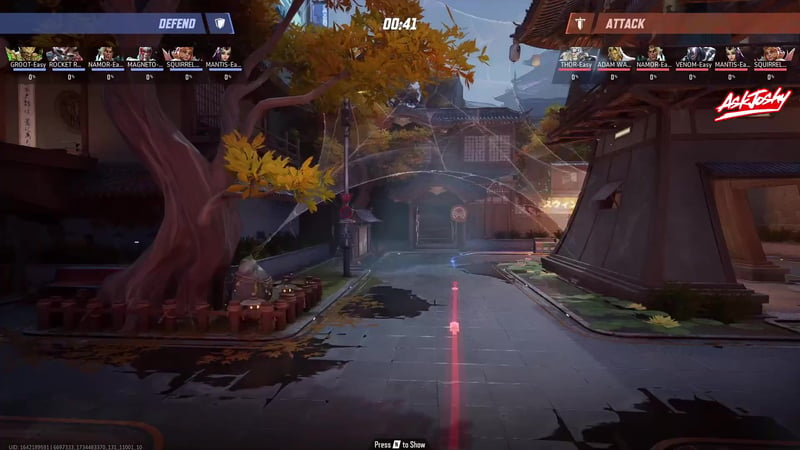
🎯 The core idea
Spider-Islands (Tokyo 2099) is a Convoy map — Marvel Rivals' escort/payload mode — split into three checkpoints, each with its own chokepoint, health pack layout, and destructible terrain. This guide walks the full route from both sides: where attackers push, where defenders hold, which walls are actually breakable, and where every health pack sits, since every single one in this map is on the ground rather than elevated.
The map's physical layout — routes, walls, health packs, chokepoints — doesn't change between balance patches, which is what this guide is built on. Specific hero picks are given as examples of the archetypes that work well here (flankers, flyers, tanks) rather than a fixed tier list, since those shift with balance far more often than the terrain does.
- free costs nothing
- cheap small cost
- setup needs preparation
- grind pays off slowly
- skip the thing to stop doing
Checkpoint 1: the first push out of spawn

Attackers push out of spawn to where the convoy first drops onto the ground. Ranged characters can hang back and take shots at defenders from range, while melee-oriented attackers tend to run for one of two jump pads to create an alternate path and split the defenders up. Defenders are most likely to post up at the first choke point in a tight cluster — tanks and healers holding together to block the convoy directly.

Health packs on this first stretch: one just off to the left of the path near the very start (the only one usable until the first corner), then at the corner, options open up — one tucked close-left, one close-right, and another a little further on the close-right, next to a Hulk plushy sitting in a small room just off the street (pictured above). Every health pack on this entire map sits on the ground, not up on any elevated ledge — if you're in danger, the instinct should be to drop down rather than climb.

Past that corner, defenders hold mostly from high ground or the corner of the nearby building, since it's a long hallway they can shoot straight down. Ranged attackers can either break through the paper walls up there for new sightlines, or post up at range and take the long shots down the hall themselves. There's another ground-level health pack close to the left as the path approaches the first checkpoint itself, and one more on the close-right of the checkpoint — that second one is hotly contested, since defenders funnel through the same hallway (or the space just above the point) to reach it.
The defender's opening perspective
When the round starts, defenders spawn near a bridge, and any hero with a grapple or zipline-style mobility tool can swing off it to shave a couple of seconds off their rotation to the front line. The exits to the right of defender spawn are dead ends — going there wastes time. The fastest paths out are through the window or the door straight ahead; a hero who can fly or climb walls can save additional time by going over the wall directly rather than through either opening.
Checkpoint 2: the second push and a new spawn

Once the first checkpoint falls, defenders fall back to a new position and attackers get a new spawn point of their own — pictured above. From there, attackers can either jump up and out of the hallway or push straight through it, which is the faster route back to the convoy; defenders now have a considerably longer run to get back into position.
There's a health pack on the close-left as the convoy moves along this stretch. Defenders will most likely set up on high ground at the top-right or top-left, again favoring corners where tanks and healers can cluster together. This is also where flankers earn their keep: mobile attackers who can dive around the choke and unstick a balled-up defense are especially effective at breaking this kind of setup, since the defenders' clustered positioning is strong against a straight push but vulnerable to flanking. Spider-Islands leans heavily vertical throughout — grapples, ziplines, jump pads, wall-crawling and flight all shave real time off a rotation here, more so than on a flatter map, which is exactly why mobility-focused heroes overperform their raw stats on this particular map.

On defense, flying heroes get real value here too — there's enough natural terrain around this section for a flyer to dart in, take a shot, and retreat into cover before the enemy team can punish it, or even use the terrain itself to block incoming attacks entirely while staying just out of reach.
As the payload rounds the next corner, assuming defenders' healers get dealt with before their tanks can meaningfully react, the push continues to the gate for the second checkpoint. There's a side area with a health pack off the main path here, but it's far enough from the convoy route that it only matters if a fight is specifically happening in that pocket — most players won't have a reason to detour there. A second, similarly out-of-the-way health pack sits near the cliff edge on the far side, more useful to a long-range defender making a last-ditch stand than to anyone pushing the cart directly.
Checkpoint 3: the final stretch

After the second checkpoint, defender spawn moves all the way back to a large building (pictured above) with only two real routes out: through a highly destructible building on the left, or straight down a set of stairs to meet attackers head-on. There's an alternate side path with its own health pack, and several jump pads scattered through this area — some of their intended use isn't obvious at a glance, but they're especially useful for melee heroes and tanks trying to close distance quickly.

The third and final stretch runs along this area and up a set of stairs — a tough hold for defenders, since they only really have two entrances to contest it from, and their spawn is now about as far back as it gets. This section is themed as a station dispatching different interdimensional spider-heroes — Latveria, Krakoa, Shogun Spider, Ghost-Spider and others are all visible on the board here, a nice detail for anyone who enjoys the Spider-Verse lore side of this map. There's a health pack nearby if a fight breaks out in this area — one on each side — and it's highly contested, since it matters to both a defending tank trying to survive and a low-health attacker looking to top off.
The last corner

This corner is genuinely the defenders' last stand — they spawn and approach from directly around it, jumping onto the cart as soon as they're able. It's a long run for attackers to reach from their own spawn, which makes this the hardest corner to break as attacker. There are two health packs very close together here (within about 15 feet of each other), which both sides should know about — it's rare for a map to stack two health packs this close, and it matters on the stretch where the round is actually decided.
Once the convoy reaches this final spot, the round ends. There's plenty of space up here for long-range defenders to hold from, but the stronger defensive pick tends to be the beefiest characters available — tanks who can contest the cart directly and survive being focused, alongside attackers with strong self-sustain. Healers have a genuinely hard time in this room, since sightlines are scattered across a large open space; anything that keeps the fight consolidated in one spot (a hero who can just plant next to the cart, letting AOE healing do its job) makes their life considerably easier.
How this guide was fact-checked
The Marvel Rivals Wiki (marvelrivals.wiki.gg) confirms Spider-Islands is still a current map under the Convoy game mode, per its Maps listing page (last updated November 2025) — this matters because the source video is from December 2024, roughly a year and a half old at the time of writing, and the map could plausibly have been removed, reworked, or moved to a different mode since then. It hasn't. The wiki has no dedicated page breaking down this map's specific layout, routes or health pack positions beyond that listing, so the route-by-route detail in this guide comes entirely from the source video itself, cross-checked frame by frame against the footage in the images above. The specific heroes named as examples throughout (Spider-Man, Black Panther, Iron Fist as flankers; Iron Man and Storm as defensive flyers; Venom, Thor and Doctor Strange as final-corner tanks) are all still active heroes in the current roster, though this guide makes no claim about their current balance standing — only that they're genuine examples of the archetypes described, which is what the source video itself is illustrating.
What this guide doesn't answer
This guide doesn't rank heroes for this map or claim any of the named examples are currently the best pick — hero balance shifts far more often than a map's terrain does, and pairing a specific character recommendation with the wrong patch is a worse outcome than describing the archetype and letting the reader pick the current best example of it. It also doesn't cover every jump pad's exact intended path — the source video itself notes some of them are non-obvious, and this guide doesn't invent a definitive answer where the source didn't give one. It doesn't cover ranked-specific strategy like when to save ultimates for a specific checkpoint, since the source is a pure map-layout breakdown rather than a coaching guide. And it doesn't cover the map's appearance in other modes, since Spider-Islands is confirmed as a Convoy-mode map only. One thing this guide deliberately doesn't invent an answer for: neither the source video nor the wiki mentions any "spider bots" as an active gameplay mechanic on this map (as opposed to the decorative interdimensional-spider lore board covered above) — if that refers to something added after this footage was recorded, it isn't something this guide can verify, so it isn't claimed here.
Frequently asked
Where are the health packs on the Spider-Islands map?
Every health pack on this map is on the ground rather than elevated, spread across three checkpoints. Notably there's one tucked into a small room next to a Hulk plushy on the first stretch, and two health packs within about 15 feet of each other on the final corner near the last checkpoint -- worth knowing since that's the stretch where rounds are most often decided.
What heroes work best on Spider-Islands?
Flanking attackers like Spider-Man, Black Panther and Iron Fist are well-suited to breaking up defenders who cluster at chokepoints, since the map is heavily vertical with grapples, jump pads and wall-crawling routes. On defense, flyers like Iron Man and Storm can use the natural terrain to dart in, take shots, and retreat. These are examples of archetypes that work well here rather than a fixed tier list, since hero balance shifts more often than the map's layout does.
Are the walls on Spider-Islands actually destructible?
Yes -- almost every wall that looks like paper or thin plywood can be broken down, including nearly an entire building on the second stretch (only the roof survives). There's also one specific decorative mirror early in the map that's destructible and can be shot through, which most players don't expect.
Where is the hardest chokepoint for attackers to break?
The final corner, right before the convoy reaches its last stop. Defenders spawn and reach it almost instantly while attackers have the longest run of the entire map to get there, making it the map's genuine last stand for defense.
Is Spider-Islands a Convoy or Domination map?
Convoy -- Marvel Rivals' escort/payload mode. It's confirmed as a Convoy-mode map on the game's current map list, with no Domination or other mode variant.
Read next
Yggdrasil Path Map Guide: Routes, Health Packs & Easter Eggs
A full checkpoint-by-checkpoint route guide to Yggdrasil Path (Yggsgard) -- every health pack location, defensive chokepoint and Loki-themed Easter egg on one of Marvel Rivals' original Convoy maps.
Midtown Map Guide: Routes, Health Orbs & Destructible Buildings
A full checkpoint-by-checkpoint route guide to Midtown (Empire of the Eternal Night) -- every healing orb location, flank route and the destructible buildings that reshape the map mid-fight, from both the attacker's and defender's side.
Marvel Rivals Thebes Map Guide: Chokepoints, Sand Tunnels, and Off-Angle Tips
A point-by-point breakdown of Thebes, Marvel Rivals' newest Convoy map, covering the sand pit health pack, pyramid tunnel, and the sand tunnel flanks that decide points two and three.
Marvel Rivals PC Settings 2026: Boost FPS, Cut Input Lag
A complete PC optimization pass for Marvel Rivals: GPU driver setup, Windows-level tweaks, in-game graphics settings, and the third-party tools worth using, with on-screen footage used to correct a couple of the video's own narration errors.