
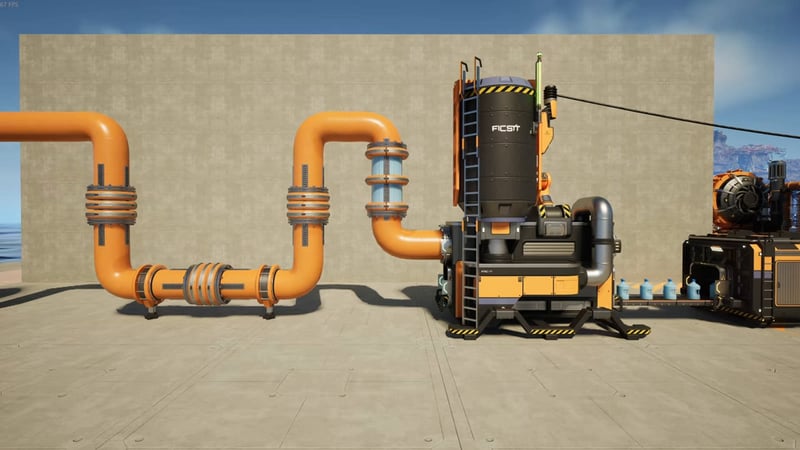
🎯 The core idea
Fluids in Satisfactory are bidirectional, headlift-driven, and slow to prime — most "broken pipe" problems are really sloshing or insufficient headlift, not a wiring mistake, and understanding those two mechanics fixes almost everything.
- free costs nothing
- cheap small cost
- setup needs preparation
- grind pays off slowly
- skip the thing to stop doing
Pipe basics: two tiers, and reading the flow rate UI

Satisfactory has two pipeline tiers: Mk.1 (Mk1) carries up to 300 m³/min, Mk.2 (Mk2) carries up to 600 m³/min (confirmed current on the wiki). Mixed Mk.1/Mk.2 networks used to be bugged but that's been fixed, so mixing tiers deliberately is a valid strategy covered later in this guide. Fluids fill sequentially — the first pipe segment in a chain saturates before the next one starts filling — so watching the flow-rate indicator only tells you the true story once the whole network is full; a fluctuating indicator on a still-filling network isn't automatically a problem.

Headlift and dynamic pressure: what actually pushes fluid uphill

Headlift is the maximum height a fluid can be pushed vertically above its source. Most producers and extractors generate 10 m of headlift (with roughly 10% leeway before flow breaks down); a Mk.1 Pipeline Pump sets headlift to 20 m, a Mk.2 pump to 50 m. Headlift is canceled and replaced by whatever a connected machine's own headlift is — except at a valve, which passes headlift through while throttling flow (with one bug: two valves placed back-to-back in sequence cancel headlift entirely).

Moving fluid also generates dynamic pressure, which can temporarily push fluid higher than a source's rated headlift — but because it's dynamic, not constant, that boost settles back down once the initial flow surge passes, and a factory that only worked because of that temporary boost will eventually stall. This, along with fluids being bidirectional (able to flow backward once they hit a dead end), is the root cause of most "why did my pipe just stop working" confusion — what looks like sloshing, an emptying pipe, or a water-pressure problem is almost always headlift or dynamic pressure doing exactly what it's supposed to.
A pipe that fills partway and then stops rising isn't holding an "air pocket" in the traditional sense — Satisfactory's pipes don't model air separately, but a vertical pipe that can't reach full height simply hasn't been given enough headlift, and no subsequent pipe past that point will ever reach max flow rate until it is.
Splitting fluids between pipe tiers, and a 3-way point system

Splitting a full pipe divides flow based on each output pipe's own capacity, not evenly by pipe count. A full Mk.2 pipe (600/min) split into two Mk.1s divides evenly at 300/300, since both outputs share the same capacity. Split that same Mk.2 into one Mk.2 output and one Mk.1 output instead, and it divides 400/200 — a 2:1 ratio matching their relative capacities (you can force an even 300/300 split here instead by throttling the Mk.2 output with a valve).

For splits across three or more outputs, use a point system: count each Mk.2 output as 2 points and each Mk.1 as 1 point, add the total, then divide the source flow rate by that total to get the flow-per-point. Two Mk.2s and one Mk.1 splitting 600/min is 5 points total (120/point) — 240/240 down the Mk.2s and 120 down the Mk.1. Add a pump after each split to stop backflow and keep the math accurate, especially if any branch goes upward or passes through a valve.
Valves: the mistake almost everyone makes

Valves throttle flow and block backflow, but fluid always takes the path of least resistance — so splitting a full Mk.1 pipe into one open branch and one valve set to 150/min does not give 150/150. The open branch wins the contest and pulls 200, leaving only 100 through the valve. The fix: set valves on both branches to the intended rate (150/150 here), or add a pump before the valve's input so the pipe feeding it is always full — a valve only passes its full set rate once the pipe ahead of it is full.
This is the single most common "why isn't my valve working" mistake, and it looks exactly like a satisfactory pipe troubleshooting problem rather than what it actually is: an open, unthrottled branch out-competing a throttled one for the same source flow.
Buffers: fill by headlift, and never chain them in series
Fluid Buffers and Industrial Fluid Buffers give headlift proportional to how full they are, and reach max flow rate once they hold roughly 75 m³ (small buffer) or 300 m³ (industrial buffer). Always pump into and out of a buffer to stop sloshing and to guarantee the pipes leaving it get consistent headlift rather than headlift that rises and falls with the buffer's fill level.
Never chain buffers directly in series. Connected buffers try to equalize their fluid levels with each other, which produces extreme sloshing across the whole chain. Place them in parallel off a main pipeline instead, each fed by its own pump.
Priority junctions, VIP junctions, and overflow

A basic pipe junction has unlimited flow rate and simply mirrors input to output, but the vertical position of a merge matters: fluid entering from the bottom pipe is prioritized, then the middle, then the top. That priority ordering is also what powers Variable Priority (VIP) junctions, which fully prioritize one pipe over others by exploiting how gravity fills pipes — genuinely useful for keeping a byproduct pipe fed first, but it depends on a known gameplay bug (the developers have said they won't fix it, since too many existing factories now depend on it).

For "what happens when I have too much fluid," an overflow junction (an upside-down U-bend fed by a powered pump) sends fluid to a second destination only once the first is full — handy for routing excess packaged fuel to power generators only after storage tanks are topped off.
Reducing sloshing in production-line manifolds
Manifolds feeding a row of machines are especially prone to sloshing, because a full buildable buffer stops accepting fluid and pushes the backed-up flow right back into the pipe it came from. A handful of practical fixes: keep manifold-feeding pipes at Mk.1 rather than Mk.2 wherever the line doesn't need more than 300/min, feed manifolds from above rather than below (gravity prioritizes the downward pipe, so machines warm up in a clean sequence instead of all needing to fill at once), and add a buffer at the end of the manifold to stabilize outflow — unless the manifold is bottom-fed, where a buffer makes the sloshing worse instead of better.
Fluid towers, and the known bugs to watch for

A fluid tower — a filled buffer built high up, feeding a network purely by gravity — avoids running pumps continuously to move fluid vertically. The trick of sealing its input with a valve set to zero so it stays permanently full is popular, but the video's presenter flags it as behaving like a bug rather than real hydraulics, and notes it can fail outright on setups with many connected networks or on dedicated servers. Treat it as an occasional tool, not a default headlift strategy.
Two other bugs worth knowing: placing a valve or pump can sometimes silently stop a pipe receiving fluid at all (delete and replace both connecting pipe segments to fix it), and very long pipe networks can empty themselves after repeated save/reload cycles for no clear reason. The pipe-hole bug from Satisfactory 1.0 has since been fixed.
How this guide was fact-checked
All of this reflects Satisfactory 1.2's current fluid dynamics — pipe capacities (Mk.1 300 m³/min, Mk.2 600 m³/min) and every headlift figure quoted (10 m for most producers/extractors, 20 m for a Mk.1 pump, 50 m for a Mk.2 pump) were checked against the current Satisfactory Wiki's Pipeline and Head Lift pages, both reachable and current, and matched the source video exactly — consistent with the Content Plan's note that this is the best-sourced pick in the set, explicitly current for Satisfactory 1.2. The point-system split math, the valve-competition mistake, the buffer-in-series sloshing warning, and the VIP junction/overflow junction mechanics are transcribed directly from the video's own on-screen demonstrations, which the creator states were double-checked by a named fluid-mechanics specialist from the Satisfactory community before publishing.
What this guide doesn't answer
This guide doesn't give a step-by-step build for a specific factory (like a 500 GW rocket fuel facility) — the source video references the creator's own troubleshooting of one but doesn't walk through building it here. It also doesn't cover fluid trucks or fluid train tank cars in depth, since the video explicitly recommends sticking to plain pipes wherever possible and only mentions trucks/trains as an alternative for very long-distance transport.
Frequently asked
Why do my pipes keep sloshing or not filling in Satisfactory?
Fluids in Satisfactory are bidirectional, so once a fluid hits a full machine buffer or a dead end, it flows back into the pipe it came from. Most sloshing comes from feeding manifolds without pumps, chaining fluid buffers in series, or not giving a vertical pipe enough headlift to fill completely.
What is headlift and how much do pumps give?
Headlift is the maximum height a fluid can be pushed vertically above its source. Most producers and extractors give 10 m of headlift; a Mk.1 Pipeline Pump sets headlift to 20 m and a Mk.2 pump to 50 m, both figures confirmed on the current Satisfactory Wiki.
How do I split fluids evenly between Mk.1 and Mk.2 pipes?
A split divides flow by relative pipe capacity, not by pipe count. Splitting into two same-tier pipes gives an even split, but a Mk.2-into-Mk.2-plus-Mk.1 split gives a 2:1 ratio (e.g. 400/200 of a 600 total). For three or more outputs, use a point system: Mk.2 = 2 points, Mk.1 = 1 point, divide total flow by total points.
Why does my valve split fluid unevenly even when set to the right rate?
Fluid always takes the path of least resistance. If one branch is a valve set to a rate and the other branch is left completely open, the open branch will pull more than expected. Set valves on both branches to the intended rate, or add a pump before the valve's input to keep it full.
How do I stop fluid buffers from sloshing when connected together?
Never chain Fluid Buffers or Industrial Fluid Buffers directly in series — they try to equalize their fluid levels with each other, causing extreme sloshing across the whole chain. Place buffers in parallel off a main pipeline instead, each fed by its own pump.
Read next
The Ultimate Guide to Fluid Pipes in Satisfactory 1.2
A complete breakdown of fluid mechanics in Satisfactory 1.2, covering pipe basics, headlift, gravity flow, valves, buffers, manifolds, and troubleshooting common fluid bugs.
Satisfactory Fluid By-product & Water Recycling Management Guide
Satisfactory Oil Processing Guide: Plastic, Rubber & Heavy Oil Residue
An early-game Satisfactory oil setup: Crude Oil to Plastic and Rubber, why Heavy Oil Residue backs up your line, and how to turn that byproduct into Fuel-Powered Generator power.
Satisfactory Manifold vs Load Balancer: Which Should You Use?
A full comparison of manifolds and load balancers in Satisfactory: how each works, why manifolds take time to reach 100% efficiency, and when to actually reach for a load balancer instead.