
🎯 The core idea
Almost every fluid recipe in Satisfactory produces a byproduct alongside its main output, and if that byproduct has nowhere to go, its buffer fills, backs up the machine producing it, and that backup cascades upstream until an entire production line silently stalls — with clogged pipes and stuck belts as the visible symptom. This guide is a liquid management walkthrough that follows a real deadlocked factory being diagnosed and fixed, then covers byproduct management and the water-recycling techniques that keep an aluminum line — the chain most players get stuck on — from backing up in the first place.
- free costs nothing
- cheap small cost
- setup needs preparation
- grind pays off slowly
- skip the thing to stop doing
What an unconsumed byproduct actually does to a factory

When a recipe produces a byproduct that isn't being used or removed, its output buffer fills completely, and the machine producing it stops accepting new input — which backs the stall further up the chain, machine by machine, until production halts everywhere upstream. This isn't a rare edge case: it's the default behavior any time a byproduct output is left unconnected, and it's exactly what happened to this guide's source video's own oil rig once a train stopped picking up plastic and rubber it wasn't consuming downstream.
Diagnosing a real deadlock

Tracing a deadlock means following the backup from its visible symptom to its actual cause: in this guide's source video's example, generators ran dry because fuel refineries had stopped receiving heavy oil residue for disposal, which had stopped flowing because a refinery further upstream had a full Polymer Resin buffer, which was full because nothing downstream was consuming the plastic and rubber it was tied to. The practical lesson is that a stall showing up at the end of a chain (generators without fuel) often has its actual cause several machines further back — the fix is to trace backward from the symptom rather than immediately re-tuning the machine that looks broken.
The universal fallback: an AWESOME Sink

If you just want to get rid of byproducts without a redesign, for any byproduct that comes out as a solid item — Polymer Resin included — the simplest fix that works in nearly every situation is routing it to an AWESOME Sink. The moment this guide's source video connects the stalled Polymer Resin line to a Sink, that segment turns back on, which has a cascading effect and restarts the machines further downstream that had also stalled waiting on it. Sinking a byproduct isn't wasteful the way it can feel: you get coupons and tickets in return, and a byproduct rotting in a full buffer produces nothing at all.
Aluminum's water problem, and why it trips people up

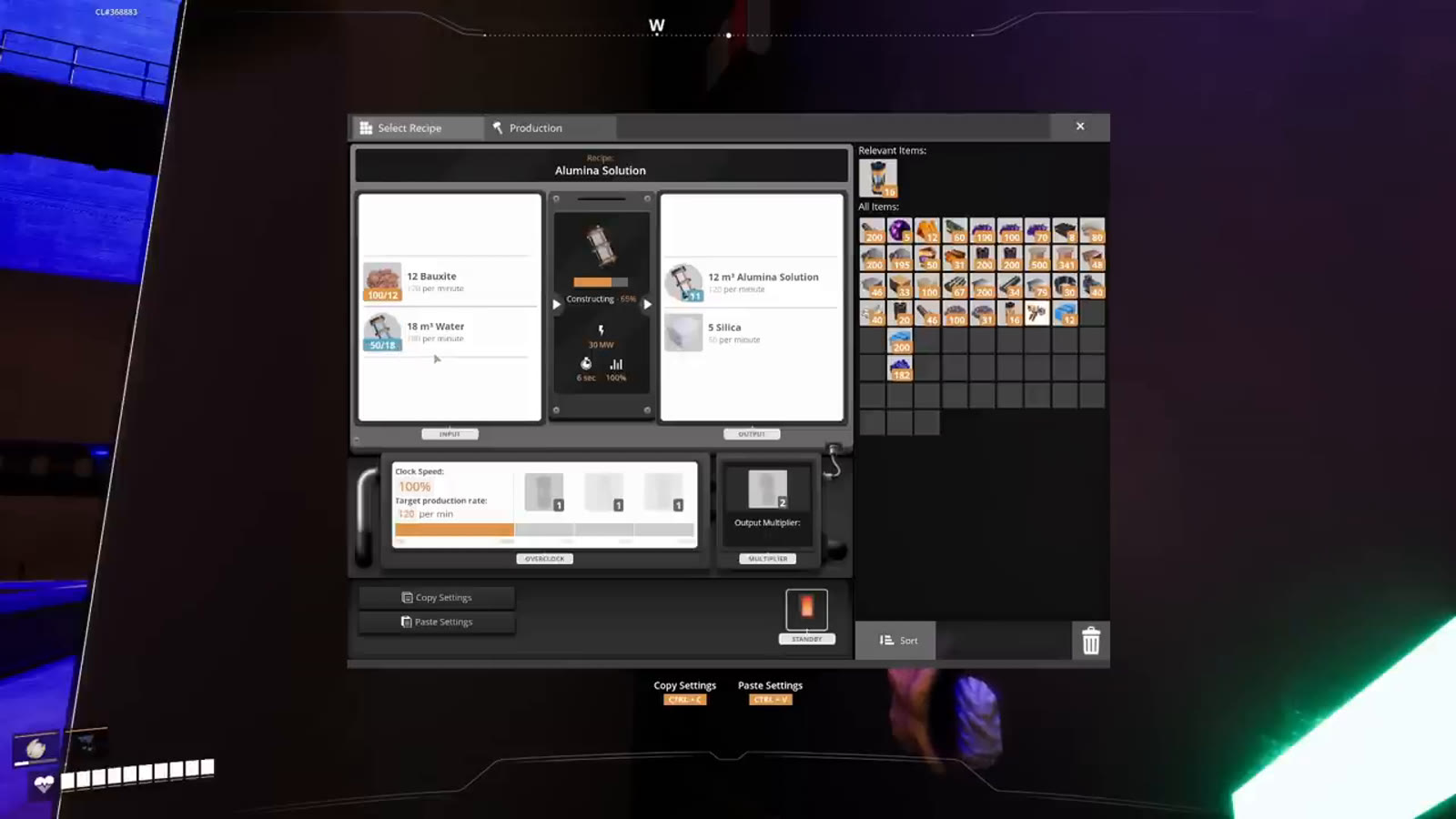
Aluminum production is where most players run into a fluid byproduct they can't just sink: turning Bauxite into Alumina Solution consumes 180 water and produces 120 Alumina Solution per minute per Refinery (confirmed on the current Satisfactory Wiki — 12 Bauxite + 18 Water → 12 Alumina Solution + 5 Silica per craft, scaling to that exact rate), and the next step, turning Alumina Solution into Aluminum Scrap, does the reverse: it consumes Alumina Solution and produces Water back out as a byproduct. At full clock, one Aluminum Scrap Refinery consumes 40 Alumina Solution and produces 20 Water per minute (4 Alumina Solution + 2 Coal → 6 Aluminum Scrap + 2 Water per craft, also wiki-confirmed) — this guide's source video's own numbers (240 Alumina Solution in, 120 Water out) describe six of these Refineries running together, not one, which is worth knowing so the ratio isn't mistaken for a single machine's rate.
Closing the loop: recycling water back into the system

The fix demonstrated in this guide's source video is straightforward: pipe the Aluminum Scrap Refinery's Water byproduct straight back into the Alumina Solution stage's water input, closing the loop instead of routing it to a sink or letting it back up. Because the Alumina Solution stage needs more water than the Scrap stage returns (360 needed against 120 recycled, in the video's six-Refinery example), the loop reduces the fresh Water Extractor demand rather than eliminating it — you still need extractors feeding the difference, but recycling the byproduct back in cuts that requirement substantially.
What to do if the water still backs up

If recycled water still overflows a refinery's buffer despite the loop, the water needs a second consumer somewhere else in the factory rather than sitting unrouted. Two Hard Drive alternate recipes exist specifically for this: Pure Iron Ingot (7 Iron Ore + 4 Water → 13 Iron Ingot per craft on a Refinery, scaling to 35 Iron Ore and 20 Water per minute for 65 Iron Ingot per minute — wiki-confirmed) turns excess water into more iron ingots than smelting the same ore alone would produce, and a Pure Caterium Ingot alternate does the same for caterium. Both are useful precisely because they consume water as an input rather than producing it, giving a backed-up water line somewhere productive to go.
Wet Concrete: the cleanest water sink

The single best fix this guide's source video demonstrates for lingering excess water is the Wet Concrete alternate recipe: 6 Limestone + 5 Water → 4 Concrete per craft on a Refinery, scaling to 120 Limestone and 100 Water per minute for 80 Concrete per minute — confirmed on the current Satisfactory Wiki, an exact match for the source video's own stated numbers. Concrete is a solid item, so it can go straight to an AWESOME Sink afterward, making Wet Concrete a clean, renewable water sink that turns a byproduct nobody wants into a resource that's always useful somewhere. It's unlocked from a Hard Drive scan, available as soon as you've unlocked Water Extractors, and gives you overflow control over excess water without needing a Smart Splitter to manage where it goes — the whole line is a single dedicated path from water in to concrete out.
The technique the source video doesn't cover: packaging fluids for belt transport
Beyond piping and sinking, a Packager can convert any fluid — including Sulfuric Acid, whose own downstream use in Battery production creates a Water byproduct worth recycling the same way as the aluminum chain above — into a packaged item using an Empty Canister, which travels by conveyor belt instead of pipe and unpacks back into the fluid (with the canister returned for reuse) at the destination. Setting up a canister loop, where empty canisters cycle continuously between a Packager and an Unpackager, is a legitimate alternative to running pipe over long distances or across floors, though it wasn't demonstrated in this guide's source video and is included here as a wiki-confirmed technique worth knowing about.
How this guide was fact-checked
The Alumina Solution recipe (12 Bauxite + 18 Water → 12 Alumina Solution + 5 Silica, scaling to 180 Water in / 120 Alumina Solution out per Refinery), the Aluminum Scrap recipe (4 Alumina Solution + 2 Coal → 6 Aluminum Scrap + 2 Water, scaling to 40 Alumina Solution in / 20 Water out per Refinery), the Pure Iron Ingot alternate (7 Iron Ore + 4 Water → 13 Iron Ingot, scaling to 65 Iron Ingot per minute), the Wet Concrete alternate (6 Limestone + 5 Water → 4 Concrete, scaling to 80 Concrete per minute) and the Packager's canister-based fluid transport are all confirmed on the current Satisfactory Wiki. The Wet Concrete figures are an exact match with the source video's own on-screen numbers. The video's 240-Alumina-Solution/120-Water aluminum example checks out mathematically as six Aluminum Scrap Refineries running in parallel rather than one, once compared against the wiki's per-machine rate — worth flagging since the video itself doesn't state the machine count explicitly. The deadlock diagnosis, the AWESOME Sink fix, the water-recycling loop and the demonstrated alternate recipes all come directly from the source video's own on-screen factory.
What this guide doesn't answer
This guide doesn't cover the underlying pipe physics that make fluids behave differently from solid items on belts (head lift, pipe junction priority, flow rate limits) — the source video explicitly says it isn't going in depth on flow systems, and that's a separate topic the Content Plan covers in its own dedicated Pipes & Fluid Mechanics guide. It also doesn't give byproduct-handling advice for every fluid chain in the game — Nitrogen Gas, Nitric Acid and Sulfuric Acid each have their own byproduct considerations that would need dedicated treatment to cover properly, and this guide focuses on oil and aluminum specifically since those are what the source video demonstrates. Finally, it doesn't cover the canister-packaging technique in the same hands-on detail as the piped examples, since the source video doesn't demonstrate it — it's included here as a wiki-confirmed option worth knowing about rather than a walked-through build.
Read next
Satisfactory Pipes & Fluid Mechanics Guide: Headlift, Flow Rates & Fixes
A complete walkthrough of Satisfactory fluid mechanics: pipe tiers and flow rates, headlift and dynamic pressure, splitting between pipe tiers, valve mistakes, buffers, priority junctions, and how to stop manifolds from sloshing.
Satisfactory Oil Processing Guide: Plastic, Rubber & Heavy Oil Residue
An early-game Satisfactory oil setup: Crude Oil to Plastic and Rubber, why Heavy Oil Residue backs up your line, and how to turn that byproduct into Fuel-Powered Generator power.
The Ultimate Guide to Fluid Pipes in Satisfactory 1.2
A complete breakdown of fluid mechanics in Satisfactory 1.2, covering pipe basics, headlift, gravity flow, valves, buffers, manifolds, and troubleshooting common fluid bugs.