
🎯 The core idea
Learning how to make Batteries in Satisfactory trips up a lot of players because it's most people's first true multi-fluid chain: Sulfuric Acid and Alumina Solution both need their own Refinery lines, both of those lines need water, and the Battery Blender itself spits out more water as a byproduct. Get the ratios and the water routing right and one Blender cleanly outputs 20 Batteries per minute — get them wrong and you'll spend an evening watching machines sit half-starved, exactly like this guide's source video does in real time.
- free costs nothing
- cheap small cost
- setup needs preparation
- grind pays off slowly
- skip the thing to stop doing
The Battery recipe, confirmed
The standard Battery recipe, confirmed on the current Satisfactory Wiki, unlocks at Tier 7 (Control System Development) — not Tier 8, despite that association sometimes floating around. A Blender takes 2.5 m³/min Sulfuric Acid, 2 m³/min Alumina Solution and 1/min Aluminum Casing, and outputs 1 Battery plus 1.5 m³/min Water as an unavoidable byproduct, on a 3-second cycle. Scaled to a fully-clocked Blender, that's:
| Input | Rate | Output | Rate |
|---|---|---|---|
| Sulfuric Acid | 50 m³/min | Battery | 20/min |
| Alumina Solution | 40 m³/min | Water (byproduct) | 30 m³/min |
| Aluminum Casing | 20/min |
There's also a Hard Drive alternate, Classic Battery, which trades the fluid chain entirely for 6 Sulfur, 7 Alclad Aluminum Sheet, 8 Plastic and 12 Wire per cycle in a Manufacturer, yielding 30 Battery/min. It avoids fluids completely, at the cost of needing four separate solid inputs instead of two fluid lines.
Why this recipe is a water trap

This is the exact dependency the Content Plan notes for this guide flagged as worth calling out explicitly: both fluid inputs need water of their own, on top of the water the Blender itself produces as a byproduct. Working backward from a fully-clocked Blender (20 Battery/min):
- Sulfuric Acid (5 Sulfur + 5 Water → 5 Sulfuric Acid, confirmed on the current wiki) needs 50 Water/min to hit the 50 m³/min the Blender wants.
- Alumina Solution (12 Bauxite + 18 Water → 12 Alumina Solution + 5 Silica byproduct, also confirmed on the wiki) needs 60 Water/min to hit the 40 m³/min the Blender wants.
- The Blender itself then hands back 30 m³/min of Water as a byproduct.
Net, a single fully-clocked Battery line consumes 110 m³/min of Water across its two Refineries and returns 30 m³/min from the Blender — a net draw of 80 m³/min that has to come from an extractor, unless you deliberately route the Blender's own water byproduct back to feed one of the Refineries.

Building the Alumina Solution line


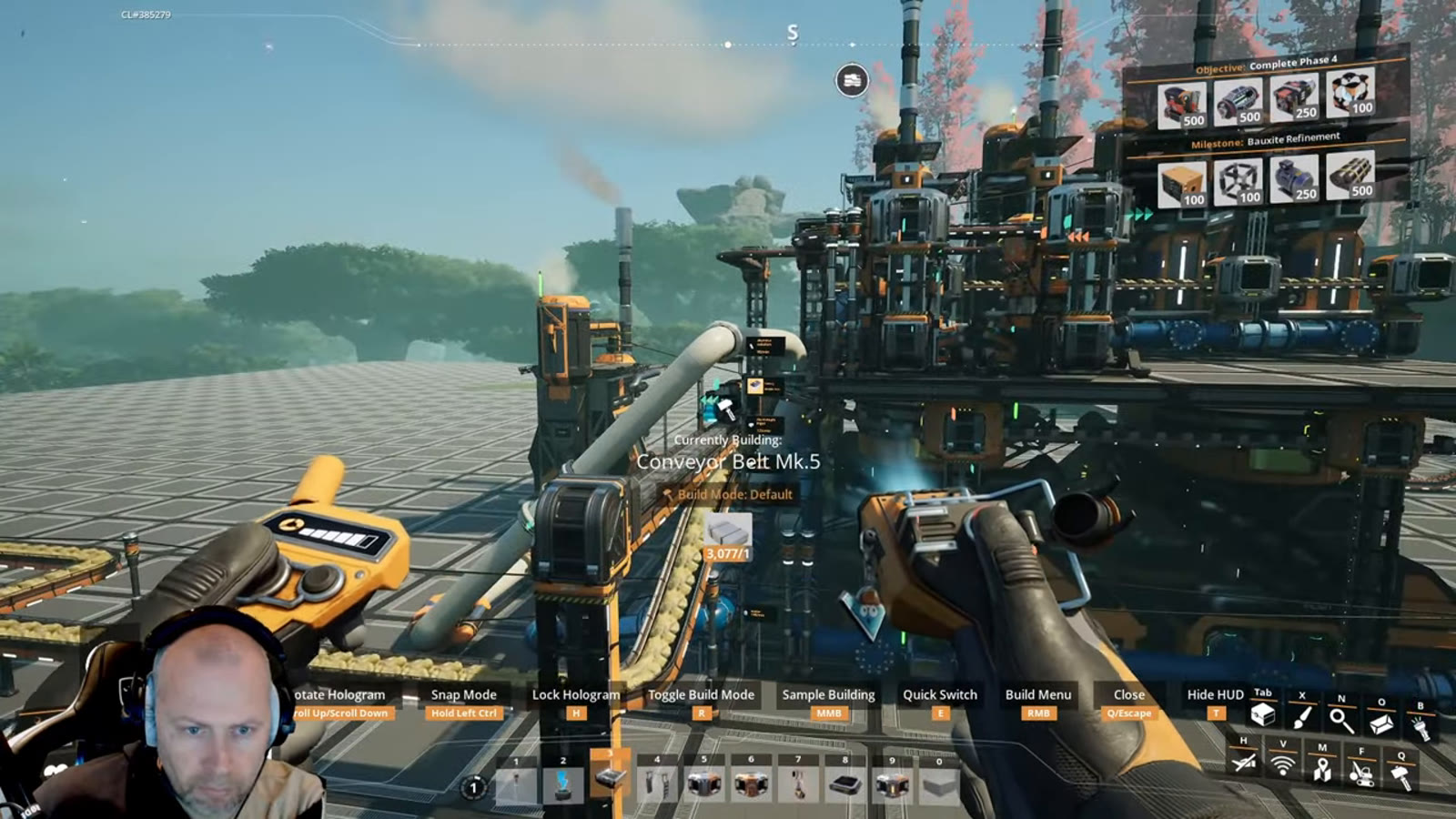
Alumina Solution needs a Bauxite node and its own water supply — the video's creator initially struggles here specifically because the water hookup wasn't in place yet, leaving the Refinery starved despite Bauxite flowing in correctly. Once water is connected, the Refinery runs cleanly and starts filling the Alumina Solution pipe toward the Blender. If you're feeding a Battery line from an existing Aluminum Ingot factory (as the video's source setup does, reusing a prior aluminum blueprint), double-check that Bauxite hasn't already been fully committed to ingot production elsewhere — the video needed to split off a dedicated Bauxite supply rather than fight over one that was already spoken for.
Sizing the Sulfuric Acid line

Sulfur is easy to underestimate here: a single fully-clocked Battery Blender wants 50 m³/min of Sulfuric Acid, which needs 50 Sulfur/min feeding the Refinery — but if you're running multiple Blenders off one Sulfuric Acid line, that number scales linearly and can catch you out, which is exactly what happens in the source video when an initial 120/min Sulfur supply falls short of what a scaled-up setup actually needs and has to be boosted afterward.
Troubleshooting a starved Blender

If your Blender is producing well below its rated output, the fix is almost always upstream: check that both fluid pipes are actually primed and flowing (a partially-filled pipe reads as a production problem but is really a flow problem), and that neither Refinery is itself water-starved. The video works through exactly this — Alumina Solution isn't filling fast enough, and the fix is boosting the upstream Refinery's clock speed rather than touching the Blender itself, since the Blender was never the actual bottleneck.
Scaling up and getting Batteries out


Once one Battery line is stable, scaling up is mostly a matter of copying the whole blueprint and giving the copy its own water, Bauxite and Sulfur connections rather than trying to share a single set of feeder lines across multiple Blenders. The exact battery factory layout matters less than making sure each copy is fully self-sufficient on inputs. For getting Batteries out to the rest of your factory, a Drone Port is a natural fit since Batteries are needed in modest, steady quantities elsewhere in the game (notably vehicle and Nuclear Power sections) rather than in the same bulk volumes as basic materials. Exporting by drones rather than belts also keeps a Battery line's layout independent from wherever the resource is actually consumed — though a Drone Port itself needs a Radio Control Unit unlocked first.
How this guide was fact-checked
The standard Battery recipe (2.5 Sulfuric Acid + 2 Alumina Solution + 1 Aluminum Casing → 1 Battery + 1.5 Water, Tier 7), the Sulfuric Acid recipe (5 Sulfur + 5 Water → 5 Sulfuric Acid), the Alumina Solution recipe (12 Bauxite + 18 Water → 12 Alumina Solution + 5 Silica), and the Classic Battery alternate recipe are all confirmed on the current Satisfactory Wiki and used to calculate every per-minute figure in this guide's water-dependency breakdown. The Content Plan notes for this topic specifically asked for the alumina/water dependency to be called out, which this guide does with wiki-sourced numbers rather than eyeballing it from the video alone. The build sequence, troubleshooting steps and scaling approach come directly from the source video's own on-screen build.
What this guide doesn't answer
This guide covers the standard fluid-based Battery recipe and its water dependency in detail, but doesn't fully work through the Classic Battery alternate's own production chain (Alclad Aluminum Sheet, Plastic and Wire all have their own upstream requirements this guide doesn't trace). It also doesn't cover exact blueprint dimensions or snapping details for the specific build shown in the source video — the video reuses a pre-made blueprint from the creator's own earlier upload rather than building from scratch on screen, so this guide describes the resulting production math rather than a from-scratch build walkthrough. Finally, it doesn't cover Drone Port setup or Radio Control Unit requirements in depth, since the video only mentions exporting Batteries by drone as a future plan rather than demonstrating it.