
🎯 The core idea
Fuel power sits between early coal and late-game nuclear, and it scales a lot further than most players expect — with the right alternate recipes, a single pipe of oil can output more power than dozens of nuclear reactors. This guide walks through fuel, turbofuel, rocket fuel, and ionized fuel: the base ratios, the alternate recipes worth chasing, and how each fuel type performs in vehicles, drones, and the jetpack.
- free costs nothing
- cheap small cost
- setup needs preparation
- grind pays off slowly
- skip the thing to stop doing
Regular fuel: the tier 5 basics

Oil processing and petroleum power both unlock at tier 5. Overclock oil extractors with power shards more aggressively than most other miners, since oil is less common than other resources and more oil directly means more power. The standard Refinery recipe turns 6 Crude Oil (60/min) into 4 Fuel (40/min) plus 3 Polymer Resin (30/min) as a byproduct — sink the resin in the Awesome Sink, or better, combine it with water to make Residual Plastic or Residual Rubber, since most oil nodes have water nearby. If you process oil directly into plastic or rubber instead, you get Heavy Oil Residue as a liquid byproduct, which can't be sunk directly — feed it into a Refinery with no extra ingredients to make Residual Fuel, or convert it to Petroleum Coke instead.
Setting up fuel generators without the sloshing problem

A single full Mark 1 pipe (300 oil/min) feeds five Refineries at the default recipe, producing 200 Fuel/min combined. Fuel Generators burn Fuel at 20/min each, so that same pipe supports exactly 10 generators — a clean, easy ratio to scale from. Each Fuel Generator produces 250 MW regardless of which fuel type you burn (only burn duration changes), compared to 75 MW for a coal generator that also needs water — so one Mark 1 pipe of oil (10 generators, 2,500 MW) is the equivalent of over 33 coal generators. Fuel Generators are large, liquid-handling buildings that are prone to sloshing and downtime, so build them first without connecting power, let the Refineries fill the pipes completely, and only then switch the generators on.
The alternate recipes that make fuel scale into the late game

The Diluted Fuel alternate recipe (5 Heavy Oil Residue + 10 Water → 10 Fuel in a Blender) is significantly more efficient with Heavy Oil Residue than plain Residual Fuel, though it needs a lot of water and isn't available until tier 7. Combine it with the Heavy Oil Residue alternate recipe, which converts Crude Oil directly into Heavy Oil Residue, and a single Mark 1 pipe of oil can produce 10,000 MW instead of the base 2,500 MW — four times the output, at the cost of extra buildings and a more complex line.
Turbofuel: 2.67x the power density, with a sulfur cost

Turbofuel unlocks at tier 7 through the sulfur research tree in the MAM and is confirmed on the Satisfactory Wiki at 2,000 MJ of energy per unit, compared to 750 MJ for regular fuel — a 2.67x power density increase, matching the video's claim exactly. The base Turbofuel recipe (compacted coal + fuel) yields 166.67 Turbofuel/min from one Mark 1 pipe, worth 5,555 MW. Turbo Blend Fuel, one of two MAM-unlocked alternates, is generally considered the best version since it saves sulfur — one of the game's scarcest resources — by using heavy oil residue and petroleum coke instead. Stacking Turbo Blend Fuel with the Heavy Oil Residue and Diluted Fuel alternates pushes output to 400 Turbofuel/min (13,333 MW) from the same single pipe, at the cost of routing through three different alternate recipes.
Rocket fuel and ionized fuel: the endgame power ceiling

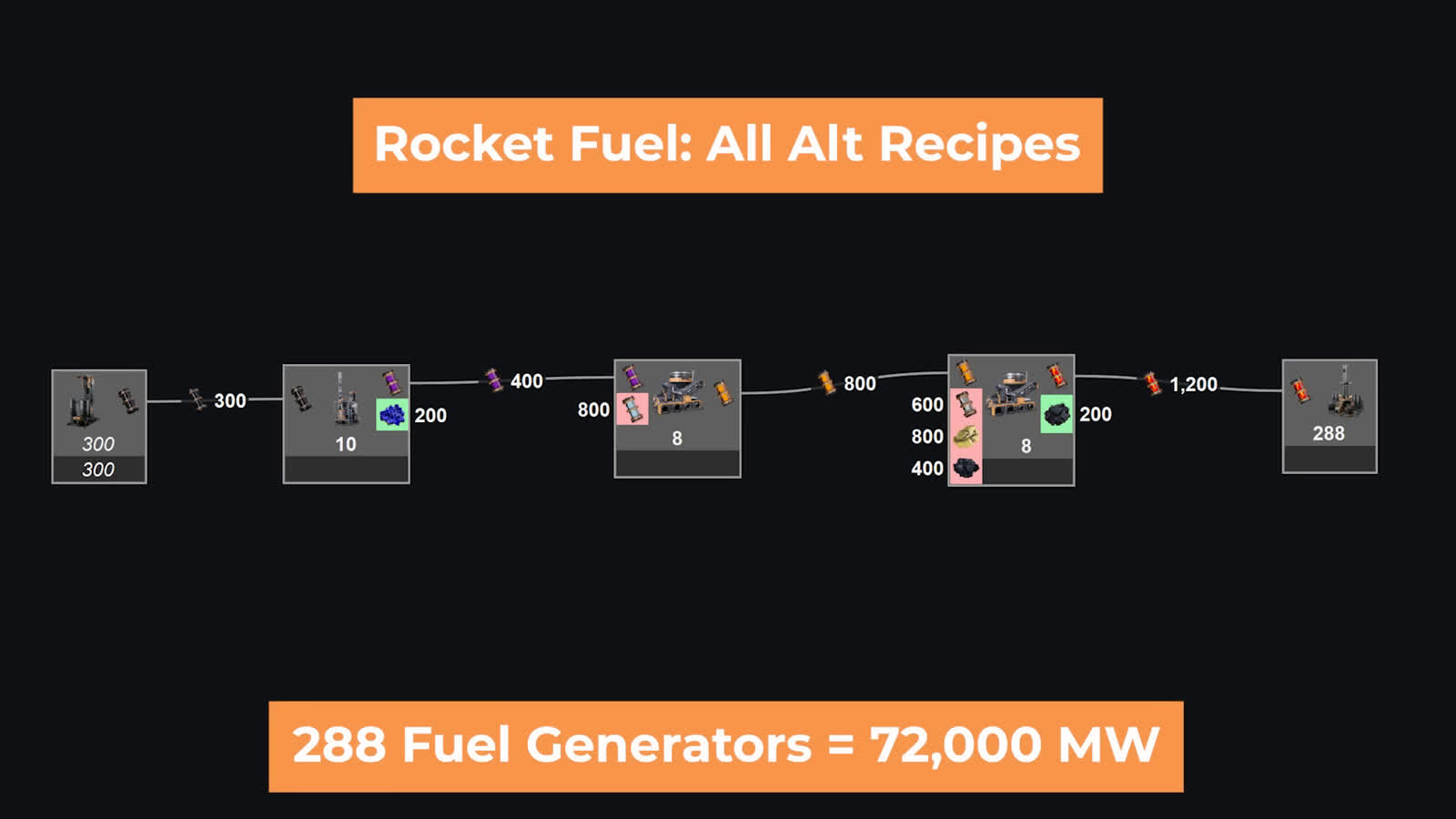
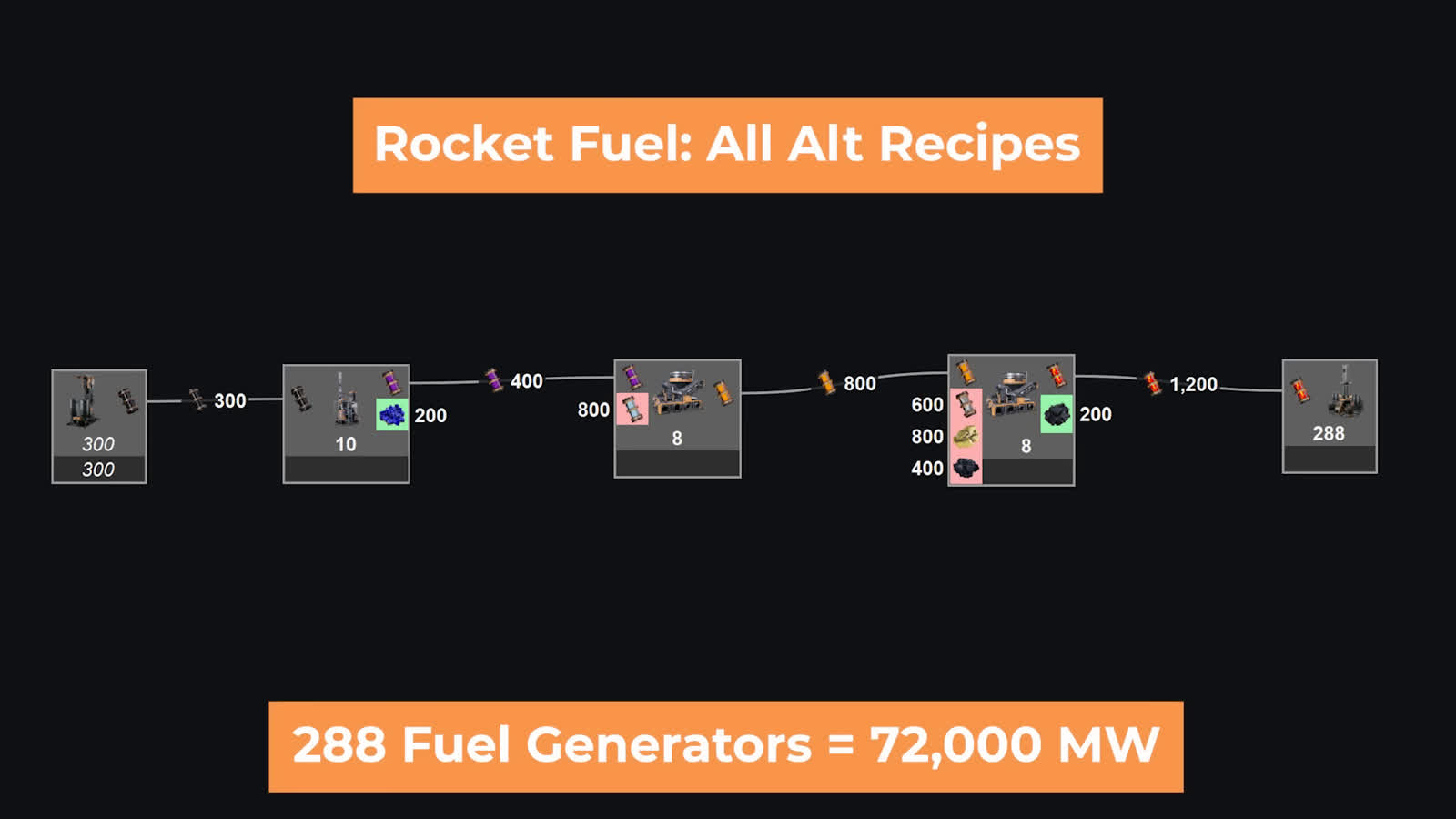
Rocket Fuel (also MAM-unlocked, tier 7) is 4.8x as powerful as regular fuel — combining turbofuel with nitric acid gives 16,666 MW from one Mark 1 pipe using default recipes, or 40,000 MW when paired with the efficient turbofuel alternates. Its own alternate, Nitro Rocket Fuel, trades sulfur for coal and produces the same compacted coal byproduct, which can be fed back into your turbofuel line. Stack every relevant alternate recipe together — Heavy Oil Residue, Diluted Fuel, and Nitro Rocket Fuel — and a single Mark 1 pipe of oil reaches 72,000 MW, the equivalent of over 28 nuclear power plants, though it requires 288 Fuel Generators to burn it all. Rocket Fuel is also a gas rather than a liquid, so headlift isn't a concern when building vertically to fit that many generators. Ionized Fuel goes one step further at 6.6x regular fuel's power density, but the video is explicit that the jump from rocket fuel's 72,000 MW ceiling to ionized fuel's 100,000 MW usually isn't worth the added production complexity for most players.
Packaged fuel for vehicles, drones, and the jetpack

Fuel type matters differently depending on what's burning it. For the jetpack, Rocket Fuel gives extreme acceleration and the highest vertical speed but a short burn time, great for scaling cliffs rather than long travel; Ionized Fuel has the longest burn time of any packaged fuel and is second only to Rocket Fuel on acceleration, making it the strongest overall jetpack fuel if you can afford to produce it. For drones, Fuel and Turbofuel are actually weaker choices than plain batteries — Rocket Fuel matches battery speed with better efficiency, and Ionized Fuel gives the best fuel value and highest speed of any packaged option, though uranium and plutonium fuel rods beat all of them on efficiency and speed. For ground vehicles, fuel type doesn't affect speed at all — only burn time — so regular fuel (or even raw coal for short routes) is fine unless a vehicle runs unusually long routes.
Quick answers: which fuel power plant layout and setup to use
For most players, the best power source progression in Satisfactory is straightforward: run coal early, move to fuel power once oil processing unlocks at tier 5, then decide between turbofuel, rocket fuel, or nuclear based on how much production complexity you're willing to manage. A basic fuel power plant layout doesn't need to be complicated — a manifold-fed set of Refineries into Fuel Generators, sized in multiples of 5 refineries to 10 generators per Mark 1 pipe, covers most of the game. For per-minute planning, remember the two governing numbers: 40 fuel per minute per refinery, and 20 fuel per minute burned per generator. If you're chasing higher power efficiency without going nuclear, rocket fuel with the full alternate recipe stack is the highest-value late-game power plant setup this guide covers, reaching 72,000 MW off a single pipe of crude oil.
How this guide was fact-checked
The Satisfactory Wiki confirms every core number in this guide with no discrepancies found: a Fuel-Powered Generator produces 250 MW at 100% clock speed regardless of fuel type (only burn duration changes) and burns Fuel at 20 m³/min, both matching the video exactly. The wiki's fuel consumption table also confirms the energy values behind each power-density multiplier the video cites — Fuel at 750 MJ, Turbofuel at 2,000 MJ (2.67x), Rocket Fuel at 3,600 MJ (4.8x), and Ionized Fuel at 5,000 MJ (6.67x) — and these numbers were also visible directly on-screen in the video's own wiki-table callouts, which this guide's frame captures reference directly. This video is from August 2025; core Tier 5-8 fuel recipes and Fuel Generator stats are stable, patch-light numbers rather than balance-sensitive ones, and the Notes on this guide's source row flagged a need to verify against any 1.2 fuel rebalances — no such rebalance was found, so the ratios here should still be current.
What this guide doesn't answer
This video is focused on power generation from fuel types, not on production line blueprints, factory layouts, or byproduct management for plastic and rubber in detail — those are covered only briefly as context for where heavy oil residue and polymer resin come from. It also doesn't cover nuclear or biomass power, treating fuel power purely as the bridge between coal and the endgame.
Read next
Satisfactory Power Guide: Biomass Burners to Nuclear
A complete walkthrough of Satisfactory's power generators, from early Biomass Burners through Coal, Fuel, and Nuclear plants, with tips for keeping the grid stable as demand grows.