
🎯 The core idea
Circuit boards feed almost every mid-game recipe, and High-Speed Connectors are the notorious cost spike that follows them — 56 Quickwire per Connector is the number that makes most players stop and actually plan a dedicated electronics factory instead of hand-feeding a few Constructors. This guide follows a real build: a single combined factory that mines its own copper and caterium ore, smelts it, and turns it into circuit boards and the Quickwire/Cable inputs a High-Speed Connector line needs. The source video is Part 1 of a two-part build-along and stops before the Manufacturers that actually assemble the Connectors go in, so this guide pairs what's on screen with wiki-verified per-minute ratios for finishing that last step yourself.
- free costs nothing
- cheap small cost
- setup needs preparation
- grind pays off slowly
- skip the thing to stop doing
Planning the layout before you place a single machine

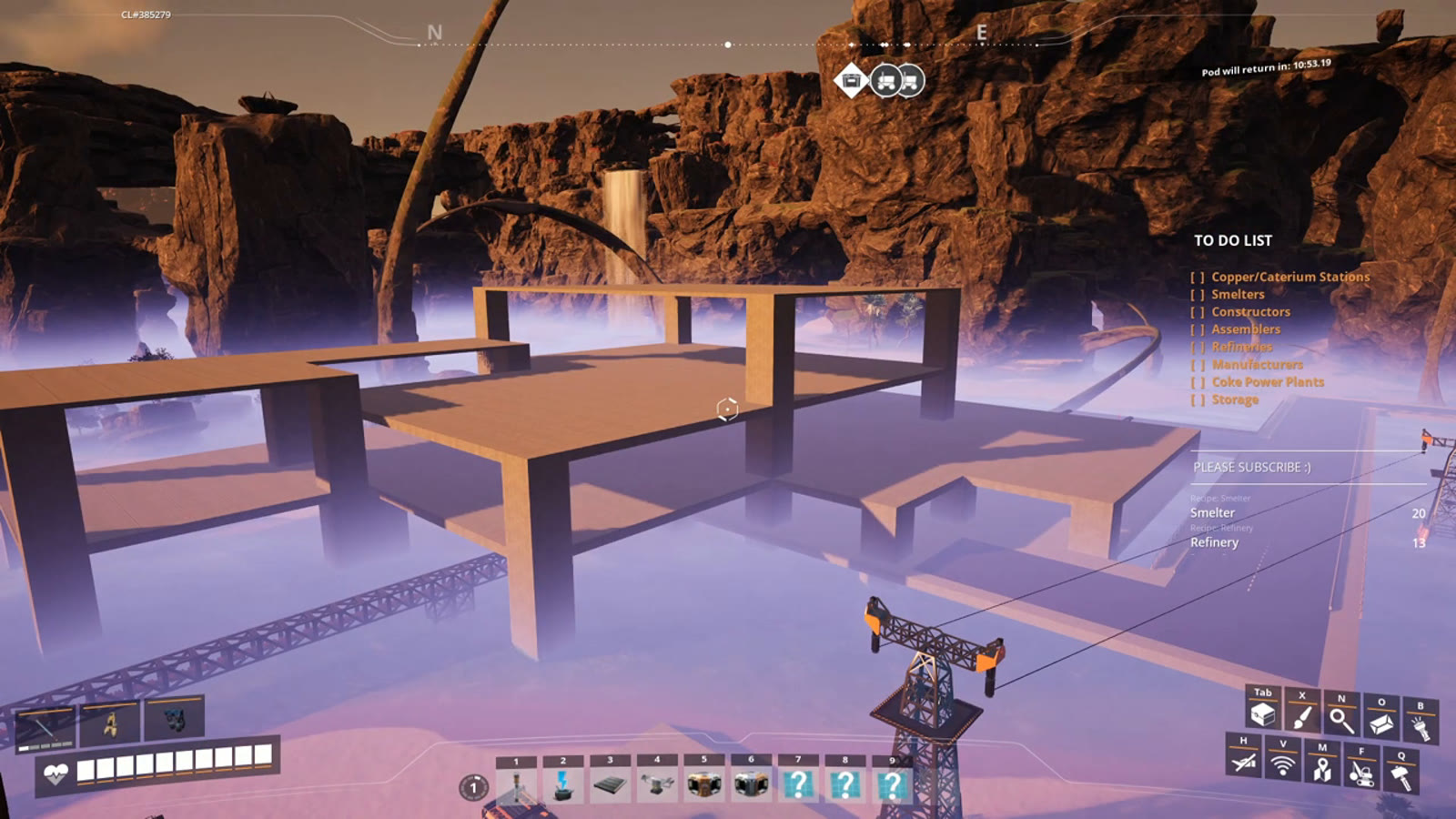
The build in this guide is a genuinely large one: 20 smelters, 13 refineries, 9 Constructors, 17 Assemblers and 6 Manufacturers by the time it's finished, all inside one multi-floor frame built next to an existing oil facility. Before placing anything, the plan assigns floors by function — plastic refineries and Manufacturers up top, Assemblers in the middle, Constructors and smelters down low — so that ore and intermediate parts mostly flow downward through the building rather than crossing back and forth. Planning the electronics factory this way, floor by floor, before committing to a machine layout is what keeps a build this size from turning into a tangle once the belts and pipes go in.
Two ore inputs, hauled in by truck

The whole factory runs on two truck-hauled ore inputs: a copper node putting out 356.67 parts per minute and a pure caterium node nearby producing 341.50 parts per minute. Both get a Mk.4 belt into a truck station rather than a direct pipeline back to base, since neither node sits close enough to the factory for a straight belt run. One tractor per line turns out to be enough to keep up with both nodes' actual output — worth confirming yourself before building a second tractor per route, since it's easy to over-provision here without checking numbers first.
Smelters: 20 machines split by ore type

Twenty smelters process the two ore streams: 12 for copper ingots and 8 for caterium ingots, laid out as manifold lines rather than balanced splitters since a manifold is faster to place at this scale and evens out well enough once machines are running near full clock. Because the actual node outputs (356.67 and 341.50 items per minute) don't divide evenly across whole smelters, one smelter in each group gets downclocked slightly so the group's total output matches the node exactly instead of over- or under-producing — a small amount of fine-tuning that avoids wasting ore on one end or starving the line on the other.
Constructors: caterium ingot to Quickwire to Cable

Nine Constructors handle two jobs in sequence: three convert caterium ingots into Quickwire (the standard recipe is 1 Caterium Ingot → 5 Quickwire per craft, which scales to 15 Caterium Ingot per minute in for 75 Quickwire per minute out at full clock — confirmed on the current Satisfactory Wiki), and six turn copper Wire into Cable (2 Wire → 1 Cable, scaling to 60 Wire per minute in for 30 Cable per minute out). Both groups sit close enough together that the Quickwire and Cable lines feed straight into the next floor's Assemblers without needing to route them anywhere else first — one of the advantages of stacking a factory by process stage rather than by machine type.
Circuit boards via the Caterium alternate recipe

Rather than the standard Circuit Board recipe (2 Copper Sheet + 4 Plastic → 1 Circuit Board on an Assembler, scaling to 15 Copper Sheet and 30 Plastic per minute in for 7.5 Circuit Boards per minute out), this build uses the Caterium Circuit Board alternate unlocked from a Hard Drive scan: 10 Plastic + 30 Quickwire → 7 Circuit Board per craft on an Assembler, which scales to 12.5 Plastic and 37.5 Quickwire per minute in for 8.75 Circuit Boards per minute out at full clock — both figures confirmed on the current Satisfactory Wiki. Seven Assemblers running this recipe at full clock would produce 61.25 Circuit Boards per minute, more than the 56 actually needed downstream, so every Assembler in the group gets downclocked to exactly 8 Circuit Boards per minute each instead — a cleaner, more even number than leaving one machine unclocked and the rest at max. This same electronics layout also has a second bank of seven Assemblers producing Quickwire via the Fused Quickwire alternate (1 Caterium Ingot + 5 Copper Ingot → 12 Quickwire per craft, scaling to 7.5 Caterium Ingot and 37.5 Copper Ingot per minute in for 90 Quickwire per minute out) for the separate High-Speed Connector line described below — the 90-per-minute figure the video reads directly off an Assembler matches this alternate recipe's wiki-listed rate exactly.
Plastic feeds both lines

Ten of the factory's 13 refineries make plastic, fed from one shared crude oil pipe rather than 10 separate connections — spinning each refinery to face the same direction lets one pipe run past all of them and connect to each with a short offset branch, instead of piping oil to every machine individually. The resulting plastic output splits unevenly by design: roughly 80 plastic per minute goes to the Caterium Circuit Board line and about 120 plastic per minute goes toward the factory's separate computer production (planned for the still-unbuilt Manufacturer floor). The remaining three refineries process the heavy oil residue left over from plastic production into petroleum coke, which this build uses to power its own coal generators rather than drawing from the base grid.
Getting the fluids actually flowing

Getting fluids moving reliably takes more trial and error than the solid production lines: pumps need enough headlift to clear the distance between floors, and a pipe run that looks fine on paper can still leave a refinery starved if the pump is placed too far from where the elevation gain actually happens. In this build, one pump initially couldn't push oil high enough to the second floor, and moving it closer to the base of the climb — rather than adding a second pump right away — was what got the pipe filling properly. Fluid buffers downstream of the plastic refineries hold the backlog of heavy oil residue until the next episode's petroleum coke refineries are built, which is a reasonable stopgap for an intermediate byproduct that isn't ready to be processed yet.
What Part 1 leaves for the High-Speed Connectors themselves

By the end of this build session, copper and caterium stations, all 20 smelters, all 9 Constructors, all 17 Assemblers and most of the 13 refineries are running — but the 6 Manufacturers that actually assemble computers and High-Speed Connectors, along with the coal power plant and storage, are left for a follow-up episode this guide's source doesn't verify exists in a build-along format. To finish the High-Speed Connector line yourself once Manufacturers are unlocked, the standard recipe is 56 Quickwire + 10 Cable + 1 Circuit Board → 1 High-Speed Connector per craft, scaling to 210 Quickwire, 37.5 Cable and 3.75 Circuit Boards per minute in for 3.75 High-Speed Connectors per minute out — confirmed on the current Satisfactory Wiki. That 210 Quickwire per minute figure is the real HSC bottleneck: it's roughly double what this build's dedicated Quickwire bank of seven Assemblers produces (90 per minute each, or 630 per minute for the full seven), so a single Manufacturer running the standard recipe needs only a fraction of one Assembler's output, and the excess Quickwire is what makes stacking multiple Manufacturers on the same electronics floor practical. A Silicon High-Speed Connector alternate also exists from Hard Drive scanning — 60 Quickwire + 25 Silica + 2 Circuit Board → 2 High-Speed Connector, scaling to 90 Quickwire, 37.5 Silica and 3 Circuit Boards per minute in for 3 High-Speed Connectors per minute out — which trades some Quickwire demand for Silica if that's the more available resource in your save. (Some players search for the Circuit Board item under "silicone circuit board" — the in-game name is Circuit Board, and the Silicon-based alternate recipe is spelled "silicon," not "silicone.")
How this guide was fact-checked
Every Circuit Board, Quickwire and High-Speed Connector recipe cited here — the standard and Caterium alternate Circuit Board recipes, the standard and Fused alternate Quickwire recipes, the Cable recipe, and the standard and Silicon alternate High-Speed Connector recipes, along with every per-minute figure derived from them — is confirmed on the current Satisfactory Wiki. Two of those figures also cross-check directly against the source video's own on-screen numbers: the Fused Quickwire alternate's wiki-listed 90 Quickwire per minute at full clock matches what the video reads off its own Assembler exactly, and the video's math for downclocking seven Caterium Circuit Board Assemblers (61.25 per minute available, 56 needed, 8 per minute each) is consistent with the wiki-listed 8.75-per-minute full-clock rate for that recipe. The ore node outputs (356.67 copper, 341.50 caterium per minute), the smelter, Constructor and refinery counts, and every build technique described — the shared-oil-pipe trick, the pump-placement fix, downclocking to match exact node totals — come directly from the source video's own build, which this guide's video source doesn't independently verify against the wiki since node purity varies by save.
What this guide doesn't answer
This guide covers the factory's Part 1 build: ore extraction, smelting, Constructors, the Circuit Board line and the plastic refineries, plus wiki-sourced ratios for finishing the High-Speed Connector step once Manufacturers are unlocked. It doesn't cover the actual Manufacturer construction, computer production, the coal power plant, or the storage and decoration pass — those appear in a follow-up episode this guide's Content Plan notes flag as likely existing but not independently verified, so this guide doesn't assume it exists or describe it. It also doesn't cover exact foundation counts, snapping coordinates or a copy-paste blueprint for the build; the source video is a roughly 69-minute build-along and this guide summarizes its structure, ratios and reasoning rather than transcribing every placement. Finally, it doesn't compare the Caterium Circuit Board and standard Circuit Board alternates head-to-head on resource efficiency — that would need its own dedicated alternate-recipes comparison to do properly.
Read next
Satisfactory Rotors, Stators & Motors Production Guide
Satisfactory Modular Frames Production Guide
Satisfactory Heavy Modular Frames Production Guide
Satisfactory Battery Production Guide: Sulfuric Acid & Alumina Solution Ratios
Step-by-step guide to building a Battery production line in Satisfactory, covering Sulfuric Acid and Alumina Solution ratios with optimised multi-fluid chain blueprints.