
🎯 The core idea
Alternate recipes aren't strict upgrades — most are context-dependent tradeoffs between resources, power and buildings — but a handful genuinely stand out as close to objectively good, and they compound when combined with each other rather than working in isolation. This is a curated set of standouts for beginners through late game, not an exhaustive rankings list of every alternate in the game.
- free costs nothing
- cheap small cost
- setup needs preparation
- grind pays off slowly
- skip the thing to stop doing
How to actually pick an alternate recipe
Before the list: outside of the standout recipes below, very few alternates are good 100% of the time. Weigh three things when a hard drive scan offers you a choice: whether you value resource, time or power efficiency more right now; whether your current production line for that item is worth tearing down; and whether the recipe's byproduct plays nicely with what you're already building. Every alternate recipe is eventually unlockable — they're just gated by tier — so there's no need to stress about "wasting" a hard drive scan on something you'll skip; you can come back for it later.
Most of the best recipes are best because of how they combine with other alternates, not in isolation — several examples below only reach their full value when chained together.
Cast Screws (Tier 1): skip the rod step entirely

Cast Screws turns Iron Ingots directly into Screws, skipping the Iron Rod step completely. Both the standard chain (ingot → rod → screw) and Cast Screws land on the same 1:4 ingot-to-screw ratio, so you lose zero resource efficiency — you're purely saving on building and power for an entire extra tier of Constructors, which the video estimates at roughly 40% power savings for screw production. Fewer buildings also means less to tear down and rebuild later, which matters more than it sounds like early on.
Iron Pipe (Tier 3): steel pipes without coal

Tier 3 is where coal demand splits between Coal Power and steel production. Iron Pipe makes steel pipes out of iron ingots instead of steel ingots, removing coal from that chain entirely — at the cost of roughly triple the iron (iron is far more plentiful than coal, so this is usually a good trade) and a negligible 6% less power. Steel beams have no coal-free alternate, so you'll still need coal there, but combining Iron Pipe with Encased Industrial Pipe (which uses steel pipes instead of beams for Encased Industrial Beams) and this pattern extends further: chaining these alternates lets you build Heavy Modular Frames using only iron and concrete, no coal at all.
Molded Beam & Molded Pipe (Tier 3): steel savings via concrete
Since steel beams have no coal-free option, the Molded alternates cut the steel cost instead: adding plentiful concrete into the mix drops Steel Beams from 4 ingots per beam down to 2.6, and Steel Pipes from 1.5 ingots per pipe down to 1. The tradeoff is a small power increase — 5% more for Molded Beam, 13% more for Molded Pipe — which is easily offset by redirecting the coal you save into power production instead.
Pure Ingots and Wet Concrete (Tier 5 / Tier 3): trading water for ore efficiency

Pure Ingot isn't a single recipe — it's a family, one per base ingot, unlocked at Tier 5. Every version costs meaningfully less ore than the standard recipe in exchange for adding water. That's a double win rather than a downside: water is one of the most annoying byproducts to get rid of, so a pure-ingot line gives it somewhere useful to go, and the ore savings genuinely extend how far your world's resource nodes will last if you're aiming to max out the game. Steel has no "Pure" recipe by name, but Solid Steel Ingot (available earlier, at Tier 3) fills the same role, and Wet Concrete — unlocked at Tier 3, requiring 6 Limestone + 5 Water for 4 Concrete via a Refinery — is usually the first stop for players looking to burn off excess water.

Heavy Oil Residue + Diluted Fuel (Tier 5 / Tier 7): quadrupling fuel output

This is the standout combination in the whole video. Ordinarily, Heavy Oil Residue is an annoying byproduct you're stuck disposing of. The alternate recipe instead lets you produce it directly from Crude Oil (3 Crude Oil/min → 4 Heavy Oil Residue/min + 2 Polymer Resin/min via a Refinery), and the Diluted Fuel alternate then turns that residue into fuel by adding water (5 Heavy Oil Residue + 10 Water → 10 Fuel via a Blender). Run the numbers: 30 Crude Oil/min through this chain nets 80 Fuel/min, versus only 20 Fuel/min from the same 30 Crude Oil/min through the standard recipe — a 4x output increase for about 50% more power consumption, which the video calls a clearly worthwhile trade.
The chain does still produce Polymer Resin as a byproduct, but since it's a solid rather than a liquid, it's trivial to route straight to the AWESOME Sink — or, if you want more mileage, combine Polymer Resin with water to make Fabric, whose Sink value jumps from 12 to 140 points, and which otherwise can only be produced by hand-gathering natural materials.
Silicon Circuit Board (Tier 5): dodging the aluminum silica bottleneck

Aluminum processing produces silica as a byproduct of alumina solution, and silica is also needed later in aluminum ingot production — but relying on that byproduct as your main silica source risks fluid backups in the alumina refineries, which is exactly the kind of problem worth avoiding. Silicon Circuit Board sidesteps the issue by replacing plastic with silica as an input for circuit boards, which also completely removes the plastic/oil dependency from that chain and consumes roughly 70% less power, since it swaps refineries (30 MW each) for Constructors (4 MW each). This pairs especially well with the Pure Aluminum Ingot alternate, which is a strong recipe in its own right but removes silica from its own chain — meaning you'll need somewhere else to send your silica output, and Silicon Circuit Board is the easiest option.
Heavy Encased Frame (Tier 6): the late-game Heavy Modular Frame upgrade

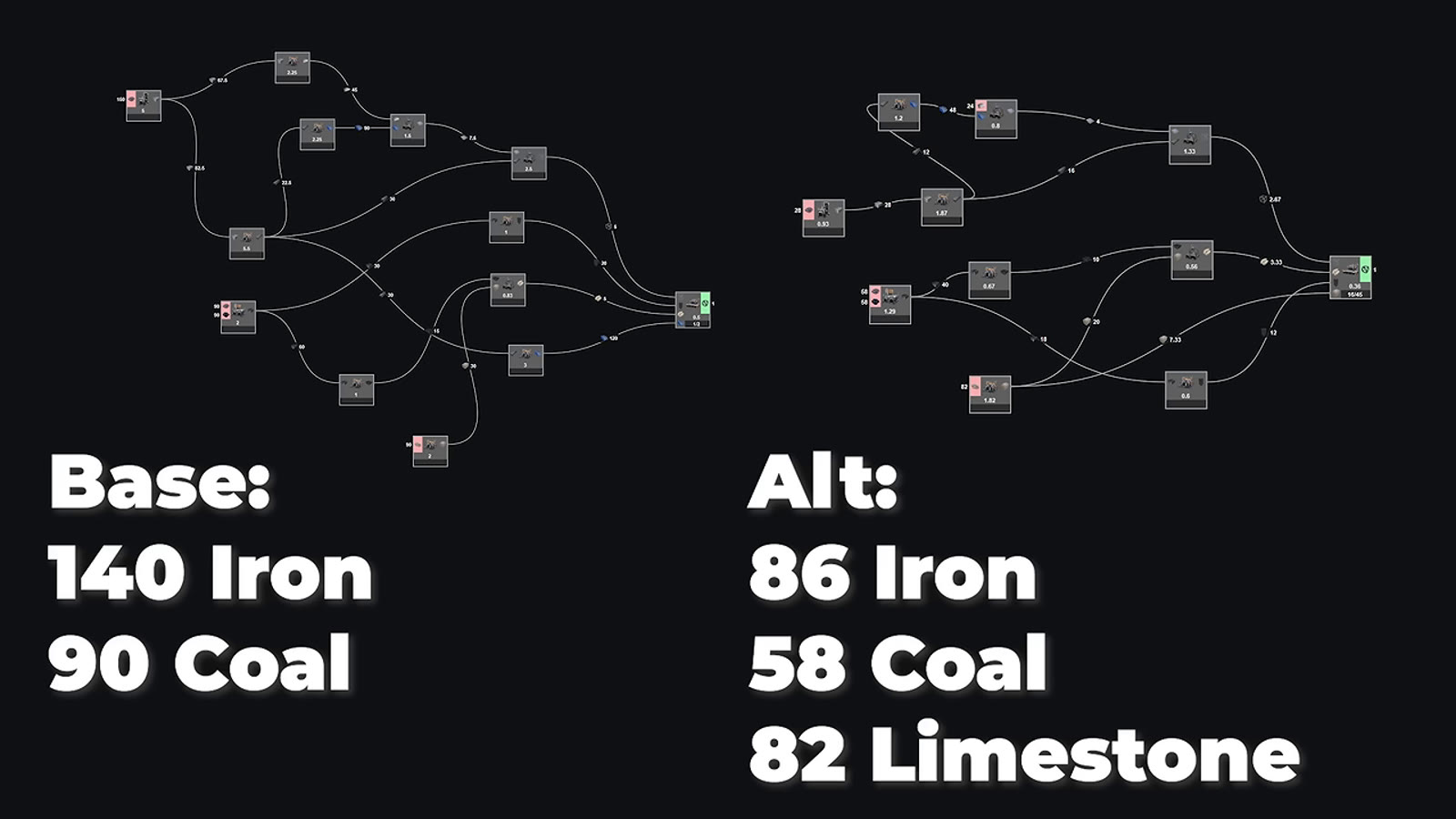
Heavy Modular Frames are a notorious screw bottleneck even with high-tier belts. Heavy Encased Frame keeps three of the four standard ingredients and replaces screws with concrete, which is more resource-efficient outright — beating even a standard line built on the Steel Screws alternate — while also cutting overall power draw by around 50%. The video's own side-by-side comparison (pictured above) shows a fully optimized standard line needing 140 Iron and 90 Coal against the Heavy Encased Frame alternate's 86 Iron, 58 Coal, and 82 Limestone for the same output.
How this guide was fact-checked
Every recipe ratio, tier unlock, building type and power figure in this guide is transcribed directly from the source video's own on-screen recipe cards and comparison charts (Cast Screws, Iron Pipe, Molded Beam/Pipe, Wet Concrete, Heavy Oil Residue, Diluted Fuel, and the Heavy Encased Frame comparison chart) rather than from the narration alone — these are screenshots of the actual in-game recipe data, which is a more reliable primary source than a spoken approximation. The Content Plan notes flag alternate recipe balance as patch-sensitive; this video is recent (2026-05-28) and explicitly current for Satisfactory 1.2, which is the newest available source for this topic as of writing.
What this guide doesn't answer
This guide doesn't rate every alternate recipe in the game — the source video deliberately covers only a curated set of standouts and states outright that most late-game alternates are too context-dependent or niche to rank meaningfully, rather than offering a full alt recipe rankings list. Recipes it does not mention at all, including Caterium Computer, Coke Steel Ingot, and Recycled Plastic/Rubber, simply weren't part of this video's curated list — they're solid alternates in their own right, but rating them here would mean inventing an opinion the source never gave. It also doesn't cover miner/extractor power numbers in any of its comparisons, since the video explicitly excludes them as too variable depending on miner tier and overclocking to give a fair number.
Frequently asked
What is the best early-game alternate recipe in Satisfactory?
Cast Screws (Tier 1) is the standout early pick — it turns Iron Ingots directly into Screws at the same 1:4 ingot-to-screw ratio as the standard rod-based chain, while using around 40% less power by skipping an entire production step.
How do I make steel pipes without using coal in Satisfactory?
The Iron Pipe alternate recipe (Tier 3) makes steel pipes from iron ingots instead of steel ingots, removing coal entirely. It costs roughly triple the iron and 6% less power, which is usually a good trade since iron is far more plentiful than coal.
Are Pure Ingot alternate recipes worth using?
Yes — every Pure Ingot recipe (Tier 5) uses significantly less ore than the standard version in exchange for adding water. That's a double win: water is one of the most annoying byproducts to dispose of, and the ore savings extend how long your world's resource nodes last.
How do I maximize fuel production from crude oil in Satisfactory?
Chain the Heavy Oil Residue alternate (Tier 5, converts Crude Oil directly to Heavy Oil Residue plus Polymer Resin) into the Diluted Fuel alternate (Tier 7, combines Heavy Oil Residue with water). Together they turn 30 Crude Oil/min into 80 Fuel/min, versus only 20 Fuel/min from the standard recipe.
What's the best alternate recipe for Heavy Modular Frames?
Heavy Encased Frame (Tier 6) replaces screws with concrete in the recipe, which is more resource-efficient than even an optimized standard line and cuts power draw by roughly 50% — a comparison in the source video shows 86 Iron/58 Coal/82 Limestone versus 140 Iron/90 Coal for the standard approach.