
🎯 The core idea
Teamfights are decided before the first spell lands. Know your champion's job, find the space where you are safe but still useful, track the three or four enemy spells that can kill you, and hit the closest target you can damage safely, not the one you wish you could reach. Set fights up early around objectives, stand in an arc rather than a line, and review two fights after every game.
- free costs nothing
- cheap small cost
- setup needs preparation
- grind pays off slowly
- skip the thing to stop doing
Why you win lane but lose teamfights

free Plenty of players win their lane and then hand the lead back in the first five-versus-five fight. The Mobalytics video behind this guide shows why with eye-tracking data. It compares a lower-level player and a Challenger player watching the same kind of fight. The lower-level player keeps their eyes on their own champion and the area right around it, with the odd glance at the minimap. The Challenger player watches the whole fight like a spectator while they walk in: every enemy, the minimap, who has used which spell, and who is leaving.
The video's main point is that most fights are won or lost in the seconds before they start. If you walk in without knowing where the enemy jungler is, which carry has Flash, and what your own job is, you are reacting, and reacting is always a little late. So the rest of this guide covers what to look at, where to stand for each role, who to hit, and how to set fights up. Laning skills still matter more for your rank overall, which is why the laning guide and the ranked climb guide come first. But the habits below are what turn a lane lead into a won game.
Where to look before and during a fight

free In the first clip of the video, the blue bubble marks where a lower-level Thresh is looking. It stays in front of his own champion while he walks into a bush, so he never sees the Lee Sin coming and dies after pressing a couple of buttons. The higher-level player starts tracking the fight while still dead and waiting to respawn, and keeps scanning cooldowns, items and the minimap during the chase.
You do not need an eye tracker to copy this. Before a fight, check four things in order:
- The minimap. Count the enemies you can see. If one is missing, assume they are on the flank you can't see.
- The scoreboard (Tab). Look at enemy items: a finished Zhonya's Hourglass, Quicksilver Sash or Guardian Angel changes who you can kill.
- Enemy summoner spells. Who has Flash, who has Cleanse, who has Teleport. More on tracking these below.
- Your own team. Who is ahead, who is low, who has ultimate ready.
During the fight, glance away from your own champion every second or two. Keep your camera on the fight, not on yourself. If you play locked camera, try unlocking it for a few games just to see more of the fight.
Know your champion's job in the fight

setup Coach Mysterias' newer teamfighting video (Season 2025) makes this its first two points. First, ask what your champion is built to do: engage, peel, flank, poke or deal sustained damage. Drop every option your champion is bad at, and the fight gets much simpler. Second, ask what your job is in this game. If your Jinx is far ahead, an engage support with heavy crowd control should probably stay next to her and peel, not dive in and leave her open.
| Champion type | Main job in a teamfight | Usual first target | Where to stand |
|---|---|---|---|
| Tank or engager (Malphite, Leona, Ornn) | Start the fight or block the enemy's start | The enemy carry you can reach, or whoever enters your team | Front, slightly to the side |
| Fighter or bruiser (Darius, Jax, Renekton) | Make space, threaten anyone close | The nearest enemy you can stick to | Front or flank |
| Assassin (Zed, Talon, LeBlanc) | Remove one carry, then leave | Squishy backline once key crowd control is spent | Side angle, out of sight |
| Control or burst mage (Orianna, Syndra) | Hit several enemies with spells or delete one target | Whoever walks into range | Second line, behind the frontline |
| Marksman (Jinx, Kai'Sa, Aphelios) | Steady damage for the whole fight | The closest enemy you can hit safely | Back, connected to the team |
| Enchanter or peel support (Lulu, Janna) | Keep your carry alive | Whoever dives your carry | Next to the carry |
The champions named are examples. If you are not sure which row your champion fits, a good champion guide or the champion's own abilities will tell you. Read the role guides for the details of each position: top lane, jungle, mid lane and support.
Frontline vs backline, and the arc formation

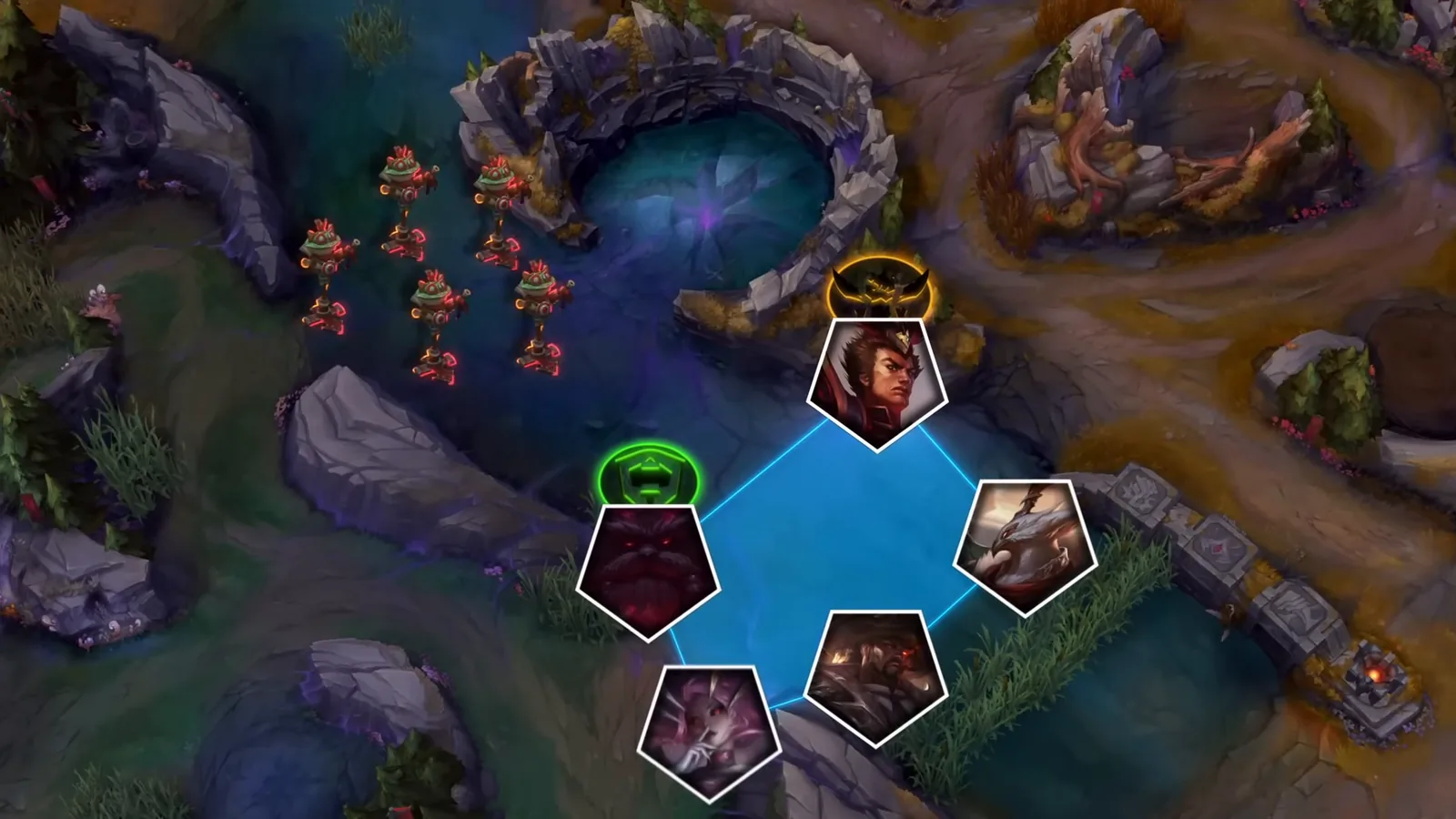
free The classic teamfight positioning rule is front to back: tanks in front, carries behind them. It is simple and it works. Mysterias argues for a better shape, a curved arc (he calls it the banana formation) around the enemy team, and uses an LCK 2024 Summer final fight to show it. He lists four reasons it beats a straight line:
- If someone dives your backline, everyone in the arc can turn and hit them at once.
- Your carries stay safe but still in range to deal damage.
- Your frontline can walk forward and take space without leaving anyone exposed.
- You are not stacked up, so area spells like a Malphite or Orianna ultimate hit fewer people.
There are limits. Flanks punish the sides of an arc hard, and an arc that is too wide or broken in the middle falls apart when the enemy engages. In solo queue you can't call a formation, so translate it into one habit per role: frontline players play slightly to the side, not straight into the enemy; carries stay connected to the team; assassins and flankers move to the side and wait.
How to teamfight as a tank or engager

setup As a tank your job is to create space for your carries, not to die first. That means walking forward to threaten, holding your crowd control for the right moment, and starting the fight only when it's good for your team.
How to engage a teamfight well:
- Count before you go. If the enemy has five champions on the minimap and your team has four nearby, wait. Engaging while a teammate is still walking from a side lane is the most common way tanks throw a fight.
- Engage when key spells are down. If their carry just used Flash, or their support used the shield that would have blocked your crowd control, that is your window.
- Engage where your team can follow. A perfect Malphite ultimate on three people does little if your damage dealers are fifteen seconds away.
- Turn back after the engage. Once your big crowd control is spent, look behind you. If an assassin or fighter is diving your carry, walk back and put your remaining crowd control on them.
The Mysterias diagram above shows a five-champion arc: the frontline spreads across the front instead of standing in one stack, which leaves the carries behind room to fire. When you are behind in gold, you do not have to start every fight. Standing in front and forcing the enemy to walk through you is also frontline work.
How to position as ADC and other carries

free Coach Violet's 2026 ADC teamfighting video breaks pro clips from Ruler and JackeyLove down into three rules. The clips themselves are from Worlds 2022, MSI 2023 and the LPL in 2023, but the rules don't depend on the patch:
- Find a safe space to fight. That is usually where your team is standing and where you have vision. Fighting out in the open without vision and away from teammates is how carries get caught.
- Know the enemy's threats and your answer to each. Before the fight, name the three or four spells that can kill you (a Renekton Flash stun, a Vi or Malphite ultimate, a Blitzcrank hook) and decide how you will deal with each: stand out of range, wait until it is used, or save Flash or Cleanse for it.
- Know the ranges. Stand at the edge of your own attack range, outside the range of their threats. In Violet's clips, Ruler gets a free auto attack in because he knows the enemy marksman can't reach him from where he is standing.
Patience is the other half. In one clip Ruler stands far back while the enemy uses hook, Malphite ultimate and Vi ultimate on his teammates, then walks forward once those spells are gone. Your job is to stay alive and do damage for the whole fight. Ten seconds of auto attacks from the back beats two seconds of damage before you die at the front.
A detail from the clips worth stealing: standing against a wall can make a hook or knock-back miss you or fail to pull you anywhere useful. Use terrain as cover when the enemy has a hook champion.
Peel vs dive: how to teamfight as a support

free The diagram shows why the arc makes it easier to peel your backline: when an enemy dives your carry, the people around the carry are already close enough to hit back. "Peel" means using your crowd control, shields and heals to push threats off your carry. "Dive" means going past the enemy frontline to reach their carry.
How to peel in League of Legends:
- Stand near your carry, not in front of the team. Your crowd control is only useful against divers if you are close enough to cast it.
- Hold your crowd control for the diver. A Lulu polymorph or Janna knock-up used on the enemy tank at the start of the fight is gone when their assassin jumps in.
- Peel the threat that is on your carry right now, not the one you would like to hit.
When to dive instead: if your carry is behind or dead, or the enemy carry is alone and out of position, an engage support should go. Ask the same question as before: who is your team's win condition in this game? Mysterias' example is exactly this. If your marksman is far ahead, peeling for them is correct, and diving leaves them alone. The support guide explains how to pick between enchanter and engage supports.
How to play teamfights as an assassin or flanker

setup Assassins and flankers don't play front to back. Mysterias' advice is to move to the side of the fight and wait for a good angle or an enemy mistake before going in. The diagram shows the line a flanker takes around the side of the enemy team to reach their backline.
How to play teamfights as an assassin:
- Stay out of vision before the fight. Your threat is that the enemy doesn't know where you are. Walking up the middle with your team gives that away.
- Wait for crowd control and defensive spells to be used. If their support still has a shield or a stun ready, jumping onto their carry is a coin flip.
- Pick a target you can kill and leave. An assassin that gets one kill and dies right after has traded evenly. One kill and an escape is a winning trade.
- Don't go in first. Let your tank or the enemy start the fight, then go in from the side when everyone has looked away.
If the enemy carry is sitting behind a tank and a peel support with everything up, sometimes the right play is to hit whatever is closest and threaten from the side. The threat alone keeps their backline from playing forward.
Target selection: who to hit first

free Target selection decides more fights than mechanics do. The simple rule for most damage dealers is hit the closest enemy you can damage safely. The enemy carry is the ideal target, but walking through three enemies to reach them is how you die without dealing damage.
| Situation | Who to hit |
|---|---|
| Enemy tank is in front, carry behind them | The tank or bruiser, while you watch for a chance to reach the carry |
| Enemy carry walks into your range | The carry, right away |
| An enemy dives onto your carry | The diver; peel first, then damage |
| An enemy is low and out of position | Finish them if it's safe; one fewer enemy wins the fight |
| You are an assassin | The squishiest target you can reach and escape from |
| Enemy has a fed carry and you can't reach them | Hit what is in front of you and keep your team alive until their key spells are down |
A frontline enemy with no damage items can be ignored for a few seconds. A fighter with damage items or a bruiser with a strong comeback mechanic can't. When in doubt, ping the target you want and commit with your team. Two players spreading damage over two targets kill neither.
Cooldowns, Flash and the mental flowchart

setup The Mobalytics video describes how good players run a short plan in their head before a fight: "I'll use Q to start, save my ultimate for when their main spell is gone, and use E to get out when their jungler shows up." It calls this a mental flowchart. Anything you didn't account for breaks it, which is why the information check before the fight matters.
Mysterias splits cooldown tracking into three levels:
- Know the enemy's key threatening abilities (Malphite or Leona ultimate, a big damage spell) and their key self-defence spells (spell shields from Sivir or Morgana, a Lulu polymorph or ultimate).
- Track enemy summoner spells, especially Flash. Per the official wiki Flash has a 300-second cooldown, so a carry who flashes at 20:00 has no Flash until about 25:00. That window is when your team should force a fight.
- Bait the important cooldowns. Step toward an enemy's engage range and back out again, or show yourself on purpose so they waste a hook or ultimate before the real fight starts.
When to Flash in teamfights: use it to dodge one of the spells you named before the fight (a hook, a stun, an ultimate that would kill you), or to land a fight-winning engage. Don't Flash just to get one more auto attack.
| Spell or item | What it does in a fight (wiki values) |
|---|---|
| Flash | Blink up to 400 units; 300-second cooldown |
| Cleanse | Removes most disables and gives 75% tenacity for 3 seconds; 240-second cooldown. It does not remove airborne (knock-ups) or suppression |
| Exhaust | 40% slow and 35% less damage dealt for 3 seconds on one enemy; 240-second cooldown |
| Heal / Barrier | Heal 240-second cooldown, Barrier 180-second cooldown |
| Zhonya's Hourglass | 2.5 seconds of stasis; 120-second cooldown |
| Quicksilver Sash | Removes all crowd control except airborne; 90-second cooldown |
The Cleanse row is worth remembering: if you are holding Cleanse for a Malphite ultimate, it won't help, because that is a knock-up.
Dive, poke and engage comps

setup How you fight also depends on what your team composition wants. The clip above, from the higher-level player in the Mobalytics video, shows the kind of moment comps are built for: two enemies knocked airborne at once, with a Teleport channel on screen bringing one more champion into the fight.
| Comp type | Plan | How to beat it |
|---|---|---|
| Dive comp (several champions that jump onto the backline) | Go in together onto the enemy carries, all at once | Stand close together, hold peel and Cleanse or Exhaust for the divers |
| Poke comp (long-range mages and marksmen) | Chip the enemy down at range before the fight, then fight when they are low | Engage fast or go around them; don't sit in front of an objective getting hit |
| Engage comp (big area crowd control) | One big start from a tank that hits several enemies | Don't stand bunched up, track the engage spells, fight when they are down |
| Protect-the-carry comp | Peel the fed carry and let them do the damage | Kill or crowd-control the carry; avoid fighting through all the peel |
| Split push or pick comp | Avoid 5v5 fights, catch single enemies, pressure side lanes | Group and force objectives the split pusher can't defend |
In a lol dive comp, the most important thing is going in together. One diver who goes early just dies. In a lol poke comp, the most important thing is patience: you win by getting the enemy below half health before the fight, not by fighting first. Mid laners and junglers often decide which plan your team actually plays, so the mid lane guide and jungle guide are good follow-ups.
Fight timing and setup around objectives

setup Fight timing is about choosing when to fight, not just how. Mysterias' advice for setting up fights: use the quiet periods of the game to prepare, and ping the next objective around two minutes ahead, not when it spawns. Then your team has time to reset, buy, walk over and ward. A ping when the Dragon has already spawned means half your team arrives late.
Fighting is much easier when you have vision of the area. You control the space, you can block the narrow paths the enemy walks through, and your spells are easier to hit when they walk toward you. Choke points let you hit several enemies with one spell. The warding guide explains how to ward an objective about 60 seconds before it spawns and how Faelights work in Season 2026.
Good times to force a fight:
- An enemy carry has just used Flash (see the 300-second cooldown above).
- One or more enemies are dead or far away in a side lane.
- Your team has a power spike, like a finished item or several ultimates at level 6, 11 or 16.
- You have taken a buff that changes the fight. Per the wiki, Elder Dragon's Aspect of the Dragon lasts 150 seconds and executes enemy champions you damage below 20% maximum health. Hand of Baron lasts 180 seconds and strengthens nearby minions.
Season 2026 matters here. Patch 26.1 removed Atakhan and moved the game toward turret pushing and away from epic monster contests, so a won fight should usually become towers, not just a kill count. The objectives guide covers spawn times and which objective to fight for.
Teamfight mistakes that lose games

skip The Mobalytics video ends by putting fighting next to farming and vision as the three basics. Most lost teamfights come from the same few mistakes:
- Fighting with a player missing. Four against five is a bad fight unless the enemy is also missing someone.
- Face-checking bushes before the fight. That's how the Thresh in the video dies. Check with a ward or an ability, or don't walk in alone.
- Using your key spell on the wrong target. A crowd-control spell on the enemy tank at the start of the fight leaves nothing for their assassin.
- Chasing too far after a won fight. Chase a low enemy into fog and you can give the enemy the kill back. Take the tower or objective instead.
- Standing in a clump. Area ultimates hit three or four people when you stand together. Spread out a little, in the arc.
- Carries fighting at the front. If you are the damage, your job is to be alive at the end of the fight.
- Fighting without a reason. A fight with nothing to gain (no objective, no tower, no wave) is a coin flip with nothing to win.
Review your teamfights after the game

grind Both videos end with the same advice: review your fights. You don't need to watch the whole game. Pick two or three fights per game, ideally ones you lost, and ask:
- Was I standing where my champion should be for my role in this fight?
- Did I know where all five enemies were before the fight started?
- Which enemy spell killed me, and did I know it was available?
- Did I use my key spell at the right time, or did I waste it on the wrong target?
- Could I have come in from a different angle or at a different time?
The Mobalytics video also points out the gap between what you thought you did and what you actually did. Replays often show you were in a worse place than it felt at the time. Then watch better players in the same role and copy one habit at a time. When a replay shows you set a fight up well, give yourself credit for it. That makes it easier to repeat. The ranked climb guide has a fuller VOD review routine with micro and macro questions, plus which fights are worth taking at all.
How this guide was fact-checked
- Main source: Mobalytics, "Mastering TEAMFIGHTING in League of Legends | Open Your Eyes Part 4" (April 2020). Its eye-tracking comparison, the mental flowchart idea and the advice to prepare, review and watch better players are timeless. Its footage is from a 2020 patch, so the items and user interface in those frames are out of date. Nothing in this guide relies on a 2020 number.
- Newer sources, since the row notes asked for a more recent video: no 2026 upload covering teamfighting for all roles turned up in a YouTube search on 2026-10-23, so this guide adds two newer videos. Coach Mysterias, "Give me 7 minutes and I'll improve your teamfighting by 200%" (June 2025, Season 2025), is the source for the arc formation, champion identity, cooldown levels and objective setup. Coach Violet, "How the Best ADCS Teamfight" (July 2026), is the source for the marksman rules. His clips are from 2022-2023 pro games, which we say in that section.
- Official League of Legends Wiki (checked 2026-10-23): Flash 400 range and 300-second cooldown; Cleanse 240 seconds, 75% tenacity for 3 seconds, does not remove airborne or suppression; Exhaust 40% slow and 35% less damage for 3 seconds, 240 seconds; Heal 240 seconds; Barrier 180 seconds; Zhonya's Hourglass 2.5-second stasis, 120 seconds; Quicksilver Sash removes everything except airborne, 90 seconds; Aspect of the Dragon 150 seconds with an execute below 20% health; Hand of Baron 180 seconds.
- Official patch notes: 26.1 removed Atakhan and Feats of Strength and moved the strategic focus toward turret pushing. Baron spawning at 12:00 in that patch applies to Swiftplay only. On Summoner's Rift the wiki still lists 20:00.
- Our own work: the role table, the target-selection table and the comp table are written for this guide from the sources above. They are not taken from any one video. The Mysterias video names a support champion the captions don't make clear, so the guide describes it as an engage support with heavy crowd control instead of guessing.
What this guide doesn't answer
- Champion-specific combos and teamfight builds. Each champion fights differently. Our champion guides cover that.
- Exact objective spawn times and rewards. Those change from patch to patch. The objectives guide keeps them current.
- Shot-calling as a five-stack or in pro play. This guide is written for solo queue, where nobody controls the whole team.
- Laning phase and wave management. They come before fights; see the laning guide and wave management guide.
- ARAM teamfights. ARAM is one long fight on one lane with different rules for setup and vision, so most of the objective advice here doesn't carry over.
Frequently asked
How do you teamfight in League of Legends?
Prepare before the fight: count enemies on the minimap, check enemy items and summoner spells, and name the three or four spells that can kill you. Then play your champion's job: tanks start or block the fight, carries stay at max range next to their team, supports peel divers, and assassins wait on the side for key crowd control to be used. Hit the closest enemy you can damage safely.
Where should an ADC stand in teamfights?
Stand where your team and your vision are, at the edge of your own attack range and outside the range of the enemy's threats such as hooks, stuns and engage ultimates. Let your frontline and the enemy use their big spells first, then walk forward. Staying alive and attacking for the whole fight is worth more than a few seconds of damage at the front.
Who should you focus first in a teamfight?
Usually the closest enemy you can damage safely. Hit the enemy carry right away if they walk into your range, hit any diver who is on your carry, and finish low enemies when it is safe. Assassins should go for the squishiest target they can kill and escape from. Ping your target so the team commits damage to one enemy, not two.
When should you use Flash in a teamfight?
Use Flash to dodge a spell that would kill you or catch you, such as a hook, stun or engage ultimate, or to land a fight-winning engage. Don't use it for one more auto attack. Flash has a 300-second cooldown per the League of Legends Wiki, so an enemy carry who flashes is without it for five minutes, which is a good time to force a fight.
What is the difference between peel and dive in League of Legends?
Peeling means using your crowd control, shields and heals to keep enemies off your own carry. Diving means going past the enemy frontline to reach their carry. Peel when your carry is ahead and the enemy has divers; dive when your carry is behind or the enemy carry is alone and out of position. Note that Cleanse does not remove knock-ups or suppression.
Read next
How to Win Lane in LoL: Trading, Spacing and Laning Tips
Laning is won with small, repeated advantages: knowing your matchup, punishing last hits, trading when your wave and cooldowns favour you, and using each crash for a recall, ward or roam. This guide covers trading, spacing, minion aggro and lane priority for Season 2026.
LoL Objectives Guide: Dragons, Voidgrubs, Herald and Baron
Every epic monster on Summoner's Rift in Season 2026: spawn timers, drake buffs and Dragon Souls, Elder, Voidgrubs, Rift Herald and Baron at 20:00, plus objective priority and bounties. Checked against the wiki and patch notes through 26.21.
LoL Summoner Spells Explained: Best Picks for Every Role
What each of the nine Summoner's Rift summoner spells does, its cooldown, and which pair to take on top, jungle, mid, ADC and support. Checked against the wiki and patch notes up to 26.21, including the top role quest's free Unleashed Teleport.
LoL Itemization Guide: How to Build and Adapt Your Items
A principle-based League of Legends itemization guide: plan your first item and recalls, read the enemy's damage, time anti-heal and penetration, and set up item sets. A current items appendix covers every Season 2026 change through patch 26.21.