
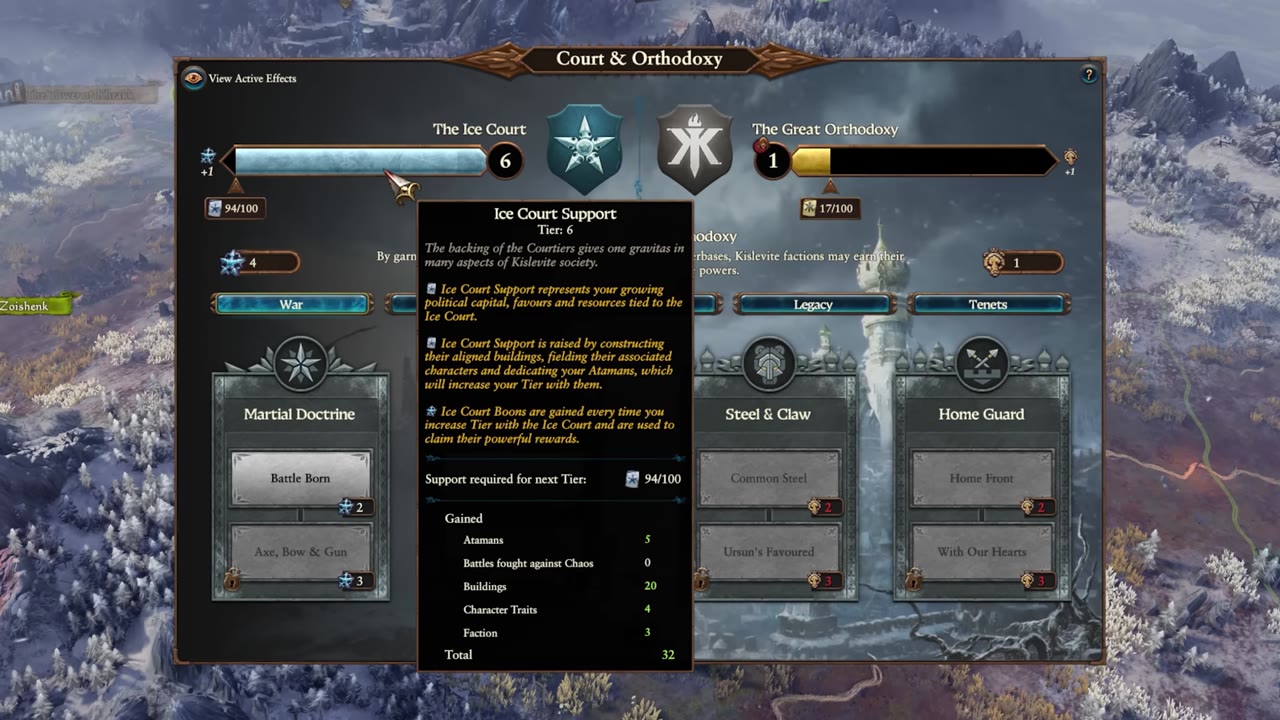
The Kislev campaign in Immortal Empires has been reworked to focus on managing political balance, Devotion, Invocations, Ataman governance, and hero training. You will be able to stabilize the campaign’s unique systems, use all four invocations efficiently, specialize Atamans for any province, and plan around each faction’s early strengths—including Mother Ostankya’s flexible start.
Quick answer
| What | Answer |
|---|---|
| Main political system | Ice Court and Great Orthodoxy balance |
| Ataman rule | One ataman per two full provinces |
| Ice Court training time | Five turns |
| Army invocations | Four options |
| Settlement invocations | Four options |
| Mother Ostankya resources | Spirit Essence |
| Ostankya hexes | Five abilities |
Get Kislev’s balance under control
The foundation of the Kislev campaign is its new political balance system, which replaces the old Supporter Race mechanic. Instead of a single progress meter, you manage a balance between the Ice Court and the Great Orthodoxy. Each side earns support mainly through buildings and character actions, and progresses through five sections: War, Hierarchy, Dominion, Legacy, and Tenets. Every section has two choices and two tiers—allowing a range of bonuses as you advance.

Maintaining equilibrium is critical: leaning heavily toward one side unlocks immediate bonuses, but brings increasing diplomatic penalties with the other. Further imbalance will trigger research penalties, higher Devotion construction costs, and reduced army stats. The safest approach is to advance both sides steadily and at similar rates—unlocking the broadest set of faction upgrades without suffering the harshest consequences. This is an ongoing management challenge, especially as your campaign expands.
Use Devotion and Invocations effectively
Devotion replaces the old Control meter in Kislev settlements. It increases via buildings, armies stationed in the province, hero presence, and Commandments. It decreases from corruption, enemy armies, and frequent conquest. Devotion levels affect both vision and Ataman dynamics: low Devotion offers increased line of sight and additional Ataman experience, while high Devotion boosts vision and removes all climate settlement restrictions.

Kislev's new Invocations system provides powerful temporary effects for both armies and settlements.
- Armies have four invocations:
- Dazh: Increases experience gain and grants flaming attacks—ideal for leveling armies or fighting the undead.
- Salyak: Boosts replenishment and healing after battles, letting damaged armies recover faster.
- Tor: Strengthens magical attacks, raising power during battles for spellcasting-focused armies.
- Ursun: Extends campaign movement range, improves bear unit damage, and gives a fear-sapping ability—best for bear-focused builds.

- Settlements have their own four invocations (with matching names but different effects):
- Dazh: Instantly completes 1 turn of construction for buildings in the region.
- Tor: Empowers defensive armies and grants a cataclysm battle spell—excellent during invasions.
- Salyak: Increases province growth, postbattle healing, and recruitment capacity.
- Ursun: Inflicts attrition on any hostile armies within your borders, deterring enemies.
The effect of low Devotion has differed across patches: it currently increases settlement line of sight and gives Atamans bonus experience. Check the game tooltips for your version before acting on this.
Build and move Atamans around your provinces
Atamans are core managers for Kislev provinces—one can be assigned for every two complete provinces you control. Each Ataman comes with a unique skill tree and regional bonuses, including boosts to income, Devotion, growth, and corruption management. Atamans can also align with either the Ice Court or the Orthodoxy for side-specific support. Their skills cover standard buffs along with a new bottom row focused on region power and specialization.

- Unlocks regional bonuses and skill advancement 3:27
- Focus on income, growth, devotion, or corruption management as needed
- Unlock region-specific power in the bottom row for maximum benefit
- Extra support and bonuses for respective heroes 3:57
- Garrisons in their region can attack roaming enemies within range
- Shift growth or recruitment specialists to provinces that need their bonuses 4:25
Train Frost Maidens and Ice Witches before you need them
Frost Maidens and Ice Witches act as Kislev’s main heroes and spellcasting Lords—but they must be trained before recruitment. Training takes five turns within the Ice Court, and each turn allows one of four effects to shape the hero’s stats or campaign influence.

- Pay the upfront cost and select your hero or Lord for training 4:55
- Pick from four options to shape the hero’s bonuses for five consecutive turns
- Hero becomes available as soon as training completes
- Avoid five-turn recruitment delays when assembling a new army
Pick the right campaign plan for each Kislev faction
Kislev's four playable factions have distinct bonuses, political pressures, and campaign openers. Use this table to compare their traits and early priorities:
| Faction | Political Pressure | Core Bonuses | Hero & Army Advantages | Special Mechanics & Focus |
|---|---|---|---|---|
| Katarin | Reduced relations with Orthodoxy, but can keep Ice Court one tier ahead | Faster research, higher Winds of Magic capacity, cheaper Ice Court training, passive support generation, corruption cleansing | Higher starting levels for Frost Maidens, reduced Ice Guard upkeep, lower miscast chance, spellcasting-focused armies | Passive Ice Court support, stronger spellcasters 5:53 |
| Kostaltyn | Stronger relations with Orthodoxy, higher penalty threshold | Better Orthodoxy support, stronger Patriarchs, bonuses on lower-tier units | Tougher support heroes, improved wound recovery, rage passive for army stats | Army built around Patriarchs and frontline units 6:44 |
| Boris Ursus | Centrist approach in Chaos Wastes | Cheaper garrisons & religious buildings, faster construction, bonus devotion | Stronger War Bear Riders, army bonuses against Chaos, immunity to chaotic attrition | Survival first, rush to bear units, improved relations with Katarin 7:41 |
| Mother Ostankya | Flexible choice: start in Naggaroth or move to Kislev | Spirit Essence for both mechanics, forest economy, beast/corruption focus | Boosted magic capacity, faster recruitment for beast units, stronger Incarnate Elemental, better spiders | Witch’s Hut, Hexes upgrade, early campaign choice shapes focus 8:41 |
Play Katarin with spellcasters and balanced infrastructure
Katarin’s campaign is the classic Kislev experience: she starts near Kislev proper and must balance infrastructure and politics. Early-game challenge is managing both sides of the political balance while staying flexible. While leaning toward the Ice Court can be tempting (and Katarin has a special leeway to keep it a tier ahead), avoiding negative penalties is more important.

Frost Maidens and Ice Witches are crucial because Katarin’s higher Winds of Magic cap lets you use more spells per battle, maximizing hero impact early. Extra hero levels help your spellcasters snowball quickly into campaign-defining assets.
Play Kostaltyn with Patriarchs and low-tier units
Kostaltyn leads the Great Orthodoxy, starting in a similarly challenging region but with more hostile threats nearby (such as Throt and Azazel). His campaign gives you more room to favor the Orthodoxy before penalties start, letting you play more aggressively.

Kostaltyn is designed for bread-and-butter armies: Patriarchs are tough and excel when deployed as buff-giving support pieces. Early-game play should focus on basic units benefiting from his lower-tier bonuses and maximizing pace against invading forces.
Survive the Chaos Wastes as Boris
Boris starts in the Chaos Wastes—a difficult environment but one made easier by devotion bonuses for settlements, which accelerate their growth and reduce climate penalties. His garrisons and religious buildings are cheaper, and he expands faster.

Boris’s army is bear-focused: War Bear Riders are cheaper and can be recruited at higher ranks. He also receives campaign bonuses against Chaos and immunity to chaotic attrition. The essential plan is to stabilize settlements, avoid bankruptcy, and reach bear units as soon as possible—using faster construction and cheaper buildings to scale up.
Use Spirit Essence and Hexes with Mother Ostankya
Mother Ostankya’s campaign features two resource-driven mechanics: Spirit Essence, and Hexes.
- Spirit Essence is primarily gained from postbattle loot, but certain buildings (such as Ostankya’s Hut) provide passive income.
- The Witch’s Hut lets you craft blessings and curses from ingredients unlocked via alliances or battles. These items appear in the pre-battle menu and can be used on your armies or enemies.
Hexes define Ostankya’s power set:
- Remove corruption from owned regions.
- Slow and weaken hostile armies.
- Teleport your own armies to magical forests.
- Boost settlement income.
- Summon Beastmen armies in your territory.

All hexes are upgraded via research, and require Spirit Essence to unlock and use. Ostankya can choose where to start her campaign: remaining in Naggaroth for bonus Spirit Essence and unique Witch’s Hut features, or returning to Kislev to access the standard building chain and get a ten-turn campaign bonus.

Her faction further boosts beast units, spider units, and magic capacity—with reduced recruitment time for the Incarnate Elemental of Beasts. Hag Witches have lower miscast chance, and all her armies gain magical attacks and bonus spell range. The optimal play is to spend Spirit Essence rapidly, unlocking stronger hexes and crafting blessings/curses as soon as possible.
- Win battles for postbattle loot; build Ostankya’s Hut for passive resource
- Use ingredients from alliances and battles to create items for battles
- Spend Spirit Essence to upgrade key abilities
- Decide to stay in Naggaroth or move to Kislev for different strategic bonuses
- Build out spider and elemental units; capitalize on magic bonuses
- Unlock and enhance Hexes and Witch’s Hut effects 11:43
Also worth knowing
- Atamans are excellent for intercepting roaming Beastmen and other raider armies. Make use of garrison sorties to catch enemies that won’t attack settlements.
- Mother Ostankya’s campaign can now be played directly in Kislev as well as in Naggaroth; select your start based on preference for standard buildings versus unique Spirit Essence incentives.
- Mother Ostankya is not locked to her starting position. You can move her between Naggaroth and Kislev as early as turn two—planning for your preferred campaign bonuses.
- The Ice Court and Great Orthodoxy bars can keep rising past their displayed limits. Some players have experienced the Ice Court bar stuck at 100/100 with no new boons appearing; consider this when planning long-term support.
- Confederation mechanics may be missing or bugged for Kislev factions. If the confederation button does not appear, there may be patch-specific bugs to work around.
Frequently asked
How does Kislev’s new balance system work?
Kislev uses a balance between the Ice Court and the Great Orthodoxy. Building support on both sides unlocks bonuses, while leaning too far toward one side causes diplomatic penalties and later penalties to research, devotion construction cost, and army stats. The safest approach is to keep both sides moving up at a similar rate.
How do Atamans work in Kislev?
Atamans are assigned across provinces, with one available for every two full provinces you control. They can be specialized for income, devotion, growth, corruption control, recruitment, or other regional jobs, and they gain skills as they level. They are strongest when moved to whichever province needs their specialty most.
What does the Ice Court training system do?
Frost Maidens and Ice Witches are trained for five turns before they can be recruited normally. Each training turn lets you choose one of four effects that shapes the hero and its army or region bonuses. Once training finishes, the hero can be recruited from any settlement.
Should Mother Ostankya stay in Naggaroth or move to Kislev?
Staying in Naggaroth gives bonus Witch’s Hut value and extra Spirit Essence, but it limits access to most Kislev recruitment and advanced buildings. Moving to Kislev gives a ten-turn campaign bonus and opens regular Kislev building options. The better choice depends on whether you want the stronger thematic start or the more flexible economy and recruitment base.
Read next
Total War: Warhammer 3 High Elves Guide: Patronage, Influence and the Intrigue Game
This plan covers the shared High Elf mechanics in Immortal Empires and how each legendary lord changes the campaign plan. It is for players who want to choose a lord, understand the faction systems, and know what to prioritize early.
Total War: Warhammer 3 Dark Elves Guide: Black Arks, Slaves and No Global Recruitment
This guide covers the early campaign, core army choices, hero roles, Malekith’s skill path, Black Arks, technology, and the slave economy for Dark Elf play in Immortal Empires. It is aimed at players who want a practical opening plan and the main systems that make Dark Elf campaigns work.
Total War: Warhammer 3 Khorne Guide: Skarbrand, Blood Hosts and Skulls
A practical campaign plan for playing Skarbrand and the Exiles of Khorne in Immortal Empires. It focuses on battlefield control, leveling, settlements, blood hosts, skull spending, diplomacy, and nonstop expansion.
Total War: Warhammer 3 Lizardmen Guide: Geomantic Web, Rites and Blessed Spawnings
A practical early-to-late campaign plan for Kroq-Gar and the Last Defenders, focused on surviving the opening wars, building efficient armies, and scaling into a Stegadon-heavy late game. It is for players who want a clear path through the faction’s early economy, unit choices, heroes, and research priorities.