
This ranks the five Legendary Lords of the End Times in Immortal Empires by how well their whole campaign plays: economy, mechanics and pacing, not how hard the lord hits in battle. Use it to choose your next start and to know which weak spots to plan around before turn one.
Quick answer
| What | Answer |
|---|---|
| Best campaign | Neferata |
| Second place | Boris Todbringer (Empire) |
| Fourth place | Glottkin (Nurgle) |
| Skaven pick | Thanquol, with Stormfiends as a front line |
| Lowest rank | Nagash (fifth) |
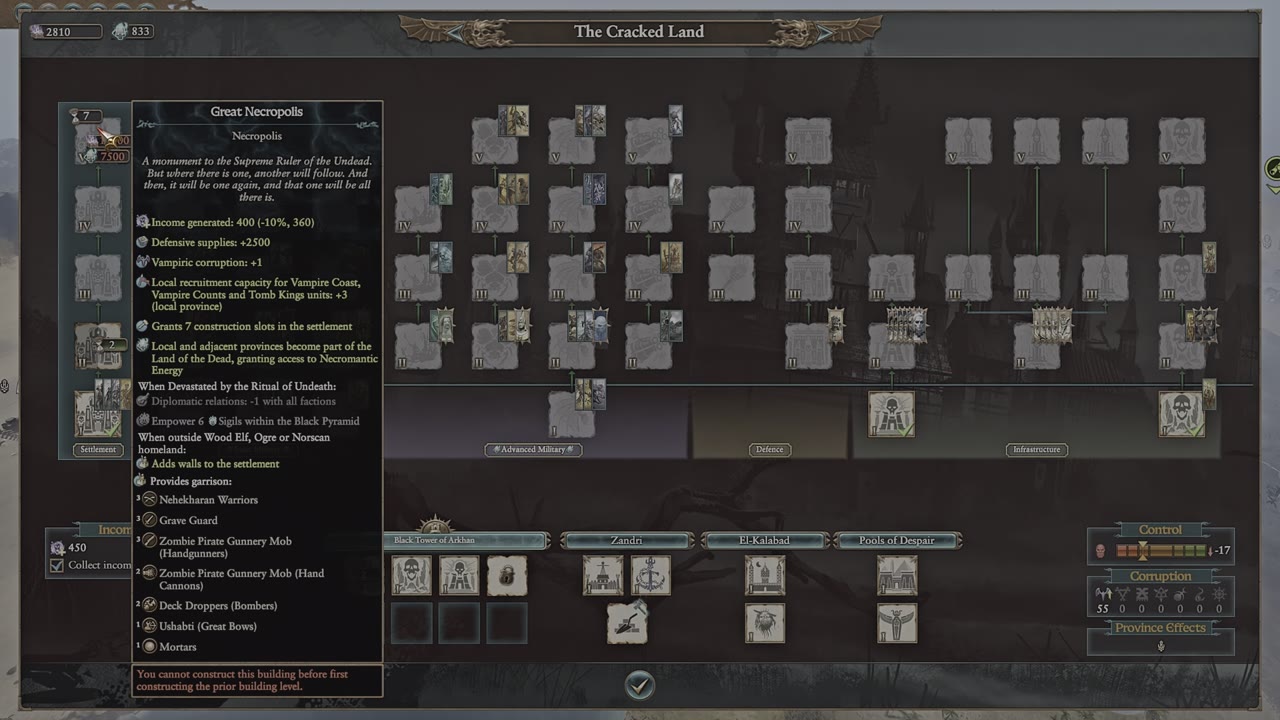
| Nagash Necropolis cost | 7,500 Necromantic energy for a tier five main building |
How the five Lords of the End Times rank
The order below judges the campaign as a whole. A lord can be the strongest model on the battlefield and still sit at the bottom if the economy and unlock pacing fight you all game.
| Rank | Lord | Faction | What carries the campaign | What holds it back |
|---|---|---|---|---|
| 1 | Neferata | Vampire Counts | Web of Power, covens that hold territory, wide climate access | Web of Power is a slow resource-spend loop |
| 2 | Boris Todbringer | Empire | Faction-wide melee and Cult of Ulric bonuses, open north | Fervor builds slowly; still needs artillery for sieges |
| 3 | Thanquol | Skaven | Stormfiends, extra Vermin Lords, a free region province | Master plans are randomised and hands-off |
| 4 | Glottkin | Warriors of Chaos (Nurgle) | Gardens of Corruption, automatic plagues, souls economy | Vassals make the map trivial; little challenge |
| 5 | Nagash | Undead | The most powerful lord in battle, every undead roster | Weak economy, Necropolis limit, slow unlocks |
If you want an Empire campaign built around expansion and confederation rather than fighting, Karl Franz is still the better pick than Boris — his guaranteed confederation is the difference 19:51.
Why Nagash ranks last despite his power
In battle, Nagash is close to untouchable. He summons units mid-fight, including a white king and zombies, his lore of magic makes him unbreakable, and he recruits from every undead roster in the game 0:30. Arkhan the Black joins as a second legendary lord within a couple of turns. The campaign around him is the problem.
Necromantic energy is spent on almost everything, and it comes in slowly:
- Upgrading a Necropolis to tier five costs 7,500 for the main building alone 1:57. Every Necropolis pays this separately.
- Barracks cost hundreds to thousands each, and advanced military buildings cost more.
- Raising unit capacity costs energy.
- Grave Call, the special recruitment, also draws on it.
- Going over the Necropolis limit cuts your energy gain, and your income penalty can reach minus 100% 6:48.

Taking a settlement gives no energy at all — it comes mainly from field battles. Minor settlements are always tier one and give up to 20 each.
Gold is just as tight:
| Building | Income | Note |
|---|---|---|
| Basic economic building (minor settlement) | 100 | Costs 1,000; pays back in barely 10 turns |
| Necropolis economic building | 200 | Capped by the Necropolis limit |
| Vampire Counts tier one income building, for contrast | 400 | Cheaper, too |
Confederation is restricted: a faction holding more than five regions cannot be brought in, so you have to beat it down first. The Mortarchs and most of the roster sit behind ten unlocks that take most of the campaign to finish 6:48. By the time the full toolbox is open, you have already beaten whatever the map threw at you. The Black Pyramid and the research tree are excellent; they simply arrive late.
Work around Nagash's economy
None of these fix the design, but together they keep a Nagash campaign funded and fielding armies.
- They are always tier one, so you lose nothing by burning them 5:49
- Nagash's minor settlements are valued highly in trades — the most reliable gold source he has
- Pyramid summons get the pyramid's buffs; building-recruited units do not
- Roughly 8,000 to 10,000 energy from one large battle
- A wind of death lord via sigil upgrades, filled with skeletons, for around 500 energy
- Confederating him early hits income hard; there is no deadline
Every Necropolis you add pushes you towards the limit, and going over it cuts your energy gain and your income at the same time. Plan which provinces get one before you expand.
Glottkin: the best Nurgle campaign
Glottkin plays as a Nurgle-only Warriors of Chaos campaign. You recruit Nurgle and undivided units — Hellcannons and greater daemons included — but nothing from the other gods 9:14.
The centrepiece is the Gardens of Corruption: you can build seven in a campaign. They grow faster than normal settlements and spread plagues on their own, so you never have to brew one by hand.

Seven gardens limit how far you can spread, but dark fortresses fill the gap. More of them exist now: Marienburg, Altdorf and Nuln in the Empire, where previously only Nuln counted 9:44.
The economy runs on souls. Units and buildings cost souls to build and souls to maintain, which is a cleaner system than managing infections. On top of that you get Nurgle challenges, which improve plagues and army capacity, and rituals of decay for campaign-wide benefits.
Glottkin brings four legendary heroes but no new generic lord option. Your Chosen have to reach rank eight before they unlock the next unit tier, which slows the roster down 12:10.
The weakness is the one every Warriors of Chaos campaign shares: you vassalise factions, the dark fortresses are rarely attacked, and the map stops pushing back. It works, it will not frustrate you, and it rarely challenges you.
Thanquol: a solid Skaven campaign with a gimmick
The biggest gain is for every Skaven faction: Stormfiends. They give Skaven a real front line, and they can fight alongside Clanrats and Stormvermin because those units can pass through them 13:37. Rat Ogres never filled that role.
| Stormfiend variant | Role |
|---|---|
| Ratling cannons | Ranged |
| Warpfire projectors | Ranged |
| Windlaunchers | Ranged |
| Shock gauntlets | Melee |
| Grinderfists | Melee |
| Mauls | Melee |

Thanquol's own campaign has real advantages:
- Skreech is the legendary hero.
- He can field more Vermin Lords than anyone else, because he has two routes: the dominating scheme upgrade or research, and a master plan 14:06.
- He starts with a free region province, unlike Ikit Claw, who has to spend early Food on the single-region Skavenblight.
- He has a quest battle against Gotrek and Felix.
The disappointment is master plans. You start one, the outcome is randomised, and you interact with it once or twice at most before it resolves 17:30. They do produce money, resources and Under-Cities, and after the final battle they let you destroy whole provinces with moon chunks. They just never ask a decision of you.

Boris Todbringer: a melee Empire campaign
Boris makes an all-melee Empire army work. The strength is not any single unit — it is the stack of bonuses he applies across your forces 20:20:
- Faction-wide upkeep reduction for Cult of Ulric units.
- Recruit rank, melee attack and weapon strength for Cult of Ulric units.
- Leadership and melee defense for melee units.
- The High Altar of Ulric, which gives Knights of the White Wolf and his templar knights physical resistance, melee defense, weapon strength and charge bonus.

He starts with a legendary hero, and from the early game Warrior Priests, Priests of Ulric, Warriors of Ulric for chaff and Wolf-Kin give you a melee core 22:41. Melee holds up better than gunlines when you face several enemy stacks at once, which is most campaign battles on higher difficulties. Keep artillery in each army anyway: sieges punish a pure melee force.
He also has frozen and mountain climates, so the north is open to settle 24:36.
Fervor builds slowly, especially later on, so you cannot keep every bonus active at once. Pick the ones that matter for the battle in front of you.
Beastmen attack Middenheim constantly. They go for that one city rather than ravaging your lands, so a solid garrison there keeps it under control.
Neferata: the best undead campaign
Neferata builds around Lahmian handmaidens and vampires. They were toned down before release and are still strong, effective units 27:28.
What lifts her above the other Vampire Counts lords is the campaign around her:
- Covens placed under settlements help you keep territory, which offsets how badly the Vampire Counts confederation system strips land from you 29:23.
- Wasteland, mountain and temperate climates — not frozen — open a large part of the map.
- Zharr-Naggrund can fall early, and a high-end city that soon starts the snowball the Vampire Counts usually lack.
- She gets a handful of Tomb Kings units and a tier five settlement.
She is the only Vampire Counts legendary lord here with a unique campaign mechanic, the Web of Power 30:50. Its actions let you:
- Sap wealth for money.
- Gain magical items.
- Teleport a targeted force to an adjacent province.
- Teleport Neferata herself to a targeted vampire coven.

It is a wait-and-spend loop rather than a deep system, but the mobility it adds is more than any other Vampire Counts lord has. Use covens to guard the landmark settlements you want to keep, such as Drakenhof, Mousillon and Kemmler's starting settlement. Research the Red Duke to help hold Mousillon 32:15.
Vlad and Isabella have the stronger combat benefits. Neferata simply has the campaign that works.
Also worth knowing
- Battles in the Land of the Dead are the energy fix. One large battle there can return roughly 8,000 to 10,000 Necromantic energy, which covers several of the costs listed above.
- Pyramid summons beat recruitment buildings. Units unlocked in the Black Pyramid receive its buffs; units from recruitment buildings do not. Build recruitment buildings for heroes.
- The Long Victory asks a lot. It needs six Mortarchs and six books, which pulls the whole campaign towards that checklist and away from playing it as a sandbox.
- Arkhan can wait. Confederating him early is a heavy economic hit, and nothing forces the timing.
- The five-region rule is subjugation, not confederation. You beat a faction down to five territories before it will join you, which is why it plays as a conquest rather than a deal.
Frequently asked
Is Nagash a bad campaign in Warhammer 3 Immortal Empires?
Nagash is one of the strongest lords in battle, but his campaign is held back by a weak economy, a Necropolis limit, and Necromantic energy that comes from battles rather than from taking settlements. Most of his best tools, such as the Black Pyramid and the research tree, arrive late. Players who work around the economy can still do very well with him.
How do you get more Necromantic energy as Nagash?
Energy comes mainly from battles, not from capturing settlements. Players report that one large battle inside the Land of the Dead can yield roughly 8,000 to 10,000. Unlocking summons through the Black Pyramid instead of building recruitment buildings also saves a great deal of energy.
Should I play Boris Todbringer or Karl Franz?
Karl Franz is still the better pick for an Empire builder campaign because of his guaranteed confederation. Boris Todbringer is the better choice for a straightforward, melee-focused Empire campaign with strong Cult of Ulric bonuses and access to frozen and mountain climates.
Which Vampire Counts lord has a unique campaign mechanic?
Neferata is the only Vampire Counts legendary lord here with a unique campaign mechanic, the Web of Power. It lets her sap wealth, gain magical items, teleport a targeted force to an adjacent province and teleport herself to a targeted vampire coven.
Read next
Warhammer 3 Patch 9.0 Race Tier List (November 2026)
Ranks the races of Total War: Warhammer III Immortal Empires after Patch 9.0 and Lords of the End Times, judged on campaign play as well as raw strength. It is for players choosing which race to start a campaign with.
Total War: Warhammer 3 Best Faction for Beginners 2026: The Easiest Campaigns to Start With
This plan covers beginner-friendly campaign choices in Total War: Warhammer 3, with a focus on safe starts, manageable mechanics, and factions that teach core systems. It is aimed at new players who want an easier first campaign without making the game too trivial.
Total War: Warhammer 3 Campaign Difficulty Tier List 2026: Easiest and Hardest Legendary Lords
A difficulty tier list for Legendary Lord campaigns in Immortal Empires, covering which starts are easiest, hardest, and most forgiving. It is aimed at players choosing a first campaign or comparing how different factions handle early pressure.
Total War: Warhammer 3 Faction Tier List 2026
This guide explains how the 24 races in Total War: Warhammer III compare in campaign strength, economy, roster quality, and overall ease of use. It is for players who want a quick ranking and the reasons each race lands where it does.