
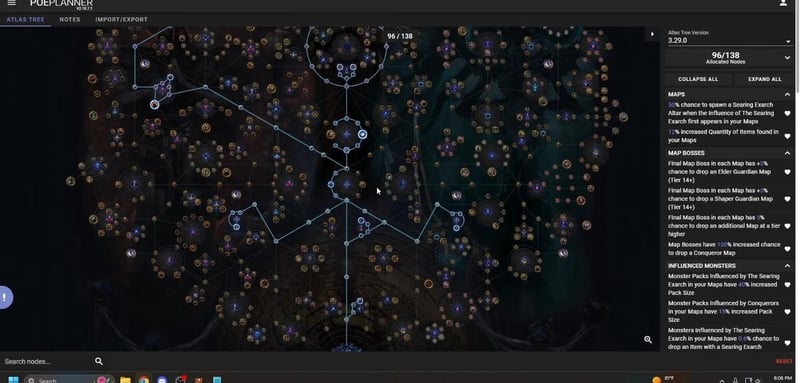
Quick answer: Take the Shaping nodes near your start, push to tier 14 so Searing Exarch red altars become runnable in every map, then socket Voidstones in this order: Exarch/Eater, Originator, Shaper & Elder, Maven last. Each socketed Voidstone gives maps a 25% chance to drop one tier higher — all four means every map opens at tier 16.
- free costs nothing
- cheap small cost
- setup needs preparation
- grind pays off slowly
- skip the thing to stop doing
Atlas progression at a glance
| Stage | Goal | Key nodes / actions |
|---|---|---|
| 1. First passives | Open up the map pool | Shaping nodes near your start (left, bottom, top-right), then nearby Shrine clusters for clear speed |
| 2. Tier 6-13 | Fund your currency early | Run Searing Exarch quest altars (work from tier 6-16) before the tier-14 lock applies |
| 3. Tier 14 push | Unlock red altars everywhere | Tier 14 is the hard gate — below it, only the quest version of Exarch altars works |
| 4. Voidstones | Push every map to tier 16 | Socket order: Exarch/Eater → Originator → Shaper & Elder → Maven. Each gives +25% chance maps drop a tier higher |
| 5. Strategy trees | Specialize for your farm | Respec into Delve, Syndicate, Abyss or Mercenary wheels once your map pool is stable (see below) |
How to progress your Atlas in Path of Exile 3.29
The efficient route for softcore trade is to rush tier 14+ maps. Everything else follows from that one decision, because red Eldritch Altars — the Searing Exarch ones — can only be run in tier 14 and above once the quest versions are done. Those altars are the point: they drop Lesser Eldritch Embers, which sell for at least a chaos each on day one and climb through the league, with Grand variants reaching ten chaos and up, plus raw Chaos Orbs — exactly the currency you want early, before Divines inflate. This is not a strict rush, though — you still have to work the Maven questline, so you're not skipping from tier 1 to tier 14 in one jump.
Spend your first Atlas passives on the Shaping nodes near your starting location (left, bottom and top-right), then grab early Shrine clusters for clear speed and survivability.
Voidstone order
Collect Voidstones in this order: Exarch/Eater first, then Originator, then Shaper & Elder, and Maven last. Each socketed Voidstone gives your maps a 25% chance to drop one tier higher, so with all four socketed every map on your Atlas opens at tier 16. This order front-loads the Voidstones that are cheapest to acquire early and saves Maven — which needs the most Atlas investment to access efficiently — for when your tree is already built out.
Delve atlas tree 3.29
A Delve-focused respec is worth building once your map pool is stable and you want Sulphite and Delve-exclusive currency as a secondary income alongside mapping. Rather than list specific node names here — Indie Stone-style wheels get rebalanced between patches and the exact nodes are easy to get wrong from memory — open the in-game Atlas tree or a community Atlas planner (PoB-adjacent tools list the current tree) and search for Delve-tagged nodes; look for the Sulphite-gain cluster near the Delve starting wheel first.
Syndicate atlas tree 3.29
A Syndicate-focused tree raises both Intelligence drops and the value of each Safehouse you run, which matters if your build wants Catarina or Jun's unique-crafting rewards. As with Delve, verify the exact node layout in-game or on an Atlas planner before committing points — the Syndicate wheel sits in its own section of the tree and is worth a dedicated respec once you're farming red maps consistently rather than trying to split points with mapping-speed nodes.
Abyss and Mercenary atlas tree
Both mechanics are strong 3.29 picks because Abyss was reworked to spawn pre-opened pits with no backtracking and is now the primary source of Abyssal Jewels and Stygian Vises, and Mercenaries went core with their own dedicated Atlas passives and Trarthan Scarabs. If you're running either as a main farming strategy, check the current Abyss and Mercenary wheels in-game — both grew new nodes with the 3.29 reworks, so a build guide written before the patch will be missing them.
What to allocate first for a league start
For a typical softcore trade start: Shaping nodes → quantity/rarity nodes near your path → Searing Exarch altar nodes once you're pushing toward tier 14 → the full item-quantity wheel if you're also chasing the challenges that need 80%+ or 150%+ quantity maps. Respec out of early clear-speed nodes once your map pool is wide enough that speed stops being the bottleneck.
FAQ
How do you progress the Atlas fastest in Path of Exile 3.29? Rush to tier 14 as fast as your build safely allows — that's the hard gate for running Searing Exarch red altars outside their quest versions — while working the Maven questline alongside it rather than skipping straight there.
Which Voidstone should I get first, and how many Atlas points do I need? Exarch/Eater first, then Originator, then Shaper & Elder, with Maven last since it needs the most Atlas investment to reach efficiently. Each socketed Voidstone adds a 25% chance for maps to drop a tier higher.
What is the best Atlas tree allocation order for league start? Shaping nodes near your start, then nearby Shrine clusters, then push toward the Searing Exarch altar nodes as you approach tier 14 — specialize into Delve, Syndicate, Abyss or Mercenary wheels only after your core map pool is stable.
Is Wrath of the Cosmos safe to take? Check the node's current wording in-game before allocating it — Eldritch Altar-affecting Atlas passives have changed wording across patches, and committing points based on an old description risks a wasted respec.
Which league mechanics should I skip while progressing the Atlas? Nothing you're not already planning to run for drops — Abyss, Legion, Delirium and Mercenaries all layer onto normal maps once allocated, and several PoE 3.29 challenges (Cross Contamination, Legendary Leagues) reward running multiple mechanics at once rather than skipping them.
What is the best atlas tree in 3.29? There's no single universal tree — it depends on whether you're optimizing for mapping speed, Delve, Syndicate or a specific boss strategy. Start with Shaping nodes and the Voidstone path above regardless of your end goal, then specialize once your core map pool is tier-16 capable.
Sources
Tier-14 altar gating, Voidstone order and the 25%-per-Voidstone map tier chance are corroborated by current community Atlas progression guides for 3.29 (AllThings.How, Sportskeeda). Node-level detail for Delve, Syndicate, Abyss and Mercenary strategy trees is deliberately not stated as exact node names here — those wheels shift between balance patches, and this guide points to the in-game tree and Atlas planners rather than risk a stale or invented node list.
Read next
- PoE 3.29 Challenge Guide — Atlas Assertions and quantity-gated challenges
- PoE 3.29 Atlas Anomalies Guide — what Voidstone quadrants unlock
- PoE 3.29 Curse of the Allflame Guide — the league mechanic running alongside your Atlas
Frequently asked
How do you progress the Atlas fastest in Path of Exile 3.29?
Rush tier 14 maps. Tier 14 is the gate that lets you run Searing Exarch (red) Eldritch Altars in every map once the quest versions are exhausted, and those altars drop Lesser Eldritch Embers and raw Chaos Orbs that fund your league start.
The key trick is that a node's bonus objective can be completed by running a map at a higher tier than the node's natural tier — so once you are at tier 14 you go back and clear leftover low-tier nodes with tier 14+ maps, completing the Atlas and running a profitable altar in the same map.
Watch the rarity requirement, because it scales with the node's colour and the source video's "magic or higher" only holds for white maps: white (T1–5) needs magic, yellow (T6–10) needs rare, and red (T11–16) needs rare and corrupted. Note also that since 3.26 completing a map at a tier lower than it naturally appears grants no bonus completion at all.
Which Voidstone should I get first, and how many Atlas points do I need?
Take the Searing Exarch stone first. Your whole progression plan is running red altars, the Exarch line is the easiest of the four pinnacle fights, and it feeds the altar strategy directly.
The four Voidstones and their sources are: Omniscient (The Searing Exarch), Grasping (The Eater of Worlds), Ceremonial (The Maven) and Decayed (The Elder / Uber Elder). Each grants Tier 1–15 Maps found have 15% chance to become 1 tier higher and a 0.4% chance per socketed stone for a tier 16 drop to become tier 17. With all four socketed the entire Atlas is tier 16.
Recommended order after the Exarch: Eater of Worlds, then Shaper and Elder (the regular versions, not Uber Elder), then Maven. There is no need to rush all four.
Full Atlas passive completion is 138 points. The video targets roughly 120+ before settling into a dedicated farming strategy, though some strategies such as Ultimatum run fine on 50–60.
One caveat: the 3.29 video shows an item called an "Eldritch Voidstone" with quadrant-scoped modifiers that the wiki does not document — its Voidstone page currently runs only to 3.26. Confirm that one in-game.
What is the best Atlas tree allocation order for league start?
Fixed opening, no real variation:
- Shaping the Mountains, then Shaping the Skies, then Shaping the World — these push dropped maps a tier higher (reaching 85% chance for tier 1–15 maps in the planner screenshots) and are what actually gets you to tier 14.
- Shrine nodes on the way — take these on every build, no exceptions. The finished cluster gives an extra shrine, 50% increased buff effect and 50% increased duration.
- Finish the map wheel and the additional shrine chance, guaranteeing two buffed shrines per map.
- Once you can run them, the full Searing Exarch altar cluster.
- Then 1% quantity nodes, pack size, and Elder/Shaper/Conqueror map chances.
Is Wrath of the Cosmos safe to take?
Yes, and this is the most counter-intuitive part of the tree. The node gives Searing Exarch altars a 50% chance of an additional Upside, but altars that receive one get 100% increased Effect of Downsides.
It is safe because of how you play altars: you only ever click the minion altars, plus the occasional boss altar when the reward is worth it. You never click the player-debuff options. Stronger altar minions are not a threat to any functioning build, so the amplified downside lands on choices you were never going to take, while you keep the extra upside.
Which league mechanics should I skip while progressing the Atlas?
Almost all of them — but for a specific reason: you have no Atlas points invested in them yet, so the reward does not justify the map time. That reasoning flips once your tree is finished.
The exceptions are the near-instant ones worth stopping for: essences (just a rare to kill), strongboxes, Heist boxes, and Mercenary encounters. Blueprints and merc rewards can be worth a few chaos or better for seconds of effort.
On optional tree branches: Betrayal (Jun) is fine but optional — four nodes if you want it, and many players spec in during yellow maps then refund in reds. Essence is worth it for attack builds wanting flat elemental damage from Hatred, Anger and Wrath. Harvest is the one to skip — too many points, too much map time, and weak in early softcore trade.
On favourite maps, which the video never mentions: there are 12 favoured map slots, unlocked by objectives you hit during progression anyway (a tier 16/17 map, Elder and Shaper Guardians, a Conqueror, Sirus, the Shaper, Uber Elder, the Maven, the Eater of Worlds, the Searing Exarch). Each favourite gives that map a 10x drop-weight multiplier, stacking up to 120x on a single map. It changes which maps drop, not how many — which is why it barely matters mid-rush and matters a great deal once you settle into farming one layout.
What is the best atlas tree in 3.29?
There's no single universal tree — it depends on whether you're optimizing for mapping speed, Delve, Syndicate or a specific boss strategy. Start with Shaping nodes and the Voidstone path above regardless of your end goal, then specialize once your core map pool is tier-16 capable.
Read next
Uber Elder Boss Fight Guide: Fragments, Mechanics & Loot Explained
How the Uber Elder dual boss fight actually works: fragment requirements, alternating invulnerability, permanent ground vortices, and loot, checked against the current wiki with notes on what's changed since HeavyHeals recorded the source video in 2024.
Shaper Boss Fight Guide: Access, Phases & Attacks Explained
How the Shaper fight actually works: fragment access, the three-phase structure, the beam/slam/ball attacks, and loot, checked against the current wiki with notes on what's aged out of Zizaran's 2022 recording.
PoE Mapping Guide Explained: Tiers, Atlas & Void Stones
A conceptual overview of Path of Exile's endgame map system - tiers, white/yellow/red terminology, and Void Stones - built from an older Zizaran lecture but explicitly fact-checked against the wiki to flag which mechanics (like the "connected map" system and Favourite Maps) have since been reworked.
Path of Exile Delve Guide Explained: Sulphite, Azurite, Fossils & Finding Hidden Walls
A beginner-friendly walkthrough of Path of Exile's Delve system: what it gives you (fossils, Azurite upgrades, unique bosses), how to sustain sulphite from mapping, and how to actually find the hidden walls that gate the best rewards.