
🎯 The core idea
Delve is Path of Exile's endless mine: an infinite branching cave system reached through Niko, Master of the Depths. It's the primary source of fossils, a strong Azurite-upgrade progression loop, and one of the few permanent (non-league-specific) endgame systems. This guide covers what Delve gives you, how to get into it, and — the part most players actually get stuck on — how to read the map and find the walls hiding the best rewards.
- free costs nothing
- cheap small cost
- setup needs preparation
- grind pays off slowly
- skip the thing to stop doing
What Delve actually is

Delve takes place in the Azurite Mine, an effectively endless network of nodes connected by paths. From any node you can push deeper (higher depth, tougher monsters, better rewards) or sideways to an adjacent node at a similar depth to explore more of the map without raising difficulty. The mine is split into named biomes — Mines, Fungal Caverns, Petrified Forest, Abyssal Depths, Frozen Hollow, Magma Fissure, Sulphur Vents, and others — and according to the Path of Exile Wiki, each biome restricts which item modifiers can appear on drops found there (for example Frozen Hollow drops nothing with Fire or Physical/Chaos Ailment modifiers, and favors higher-level mods).
The video names specific fossil types per biome (e.g. "Frozen Hollow → Frigid, Serrated, Prismatic, Sanctified, Shuddering"). The general biome-restricts-drops mechanic is wiki-confirmed, but the Delve wiki page itself documents biome restrictions as modifier-type rules, not a fossil-name table — the fossil-per-biome pairings shown on screen come from the video's own wiki lookup (visible in the source frame above), not from narration, so treat exact fossil-to-biome pairings as frame-verified rather than independently wiki-verified on this page.
Fossils and resonators

Fossils are one of the main things Delve is farmed for. Slot them into a resonator to force specific modifier rules onto an item while crafting — for example, Frigid Fossil forces "more Cold modifiers, no Fire modifiers." Resonators come in 1, 2, 3, and 4-socket versions, and multiple fossils can be combined in one resonator to stack their rules.
The video also describes a Harvest craft, "Reforge Fossils," that consumes a stack of 10 fossils (a stack of 20 for rarer types, which yields a stack of 10 back) and converts them to a different fossil type. This wasn't covered on the wiki's Delve page and couldn't be verified there — treat the exact stack-size numbers as unconfirmed until checked against the Harvest or Fossil wiki pages.
Getting sulphite and starting a delve

To delve at all you need sulphite, which is spent to power the mining cart. The wiki confirms sulphite comes from maps: a Niko mission can occur naturally on a map, and Atlas passive tree nodes or Sulphite Scarabs can increase the chance or guarantee it. Once you're in the mine, spending sulphite advances the cart and unlocks nodes along the way.
The upgrade panel above is a real in-game example: at depth 240 this character has 30,000/30,000 Sulphite Capacity, 48% Darkness Resistance (from a raw value of 390% reduced by a −342% depth penalty), and 118% Light Radius. According to the wiki, sulphite cost itself scales with depth and caps at 1,100 sulphite per node around depth 890 and beyond — so capacity upgrades matter far more once you're delving deep than they do early on.
Delving: the cart, the darkness, and Azurite nodes

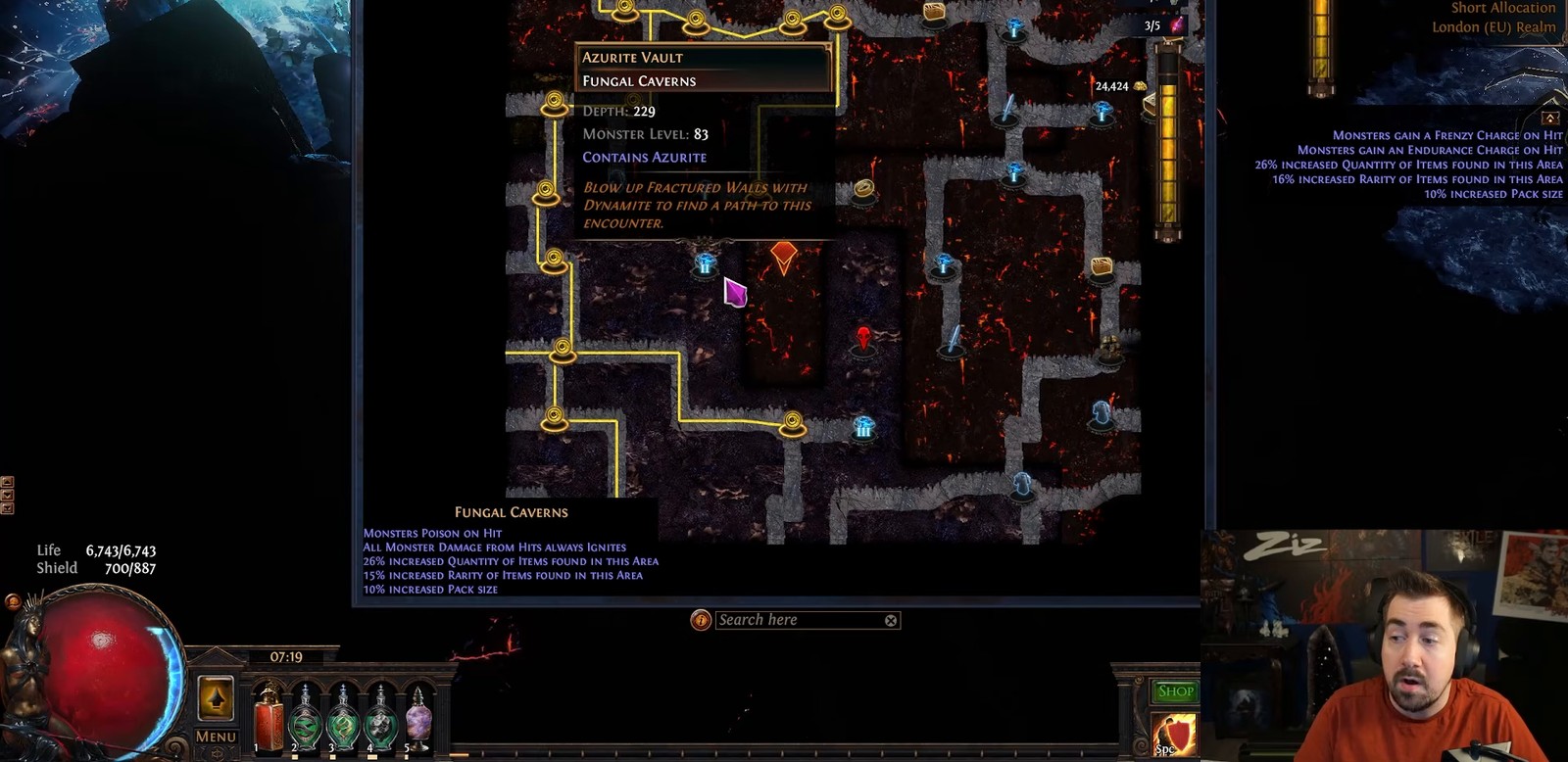
Once you're moving, the cart drives itself toward the next node — you can run ahead of it into the darkness and it will catch up, so there's no need to babysit its pace. Side areas branch off the main path; early on it's worth checking most of them, since they can contain loose fossils, currency, resonators, or Azurite nodes (the light-blue nodes that top up your Azurite for further upgrades). As you get more experienced, the video's advice is to stop checking every side area and instead learn to recognize, by layout alone, which ones are worth a detour — described in-video as something that "you sort of just get used to," similar to learning which campaign zones are worth exploring fully.
Finding secret walls

This is the step most players get stuck on, by the creator's own account ("people send me screenshots like, can you help me find it"). Some nodes are only reachable by detonating a fractured wall with Dynamite, revealing a hidden connecting path. There's no on-screen indicator for these — you have to read the tunnel layout: an area with dead ends, or a shape that clearly has "one more exit" than what's visible, usually means a wall is hiding a path nearby.

Zizaran notes two-exit or otherwise irregular layouts are rare exceptions — "in all my time delving... I've seen it twice" — so treat unusually shaped nodes as edge cases, not the norm, when learning to read layouts.
Bosses and unique rewards — a correction

The video mentions Delve has bosses that drop valuable items, name-dropping a "Grand Architect" boss as the source of the unique jewel The Adorned, and another boss tied to a "bloodline" ascendancy-related reward. The Path of Exile Wiki does not support this framing: it lists three specific Delve bosses tied to fixed nodes and depths — Ahuatotli, the Blind (The Grand Architect's Temple node, Vaal Outpost biome, depth 50), Kurgal, the Blackblooded (The Lich's Tomb, Abyssal City biome, depth 90), and Aul, the Crystal King (The Crystal King's Throne, Primeval Ruins biome, depth 130). The wiki does not connect any of these to The Adorned or to a bloodline/ascendancy reward on the Delve page itself.
Per this guide's fact-checking rule, the wiki's boss list above supersedes the video's naming on this point. If you're hunting a specific unique from a Delve boss, treat the node name and biome/depth pairing above as the reliable reference; the "Grand Architect → Adorned" claim is likely the creator conflating a node name with a drop and is flagged here rather than repeated as fact.
What this guide doesn't answer
This is a beginner-friendly Delve explained overview, not a min-maxing strategy guide — it doesn't recommend a specific best delve build or the exact gear needed to push extreme depth safely, since the source video doesn't cover build specifics either. It also doesn't give precise resonator crafting recipes. If you're looking for a character build for deep delving, or exact fossil-and-resonator crafting odds, check a dedicated build guide and the Fossil/Resonator wiki pages rather than relying on this guide's illustrative fossil-combo example.
How this guide was fact-checked
Wiki-verified against poewiki.net/wiki/Delve: sulphite sourcing from maps, the depth-based difficulty/reward scaling, the Azurite upgrade system (Sulphite Capacity, Darkness Resistance, Light Radius, Flares, Dynamite) and its Azurite costs, sulphite's depth-based cost cap (1,100 at depth 890+), and the three named Delve bosses (Ahuatotli, Kurgal, Aul) with their nodes/depths — which corrected the video's "Grand Architect / Adorned" claim.
Frame-verified only (not present on the wiki's Delve page, so sourced from in-game/in-video evidence instead): specific fossil-to-biome name pairings, exact resonator socket mechanics, the Harvest "Reforge Fossils" stack sizes, and the "chance for a fractured item" claim on special nodes. These are flagged inline above rather than stated as wiki fact.
Frequently asked
How do I start Delving in Path of Exile?
Delve is unlocked by talking to Niko, Master of the Depths, then powered by sulphite. Sulphite is earned from maps — a Niko mission can trigger naturally, and Atlas passive tree nodes or Sulphite Scarabs increase the odds. Once you have sulphite, enter the Azurite Mine and spend it to move the mining cart deeper or sideways.
How deep can you delve in Path of Exile?
The mine is effectively endless (the depth counter loops after 65,535). In practice, sulphite cost per node scales with depth and caps around 1,100 sulphite at depth 890 and beyond, and monster difficulty keeps rising, so most players stop well before the theoretical ceiling — going past depth 300-600 requires serious defensive investment, not just Azurite upgrades.
What's the best way to farm Azurite and sulphite efficiently?
Sulphite comes from mapping, so sustaining it means investing Atlas passive tree points (or running Sulphite Scarabs) into a higher chance of Niko missions. Once inside the mine, Azurite nodes (the light-blue markers on the chart) top up your Azurite, which you then spend at the Voltaxic Generator on Sulphite Capacity, Darkness Resistance, Light Radius, Flares, and Dynamite upgrades — prioritize Darkness Resistance and Light Radius early so darkness damage doesn't limit how far you can explore.
How do I find hidden walls and secret areas in Delve?
Some nodes connect to a hidden node only through a fractured wall, destroyed with Dynamite. There's no marker for these — you learn to read the tunnel layout: if a node's visible shape implies more exits than are shown, or a dead end looks suspiciously deliberate, there's likely a wall nearby. This becomes intuitive with practice; irregular layouts with fewer exits than expected are rare exceptions, not the norm.
What do fossils and resonators actually do in Delve?
Fossils, one of Delve's main rewards, are slotted into resonators (1 to 4 sockets) to force specific crafting rules onto an item, such as guaranteeing more of one modifier type and excluding another. Combining fossils in a multi-socket resonator stacks their rules, which can make otherwise very rare modifier combinations dramatically cheaper to hit than crafting with plain currency. Exact resonator socket mechanics and fossil-conversion crafts are worth checking on dedicated Fossil/Resonator references for precise numbers.
Read next
PoE Atlas Passive Tree & Progression Guide 3.29: Voidstones, Red Altars and What to Allocate First
A step-by-step Path of Exile 3.29 Atlas guide built from Fubgun's progression video and fact-checked against the wiki: rush tier 14 for red altars, complete low-tier nodes with high-tier maps at the right rarity, take the Searing Exarch Voidstone first, and allocate the Atlas passive tree in the order that funds your league start.
Path of Exile 3.29 Curse of the Allflame Guide: Charts, Voyages and the Bathysphere Explained
A complete Curse of the Allflame explainer built from ZiggyD's charts and voyages guide: how charts work, how to escape without drowning, how adjacency on the Plan your Voyage board actually resolves, and the four strategies that carry the league mechanic.
PoE Mapping Guide Explained: Tiers, Atlas & Void Stones
A conceptual overview of Path of Exile's endgame map system - tiers, white/yellow/red terminology, and Void Stones - built from an older Zizaran lecture but explicitly fact-checked against the wiki to flag which mechanics (like the "connected map" system and Favourite Maps) have since been reworked.
PoE 3.29 Mercenaries of Trarthus Guide: Recruiting, Infamy and the Mercenary Rush Farm
Mercenaries of Trarthus returned as core content in 3.29. This guide covers how to recruit and hire mercenaries, what Infamous status actually changes, the four Trarthan scarabs, the Atlas passives worth taking, and the mercenary rushing farm that turned 400 chaos of cheap maps and scarabs into 16 divines in ninety minutes. Every number is checked against the Path of Exile Wiki.