
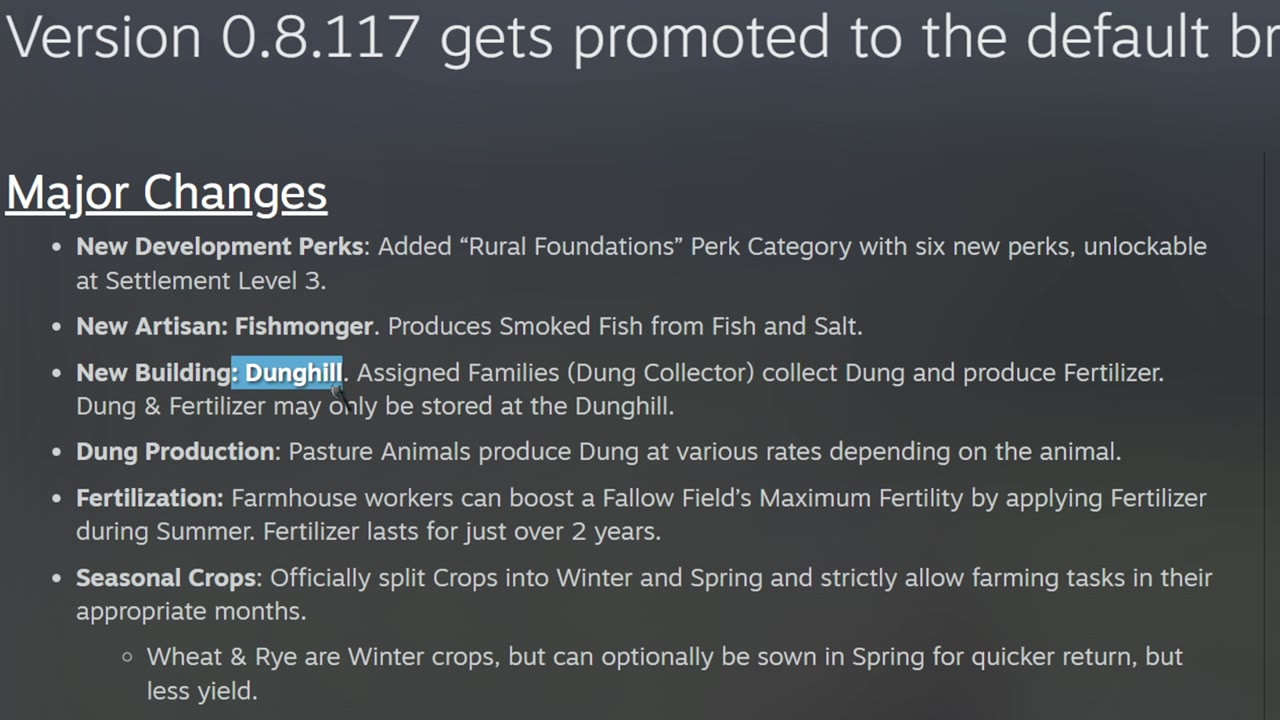
Version 0.8.117 is on the main branch, and it changes how you feed a town and run your fields. This page covers the new Fishmonger, fertilizer from the Dunghill, the stricter sowing seasons, the reworked crop rotation, the Rural Foundations perks and the balance numbers worth knowing before you found a new settlement.
Quick answer
| What | Answer |
|---|---|
| Version | 0.8.117, now on the main branch |
| New perks | Rural Foundations: 6 perks, unlocked at settlement level 3 |
| Fishmonger | Turns fish and salt into smoked fish |
| Fertilizer effect | Lasts just over 2 years, applied in summer to fallow fields |
| Rich fertility bonus | Lowered by 30% |
| Double maintenance | Lowered from 100% to 25% |
| Ranged damage | War bows +23%, crossbows -16% |
Produce smoked fish with the Fishmonger
The Fishmonger is a new artisan that takes fish and salt and turns them into smoked fish 0:30. Raw fish used to be hard to stockpile in any quantity. Smoked fish is not: a steady supply chain can push your stock well past 1,000.

That stockpile matters because level 2, level 3 and level 4 houses all demand meat, and smoked fish counts toward it. If your region is poor for livestock, a fishing hut feeding a Fishmonger is now a realistic way to upgrade housing.
Salt is the other half of the recipe, so secure a supply before you build the workshop — a Fishmonger with fish and no salt produces nothing.
Set up fertilizer with the dunghill
Fertilizer is back. Animal dung is gathered by Dung Collectors, stored at a new building, the Dunghill, and spread on fields by your farmhouse workers 1:00.

- dung is stored only at the Dunghill
- pastures alone already supply plenty
- fertilizer is applied only to fallowing fields
- 1:28
Fertilizer goes on in summer and only on fallow land. A field you planted this year will not be fertilized until it rotates into fallow, so start the Dunghill a season before you need it.
Plan crops around winter and spring seasons
Crops are now split into winter crops and spring crops, and each farming task is locked to the months it belongs in 1:28.
| Crop | Season | Can it be sown in spring? |
|---|---|---|
| Wheat | Winter | Yes, for a lower yield |
| Rye | Winter | Yes, for a lower yield |
| Flax | Spring | Spring only |
| Barley | Spring | Spring only |
| Oats | Spring | Spring only |
Spring sowing of wheat or rye is a fallback for a field you missed in autumn, not a plan: the yield is smaller.

The field panel has been reworked around this. Open any field and the top row shows a timeline of the next 12 months of field activity 2:08, so you can see at a glance when it will be plowed, sown and harvested.
Understand the new crop rotation rules
Crop rotation is always on and can no longer be disabled 1:57. Several smaller rules changed with it:
- A field with crops selected but nothing planted regenerates fertility as if it were fallow.
- Plowing fallow fields is allowed in spring, summer and autumn, but it has the lowest priority of any task. Busy farmhands will leave it until last.
- Crops still standing in October are no longer force-rotated. They slowly die and lose yield instead, which gives you a window to get workers on the field and salvage part of the harvest.
- Fallow fertility builds up gradually, with most of it recovering late in the year. Crops behave the same way and do most of their growing in the final months.
Rotation now happens on one of three triggers 2:54:
| Trigger | When | Applies to |
|---|---|---|
| Nothing to harvest | September 1 | Any field with nothing to harvest, including fallow |
| Harvest finished | As soon as the harvest completes | A field still harvesting in October rotates the moment the last crop is in, e.g. after October 15 |
| Field died | November 1 | A field whose crop died and was never harvested |
A late harvest no longer resets the field for you, it rots. If October arrives with crops still in the ground, move workers onto those fields first — every day they wait is yield lost.
Choose the Rural Foundations perk that fits your settlement
Rural Foundations is a new development perk branch with six perks, unlocked at settlement level 3 3:24. Three of them reshape how a settlement works:
| Perk | What it changes | Take it when |
|---|---|---|
| Woodland Beekeeping | The Forester's Hut stops planting trees and its workers collect honey from wild beehives instead. Better pollination bonus. Cider needs 3 apples instead of 4 3:52 | Your region cannot grow barley and you still need to meet beverage demand |
| Fish Husbandry | Fishing allowed in winter. Fishmonger efficiency +25%. Shoal of Fish capacity +15%. Reproduction -50%, but it now happens in spring, summer and autumn instead of spring alone 4:20 | You have a rich fish deposit |
| Practical Tillage | Goats and pigs in backyard animal pens produce dung for the Dunghill 4:49 | You fertilize heavily and pastures are not keeping up |

Fish Husbandry is the strongest of the three on the right map. Year-round fishing plus a faster Fishmonger is the most direct way to cover meat demand for level 2 to level 4 houses. On a poor fish deposit, the halved reproduction rate can leave you worse off.
Woodland Beekeeping takes tree planting away from the Forester's Hut entirely. Combined with the reduced planting density in the balance changes, a settlement that burns a lot of timber can thin its forests quickly. Watch your woodland before committing.
Use pastures and the other quality-of-life changes
You can now choose which animals each pasture accepts 5:17: sheep only, cows only, or both together. The most useful option is a pasture for calves only. Build it right next to the butcher, send calves there, and the walk to slaughter becomes a few steps. Butcher calves, not your breeding cows.
Other changes to plan around:
- Wild animals, berries and mushrooms spawn deeper into the forest where possible 5:46. Expect longer walks for hunters and foragers early on.
- The wooden church now triggers a wide road in front of it, and wide roads also form along longer stretches of plot borders.
- Oxen follow roads less strictly, which helps when they haul logs from deep in the forest 6:14.
- The AI has had a round of fixes, but its buildings still cannot be attacked. You can only kill its units.
Adjust to the balance changes
| Change | Amount | What it means for you |
|---|---|---|
| Rich regional fertility bonus | -30% | Far fewer green spots on the fertility map. Flax and barley fields are harder to place, even in a farming region 6:43 |
| Forester tree planting density | About -66% | Replanted forests regrow far more thinly |
| Deep mine output | Decreased | Plan for less ore per mine |
| Double maintenance | 100% → 25% | A much smaller penalty than before 7:12 |
| War bow damage | +23% | Bow units hit noticeably harder |
| Crossbow damage | -16% | Crossbow-heavy armies lose some punch |
The fertility cut is the change most likely to hurt a new start. Check the region's fertility overlay for each crop before you lay out fields, and use the Dunghill to make up the difference.
Also worth knowing
- Experienced Forestry may suit crossbow armies. It raises militia archer range and sawpit efficiency, and players fielding crossbow militia with spearmen rate it highly — though the crossbow damage cut takes some of the edge off.
- Watch spear production limits. A bug in the beta set a spear production limit to 100,000 when you set one with no spears in storage. If a limit jumps to an absurd number, set it again once some spears are stocked.
Frequently asked
What does the forester's hut do with the Woodland Beekeeping perk?
The forester's hut becomes a settler's hut and no longer plants any trees. Its workers go into the forest and collect honey from beehives instead. It also gives a better pollination bonus and cuts the apples needed per cider from four to three.
How does fertilizer work in Manor Lords 0.8.117?
Dung collectors gather dung from pasture animals, which means cows and sheep, and store it at the dunghill. Farmhouse workers then use it to boost fertility during the summer, and only on fields that are fallowing. The boost lasts for just over two years.
Can you burn down enemy AI buildings yet?
No. Attacking the AI's buildings is not possible at the moment, and you can only kill its units. The AI receives fixes in this update, so the feature may follow later.
Which crops are winter crops and which are spring crops?
Wheat and rye are winter crops, though they can optionally be sown in spring for a smaller yield. Flax, barley and oats are spring crops and can only be sown in spring.
Read next
Manor Lords Mega City Start Guide
This guide plans the opening phase of a large settlement in Manor Lords, from stabilizing food and fuel to unlocking church access, trade, and industrial production. It is aimed at players who want a practical early-to-mid game setup for a sprawling city on the Wide Valley map.
Manor Lords Kargweiger Mega Farm Guide
A planning guide for turning a new region into a large farming settlement with workable early survival, modular farm layouts, and later food-processing infrastructure. It is aimed at players who want a practical build path for a fertile region that can actually keep pace with harvest windows and population growth.
Manor Lords Hunting Camp Efficiency Guide
This guide explains how to diagnose hunting camp efficiency by comparing the pantry, the animal resource node, and worker delivery routes. It is for players who want steadier meat and leather production from hunting camps and want to know when to add workers or a second camp.
Manor Lords Biggest Mistakes to Avoid
This guide covers the most common early and midgame mistakes in Manor Lords, with a focus on logistics, markets, farms, military stamina, wood production, population growth, and resource imports. It is for players who want a practical checklist for keeping a settlement efficient without wasting labor or falling behind on supplies.