
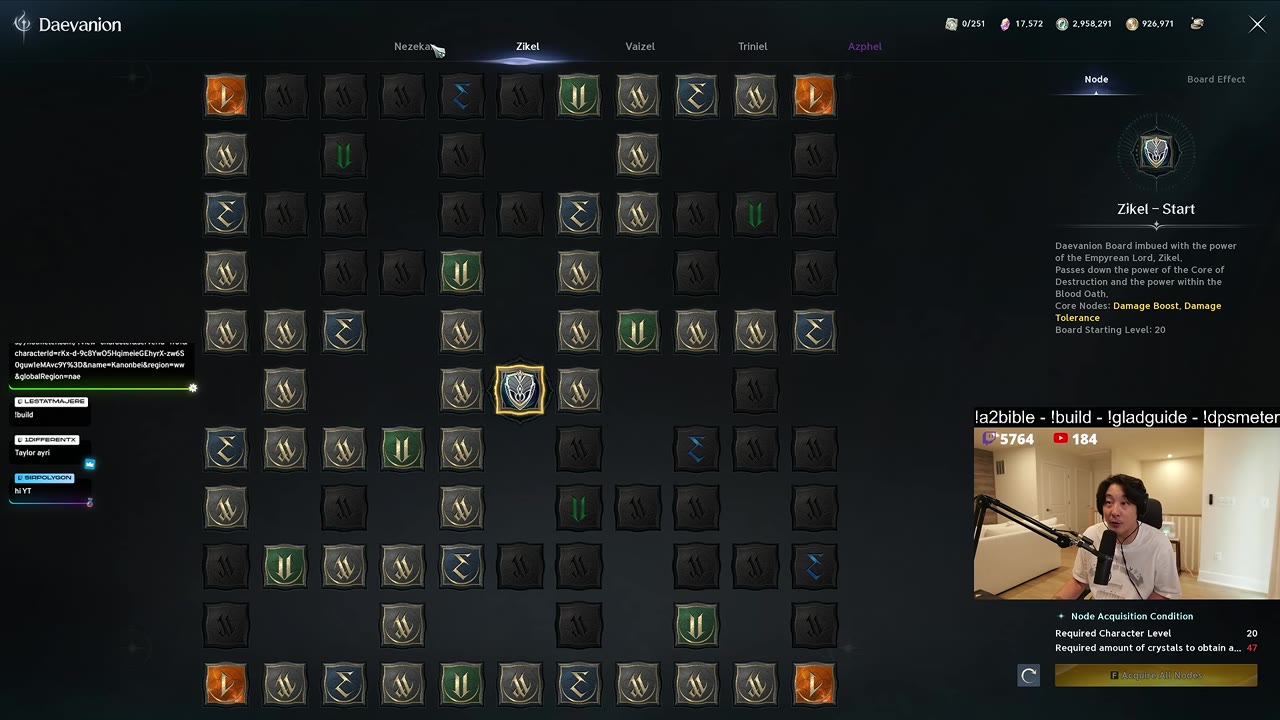
The Daevanion board looks like a maze, but every class follows the same few rules on it. This page shows what each node colour does, which corner bonuses to skip for good, and the order to spend points in, so you can plan your own route without copying someone else's board.
Quick answer
| What | Answer |
|---|---|
| Top priority | Key active skills at level 12 or 16 |
| Skill breakpoints | Level 12, 16 and 20 |
| Third slot | Level 20 on a skill unlocks a third node slot for it |
| Ignore forever | Multi-hit resist and crit damage tolerance |
| Crit target | About 1,100 crit |
| Passives | No break points; the higher the level the better |
What each Daevanion node colour gives you
Every board mixes the same four kinds of node. Learn the colours first and the board stops looking random.
| Node colour | What it gives | Worth chasing? |
|---|---|---|
| Orange (outer corners) | Large stat bonuses such as Damage Boost, Combat Speed or Cooldown Reduction | Mostly yes — usually the highest-value nodes, with a few exceptions |
| Blue | Skill levels for one active skill | Yes, for the skills you actually use |
| Green | Passive skill levels | Yes, your class's key passives first |
| Gray | Attack Bonus, Critical Hit and minor stats such as 50 MP | Only Attack Bonus and crit; the rest is not worth a detour |
1:00 shows where the orange nodes sit on the outer rings.

One board is PvP-only. It offers around 100 health, but none of it helps you in PvE content 0:30. It still raises your gear score, and that matters early: content unlocks by gear score, not by combat power. If you are short of the gear score for the next unlock, a few cheap points there can be worth it.
Combat power is not a perfect measure either: two characters at 90k combat power can perform very differently.
Which orange corner nodes to take and which to skip
Corner nodes are not all equal. Two of them do nothing for PvE, because bosses never crit you and never multi-hit you.
| Board | Corner nodes | What to do |
|---|---|---|
| Nezekan (first) | Cooldown Reduction, Combat Speed | Take all of them |
| Zikel (second) | Damage Boost, Damage Tolerance | Damage Boost now; Damage Tolerance later |
| Vaizel (third) | Crit Damage Boost, Crit Damage Tolerance | Crit Damage Boost eventually; skip Crit Damage Tolerance forever |
| Triniel (fourth) | Multi-Hit Chance, Multi-Hit Resist (more of each, since the board is bigger) | Multi-Hit Chance eventually; skip Multi-Hit Resist forever |
The two permanent skips are the single biggest point saving on the board 1:57. Corner placement makes them look valuable, and many players spend points on them early for that reason alone.
Damage Boost pays off immediately. Damage Tolerance is useful and you will want it eventually, just not ahead of your damage nodes. Multi-Hit Chance and Crit Damage Boost are good to own, but they rank behind your key active skills 6:15.
Combat Speed becomes the right pick once a key skill sits at level 12 and you know the board's blue nodes cannot carry it to 16. At that point, extra blue nodes for it add almost nothing, and the corner does.
If you are tanking and struggling to stay alive, take the tolerance nodes earlier. Damage-focused players should leave them until their offensive nodes are done.
Get key skills to level 12, 16 or 20
Blue nodes raise one active skill's level. As a skill levels up, it unlocks bonus rows in its skill window (open it with K), and you need level 16 to unlock all of them. Level 20 opens a third slot, so you can equip three bonuses on that skill instead of two 2:26.

Keep every skill you invest in at 12, 16 or 20. The gain from 12 to 13 is negligible, so a point that only moves a skill one level past a breakpoint belongs in a key passive instead 4:50. If you notice a skill sitting at 13, pull it back to 12 and spend the point elsewhere.
Which breakpoints you need depends on your class. Some classes need several skills at level 16 before they come online; others need one or two skills at level 20. Work out which abilities you want at +12 and +16 at a minimum, and neglect the skills you rarely press.
The board alone cannot take a skill to level 16. The rest has to come from gear:
| Source | Use it for active skill lines? |
|---|---|
| Rings | Yes — the best place for them |
| Arcanas | Yes — skill lines are what they are for |
| Weapon and guard | Possible, but their other lines are far stronger |
Before you commit points, count how many blue nodes the board offers for that skill plus what your gear already gives. If the total cannot reach 16, stop at 12. A lucky skill line on a ring while levelling changes that maths, so recount whenever your gear changes.
While levelling, take the blue nodes for any skill your class leans on to reach level 12 before you head for the outer corners 5:45.
Prioritise your class's key passives
Green nodes level your passives, and passives have no breakpoints: every level helps, so push your key ones as high as the board allows 7:38.
Every class has a few high-priority passives worth reaching early. You will need to research your own class's list; for Templar it looks like this:
- Fury is the best Templar passive. It raises front attack damage boost and PvE damage boost for you and for your party.
- Impact Hit is the second priority, because it gives double chance 8:07.

Once the key passives are done, pick up any other passives that sit along the routes you are already taking. If a key passive node sits next to a corner you want later, grabbing both on the same path saves points.
Push crit to 1,100 and take attack bonus
Most gray nodes are filler — nobody should detour for an extra 50 MP. Two are worth routing through: Attack Bonus and Critical Hit.

Aim for roughly 1,100 crit. That gives you about 50% crit uptime against end game tier stage four transcendence bosses 10:02. Buffs and PvE crit also move the number, so check your stat sheet with your usual buffs active rather than counting board nodes alone.
When two routes lead to the node you want, take the one that passes through crit or Attack Bonus 10:32. Once you hit the crit target, more crit nodes are wasted, and every gray point should go to Attack Bonus instead.
On the Korean servers, end-game gear supplies enough crit on its own. In this version you still need the board to reach the target, so crit nodes matter during early progression.
The order to spend Daevanion points
When you have a point and several nodes within reach, work down this list and take the first one that applies 11:00.
- Stop at 12 if the board and your gear cannot reach 16
- Never Multi-Hit Resist or Crit Damage Tolerance
- 11:58
- Crit up to about 1,100, then Attack Bonus only
- 12:26
- Earlier if you tank and keep dying
Break the order when levelling demands it. If you are grinding and your AoE skill needs to hit level 12, take its nodes ahead of anything higher on the list. The board rewards following the principle, not a precise path.
You cannot take every node in this version, so every board is a set of trade-offs. The skill lines on your own gear change which blue nodes you need, which means someone else's exact route will waste points on your character.
Also worth knowing
- Look up a board map before you plan. Community-made maps show which skill each blue node boosts, so you do not have to hover over every node to find the one you want.
Frequently asked
Which Daevanion board nodes can I ignore for PvE?
Multi-hit resist and crit damage tolerance can be ignored permanently, because bosses do not crit or multi-hit the player. Damage tolerance can wait until later in progression. A tank that struggles to stay alive can take tolerance nodes earlier.
How do I get a skill to level 16 in AION 2?
The Daevanion board cannot take a skill to level 16 on its own. Extra active skill lines also come from rings and arcanas, and weapon and guard can supply them too, although the other lines on those two items are better. Pick up the board nodes for the skill first, then make up the rest from those sources.
Is it worth upgrading a skill from level 12 to 13?
No. The gap between level 12 and 13 is very small, so skills are best left at 12, 16 or 20. Spend the remaining skill points on key passives that raise damage.
How much crit do I need from the Daevanion board?
A general target is about 1,100 crit, which gives roughly 50% crit uptime on end game tier stage four transcendence bosses. Buffs and PvE crit also affect the number. Once crit is capped, take attack bonus nodes instead of more crit.
What is the PvP-only Daevanion board for?
It does nothing for you outside PvP, even though it shows around 100 health. It can still pad your gear score, which matters early because content unlocks by gear score rather than combat power.
Read next
AION 2 Skill Level 16: How to Raise Skills Past the Cap
Wisdom stones stop raising a skill at some point, but three other systems keep adding levels: Daevanion boards, Arcana cards and rerolled gear stats. This guide is for players whose active and passive skills have stopped leveling.
AION 2 Templar PvE Build, Stigmas and Gear Guide
Covers the Templar's PvE skill specs, stigma choices, macro, boss opener, gear stats, Arcana, Pantheon and Pet Genus rolling. Written for Templar players who want to maximise damage in dungeons.
AION 2 Chanter PvE Guide: Skills, Stigmas and Macro Setup
Covers the Chanter's leveling skill setup, stigmas, passives and one-button macro, then the changes that matter from level 45 onward. Written for new Chanter players who want to deal strong damage while buffing a party in PvE.
AION 2 Spiritmaster PvE Guide: Skills, Stigmas, Macro and Rotation
This guide covers the AION 2 Spiritmaster's PvE setup from leveling to mid game: which active skills, stigmas and passives to take, how to build the macro and how to run the rotation. It is written for new Spiritmaster players who want a complete, ready-to-use setup.