
Thunder at Our Gates arrives as two things at once: a paid expansion and a free update that lands in every copy of Hearts of Iron IV. This guide separates the two, so you can tell what you are paying for and what is already sitting in your division designer. The changes most likely to alter how you actually play — regimental companies and the reworked special forces doctrines — are in the free half.
Quick answer
| What | Answer |
|---|---|
| Verdict | Weak paid content - the most useful changes ship free |
| New focus trees | Australia, the Dutch East Indies and Siam |
| New sub-doctrine | Dispersed operations, built for fighting without air superiority |
| Regimental companies | One per row that holds at least three battalions |
| Soft attack | Infantry guns 20, support artillery 30 |
| Special forces XP | 120 experience before mastery perks can be unlocked at all |
| Mastery cost | 60 mastery per perk, cut from 100 |
| Special forces cap | Around 270 late-run with expanded special forces, against 170 before |
See what is paid and what is free
| Change | Comes from | What it touches |
|---|---|---|
| Focus trees for Australia, the Dutch East Indies and Siam | Paid expansion | Three playable countries, all in the same corner of the Pacific |
| Army headquarters | Paid expansion | Generals deployed on the map as their own unit |
| Ship captains | Paid expansion | Promotions and medals, extended to the navy |
| Dispersed operations | Paid expansion | One new sub-doctrine in the operations branch |
| Regimental companies | Free update | Every division template you build |
| Special forces doctrine rework | Free update | Marines, paratroopers, mountaineers and the special forces cap |
The split is the important part. Nothing on the paid side changes how a normal campaign runs — it adds three countries you may never play and two systems you can ignore. The free update 4:47 is the half that reaches your existing saves, because both of its changes apply to units you already field.
Weigh up the three new focus trees
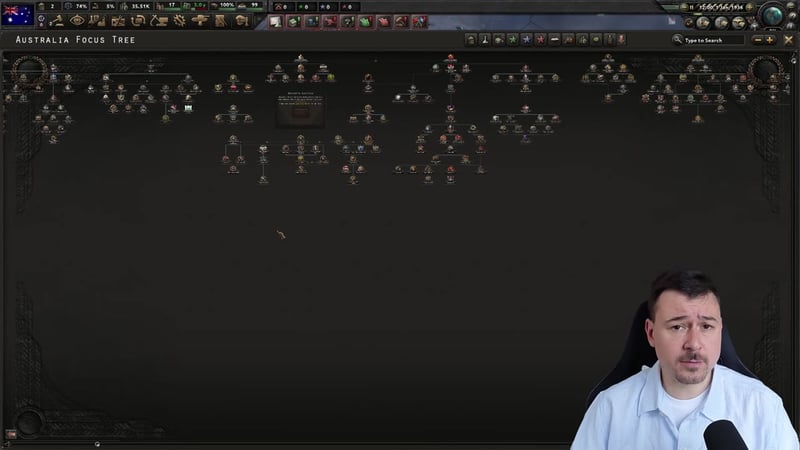
Australia, the Dutch East Indies and Siam are the three new trees. Siam's is noticeably smaller than the other two, and it carries limited wars — a mechanic that gives an isolated minor something to fight over, and the one genuinely good idea in the set.

The problem is the region, not the design work. You start far from anything that decides the war, with almost no early expansion targets, so the opening years are spent building rather than taking. Australia is the widest of the three, with fascist and communist paths that branch properly 1:27, while the Dutch East Indies leans on its non-aligned route.

Expect most paths to do very little before roughly 1940. Some of them do become powerful, but only in a campaign you intend to play out for years of game time. If you tend to end runs early, pick a different country.
New Zealand was not reworked, but it did gain a handful of extra focuses in the same update.
Get to grips with the new paid mechanics
An army headquarters puts a general on the map as a small separate unit, rather than leaving him as a portrait in the army panel. Divisions assigned to that headquarters get its buffs, and customising the headquarters unlocks abilities that only exist while the general is physically deployed.


A deployed general can be captured in combat, and capture is guaranteed if the unit is encircled 2:53. That is the failure mode to plan around: park headquarters behind the front, not in the province you are about to lose. A captured general comes back through a raid, through the intel network, or by taking the victory point he is held in.
Ship captains extend promotions and medals to the navy. A captain can be promoted to admiral and awarded medals in the same way an army officer is.

Dispersed operations is the one new doctrine option in the paid half. It sits in the operations branch and is built entirely around fighting without air superiority, trading fighter cover for resistance to enemy air.

Its multiplayer value is untested: taking it while you also hold air superiority may be much stronger than intended, and that will not be clear until it has been played properly.
Add regimental companies to your divisions
Regimental companies are a new row in the division designer, and they are free for everyone. Each battalion row that holds at least three battalions can take exactly one.

- three or more unlocks the slot
- 5:04
- infantry, cavalry, motorised, mechanised and artillery share one list; motorised artillery and armour get another
- frees the support slot for something stronger
- regimental companies add stats, not width
- no new equipment types: infantry equipment, support equipment, anti-air, artillery, rocket artillery
Adding more than three battalions to a row does not improve the company. The count only decides which companies are on offer, so there is no reason to bloat a row for a better version of the same thing.

With all techs researched, infantry guns give 20 soft attack where support artillery gives 30 5:43, and without full tech the gap is wider. Treat regimental companies as extra capacity for the stats you could not fit, not as a replacement for a support company you already run.

Rebuild your special forces around the new doctrines
Special forces now work like every other doctrine branch: pick a grand doctrine first, then choose among sub-doctrines, each carrying mastery perks to unlock.

The consistency is welcome; the cost is that the old route is closed. Previously 360 experience unlocked special forces and all their perks, which meant a navy trained from day one could finish the marine perks without ever fighting. Now 120 experience only gets you to the point where mastery perks can begin unlocking 7:34, and mastery itself is earned almost exclusively by fighting with the special forces themselves.
Plan for that in your war schedule rather than your research. If you intend to lean on paratroopers or marines, commit them to real combat early, even in secondary theatres, or the tree stays half-open into the mid-game. Both perk unlocks and special forces cap growth are slower than they were.
Pick between expanded and elite special forces
| Point in the run | Expanded special forces | Elite special forces |
|---|---|---|
| Immediately after picking | 4% capacity modifier, which needs a large army to mean anything | The choice if you want a bonus that lands now |
| As a minor nation | Often less than one extra division | Same reasoning, more strongly |
| Mid-game, average army | Typically one or two extra special forces divisions | Steady value rather than scaling |
| Long campaign, large army | Cap reached around 270 in a late communist China run, against roughly 170 before the update | Not where its value sits |

The shape of expanded special forces is a percentage of something you do not have yet, so it is underwhelming when you pick it and overpowered by the time it compounds 8:59. Choose it only for a campaign you know will run long. For anything shorter, elite special forces gives you something usable in the years you will actually play.
Know what changed after feedback and what was pulled
Three balance changes landed between early access and release, all of them softening the special forces nerf:
- Mastery gain was increased tenfold from its initial value.
- Mastery perks were cut from 100 mastery to 60.
- A special forces cap reduction was folded into the instant bonus of every sub-doctrine.
One larger change was written and then reverted before release: every subject automatically joining its overlord's wars 10:54. Subjects still have to be called in as before. The reversion is described as being in place for the time being, so it is worth re-checking after future patches rather than assuming it is settled.
Also worth knowing
- Ship captains are less empty than they look. A captain picks up traits from the class of ship he served on, so a destroyer or submarine career produces an admiral specialised in that role. Naval medals also apply to far fewer units than army medals do, which makes each one worth more.
- There may be nobody left to promote. Most historical officers who were still captains in 1936 already start the game as admirals, so the promotion system often has no candidates in the pool it was built for.
- Medals cost 30 political power for a bonus to one division. That is poor value when you field hundreds of them; as a minor nation, where a single medal covers a real share of your army, the arithmetic changes.
- Regimental companies pay off for very little equipment. In practice a useful bonus can cost on the order of 5 support equipment or 4 artillery, which is what makes freeing a support slot worthwhile rather than a wash.
- New Zealand got extra focuses, not a rework. A few additional foci rather than a new tree, so do not plan a campaign around it.
Frequently asked
Is Thunder at Our Gates worth buying?
For most players, no. The paid half is three focus trees in a corner of the map with almost no early expansion options, plus army headquarters, ship captains and one new operations sub-doctrine, none of which change how a normal campaign plays. The changes that matter most, regimental companies and the reworked special forces doctrines, arrive in the free update whether the expansion is owned or not.
Do I need the DLC to get regimental companies?
No. Regimental companies come with the free update alongside Thunder at Our Gates, so every Hearts of Iron IV player gets the new division designer rows. The same applies to the reworked special forces doctrines.
Do puppets automatically join your wars now?
No. A change making every subject join its overlord's wars automatically was planned during development and pulled before release, at least for now. Subjects still have to be called in as before.
Are ship captains worth using?
They are cosmetic for most fleets but not entirely empty. Captains pick up traits based on the ship class they served on, so a career on destroyers or submarines produces an admiral specialised in that role, and naval medals apply to a much smaller number of units than army medals do. The catch is that most historical admirals who were still captains in 1936 already start the game as admirals, so there is little reason to promote anyone.
Which countries got new focus trees in Thunder at Our Gates?
Australia, the Dutch East Indies and Siam get the three new trees, with Siam's being the smallest of them. New Zealand received a small addition rather than a rework, gaining a handful of extra focuses.
Read next
HOI4 DLC Guide
Every Hearts of Iron IV expansion, country pack and theater pack, with what each one adds and when it was released. Explains the difference that decides a purchase — expansions rework systems for every country, packs add focus trees for specific nations — and which DLCs are already part of the base game.
HOI4 Intelligence Agency Guide
How the intelligence agency works in Hearts of Iron IV: what operatives are, what the five upgrade branches buy, how cryptology and the Spy Master fit in, and why an agency started late never pays for itself.
HOI4 Country Tags
Every Hearts of Iron IV country tag, the three-letter code console commands use instead of a country's name, with the ideology each nation starts under. Includes how tag, annex and puppet take them, and why a run that uses them earns no achievements.
HOI4 Achievements
Every Hearts of Iron IV achievement, grouped by the expansion that added it, with what each one asks for and the country that makes it manageable. Covers the three rules that decide whether an achievement can unlock at all — ironman, console commands and mods — and six worth clearing first.