
Understand how territory is divided during a Hearts of Iron IV peace conference, including how war score decides who gets first pick and which regions are most contested. Learn how to maximize your demands and anticipate the limits of late-game bargaining, plus what the latest DLC changes.
Quick answer
| What | Answer |
|---|---|
| Conference start time | 0800 on 25 January 1944 |
| Main priority | War score decides who demands first |
| First major demand | Moscow |
| Late-game target | Stalingrad |
| Canada claim | Canada |
| DLC name | No Compromise, No Surrender |
Read the war score and know who gets first pick
Identifying which nation controls the order of demands is crucial. The war score (sometimes called "mor score") ranks participants by their contributions throughout the war. The country with the highest war score starts the peace conference and gets the earliest and strongest claims to territory. Traditionally, the session begins with the victors taking turns, and the losers have less influence.

Make your first territorial demands
Once turn order is established, make territory demands starting with the key regions:
- First and most contested capital 4:47
- Canada is argued as a priority 7:08
- Major city demand, renamed after the takeover 8:05
Watch how allies and puppets split the table
Peace conferences divide participants into victors and losers, sometimes with puppets involved:
- The Empire and an unnamed, separate fascist faction share the victor's side. These groups may cooperate in demanding territory but make independent claims due to different colors and ideologies.
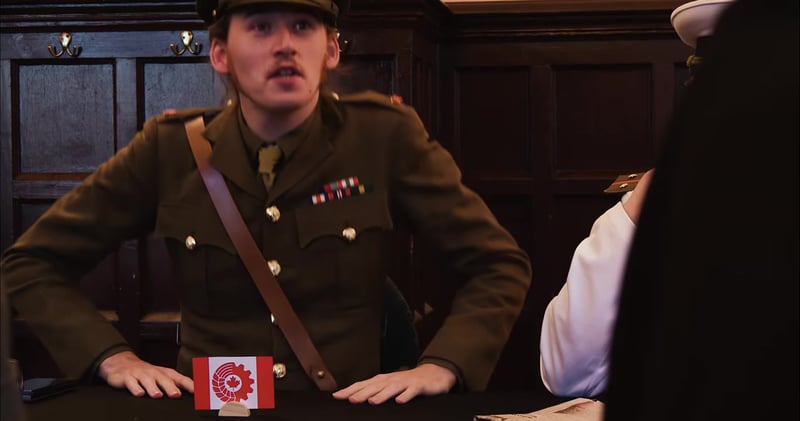
- On the loser side are representatives like Joseph Stalin (USSR) and Tim Buck (communist Canada), both expected to lose territory.
- Philip Petain stands as the puppet leader of Vichy France, representing a state controlled indirectly by the victors.
- Oswald Mosley leads the British Union of Fascists and "the Empire," marking his place on the winner's side but acting as a forceful coordinator.
Puppet arrangements affect claims—puppet states may have their interests negotiated or ignored, and leaders sometimes joke about the extent of control their faction has.
Use war score on the right target before it disappears
The best territories go fast—high-value cities like Moscow are immediately contested, and other capitals like Stalingrad become bargaining chips:
- The capital, Moscow, attracts immediate competing demands. Both major factions vie for it, and the final claim can be the result of heavy negotiation or repeated point spending.
- Stalingrad becomes a valuable city demand, often renamed by its new owners (in this case "Hitlerat") for political or comic effect.
- If multiple claimants overlap in the same region, the borders can become messy—this is commonly referred to as "border gore," where the map is left with jumbled, unrealistic provinces due to conflicting demands.
No image available as planned for border gore — see the section for narrative description.
Recognize the practical limits of late-war demands
As the conference drags on, the process can stall:
- Participants may begin arguing over city names, territory ownership, or minor borders rather than completing decisive claims.
- Efficiency drops as players tire, with the session ending because the group is too exhausted to continue. Scheduling is floated—"Thursday" or "the weekend"—as alternatives before quitting outright.
- In this state, defeated nations may retain unexpected territory simply because all war score and patience have been spent elsewhere.
Know what the new Hearts of Iron IV DLC changes
The latest DLC, as discussed, is No Compromise, No Surrender—but this name may not match the current official release.
The DLC is mentioned as "No Compromise, No Surrender", but the game's update cycle and official release may use "No Step Back, No Surrender." Always verify the name in-game or on official sites before assuming content.
The expansion adds several major features:
- New focus trees for Japan, China, and the Philippines, with unique national paths and strategies.
- A complete doctrine rework for land, air, and sea, changing how nations develop their military strengths.
- Enhanced faction mechanics, including new rules for joining factions and setting their goals, making coalition play deeper and more flexible.

Understand the running joke about tactical choices
Throughout the conference, recurring humor highlights strategic mishaps:
- The ME 262 project is mocked for its role as a fighter-bomber, echoing questionable historic decisions and the tendency for leaders to meddle in aircraft design.
- Tanks versus horses appears as a logistics gag—horses are cited for supply reliability, while tanks are described as overcomplicated compared to good-old cavalry and winter survival.
- Naval mechanics are referenced as confusing and mostly ignored; major powers sometimes forget or neglect their navies, leading to missed opportunities (especially common with the USSR).
These jokes reflect common Hearts of Iron player mistakes and real historical blunders, making the conference familiar to experienced players.
Also worth knowing
- Italy is sometimes placed in unexpected factions. Instead of the Axis, Italy may find itself in the Greater East Asian Co-Prosperity Sphere depending on alt-history outcomes.
- Victory is jokingly measured by destroying Tanna Tuva. Players use the fate of tiny countries as running gags for total dominance.
- France's exile to Kerguelen is part of HOI4 peace chaos. The loss of mainland France often leaves puppets and exiled states controlling remote islands.
- Mosley's performance in roleplay is noted as especially convincing. Hand gestures and character approach add to immersion.
- Stalin costume reads more like Valery Sablin than Joseph Stalin. Roleplay in conference scenes may mix historical figures, affecting visual cues.
- Stalin ignoring his navy is a classic mistake. It's common in Hearts of Iron IV for Soviet players to overlook naval assets during peace deals and military planning.
Frequently asked
Why do some countries get more territory in a peace conference?
War score decides how much influence a country has in the conference. Higher war score lets a country take turns sooner and make bigger demands before the points run out.
Can a country keep some of its land after losing a war?
Yes. If the available war score gets spent arguing over a few key regions, the defeated side can end up keeping some territory because not every demand gets covered. That is why conference ordering and point spending matter.
What happens if allies do not send enough lend-lease?
A front partner can still lose badly even with support if the material help is too small or badly timed. In this case, coal was mentioned as the main aid, and the complaint was that it was not enough to change the outcome.
Read next
HOI4 Intelligence Agency Guide
How the intelligence agency works in Hearts of Iron IV: what operatives are, what the five upgrade branches buy, how cryptology and the Spy Master fit in, and why an agency started late never pays for itself.
HOI4 Country Tags
Every Hearts of Iron IV country tag, the three-letter code console commands use instead of a country's name, with the ideology each nation starts under. Includes how tag, annex and puppet take them, and why a run that uses them earns no achievements.
HOI4 DLC Guide
Every Hearts of Iron IV expansion, country pack and theater pack, with what each one adds and when it was released. Explains the difference that decides a purchase — expansions rework systems for every country, packs add focus trees for specific nations — and which DLCs are already part of the base game.
HOI4 Achievements
Every Hearts of Iron IV achievement, grouped by the expansion that added it, with what each one asks for and the country that makes it manageable. Covers the three rules that decide whether an achievement can unlock at all — ironman, console commands and mods — and six worth clearing first.