
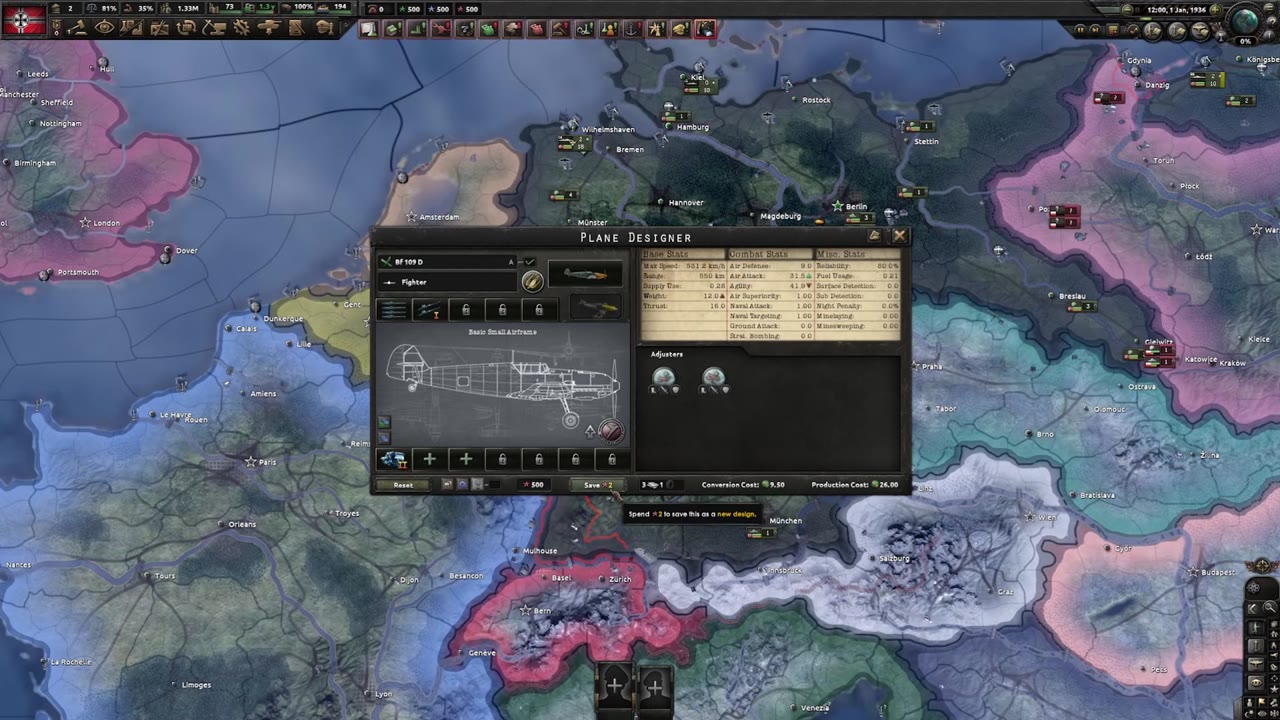
Win air superiority and provide ground support with efficient aircraft designs that maximize performance while minimizing resource strain. This guide covers optimal fighter, CAS, and naval bomber setups that currently dominate the small-airframe meta in Hearts of Iron IV. You'll learn how to prioritize essential stats, save aluminium and rubber, duplicate airframe templates for multi-role use, and convert older planes without production downtime.
Quick answer
| What | Answer |
|---|---|
| Core fighter priorities | Speed, range, air defense, air attack, agility |
| Best engine count for fighters | One engine |
| 1936 German fighter armament | One engine, cannons, BF 109 |
| Recommended meta fighter loadout | Three heavy machine guns, engine three, one armor plate, one fuel tank |
| What matters most after range | Range beats air defense |
| Carrier naval bomber efficiency | Four to five times more efficient |
| Aluminium-saving setup | No strategic materials |
Choose the stats that matter for a fighter
The key stats to watch when designing a fighter are speed, range, air defense, air attack, and agility. These have the most impact on performance for light airframes. While other stats exist, they become more relevant only on medium or heavy airframes, so prioritize them last for standard fighters.
Always start with these priorities before moving to module slots or research choices. Ignoring them leads to wasted production on planes that perform poorly in the air meta 0:32.
Build your first 1936 fighter
Assemble your entry-level fighter using the most effective combination for early-game air wars, especially as Germany. The same principles apply to other nations, though the starting modules may differ.
- Fighters with two engines are not worth the cost—switch to a medium airframe if you need more power 1:00.
- Great starting air attack and agility. See the baseline stats below.
- Upgrade these as soon as possible—they are weaker than Germany’s starter setup.
- Heavy machine guns or cannons greatly improve early air power 2:54.

Rush the tech that unlocks the 1940 fighter
To break out of the limitations of early fighters, prioritize tech research that upgrades your airframes and modules. The 1940 airframe opens up extra module slots, letting you build the meta fighter described later.
- Fuel tanks and drop tanks are critical for larger air zones 3:15.
Use the current meta fighter loadout
The dominant small-airframe fighter setup uses parts that maximize firepower, defenses, and range without overloading on engines or wasting slots.
The meta fighter design includes:
- Three heavy machine guns for high air attack and sustained dogfight credibility.
- Engine three for speed and thrust in 1940+ airframes.
- One armor plate for additional air defense and survivability.
- One extra fuel tank for expanded range.
Adding a second engine to a light aircraft is not efficient—move to a medium airframe if more power is needed 1:24. This setup balances offense, defense, and reach, letting you control large air zones and win fights against less optimized opponents 3:24.

Adjust fighter range for the region you are fighting in
Range determines whether your aircraft can operate across all parts of a theater. Too little range means mission penalties in wide regions like Poland, Africa, Ukraine, or Belarus 3:53. Always check if your fighters are covering the entire area you need.
Options to tune range:
- Add drop tanks or extra fuel tanks: Extends range, but adding too many can overload weight versus thrust 4:42.
- Switch armament modules: Using four light machine guns instead of extra heavy machine guns can boost range, at the cost of air attack.
- Balance air defense: Extra fuel tanks increase range but lower air defense—adjust based on your mission priority 5:12.
Range is more important than air defense in practice—covering the whole air zone and being able to fly missions beats having slightly better defensive stats if your planes can't reach the fight.
Duplicate one design for fighters and CAS
When you find a range-balanced fighter, duplicate it to create a CAS airframe. Maintaining identical range across fighter and CAS types ensures both can operate from the same bases and zone efficiently.
- CAS benefits from the same range as fighters. Use the duplicate-design workflow to avoid rebuilding from scratch 5:50.
Build CAS for ground support
Design CAS (close air support) for maximum battlefield effectiveness while conserving your resource use and module slots. Unlike bombers, CAS planes benefit more from defensive modules than raw air attack.
- Air attack is less crucial unless you’re designing a heavy bomber. For CAS, prioritizing air defense is preferable 6:00.
- Self-sealing fuel tanks are the best defensive module if you have enough rubber.
- Armor plates are the fallback for nations low on rubber, providing air defense without resource strain 6:48.

You can apply similar logic to naval bombers, picking modules based on torpedo missions and carrier use:
- Carrier naval bombers are four to five times more efficient than land-based bombers due to different sortie logic.
- Resource constraints should dictate module choice—tarps (torpedoes), armor plates for defense, and self-sealing when feasible 7:45.

Solve rubber and aluminium shortages
Resource shortages, especially rubber and aluminium, sharply limit how many planes you can build. Europe and the Soviet Union rarely have enough rubber, while Japan faces aluminium shortages.
- Rubber problems: Self-sealing tanks are ideal, but avoid them if your nation is starved of rubber. Armor plates are more accessible.
- Aluminium problems: The number of available factories, trade routes, and puppets isn’t enough for large-scale aircraft output. When using standard designs, even ten factories focused on fighters can miss 24 aluminium 9:13.
- No strategic materials: This module slashes aluminium use. Your planes will have weaker stats, but you can produce a much larger fleet. In wartime, having many adequate planes usually beats a handful of elite aircraft 10:38.

Use conversion without stalling production
Aircraft conversion lets you update old stockpiles to improved designs at a lower resource cost, but there are two tradeoffs: production penalties and the need for available stockpile planes.
- Example: Conversion can cut rubber use from ten to five per plane 12:33.
- Monitor whether conversion is faster or slower than normal production 13:29.
- If all planes are moved to the frontline, conversion stops. Leave some in stockpile 14:27.

Also worth knowing
- Range only affects sortie numbers, not airborne combat stats. Range determines how many planes can launch from an airbase for a mission. Once airborne, all planes fight at their full stats regardless of range. Only the number of participating aircraft is capped, so broader range is a volume advantage rather than a stats advantage.
Frequently asked
Should fighter designs use two engines in Hearts of Iron IV?
No. For light airframes, one engine is the default choice, and two engines are better saved for a medium airframe. The design gains from a second engine do not justify the cost for fighter use.
Is range or air defense more important for fighters?
Range is more important because a plane that cannot reach the air zone cannot contribute fully. Air defense still matters, but the ability to cover the target area comes first. A smaller stat advantage is less useful than being able to fly the mission at all.
What should I do if I do not have enough rubber for aircraft?
Use fewer resource-intensive modules and consider no strategic materials. That lowers some performance stats, but it lets you field many more planes. If rubber is scarce, volume often matters more than a perfect design.
Why would carrier naval bombers be stronger than land-based ones?
Carrier naval bombers operate differently and can be much more effective in practice. Their efficiency is described as four to five times higher than land-based naval bombers. That makes carrier air power especially valuable in naval wars.
Read next
HOI4 Infantry Templates 2026
This guide covers how to build offensive and defensive infantry templates in Hearts of Iron IV, including doctrine choices, support companies, and when infantry is worth using at all. It is aimed at players who want practical division setups that perform in multiplayer and single-player alike.
HOI4 Doctrines Guide 2026
This guide helps players choose doctrine paths in Hearts of Iron IV by role, with separate recommendations for grand, infantry, artillery/support, armor, and operations doctrines. It is aimed at players who want a fast tiered overview of which doctrine fits tanks, infantry, defense, or niche builds.
HOI4 Tank Designs and Templates 2026
This plan covers tank technology priorities, practical tank variants, and the division templates they fit into. It is for players who want a clear path from research and design choices to usable armored divisions.
HOI4 Meta Division Templates and Tank Designs
The division templates that competitive Hearts of Iron IV play settles on under the regimental support system, with exact battalion counts, regimental and support company slots for line-holder infantry, infantry bricks, shield infantry, marines, SPGs and heavy tank destroyers. It also covers the tank module layouts those divisions rely on, for players who can already open the division designer and want the compositions rather than an explanation of it.