
🎯 The core idea
Deadlock items come in four price tiers (800, 1,600, 3,200 and 6,400 souls), and you get nine item slots plus three Extra Slots that unlock as your team destroys enemy Walkers. Good itemization is not memorizing one build: buy for your lane first, fix defensive problems early, pick tier 4 items for a reason, and use the new Popular Items tab as a hint, not a script.
- free costs nothing
- cheap small cost
- setup needs preparation
- grind pays off slowly
- skip the thing to stop doing
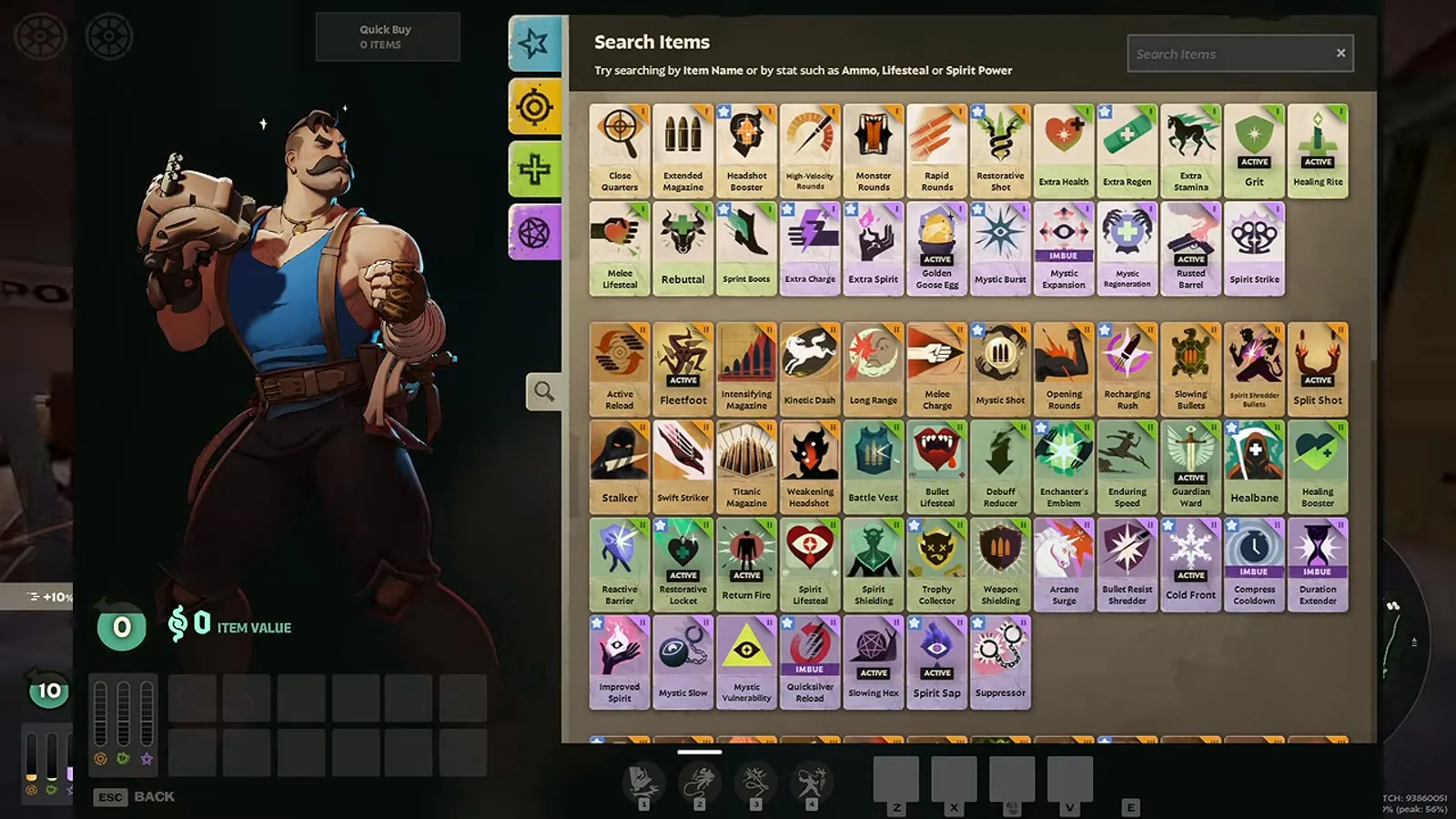
How the item shop is organized: tiers, prices and categories

The Curiosity Shop sells every item in three categories: Weapon (orange, gun damage and on-hit effects), Vitality (green, health, resistances and movement) and Spirit (purple, abilities and spirit power). Inside each category, items are split into four item tiers, and every item in a tier costs the same:
| Tier | Price | What it usually does for you |
|---|---|---|
| Tier 1 | 800 souls | Small stat items and lane tools (Restorative Shot, Extra Regen, Monster Rounds, Extra Spirit) |
| Tier 2 | 1,600 souls | Your first real power spike and early defensive answers (Debuff Reducer, Spirit Shielding, Suppressor) |
| Tier 3 | 3,200 souls | Mid-game spikes, big actives and counters (Counterspell, Metal Skin, Disarming Hex) |
| Tier 4 | 6,400 souls | Fight-winning actives and late-game scaling (Unstoppable, Crippling Headshot, Refresher) |
Many tier 2+ items have a component from a lower tier. When you buy the upgrade, the component is consumed and its price is taken off the bill, so an 800-soul Extra Spirit turns into a 3,200-soul Surge of Power for 2,400 more souls. That is why "dead-end" tier 1 items are rarer than they look: most of them are a down payment.
Items marked Active go into one of four active slots (the Z, X, C, V row in the screenshot). You can own at most four active items, even if you have free item slots left, so plan which actives you really need before your inventory fills.
The new shop UI: Popular Items, filters and 1–6 tab keys

The video was recorded on July 16, 2026, before the City Never Sleeps update of September 29, 2026 refreshed the shop. The screenshots in this guide therefore show the old layout. According to Valve's City Never Sleeps update page, the new shop adds:
- free Popular Items. Using live player data, the shop narrows the list down to the items most often bought on your hero, and each item's tooltip shows how often it is bought and in which phase of the game. Treat it as a starting point, not as the answer for your specific match.
- Item Filters. You can filter the shop down to the stats you are looking for (for example spirit resist or fire rate) and combine filters.
- Shop settings and keys 1–6. Search, focus and scrolling were improved, and by default pressing 1 to 6 while the shop is open jumps between the shop tabs.
- Build Browser. The Build Browser got better previews, build copy and paste, and instant category resizing, which makes it easier to import a build and then adjust it.
- Shop stats and investment view. While shopping you see the effect of a purchase on your stats in real time, and the HUD shows your relative investments so it is clearer when you hit a spike (more on that below).
The deadlock shop UI changed, but the item logic did not: the tiers, prices, slots and the buying advice in the rest of this guide still apply. One name did change in the same update: Armor Piercing Rounds is now called Armor Piercer.
Item slots and Extra Slots (Flex Slots): how to unlock them

Every hero starts a standard match with nine item slots that can hold any item of any tier. On top of that there are three Extra Slots, still called Flex Slots by many players, which unlock on objectives:
| Extra Slot | How to unlock it |
|---|---|
| First | Your team destroys one enemy Walker |
| Second | Your team destroys two enemy Walkers |
| Third | Your team destroys three enemy Walkers |
So the answer to "how to unlock flex slots in Deadlock" is simple: kill Walkers. With all three Walkers down you have the 12 item slots the video mentions. The wiki notes this system changed in November 2025: before that there were eight base slots and four flex slots tied to Guardians, Walkers and Base Guardians. Older videos that tell you to kill Guardians for a flex slot are out of date.
setup Because your last slots arrive late and only through objectives, the video's warning holds: buying 6,400-soul items with no clear purpose wastes the slot budget you have. When your slots are full, you sell a cheaper item to make room (see the section on investment and selling).
Your first buy in lane: three questions to ask

According to the video, clearing the whole first wave leaves you with roughly 820 souls, enough for one 800-soul item, and you want to spend it right away so you are not behind on items. DuckFilms suggests choosing that first purchase by asking three questions:
- Do you need help farming? If the enemy lane is a McGinnis with turrets or a Rem who empowers his troopers, cheap Monster Rounds (+25% weapon damage and +25% bullet resist against NPCs) clears those faster.
- Do you want to trade? On an aggressive lane, buy damage and range: High-Velocity Rounds, Mystic Burst, Extra Spirit or Headshot Booster.
- Are you taking too much poke? Then buy sustain first. Every trip back to base costs souls, time and lane pressure.
These are the best early items in Deadlock for most players because they answer the lane you are actually in. Watch your opponents in the first minute and let that decide your lane items, not a habit.
Why Restorative Shot is the default lane item

DuckFilms buys Restorative Shot in almost every lane, and the wiki numbers explain why. It costs 800 souls, gives +6% weapon damage, and every 6 seconds your next bullet heals you: 50 health from a hero or 20 from an NPC or soul orb (the wiki lists the NPC value at 20 since the May 22, 2026 patch). That heal keeps you in lane after a bad trade, and because it is a weapon item it still pushes your gun investment. One detail the video skips: the cooldown starts even if that bullet misses, so aim the healing shot.
On a very passive lane, Extra Regen (+2.5 health regen, +1.5 out-of-combat regen) is a fine alternative that lets you rotate and break crates. On a lane you can bully, for example as Mirage, the video says you can skip sustain and buy damage.
free Several tier 1 items are fine. A strong early build often has two to four tier 1 items, as long as they build into something later. The video's Seven example: Restorative Shot, High-Velocity Rounds (component of Opening Rounds and of Armor Piercer) and Extra Spirit (component of Boundless Spirit). skip Stacking 800-soul items that upgrade into nothing your hero wants.
Tier 2 items: your first real spike and early greens

Tier 2 items (1,600 souls) start to define what your hero does: mobility (Kinetic Dash), pressure (Intensifying Magazine, Long Range, Mystic Shot), sustain (Bullet Lifesteal, Healing Booster) or utility. Supports and utility heroes get a lot out of an early Slowing Hex or Spirit Sap.
Two rules from the video are worth keeping:
- setup Buy greens (vitality) before the problem gets big. Weapon Shielding and Spirit Shielding give a barrier when you take a burst of hero damage in a short window, plus 18% bullet or spirit resist for the 8 s it lasts. Reactive Barrier helps against crowd-control heavy heroes like Abrams, Bebop or Krill. Buying defense early is not wasted; rushing it late when farm has dried up is much harder.
- skip Don't buy Suppressor in lane by reflex. It reduces the fire rate of enemies you hit with spirit damage (-28% for 4.5 s, per the wiki after the July 28, 2026 change), which is great against a gun carry in your lane. If your lane opponent is not a gun hero, it is a wasted tier 2; buy it after laning if you need it.
Debuff Reducer (+25% debuff resist) is also worth picking up early on most heroes, because it builds into Unstoppable.
Tier 3 defensive must-haves: Counterspell, Dispel Magic and Metal Skin

Tier 3 (3,200 souls) is where mid-game fights around Walkers are won. The video's "when do I buy Counterspell?" answer is: on nearly every hero, before the fights where you are needed. Per the wiki, Counterspell makes your next parry block the damage and effects of enemy abilities and items, and a successful spell parry heals you for 150 and gives +20 spirit power and move speed for 6 s (23 s cooldown, only on a successful parry). It is strongest against heroes with crowd control, like Pocket, Haze, Bebop, Lash or Rem.
Other tier 3 items the video treats as needs:
| Item | What it does (wiki) | Buy it when |
|---|---|---|
| Dispel Magic | +10% spirit resist; active purges all non-ultimate debuffs, heals 250 and gives move speed (45 s cooldown, not usable while stunned) | The enemy stacks debuffs and on-hit effects: Toxic Bullets, slows, Infernus, Vyper |
| Spirit Resilience | Flat spirit resist | The enemy team deals a lot of spirit damage |
| Metal Skin | +12% bullet resist; active makes you immune to bullets for 5 s (24 s cooldown) | One gun carry (Haze, Vyper and similar) keeps killing you |
Metal Skin vs Bullet Resilience. The video argues Metal Skin is usually better than Bullet Resilience against a fed gun hero, because resistance gets shredded by items like Crippling Headshot while immunity simply stops the damage for five seconds. That logic holds if you can kill or escape the shooter inside that window. The wiki adds a catch: Metal Skin blocks weapon damage, but on-hit effects and build-ups (Haze's Fixation, Slowing Bullets) still land on you.
Tier 3 utility and shred items worth buying

DuckFilms thinks utility items are underbought, and that almost every hero except pure gun carries should own at least one.
- Disarming Hex (wiki): disarms a target and reduces their bullet resist by 13% for 4.25 s, with a 32 m cast range and a 16 s cooldown. Used repeatedly in a fight, it shuts off the enemy gun carry and makes them easier to kill.
- Knockdown, Silence Wave, Slowing Hex, Decay give your team picks and engages.
Shred means lowering enemy resistances so the whole team deals more damage. The tier 3 shred items the video recommends:
| Item | Effect (wiki) | Good against |
|---|---|---|
| Hunter's Aura | Nearby enemies get -10% bullet resist and -15% fire rate, doubled if only one enemy hero is near; you only need to be close | Tanky melee frontlines; strong on Abrams, Billy, Yamato, Calico |
| Alchemical Fire | Active flask: an area that deals rising spirit damage and lowers enemy bullet resist for 5 s | Enemies who move and fight as a clump |
| Spirit Rend | Bullets apply -8% spirit resist and give you and allies +10% spirit lifesteal against the target | Teams with lots of spirit resist |
| Toxic Bullets | Bullets build a bleed and apply -35% incoming healing | Heroes with high regen and healing |
Tier 4 weapon items: when each one is worth 6,400 souls

Tier 4 items can turn one good decision into a won fight, but only if they answer something in the match. The video's quick verdicts on the tier 4 weapon items, with wiki numbers where they matter:
| Item | Buy it when |
|---|---|
| Crippling Headshot | Almost always good for gun heroes: headshots apply -16% bullet resist, -16% spirit resist and -35% incoming healing for 12 s |
| Armor Piercer (formerly Armor Piercing Rounds) | The enemy stacks bullet resist (Plated Armor, Bullet Resilience). The video advises against it into Metal Skin, which stops all bullet damage while active |
| Inhibitor | You need to shut down a damage carry: bullets build up to -30% outgoing damage and -40% incoming healing. The video pairs it with Ricochet so the debuff spreads |
| Silencer | Ability-reliant enemies like Lash: bullets build to a silence and reduce their outgoing spirit damage by 25% |
| Ricochet | Enemies are clumped or you face McGinnis turrets; also helps Mirage and Wraith farm |
| Spellslinger | Heroes who weave abilities between shots and want more fire rate |
| Spiritual Overflow | Heroes who keep shooting and use duration abilities (Infernus, Mirage, Vyper, Vindicta) |
| Lucky Shot | A late-game gun carry who is far ahead |
| Frenzy, Crushing Fists, Capacitor | Niche: Lady Geist and Warden for Frenzy, melee heroes for Crushing Fists, Ivy or Wraith style builds for Capacitor |
One correction: the video gives Spiritual Overflow +15% ability duration, but the wiki lists +13% (alongside +13% spirit lifesteal, +90 health and +6 spirit power, plus a charge-up that grants fire rate, spirit power and spirit lifesteal while you shoot heroes).
Tier 4 vitality items: defense that pays for itself

The video's take on the green tier 4 items:
- setup Unstoppable (wiki: +25% debuff resist; active grants immunity to stun, silence, sleep, root and disarm for 5.5 s on a 60 s cooldown) is a good buy on almost any hero, especially before Mid-Boss fights. It upgrades from Debuff Reducer, so buy that tier 2 early.
- Inhibitor, Siphon Bullets, Leech, Vampiric Burst are sustain or anti-carry picks. Siphon Bullets is best into very tanky teams, since it steals max health.
- Plated Armor (wiki: 30% chance to deflect bullets and 50% chance to prevent on-hit effects) is good against build-up and damage-over-time gun heroes, but loses value once they buy Crippling Headshot and Armor Piercer. Against those, Metal Skin is the better answer if you can win the fight in its five seconds.
- Spellbreaker helps against one-shot spirit burst (Lash, Pocket, Grey Talon, Paradox), though the video often prefers Counterspell plus Spirit Resilience instead.
- Colossus, Healing Tempo, Infuser, Diviner's Kevlar, Juggernaut, Witchmail, Phantom Strike, Divine Barrier, Indomitable are hero- and situation-specific. The video rates Indomitable lowest, because Unstoppable and Counterspell do a similar job more reliably.
- skip Cheat Death as a routine buy. The video treats it as a last-slot item for a hero who is far ahead and whose death loses the fight.
Tier 4 spirit items: Scourge, Refresher and team picks

For tier 4 spirit items, the video highlights:
- Scourge: always strong. Per the wiki it is an active you cast on yourself or an ally that gives +40% spirit resist, +20% debuff resist and a damaging aura based on the enemies' max health for 10 s. The video calls it "100% bonus health" and "+17% debuff resist"; the wiki lists +100 bonus health and +20% debuff resist.
- Escalating Exposure and Spirit Burn are your answers when the enemy stacks spirit resist; Escalating Exposure also suits area-damage heroes.
- Refresher only on heroes whose ultimate wins fights (Dynamo, Lash, Pocket, Yamato). skip It on heroes whose ultimate does not decide fights.
- Cursed Relic (the video calls it Curse), Ethereal Shift, Echo Shard, Boundless Spirit, Transcendent Cooldown are broad picks; Transcendent Cooldown is best with lots of active items.
- Vortex Web and Arctic Blast set up team combos, such as pulling enemies together for a Paradox bomb or a Dynamo ultimate.
setup At higher ranks, build for the team too. A support can buy Scourge and cast it on the frontliner, so that player can spend their own slot on something else.
Item investment bonuses, the 4.8k spike and selling items

Every item you own also counts toward an investment bonus in its category. The wiki values for the first steps:
| Total souls in one category | Weapon damage | Spirit power | Health |
|---|---|---|---|
| 800 | +9% | +7 | +9% |
| 3,200 | +18% | +19 | +20% |
| 4,800 | +46% | +38 | +38% |
| 28,800 (max) | +115% | — | — |
The jump at 4,800 souls is the "4.8k spike" players talk about, and it is why a build suddenly feels stronger. Upgrades matter here: when an 800-soul item turns into a 1,600-soul item, your investment in that category goes up by the difference, and the investment counts the category of the item you now own. Reaching your weapon or vitality spike before the enemy is a real advantage in fights. The new HUD investment view from City Never Sleeps makes this easier to track.
Selling items: you get half the price back, or the full price if you sell before leaving the shop area where you bought it (the yellow rectangle on the ground). Selling also removes that item's investment bonus, so when you sell items to free a slot late in the game, sell the cheapest item that no longer does a job.
How this guide was fact-checked
- From the official wiki (deadlock.wiki): the four tier prices, nine base slots plus three Extra Slots and their Walker unlocks (including the November 2025 change), component discounts, selling refunds, the four active item limit, the investment table and the 4.8k spike, and the stats of Restorative Shot, Extra Regen, Monster Rounds, Suppressor, Debuff Reducer, Weapon and Spirit Shielding, Counterspell, Dispel Magic, Metal Skin, Disarming Hex, Hunter's Aura, Spirit Rend, Toxic Bullets, Crippling Headshot, Armor Piercer, Inhibitor, Silencer, Plated Armor, Unstoppable, Spiritual Overflow and Scourge.
- From Valve's City Never Sleeps update page: Popular Items, Item Filters, the 1–6 tab keys, the Build Browser changes, shop stats and the investment HUD. The wiki's own update page only says "Refreshed Shop UI" and confirms the rename of Armor Piercing Rounds to Armor Piercer.
- From the video (DuckFilms, uploaded July 16, 2026): the buying philosophy, hero examples and item opinions, and the "about 820 souls after the first wave" figure, which we could not confirm on the wiki.
- Corrections to the video: Spiritual Overflow gives +13% ability duration, not 15%; Scourge gives +100 bonus health (not 100%) and +20% debuff resist (not 17%); Armor Piercing Rounds is now named Armor Piercer; the video's shop screenshots predate the September 29, 2026 shop refresh. We also added the wiki's Metal Skin caveat that on-hit build-ups still apply.
What this guide doesn't answer
- Full hero builds: what to buy on a specific hero belongs in that hero's guide; this page covers how to think about the shop.
- Build theory in depth: detailed investment math and build planning are a separate topic, so the numbers here stop at what you need to recognize a spike.
- Corrupted items and The Broker: the new City Never Sleeps trader exchanges high-tier items for corrupted versions; how that changes item choices needs its own guide.
- Street Brawl legendary and enhanced items: they only exist in that mode.
- Exact patch numbers for every item: values change often; check the item's wiki page before relying on a number we did not list.
Frequently asked
How do you unlock Extra Slots (Flex Slots) in Deadlock?
Your team unlocks one Extra Slot for each enemy Walker it destroys: the first after one Walker, the second after two and the third after three. Together with the nine base slots every hero starts with, that gives you 12 item slots. Since November 2025 Guardians and Base Guardians no longer unlock slots.
How much do Deadlock items cost in each tier?
Deadlock has four item tiers with fixed prices: tier 1 items cost 800 souls, tier 2 cost 1,600, tier 3 cost 3,200 and tier 4 cost 6,400. If you already own an item's component, its price is subtracted when you upgrade, so Extra Spirit (800) into Surge of Power (3,200) costs 2,400 more.
What should I buy first in Deadlock?
Buy one 800-soul item as soon as you can afford it in lane. Restorative Shot is the safe default: +6% weapon damage and a bullet every 6 seconds that heals 50 from heroes or 20 from NPCs and orbs. Pick Monster Rounds if you need to clear turrets or empowered troopers, or damage items like High-Velocity Rounds if you are winning trades.
What are Popular Items in the Deadlock shop?
Popular Items is a shop tab added in the City Never Sleeps update (September 29, 2026). It uses live player data to show the items most often bought on your hero, and tooltips show how often each item is bought and in which phase of the game. The same update added item filters, 1 to 6 keys to switch shop tabs and build copy and paste in the Build Browser.
How much do you get back when you sell items in Deadlock?
Selling an item refunds half of what you paid. If you sell it before leaving the shop area where you bought it, you get the full price back. Selling also removes that item's investment bonus, so sell the cheapest item that no longer does a job when you need a free slot.
Read next
Deadlock Map Guide: Lanes, Districts & New Locations
A tour of Deadlock's reworked City Never Sleeps map: the nine locations on the York, Broadway and Greenwich lanes, the Theater, Chinatown, Haunted Lot and Plaza districts, and how the Bell Tower and Sunken Plaza jackpots work. Ends with a callouts cheat sheet.
Deadlock Ranked Guide: How to Unlock Ranked & Rank Points
Everything you need to unlock and climb Deadlock Ranked: the 60-win and 15-wins-per-hero requirements, placements, all 11 ranks, rank point and protection rules, bans, duo limits and the Season 1 end date.
Deadlock Haunts Guide: All Jungle Camps & Sinner's Sacrifice
Every Haunt family from Deadlock's City Never Sleeps jungle rework: where it lives, which special attack to dodge, and how camp tiers set souls and respawn timers. Also covers the new fast red-light jackpot on Sinner's Sacrifice machines.
Deadlock Beginner Guide: How to Play (2026)
A new-player guide to Deadlock after the City Never Sleeps map rework: how a match is won, why trooper waves and souls matter most, how to use the shop and public builds, and the habits that keep you alive in your first matches.