
🎯 The core idea
Poke (also called spam, or zone control) is one of Marvel Rivals' three core team composition archetypes, alongside dive and brawl. It wins by controlling space with long-range duelists and a disruptive frontline, forcing the enemy to burn defensive resources before a fight even starts. This is a masterclass-level breakdown from a coach who runs team and 1-on-1 coaching, covering the positioning theory, the map-control concepts (crossfire, lane control), and two pro-play replays that show poke comp actually being played and countered.
This guide is theory and positioning fundamentals, not a hero tier list — the coach names heroes throughout as examples of the archetype, and general balance shifts patch to patch, so treat the underlying concepts (angles, crossfire, lane control) as the transferable skill.
- free costs nothing
- cheap small cost
- setup needs preparation
- grind pays off slowly
- skip the thing to stop doing
Poke comp strengths and weaknesses

Poke's core strength is map control: because poke heroes fight from long range, they apply direct, consistent pressure on the enemy and force them to spend defensive resources (shields, bubbles, mobility) just to stay alive, without needing to commit to a close-range fight. That consistent pressure also grants real map control — the enemy has to move carefully around it instead of holding ground freely.
The tradeoff is mobility and sustain. A poke comp is less mobile than a dive or brawl comp, which means an isolated or out-of-position poke player is comparatively easy to punish — a diver or a coordinated push can pick them off before the rest of the team can help. Poke also mostly fights at long range, so its close-range sustain is weaker, making it harder to win a fight that gets dragged into brawl range.
Positioning: the angle scale, and taking crossfire
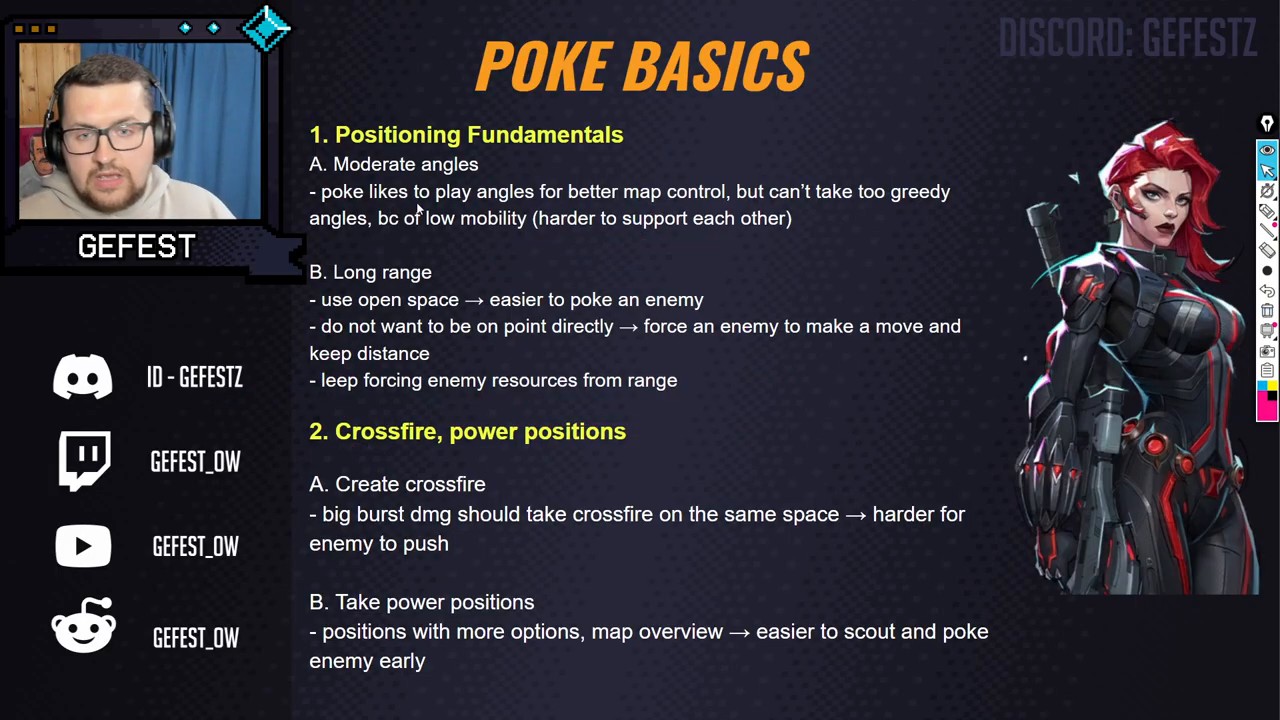
Positioning in a poke comp starts with understanding angles as a scale. On one end are soft angles — playing relatively close to your core, not isolated, not deep into a flank. On the other end are hard (or deep) angles, favored by highly mobile duelists like Black Panther or Magik. Where a given hero sits on that scale depends on their mobility and range: a low-mobility poke hero like White Fox tends to hold a softer angle, while a poke hero with more escape tools can afford to drift further out.
Because poke heroes fight from range rather than up close, they typically settle in the middle of that scale — moderate off-angles. That lets a poke player do damage before the fight properly starts, without going so deep that the rest of the team can't back them up if things go wrong.

Power positions and peek-shooting

Power positions — spots with a wide sightline and multiple angles of attack, often on high ground — matter because they multiply your opportunities to land shots. It's true that hitting a target on the same height as you is mechanically easier than shooting down at one, but a power position gives you so many more chances to fire that missing a shot or two barely matters; the net pressure on the enemy still goes up. Elevated positions are also harder for the enemy to punish back, since they have fewer angles to threaten you from in return.
With characters like Punisher or Ultron, the accompanying technique is peek-shooting: charge or line up a shot from behind cover, peek out just long enough to fire, then return to cover immediately rather than standing in the open to trade. Playing closer to cover in general — rather than out in the open — gives you more control over when a fight actually starts, because you decide when to expose yourself.
The power graph: why poke wants a long fight

Each composition archetype has a different power curve over the course of a fight. Brawl starts with high power that gradually declines the longer the fight drags on. Dive is the most extreme: a huge, sudden power spike the instant the dive hero commits, followed by a hard crash once they've spent their tools and have to disengage. Poke (labeled "Spam" on this graph) is the odd one out — a flat, consistent power level that barely changes over time, because it isn't burning cooldowns to spike damage, just applying the same ranged pressure continuously.
That graph is the whole logic behind poke's win condition: attack from range, force defensive resources, and punish the enemy early in open space, all while staying in the poke phase — the part of the fight before both teams have actually committed and are trading damage up close — for as long as possible. The longer that phase lasts, the more free value a flat, consistent damage curve accumulates compared to a comp whose power is concentrated into one spike.
Lane control and role-specific execution

Most Marvel Rivals maps can be split into three lanes — a main lane where the objective usually sits, plus a lane on each side. A poke comp wants to control as many of those lanes as possible at once, because it multiplies the angles it can pressure the enemy from and lets one lane's group support another if it gets pushed. The rule the coach repeats most: when your lane gets pushed, don't fall all the way back to the main lane — keep rotating along your own lane, from one off-angle to the next, so you stay in range of your team's support instead of getting isolated in the open.
Pro-play example: triangle setups and controlling three lanes

In one replay (Crazy Raccoon vs. STG), Crazy Raccoon's poke comp set up on three separate high-ground positions at once — described as a "triangle" — so each small group could see and support the others while collectively pressuring every lane. STG countered by refusing to fight in the open: they used teleport-style mobility to close the distance quickly and avoid extended exposure to the poke damage, and eventually collapsed on isolated members once the gap was closed.
This is the core matchup logic worth remembering both ways: poke wants to stay at range and control lanes for as long as possible, while the counter-strategy is closing that distance fast and refusing to fight from far away — see the counter-play section below.
Pro-play example: what happens when a lane player gets isolated

In a second replay (Fly Quest vs. Crazy Raccoon), Crazy Raccoon's Vital took an angle to help create crossfire — exactly the positioning this guide recommends — but pushed slightly too deep on the soft-to-hard angle scale and got caught and picked off before the rest of the team could rotate to help. This is the tradeoff in miniature: an angle needs to be aggressive enough to matter, but moderate enough that your own team can still back you up if the enemy punishes it. When it goes too deep, poke's low mobility means there's often no way back.
How to play against a poke comp (its counters)
The flip side of everything above is worth knowing even if you never queue poke yourself, since these are the counters most likely to show up across your own games:
How this guide was fact-checked
The Marvel Rivals Wiki (marvelrivals.wiki.gg) has no page covering team composition archetypes, poke/spam strategy, crossfire, or lane control — confirmed by checking the wiki's hero-only navigation and its 704-page/64-article count, none of them strategy pages — so this guide relies entirely on the source video's own coaching framework, its on-screen slides (Poke Basics, Power Graph, Other Specifics), its live interactive diagrams, and its two pro-play replay breakdowns, all of which are captured directly in the images above. One correction made against the source: the auto-generated captions this guide's transcript was built from consistently mishear the hero Namor as "Neymar" (the footballer) and Black Widow as "Widowmaker" (an unrelated hero from a different game) — both have been corrected throughout to the actual Marvel Rivals heroes the coach is describing.
What this guide doesn't answer
This guide doesn't rank specific heroes for the poke archetype or provide a hero-by-hero tier list — the source is a positioning and macro-strategy class, and hero viability shifts with balance patches faster than this kind of structural guide should try to track. It also doesn't cover every map's specific lane layout in detail; the three-lane model is explained conceptually and applied to the maps shown in the two replays, not exhaustively mapped for the entire map pool. And it doesn't provide solo-queue-specific adjustments in depth — lane control and crossfire, as covered here, assume a level of team coordination that a solo-queue lobby communicating through pings and rotations alone may not fully reach.
Frequently asked
What is a poke (spam) composition in Marvel Rivals?
A poke (also called spam or zone control) comp is one of Marvel Rivals' three core team composition archetypes, alongside dive and brawl. It uses long-range duelists and a disruptive frontline to apply consistent damage from range, forcing the enemy to burn defensive resources and controlling map space without needing to commit to close-range fights. Its tradeoff is lower mobility and weaker close-range sustain than dive or brawl comps.
What is crossfire and why does it matter for poke comps?
Crossfire means pressuring a single target from two or more angles at once, so cover that blocks one attacker doesn't block the other. It denies the enemy safe aggression and pushes them out of cover, and it's most effective when at least one of the angles involved is high burst damage rather than just chip damage.
How do you beat a poke composition?
Avoid standing in open space, since that's where poke's range and crossfire do the most damage. Close the distance quickly using mobility or teleport tools instead of walking through open lanes, avoid long drawn-out fights (poke's win condition depends on staying in the poke phase as long as possible), bring a frontline shield hero so your team can walk forward without poke forcing your defensive resources, and punish poke players who push their angle too deep to be supported.
What's the difference between the poke phase and the brawl phase?
The poke phase is the part of a fight before both teams have actually committed and are trading damage up close — both teams are far apart, rotating and applying ranged pressure. The brawl phase begins once both teams close the distance and start fighting at close range. A poke comp wants to stay in the poke phase as long as possible, since that's where its flat, consistent damage output has the advantage.
Why does lane control matter for a poke comp?
Most Marvel Rivals maps split into three lanes — a main lane where the objective usually sits, plus a lane on each side. Controlling multiple lanes at once multiplies the angles a poke comp can pressure the enemy from and lets one lane's group support another if it comes under pressure. The key habit is rotating along your own lane rather than falling all the way back to the main lane when pushed, which keeps you in range of your team's support.
Read next
Ultimate Timing & Team-Wipe Combo Guide (Marvel Rivals)
Five ultimate combo pairings for team wipes in Marvel Rivals, fact-checked against a nearly two-year-old source video: Groot into a follow-up ult, Loki's double-ultimate transform, Doctor Strange's portal repositioning, and one combo (Rocket + Punisher) that no longer works.
Dive Composition Guide: Kill Boxes, Staging and Timing (Marvel Rivals)
An intermediate breakdown of dive composition in Marvel Rivals: how it fits the poke/brawl/dive triad, the three mistakes that get dive players blamed, kill boxes, attention pulling, staging, and a numbers-tracking rule for when to turn a fight.
Positioning & Survivability Guide: The CAR Checklist (Marvel Rivals)
A top 400 coach's full positioning framework: value and power angles, the three most common map kill boxes, the CAR checklist (cover, angle, range), comp-based positioning, and the habits that get players killed or wipe their team.
Marvel Rivals Best Vanguard Heroes Guide (Season 9.5): Top 4 Tanks to Climb
A breakdown of the four best Vanguard (Tank) heroes in Marvel Rivals Season 9.5 — Magneto, Emma Frost, The Hood, and Hulk — plus honorable mention Peni Parker, sourced from PsychoSingh's tier list video.