
🎯 The core idea
Crafting in Path of Exile doesn't create a perfect item on demand — it rerolls the random stat pool on an item using different currency and methods, trying to land the specific combination you want. This guide covers the fundamentals: item rarity, implicit vs. explicit stats, the prefix/suffix system, and the main crafting methods (basic currency, essences, fossils, the crafting bench, and Harvest crafting). It's adapted from a Scruffy crafting masterclass video from patch 3.25, so some named league mechanics and exact currency availability may have shifted in the current league — this guide focuses on the parts of the system that have stayed structurally consistent across patches.
- free costs nothing
- cheap small cost
- setup needs preparation
- grind pays off slowly
- skip the thing to stop doing
This guide is from a 3.25 source video. Core structural rules (rarity tiers, the 3 prefix / 3 suffix cap, implicit vs. explicit stats) are long-standing Path of Exile fundamentals and are treated as reliable. Specific currency items, league mechanics (fossils, Harvest, Eldritch currency), and exact numeric drop rates are more likely to change between leagues — check current in-game tooltips or a currency exchange before assuming an item or mechanic named here is still available exactly as described.
Rarity, implicits, and the prefix/suffix system
Items in Path of Exile have a rarity tier that determines how many stats they can hold: normal (white) items have zero rollable stats, magic (blue) items can have up to two, and rare (yellow) items can have up to six. Unique items (orange) have their own fixed or semi-fixed stat pools and generally can't be modified by regular crafting currency.
Every item also has an implicit stat determined by its base type — for example, a body armour base might have an innate Armour and Energy Shield implicit. The implicit stays the same no matter how many times you reroll the item's other stats with regular currency; it normally only changes through specific mechanics like corruption or influence.
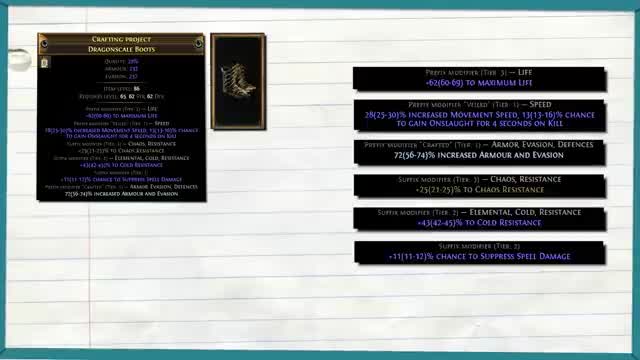
The six possible rollable stats on a rare item are split into two groups: three prefixes and three suffixes. Some stats are always a prefix (like maximum life) and others are always a suffix (like elemental resistances) — this means you can never fit more than three suffix-type stats on one item, so a build chasing all four resistance types on a single piece of gear is never possible, since resistances are suffixes and you only have three suffix slots total.

The example above shows a finished item with all six slots filled: three prefixes (maximum life, movement speed with an "onslaught on kill" effect, and increased armour/evasion) and three suffixes (chaos resistance, cold resistance, and chance to suppress spell damage) — a concrete illustration of the 3-prefix/3-suffix structure in practice.
Basic crafting currency
The video also describes a Regal Orb (upgrades a magic item to rare while keeping its existing stats and adding one more), Orb of Scouring (strips an item back to normal/white), Orb of Annulment (removes one random stat from an item), and Chromatic/Jeweller's/Fusing orbs for socket colors and links. Treat the exact existence and drop availability of any single named currency item as worth double-checking in the current league, since GGG periodically renames, removes, or restructures currency between major patches.

The video recommends using a stat-lookup tool like the PoE Database (shown above) before crafting anything, since it lists every possible prefix and suffix for a given item base — including specialized pools like Incursion mods and Veiled (Syndicate-unlocked) mods — so you know which stats are even reachable before spending currency.
Essences and fossils: guaranteeing a stat
Two of the most useful intermediate crafting tools both work by locking in one specific stat while randomizing the rest:
An Essence behaves like an Alchemy Orb or Chaos Orb (rerolling an item to rare with a fresh random stat set), but guarantees one specific named stat will be included — for example, an Essence that guarantees maximum life. This gives you one confirmed stat out of your six while the remaining five roll randomly.
Fossils, socketed into a Resonator (up to four fossils at once), also reroll all the stats on an item, but each fossil biases the roll toward or away from certain stat "tags." For example, a fossil that favors physical-tagged stats while blocking chaos-tagged stats increases your odds of physical modifiers appearing while guaranteeing chaos modifiers won't. Because fossil combinations get complex fast, tools like Craft of Exile (a community crafting simulator) are commonly used to find a fossil combination that maximizes the chance of a target stat rather than working it out by hand.
The crafting bench and Harvest crafting
The crafting bench in your hideout lets you directly add a specific stat to an item, as long as it has an open prefix or suffix slot — these bench-added stats are usually weaker than the same stat rolled randomly, but they're deterministic and often cheap, making them a common last step after you've already locked in your other five stats. Crafting recipes are unlocked by using Syndicate-dropped "veiled" items and unveiling them with Jun; some of the most-used bench recipes are "Mastercrafts" like prefixes cannot be changed or suffixes cannot be changed, which let you reroll one half of an item's stats while protecting the other half.
The Harvest crafting bench (unlocked via the Harvest league mechanic) works differently — it uses its own currency ("Harvest juice" of different colors gathered from a garden encounter) and offers unique recipes like changing one resistance type to another, rerolling an item's influence, or reforging with a bias toward a specific stat category. Critically, Harvest bench crafts respect Mastercrafts like "prefixes cannot be changed," which fossils and essences do not — making it a key tool once you've locked in stats you want to protect.
The video also describes Eldritch currency (Eldritch Orb/Ember for adding implicits, Eldritch Chaos/Exalted Orbs for rerolling only a prefix or suffix depending on rank) sourced from the Eater of Worlds and Searing Exarch pinnacle bosses. Whether these specific bosses and currencies are still the current source in your league is worth confirming, since pinnacle boss rosters and rewards are among the mechanics GGG changes most often between major patches.
Corruption: the point of no return
Corrupting an item (with a Vaal Orb) makes it permanently unmodifiable by regular crafting methods — it can do nothing, add a random implicit, transform the item into something else entirely, or destroy it outright. Most new players should avoid corrupting gear they've invested real effort into, with one common exception: flasks, which require corruption to push their quality past the normal 20% cap, at the risk of ending up with less quality than before.
What this guide doesn't answer
This is a fundamentals overview, not a full recipe book — it doesn't walk through step-by-step crafts for specific end-game items (the source video includes several worked examples like a righteous fire helmet or a triple-influenced chest, but those rely on the exact currency and league mechanics available in patch 3.25, which may not match your current league). It also doesn't cover exact drop sources or current market prices for any currency mentioned. For a specific item you're trying to craft, check a current-patch crafting guide or a tool like Craft of Exile or the PoE Database for up-to-date stat pools and currency availability.
How this guide was fact-checked
The prefix/suffix cap (three of each, six stats maximum on a rare item) and the rarity tier structure (normal/magic/rare/unique with 0/2/6/fixed stats respectively) are long-standing, structurally stable Path of Exile fundamentals and are presented as fact. The existence and basic function of Orb of Fusing (rerolling socket links) was independently spot-checked against the Path of Exile Wiki, which confirmed it as a real, current currency item with the function described in the source video.
Specific currency names, exact drop sources, league-mechanic-gated crafting methods (Harvest, Eldritch currency, fossils), and worked crafting examples are presented as accurate to patch 3.25 as shown in the source video, but were not independently re-verified against a current-patch source — treat these as likely still broadly applicable but not guaranteed unchanged.
Frequently asked
How many stats can a rare item have in Path of Exile?
A rare (yellow) item can have up to six stats total: three prefixes and three suffixes. Some stats are locked to one category - for example, maximum life is always a prefix and elemental/chaos resistances are always suffixes - which is why you can never fit all four resistance types on one item, since resistances are suffixes and you only have three suffix slots.
What's the difference between an implicit and explicit stat?
The implicit is a fixed stat determined by the item's base type (for example, a body armour base might always have an Armour and Energy Shield implicit) and stays the same no matter how many times you reroll the item with regular crafting currency. Explicit stats are the up-to-six prefix/suffix modifiers that get randomized when you use currency like Chaos Orbs, essences, or fossils.
What does an Essence do in Path of Exile crafting?
An Essence rerolls an item to rare with a fresh random stat set, similar to a Chaos Orb or Alchemy Orb, but guarantees one specific named stat will be included on the result. For example, an Essence of a certain type might guarantee maximum life, giving you one confirmed stat while the other five roll randomly.
What's the difference between fossil crafting and Harvest crafting?
Fossils (socketed into a Resonator, up to four at once) reroll all of an item's stats while biasing the odds toward or away from certain stat categories or 'tags.' Harvest crafting uses its own currency (colored 'juice' from the Harvest garden encounter) and offers different, often more precise recipes - importantly, Harvest bench crafts respect Mastercrafts like 'prefixes cannot be changed,' while fossils and essences do not, making Harvest a key tool once you've locked in stats you want to protect.
Should I corrupt my gear in Path of Exile?
Generally not, unless you're finished crafting and accept the risk. Corrupting an item with a Vaal Orb makes it permanently unmodifiable by regular crafting - it can do nothing, add a random implicit, transform the item, or destroy it outright. The main common exception is flasks, since pushing flask quality past the normal 20% cap requires corruption, accepting the risk that quality could end up lower than before.
Read next
Path of Exile Trading Guide: Buy, Sell and Trade Currency
A complete walkthrough of Path of Exile trading for new players: finding items on the official trade site, whispering sellers, meeting in hideouts, setting up a premium stash tab to sell, price checking your own items, and the two habits that stop almost every scam. Built from Schwingy's four-minute beginner tutorial, with every step that has aged in the four years since flagged, including the Currency Exchange the video predates.
PoE Campaign Leveling Guide: Zones, Vendor Recipes & Early-League Tips (Acts 1-10)
Campaign and early-league tips from Zizaran: which wiki to trust, useful vendor recipes, good leveling zones per act, and how to make early currency. Fact-checked against the wiki - one recipe claim was corrected and outdated Atlas advice (map isolation/mix-matching, removed in patch 3.28) is flagged rather than presented as current.
PoE Mapping Guide Explained: Tiers, Atlas & Void Stones
A conceptual overview of Path of Exile's endgame map system - tiers, white/yellow/red terminology, and Void Stones - built from an older Zizaran lecture but explicitly fact-checked against the wiki to flag which mechanics (like the "connected map" system and Favourite Maps) have since been reworked.
PoE 3.29 League Starter Build Tier List: Best & Cheap League Start Builds
The 3.29 Curse of the Allflame league starter tier list: S-tier picks like Glacial Cascade and Exsanguinate, cheap builds, nerfed skills to avoid, and whether to start Luminary.