
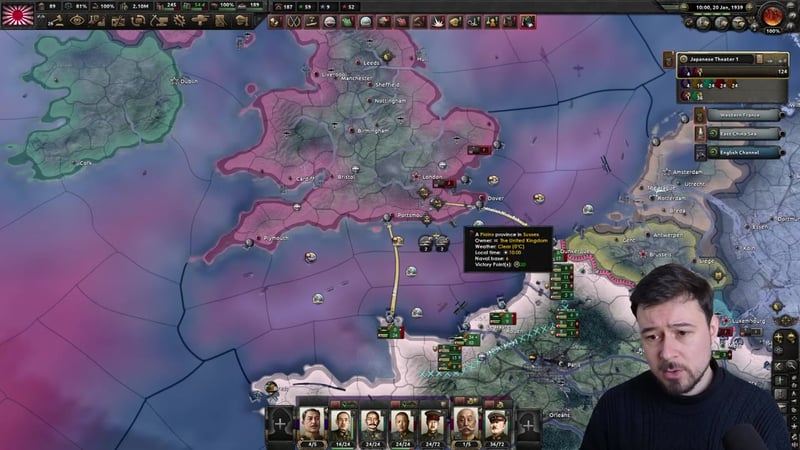
If you want to invade the UK in Hearts of Iron IV, several routes are available depending on your strength and tools. A powerful navy opens the southern coast, overwhelming air lets you land paratroopers in safer northern ports, and pre-war or supply-based tricks can help weaker nations. This guide covers the clean, honest naval route, airborne drops, timing-based launches, and supply handling—plus templates and designs for each approach.
Quick answer
| What | Answer |
|---|---|
| Best honest landing | Portsmouth and Dover from northern France |
| Best air drop target | Hull-Newcastle region |
| Air superiority needed | Over 70% |
| Paratroop preparation time | 7 days |
| Pre-war invasion timing | Launch after the naval invasion is ready |
| North Sea trick | One harbor only needs dominance in the North Sea |
| Emergency disengage | Spam the disengage button |
Pick the landing method first
The way you invade the UK depends on your navy, air force, and overall country strength. The most straightforward options are:
- Landing on the southern coast using a strong navy, with air support if available.
- Air-superiority-based naval invasion—bombers and fighters keep the sea clear even with a poor fleet.
- Paratrooper drops, if you can secure a port and bring in reinforcements.
Majors like Germany, Italy, or Japan have the industry for powerful fleets and overwhelming air, but even weaker minors can use timing tricks: build up dominance before war starts, or snipe a harbor with a well-timed invasion from a smaller sea zone. The ideal method matches your tools: navy for the south coast, air for drops, or cheese for minors without either.
Land on the southern coast when your navy is strong
The classic, honest approach is a naval invasion from northern France targeting Portsmouth and Dover—the UK’s main southern ports.

This coastline is heavily defended: Portsmouth and Dover have strong static anti-air, and Dover often has coastal forts. Even so, landing here is faster, supply routes are easier to manage, and you only have one front to watch. You can encircle fortified Dover by adjusting which province you launch from; clicking adjacent landing tiles gives partial control over invasion spread and assignments.

After landing, the southern supply lines keep your divisions fighting, and the narrow front reduces management overhead. This route lets you cut off parts of the coast and isolate enemy divisions early for easier cleanup.
Run your fleet and planes for a clean naval invasion
To ensure your invasion launches and lands safely, organize your fleet and air missions for both coverage and dominance.


Keep your main ships and air missions focused where the invasion will cross. Once divisions hit the coast, push aggressively to prevent supply issues and enemy reinforcement buildup.
Keep supply under control after you land
Without solid supply, any bridgehead will collapse fast. Manage logistics carefully:

Divisions stranded without supply lose organization and combat power. If routes default through puppets or unwanted paths, use sea-zone blocks to force supply from France or allied ports. Logistics companies, floating harbors, air supply, and safe convoy routes become critical if your infrastructure is weak.
Use air superiority to beat a weak navy
If your navy cannot contest the Royal Navy, air power can make up the difference. Assign bombers and fighters to the Channel or target sea zones; the enemy fleet is much less likely to enter areas dominated by your air force. This tactic works especially well for Germany, with minimal investment in naval production needed.
Naval bombers (including converted CAS with bomb modules) force the Royal Navy to retreat, letting weak fleets patrol on "do not engage" or raid convoys. Submarines distract the enemy and hit their logistics.

This method can reach over 50% sea dominance in a single day, rising to 68% the next. Once the invasion fires, assign your planes directly to the ground offensive for maximum support. The key is timing; trigger the landing as soon as dominance is achieved before enemy fleets regroup.
Drop paratroopers onto a safe harbor
Paratrooper drops bypass the naval fight but require strict preparation.

After landing, prioritize capturing a harbor so reinforcements and supply can arrive. Paratroopers do not hold well in prolonged combat—send in strong follow-up divisions as soon as a port is secured.
Set up cheesy pre-war dominance and North Sea tricks
If your navy and air are both weak, exploit pre-war setup or minimal sea requirements.


These tricks let weak nations snatch a foothold without directly confronting the Royal Navy. Splitting your submarines and fleets into multiple small groups can also maximize distraction.
Handle bad RNG and disengage bad fights
Even with optimal setup, naval combat has randomness—the Royal Navy may strike harder or ignore your distractions. Submarines, even in groups of one, can draw enemy focus, but since recent patches, detection increases mean they are wiped out more quickly.
If your fleet is engaged, use the disengage button in the naval battle window. Spam it repeatedly. This often lets ships escape before heavy losses build up.

You may need to disengage through several battles, losing some ships each time. If the enemy keeps pressing, reload and try again—sometimes waiting a few weeks before another attempt shifts the enemy fleet away from your route. Save before launching the invasion, even in ironman, to retry if the initial approach fails.
Use the right templates and cheap ships for each country
Matching your invasion plan to the right division and navy composition is essential for execution. The following table summarizes useful templates and approaches for different nations and invasion methods.
| Method/Nation | Division Template | Navy Setup/Notes |
|---|---|---|
| Paratrooper drop | Small, drop-focused paratrooper unit | Only needs enough transport planes; template built for rapid harbor capture |
| Motorized SPG push | Motorized SPG breakthrough | Tanks can substitute for SPGs; prioritize high soft attack |
| Japan landing | Mixed infantry-marines, with tanks | Limited special forces cap; tanks reduce supply usage |
| Turkey invasion | Mountaineers + SPGs | Cheap cruisers (“empty bottle” designs) boost dominance when a full fleet is not possible |


Adjust division width, support companies, and special forces composition to the job: marines for coastal landings, tanks for fast pushes, mountaineers for rough terrain. Cheap ships help with sea dominance when a real fleet is out of reach—especially for minors.
Also worth knowing
- Submarine distraction is much weaker in current patches. After the 1.17.5 submarine detection fix, subs are quickly detected and wiped, so reliance on disengage spam is now crucial.
- The North Sea-only harbor trick may be patched. This technique gets attention—use it while it lasts, but expect Paradox to alter it in future updates.
- Splitting into many single-ship task forces increases distraction. Assign fleets on "do not engage" across all UK-adjacent seas for maximum Royal Navy distraction—especially effective with massed cheap destroyers.
- Air Supply can save an invasion. Even when convoys are intercepted, using transport planes for supply can keep your divisions fighting—especially from a well-positioned air base.
- Strategic bombing can cripple the Royal Navy. Destroying fuel reserves via bombing and convoy raids can prevent UK fleets from staying at sea.
- Naval mines speed up dominance. Deploy mines in contested sea zones to help achieve naval superiority faster.
- Sabotage with paratroopers disrupts defenders. Dropping a paratrooper battalion can disorganize whole provinces, making the landing easier.
- Marine commandos create diversions. Multiple attacks across Britain spread defenders thin, making the main landing easier to secure.
- Supply management is key. Use logistics companies, floating harbours, air supply, and safe routes—the UK invasion often fails from supply bottlenecks, not combat losses.
- Northern UK invasion from Denmark or Norway is an option. The Hull-Newcastle region can be accessed from Scandinavian territory if you handle mountain passes.
Frequently asked
How do you get a reliable Sea Lion with a strong navy?
Use the southern coast, especially Portsmouth and Dover, because the landing is faster and supply is easier to manage. Keep destroyers on patrol, larger ships on strike force, and use submarines for convoy raiding if needed. Once the invasion starts, switch the fleet to naval invasion support and push quickly before supply problems and reinforcements build up.
How do you invade the UK without a strong navy?
Use air superiority to cover a naval invasion, or use paratroopers to take a harbor first. The key is to avoid the Royal Navy by making it busy elsewhere and by using planes to discourage it from fighting your fleet. If you cannot win the sea fight directly, the air war and timing become the main tools.
Why do paratroopers fail over southern England?
Southern Britain has static anti-air, and that can shred airborne divisions before they land. The safer airborne targets are in the Hull-Newcastle area, where the anti-air coverage is less of a problem. After landing, the goal is still to secure a harbor and bring in better divisions.
What should I do if the Royal Navy keeps engaging my fleet?
Use submarines to distract it, set the main fleet to do not engage, and spam disengage if combat starts. The naval battle window can be used to force ships out of a bad fight before too many are lost. If the situation looks bad, make a save and try again later because timing and enemy positioning matter.
Read next
HOI4 Sweden Guide
What Sweden starts with in Hearts of Iron IV, what its national spirits cost it, where the focus tree leads, and the openings the wiki's own editors recommend. Written for a nation with almost no video coverage, from the game's reference wiki.
HOI4 Turkey Guide
What Turkey starts with in Hearts of Iron IV, what its national spirits cost it, where the focus tree leads, and the openings the wiki's own editors recommend. Written for a nation with almost no video coverage, from the game's reference wiki.
HOI4 Poland Guide
What Poland starts with in Hearts of Iron IV, what its national spirits cost it, where the focus tree leads, and the openings the wiki's own editors recommend. Written for a nation with almost no video coverage, from the game's reference wiki.
HOI4 China Guide
What China starts with in Hearts of Iron IV, what its national spirits cost it, where the focus tree leads, and the openings the wiki's own editors recommend. Written for a nation with almost no video coverage, from the game's reference wiki.