
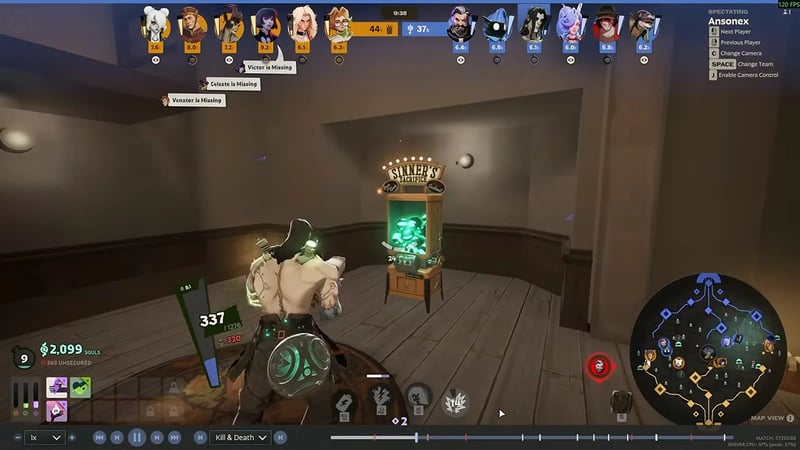
🎯 The core idea
Souls in Deadlock are your gold and your XP at once. Most of them come from trooper waves, and each trooper pays out in two halves: a ground orb that nobody can deny, and a floating orb you have to shoot. Last-hit and confirm your own orbs, deny the enemy's, and keep pushing waves while you clear jungle on the way back. That alone fixes most soul problems.
- free costs nothing
- cheap small cost
- setup needs preparation
- grind pays off slowly
- skip the thing to stop doing
This guide covers how souls work: where they come from, what last-hitting and denying actually do to a trooper's bounty, how Soul Orbs behave, and why some of your souls are "unsecured". The source video is Ansonex's "How to Get MORE SOULS in Deadlock" (uploaded February 2026, before the City Never Sleeps update). Its farming loop still holds up, but every number below was checked against deadlock.wiki as of October 2026. Where the video and the wiki disagree, the wiki wins and the correction is named in the section.
Deadlock souls explained: currency and XP in one number

free Deadlock has no separate gold and experience. Souls are both: every soul you pick up goes toward buying items and toward your next Boon (the level-up that grants ability points and power increases, the "Boon Received!" popup in the frame above). Every player starts the match with 600 souls. From then on, how souls work comes down to one rule: the more you collect than the enemy, the more items and ability points you have when fights happen.
Your total souls is also your net worth. The scoreboard bar at the top of the screen shows each team's combined souls in thousands. The gap between the two numbers is the team soul lead, and that gap decides most games long before the Patron dies. This is why the Deadlock economy rewards boring, consistent farming over flashy plays. A kill is worth a lot, but you can't count on getting one. A trooper wave shows up every 30 seconds whether anyone fights or not.
Where souls come from, ranked by value

The video's main point is that most struggling players don't know which source matters most, and it's right. Here are the current wiki values. Each source has a starting value plus growth per minute of game time.
| Source | Value at 0:00 | Growth per minute | How it's paid |
|---|---|---|---|
| Trooper (each) | 100 | +2 | 50% ground orb, 50% floating orb |
| Hero kill | 200 | +50 | Capped at 2,200 (40 min); shared with assisters |
| Sinner's Sacrifice | 310 | +3.35 | Haunted souls, first spawn 8:00 |
| Large Haunt (each) | 181 | +1.95 | Haunted souls, split equally among attackers |
| Medium Haunt (each) | 68 | +0.73 | Haunted souls |
| Small Haunt (each) | 41 | +0.44 | Haunted souls |
| Crate | 23 | +2 | 60% chance to drop, haunted |
| Tough Crate | 46 | +4 | Always drops, needs Heavy Melee |
| Guardian | 1,375 | 0 | 25% to nearby heroes, rest split across the team |
| Walker | 3,675 | 0 | Same split as Guardian |
| Mid-Boss | 3,000 | +50 | Split equally among the team |
A trooper wave has four troopers (three Ranged plus a Medic at first, then two Ranged, one Melee and one Medic after 5:00). At 0:00 that's about 400 souls per wave, and roughly 480 at 10:00. Waves arrive every 30 seconds until 20 minutes, every 25 seconds until 35 minutes, and every 20 seconds after that. That steady flow is why the video ranks trooper waves first. The wiki numbers back it up: no other repeatable source on your side of the map pays like a full wave you actually collect.
The video also says "golden statues" give a few extra souls. They don't. The wiki lists Golden Statues as Buff Containers that have a 50% chance to drop a permanent stat buff (fire rate, ammo, cooldown and so on), not souls. Still break them on your way past, just for the buff and not for your soul count.
Last hitting troopers: the two halves of every bounty

free Last hitting in Deadlock works differently from most MOBAs. When a trooper dies, its bounty splits into two equal halves.
- The ground orb (50%) drops at the trooper's feet and goes to nearby allied heroes. The enemy can't deny it. It shows as white to them and green to you. It stays for 18 seconds early on, and that rises to 40 seconds after 10 minutes.
- The floating orb (50%) pops up dark, lights up a moment later, and has to be shot or meleed to claim it. Your own orbs are green and enemy orbs are orange. One bullet or pellet is enough, whatever its damage, and that bullet goes back into your magazine.
So last hitting isn't about landing the killing blow. It's about confirming the floating orb. If nobody claims your orb within about one second, it pops and goes to nearby allies anyway. If no ally is nearby, those souls are gone. Don't let orbs you could have shot time out, and you can't relax on them either, because the enemy can take them first (next section).
There's one shortcut: kill a trooper with a melee attack and no floating orb spawns at all. You get the floating half instantly, and the ground orb still drops. Abilities that deal Melee Damage, and Mina's Rake, work the same way. When an enemy hero is aiming at your wave and waiting to deny, a melee last hit on a low trooper secures those souls with nothing to contest.
Denying souls: how to deny and steal enemy orbs

free Denying is the same move as confirming, aimed at the enemy's orange orbs. If you hit an enemy trooper's floating orb before they claim it, you deny their souls: the enemy gets nothing from that half, and the souls go to you and your nearby allies. That makes denying a two-way swing, not just a block.
How to deny in practice:
- Watch for enemy troopers about to die, either to your wave or to the enemy's own shots.
- Aim where the floating orb appears, just above the trooper's body, and fire as soon as it lights up. Before then it can't be claimed.
- Use a fast single shot. Damage doesn't matter here, only who connects first.
The owning team gets a grace period of roughly 80 ms on its own orbs, so a deny only works when the enemy is slow or not looking. The wiki also notes that orb confirmation accounts for latency. Sometimes you'll appear to hit first and still lose the orb. That's the netcode, not your aim.
Some abilities and items can confirm or deny orbs too. The wiki names Serrated Knives and Malice. In melee range, a quick melee can also secure an orb, though there's a short delay before a melee can deny an enemy orb.
Lane sharing: why two heroes earn more total but less each

setup Trooper souls are split between nearby allied heroes. The game checks two distances: within 45 m of the orb when it breaks, or within 30 m of the hero who killed the trooper. If you're inside either one, you're in the split. Shooting the orb yourself doesn't change the split. Confirming only stops the souls from being lost or denied.
| Heroes nearby | Share each | Total paid out |
|---|---|---|
| 1 | 100% | 100% |
| 2 | 54% | 108% |
| 3 | 36% | 108% |
| 4 | 25% | 100% |
| 6 | 16% | 96% |
The video says two players each get "about 60%". The wiki puts it at 54% each (108% total). The conclusion is the same: a duo lane makes slightly more souls for the team, but each hero gets just over half. The melee-kill shortcut doesn't avoid this, since the wiki says distribution is identical whether the orb is shot or the trooper is meleed.
The video uses this to say who should stay alone in a lane. Hard carries that scale with items (it names Wraith and Infernus) should solo a lane and take 100% of every wave. Heroes whose damage comes mostly from their abilities (it names Mo & Krill, Rem, Abrams and Lash) can leave lane once a Guardian falls, take shared farm, rotate, and steal enemy Sinner's Sacrifices. That's the video's coaching advice, not a game rule, but the split table shows why it works.
Secure souls vs unsecured souls: the haunted soul bag

setup Look under your soul counter and you'll see a second number marked unsecured. In the frame above it reads 2,099 souls with 563 unsecured. The wiki calls these haunted souls. You get them from neutral sources: Haunts (jungle camps), Sinner's Sacrifice machines and crates. Souls from troopers and objectives are secure right away.
Unsecured souls count toward your total and your Boons, and you can spend them (the shop takes secured souls first). The catch is that you lose them if you die. If you die carrying at least 50 + 5 per minute of unsecured souls, they drop as a Soul Bag that anyone can claim with a Heavy Melee within 3 minutes. Below that threshold they're just gone.
To secure souls, stay alive. Unsecured souls turn into secured ones automatically: 0.5% of your current haunted souls each second, plus a flat amount that starts at 1.6 per second and grows over the match. The wiki's example is 1,000 haunted souls at 10 minutes securing at about 7.9 per second. Practical rule: after a big jungle clear, don't take a risky fight until that number has dropped. Better still, spend it at the shop.
Jungle camps and farming backwards

grind Haunts give souls to every allied hero who damaged them, always split equally, and they never drop orbs, so there's nothing to deny. After City Never Sleeps the camp tiers are:
| Camp tier | Souls per Haunt | First spawn | Respawn |
|---|---|---|---|
| Small | 41 (+0.44/min) | 2:00 | 1:25 |
| Medium | 68 (+0.73/min) | 5:00 | 4:50 |
| Large | 181 (+1.95/min) | 8:00 | 5:35 |
The video's loop is to push the wave toward the enemy Guardian, take the enemy camp near it first, then fall back and take your own camp. It calls this "farming backwards". You earn both camps' souls and the enemy gets neither. The video credits a 3-minute soul lead to about 60 souls from a stolen camp plus about 30 from a box. Those specific camp values come from before the Haunts rework, so treat them as an example of how fast small gains add up, not as current numbers. The video's on-screen claim that a trooper wave is worth almost two tier-2 camps also comes from the old jungle. Check the table above for today's numbers.
For full camp layouts and routes, see the Deadlock Haunts guide and the Deadlock farming guide.
Sinner's Sacrifice, crates and the 8-minute spike

cheap Sinner's Sacrifice machines first spawn at 8:00 and pay out to melee hits: about half of the value during the hits and the rest when the machine breaks. They're worth 310 + 3.35 per minute, so about 337 souls at 8:00. The video says one is worth about as much as a full wave. At 8:00 a wave is closer to 460 souls, so a machine is roughly three-quarters of a wave, which is still a big chunk for a few seconds of punching. If you time the final hit when all the bulbs are lit, you get a Jackpot. A heavy melee Jackpot gives 4 random permanent buffs, and a light melee gives 1.
The video's advice is to steal the enemy's first machine, then go back for your own. Even at high ranks it's often left open. Lone machines respawn 5 minutes after being broken. Machines in a hybrid camp respawn only once the whole camp (machines plus Haunts) has been cleared.
Crates (the "boxes" in the video) are the filler between camps: 23 + 2 per minute, with a 60% chance to drop anything. That's 83 souls at 30:00. Tough crates need a Heavy Melee but always drop about double. All of this is unsecured, so the previous section's warning applies.
Objectives, kills and the soul lead

Objectives. The video says that taking a Walker alone is a huge soul spike. That has changed since the video. On September 16, 2026 the share for nearby heroes was cut to 25%, and the other 75% is split across all six teammates. A Walker is 3,675 souls, so if you take it alone you get roughly 919 + 459 ≈ 1,380, and every teammate gets about 459. It's still a strong spike, just smaller than it was in February. Guardians use the same split on 1,375 souls.
Kills. A hero's bounty starts at 200 and grows by 50 per minute, capped at 2,200 at 40 minutes, plus 125 for First Blood. It's split among assisters (anyone who damaged the target in the last 10 seconds). A solo kill pays 125%, and with two heroes each gets 57%. The video calls kills unreliable for a reason: you might get one kill in lane or five. Don't take a 500-HP trade early just to chase a kill.
Comeback. If your team is behind, the game helps you catch up. The losing team gets up to 26% more souls from troopers, Haunts, Sinner's Sacrifices and objectives. Kills on enemies above your team's average net worth pay extra. After 8 minutes, the two poorest players on each team get a small passive trickle. None of this is a reason to give up farming when you're behind. It's a reason to keep farming.
The soul rhythm: how to get more souls every game

grind Here's the video's loop, which it calls the "soul rhythm", with the corrected numbers above:
- Push the wave until you're in danger, not literally to the Walker. Collect every trooper's ground orb and confirm every floating orb.
- Take jungle on the way back, enemy camp first, then yours, with crates in between.
- Hit the Guardian only when it's worth it. The video's rule is to skip chip damage unless you can take about half its HP, because Guardians get much easier to kill later.
- Steal the enemy Sinner's Sacrifice at 8:00, then take your own.
- If the enemy is doing this to you, secure your own jungle and play passive until you're caught up.
A pushed wave forces an enemy to come and deal with it, and that gives you time to farm their jungle. Repeat the loop and your souls per minute go up on their own.
To measure souls per minute, divide your net worth by the game clock. The video's benchmarks: a carry running this loop is often at 35,000–40,000 souls by 25 minutes (about 1,400–1,600 per minute), and its own game ended at about 60,000 at 45 minutes after a bad start. Those are one player's numbers, not a target the game sets, but they give you a baseline. For lane trading and wave control, see the Deadlock laning guide. For when to group and push, see the Deadlock macro guide.
Common soul mistakes to stop making

skip Most of these come from the video. Each one costs souls you could have had:
- Leaving floating orbs unshot. An orb you don't claim might still reach an ally, but if the enemy gets to it first, they gain those souls and you lose them.
- Fighting for no reason in lane. Trading 500 HP "for fun" gets you nothing and often costs a wave.
- Shooting the Guardian for chip damage. That time is better spent on waves and camps.
- Doubling up a lane on a hard carry. At 54% each, your farm nearly halves.
- Dying with a big unsecured number. Spend it or let it secure before you take a risky fight.
- Ignoring the enemy's jungle. If you don't farm it, they will.
How this guide was fact-checked
From deadlock.wiki (Souls, Trooper, Haunt, Sinner's Sacrifice, Crate, Buff Container and Melee Attack pages, read October 2026): starting souls (600), every soul value and per-minute growth in the tables, trooper wave makeup and spawn frequency, the 50/50 ground and floating orb split, ground orb duration (18 s rising to 40 s), the ~80 ms owner grace period, the ~1 s orb pop, the bullet refund, the 45 m / 30 m sharing distances, the trooper and hero kill split tables, melee last hits skipping the floating orb, the haunted-soul rules (soul bag threshold, 3-minute bag, conversion rate), the post-City Never Sleeps Haunt tier values and timers, Sinner's Sacrifice timing and Jackpot rules, and the September 16, 2026 change to the objective share.
From the video (Ansonex, February 2026): the "soul rhythm" loop, farming backwards, stealing the first Sinner's Sacrifice, the solo-lane advice for hard carries vs ability heroes, the "don't plink the Guardian" rule, and the 35–40k-at-25-minutes and 60k-at-45-minutes benchmarks. Those are coaching advice and personal results, credited to the video.
Corrections to the video:
- Two-hero lane share is 54% each on the wiki, not "about 60%".
- Golden statues drop permanent stat buffs, not souls.
- A solo Walker now pays you about 1,380 souls, because the nearby share was cut to 25% on September 16, 2026.
- A Sinner's Sacrifice at 8:00 (about 337) is roughly three-quarters of a wave, not equal to one.
- The video's jungle camp values (the 60-soul stolen camp, "a wave is almost two tier-2 camps") come from before the Haunts rework. This guide uses current wiki values instead.
The video doesn't cover orb confirming or denying mechanics at all. Those sections come entirely from the wiki. All images are frames from the video's replay footage, recorded before City Never Sleeps, so the map in the minimap is the old layout.
What this guide doesn't answer
- Full jungle routes per map district. The post-rework layout is its own topic, covered in the Haunts and farming guides linked above.
- Exact trooper damage and HP math for last-hit timing. That depends on your hero's gun and items, so it belongs in hero guides.
- Soul Urn and Unstable Rift strategy. Both are team objectives with their own rules, covered in the macro guide.
- Which items to buy with your souls. See the item shop guide and the individual hero guides.
- Street Brawl economy. Super Troopers and round rules change the numbers, and this guide covers the standard mode only.
Frequently asked
How do souls work in Deadlock?
Souls are both your currency and your XP. You spend them on items, and collecting them earns Boons, which give ability points and power increases. Everyone starts with 600. Trooper waves are the most reliable source. Each trooper is worth 100 souls plus 2 per minute. Haunts, Sinner's Sacrifices, crates, objectives and hero kills add the rest.
How does last hitting work in Deadlock?
When a trooper dies, half its bounty drops as a ground orb that nearby allies collect automatically and the enemy can't deny. The other half floats up as an orb you have to shoot or melee once it lights up. One bullet is enough, and it goes back into your magazine. If you kill a trooper with a melee attack, no floating orb spawns and you get that half instantly.
How do you deny souls in Deadlock?
Shoot the enemy's orange floating orb after it lights up and before they confirm it. The enemy gets nothing from that half, and the souls go to you and nearby allies. The owning team has a grace period of about 80 ms, so denies work on players who are slow or not looking. Ground orbs can't be denied.
What are unsecured souls in Deadlock?
Unsecured souls are haunted souls from Haunts, Sinner's Sacrifices and crates. You can spend them, but you lose them if you die. If you die with at least 50 + 5 per minute of them, they drop as a Soul Bag anyone can take with a Heavy Melee. They turn into secure souls over time, at 0.5% per second plus a flat amount that grows over the match.
Do you get fewer souls sharing a lane in Deadlock?
Yes. With two heroes nearby, each gets 54% of a trooper's souls (108% total). With three, each gets 36%. A duo makes slightly more for the team, but each hero earns about half, which is why item-dependent carries prefer to solo a lane.
Read next
Deadlock Parry: How to Parry Heavy Melee (and When Not To)
How to parry heavy melee in Deadlock, with the current parry window, stun and cooldown checked against deadlock.wiki. It also covers the hero combos worth reading and when to keep your parry, including the September 2026 changes to reloads, dashes and objective parries.
Deadlock Movement Tech: Dash-Jump, Slide & Wall Jump
Every Deadlock movement trick that still works, with stamina costs and timing checked against deadlock.wiki: dash jumps, slide bunny hops, superglides, wall boosts and zipline tech. It also covers what was patched out, including AG2 dashing and heavy melee cancels.
Deadlock Laning Guide: Wave Priority, Trading & Farming
How wave priority decides the Deadlock laning phase and how to win the wave 30 seconds before each objective timer. Covers soul orbs, safe trades, camps, crates, bridge buffs and Sinner's Sacrifices, all checked against the wiki.
Deadlock Tough Crate Locations: Every Heavy Crate Spot
Where every Tough Crate (Heavy Crate) sits on Deadlock's City Never Sleeps map, lane by lane for both teams. Covers spawn and respawn timers, soul values, and the routes that collect the most crates for the least walking.