
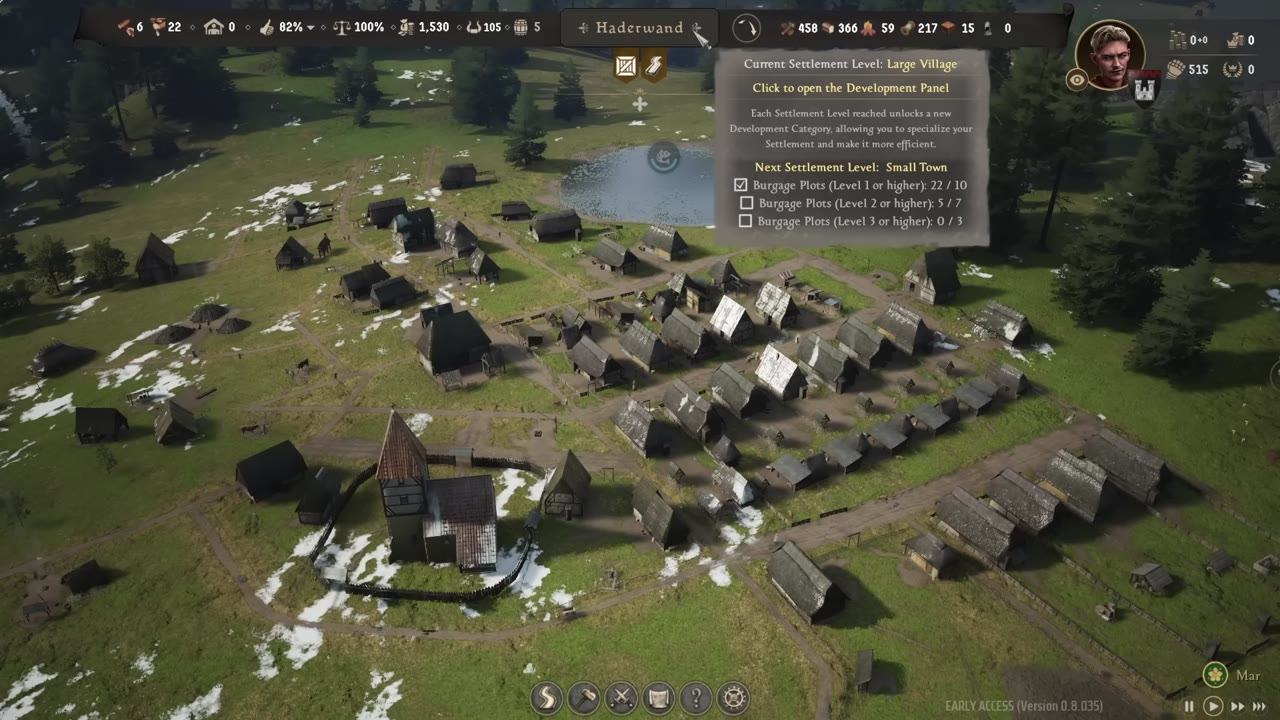
Build a self-sustaining economy in Manor Lords by leveraging sheep, charcoal, and trade to cover clothes, food, and materials for higher-tier housing. This guide shows how to start your economic loop, avoid clothing shortages, and advance your settlement efficiently.
Quick answer
| What | Answer |
|---|---|
| Best early income | Charcoal |
| Sheep imports | 26 sheep |
| Sheep upkeep | 80 yarn kept in reserve |
| Clothing output | 1 yarn -> 1 clothes |
| Butcher output | mutton and hides |
| Clothing bug detail | consumed every 30 days |
Set up your early economy
Start by securing income, as importing livestock and running production chains depend on regional wealth. Charcoal is the single strongest early source of income:
- Charcoal generates high profits and no longer requires a development point — unlock the major charcoal trade route for just 30 regional wealth 7:10.
- You need trade to import sheep and begin livestock-based production loops 6:41.
- 26 sheep cost 780 regional wealth and can quickly reproduce, expanding your herd naturally and passively.

Charcoal and yarn can be traded in any region, regardless of local deposits or map features.
Use sheep as your clothing engine
Sheep provide a simple and powerful production loop for wool, yarn, and income.
- Sheep now reproduce automatically — the sheep breeding development point is not needed 2:26.
- Even a single worker produces meaningful wool output 3:52.
- One worker converts wool to yarn; this chain is low-labor and efficient.
- Trade records show strong income from exporting yarn 4:49.


Turn yarn into clothes efficiently
Providing clothes for your settlement is simple if you keep the production loop supplied:
- The tailor produces clothes directly from yarn or linen 8:08.
- Keep at least 80 yarn in town (via trade options) — this ensures tailors are never left idle and prevents shortages 8:38.
- Even when clothes are consumed rapidly due to beta bugs, this reserve lets your housing requirements stay met.

Add shoes and food from the same livestock
Expand livestock usage to supply food and additional materials for housing upgrades.
- The butcher will slaughter sheep, producing mutton for food and hides as crafting material 9:35.
- Hides produced by the butcher become leather when processed in a tannery 11:02.
- Shoes count as final clothing items required by housing.


Plan for the current clothing bug
Currently in beta, clothes are consumed at a rate of one item every 30 days by each family 0:31. This abnormal consumption rate makes clothing seem to disappear quickly and can make meeting housing requirements difficult, even if you have a surplus in records or storage.
The issue stems from an unbalanced demand in this version; when the fix arrives, clothes will be consumed much less rapidly, making it easier to keep up with town needs.
To upgrade houses and satisfy requirements, you must deliver crafted clothing items (like clothes or shoes) to residences. Raw materials — yarn, wool, leather — do not fulfill the final demand.

Families will only upgrade if supplied with finished clothing or shoes. Pelts and leather alone are not sufficient.
Reach Tier 3 without overbuilding
Efficient use of livestock and production chains allows you to upgrade housing without excessive infrastructure.
- A loop of charcoal trade, livestock, yarn, and imported goods supports multiple Level 2 and Level 3 houses.
- Five Level 2 or higher houses can be sustained with this setup 1:28.
- Later, eighteen Level 2 houses were supplied successfully, demonstrating the scalability.
- To reach Level 3, import extra foods like ale or fruits and ensure both tailor and cobbler are operating; this covers all necessary requirements.
- Even with a single tailor, the town can reach higher settlement levels, thanks to efficient yarn and sheep production.

Charcoal and yarn provide universal trade options. You do not need region-specific resources to run this settlement plan.
Also worth knowing
- Sheep can die at high elevation in winter. The Born of the Alps development perk prevents this sheep mortality, so plan your pasture sites accordingly.
- Animal import costs are reduced by 20% with the Weiden Hinterlanders perk. This can make expanding your herd much cheaper.
- Clothing issues remain for some beta players. The clothing bug described is still active for others, so clothing may still disappear unexpectedly.
- The butcher can rapidly drain large herds. One player reported a herd of over 400 sheep dropping below 100 in less than a year; monitor slaughter rates and consider limiting butcher activity if your herd size is low.
- Clothing can vanish even with surplus on the records tab. Be aware that consumption and supply tracking may not match storage perfectly during the bug phase.
- Tailors may be delayed fetching yarn. If tailors spend too much time travelling to weaving huts, production slows down, especially at high game speeds.
- Strategic placement can help stockpile clothes. Keeping pastures, weavers, and tailors away from main storage and limiting market access lets you build up clothing reserves before opening to the public. This can help mass-upgrade a town once requirements are met.
Frequently asked
What is the best way to keep up with clothing demand early?
Use livestock to produce wool, turn it into yarn, and then convert yarn into clothes through a tailor extension. Keep a reserve of yarn in trade so the tailor always has input, and use the same livestock chain to support food and hides as well. This creates one production loop that covers both clothing and income.
Do sheep still need a development perk to reproduce?
No. Sheep reproduction is now automatic, so there is no longer a need to spend a development point on sheep breeding. That makes livestock a much earlier and more reliable investment.
Can pelts or leather still satisfy clothing demand?
No. Pelts are no longer turned into leather for clothing demand, and leather itself does not satisfy the clothing requirement. Clothing has to be made into the final item, such as clothes from yarn or linen, or shoes from leather.
How many sheep do you need for a strong town setup?
A starting herd in the low twenties can grow quickly, but the livestock supply will shrink once the butcher is active. Around 150 to 200 sheep and lambs is a safer range if you want to keep slaughtering animals while still sustaining wool production.
Read next
Manor Lords Money Guide
This guide explains how to turn trade, regional wealth, and taxes into treasury income in Manor Lords. It is for players who need a simple money loop for a growing settlement.
Manor Lords Trade Routes Setup Guide
Learn how exporting works, when trade routes are actually needed, and how to unlock them with Regional Wealth. This is for players who want to make money from surplus goods without wasting wealth on unnecessary routes.
Manor Lords Beginner Guide
A beginner guide to surviving, growing, trading, fighting, and expanding in Manor Lords. It is aimed at new players who want a practical order of operations instead of a step-by-step handhold.
Manor Lords Perfect Start and Historical City Guide
Build a self-sustaining early settlement that can survive poor fertility, grow food variety, and scale into a Tier 4 town. This plan focuses on historical burgage layouts, trade income, livestock, and the production chain needed to keep upgrades moving.