
Siam plays as a country that never lost its independence and paid for it in territory, and the focus tree makes you manage that bargain from both ends: a ruling party that can depose you and neighbours holding land you want back. This guide walks every branch — fascist, monarchist and democratic — plus the two industrial routes, the limited-war system, the resist-or-submit decision and the naval choice. By the end you will know which route to commit to and what each one costs you.
Quick answer
| What | Answer |
|---|---|
| Core mechanic | Two People's Party factions, civilian and military, tracked separately |
| Failure state | Unresolved faction anger escalates to a coup attempt and can trigger civil war |
| Limited war | Occupy the designated states inside a fixed time limit |
| Losing one | A penalty and partial collapse, not capitulation |
| Industry payoff | Both industrial branches end at the Industrial Nation focus and its late-game bonus |
| Democratic route | Provoke the military into public opposition; each time raises the final backlash against them |
| Submission | Alliance with the invading power in exchange for obligations that grow over time |
| Skipping the navy | Converts naval infrastructure into civilian factories |
Keep the People's Party factions from couping you
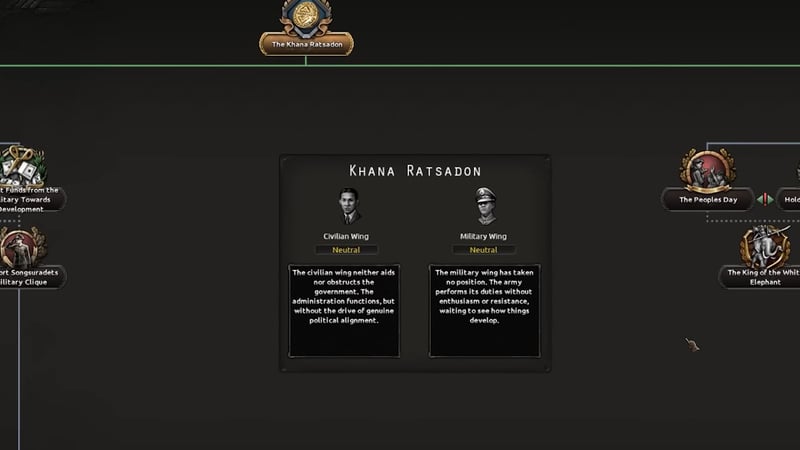
The People's Party — Khana Ratsadon, the structure that took power in the 1932 coup — is not modelled as one ideological slider. It is two factions, civilian and military, each scoring your behaviour on its own 0:31. You are running two parallel relationships, and a decision that pleases one commonly costs you with the other — not always by the same amount, so you cannot treat the pair as a see-saw and assume the total stays level.

Let a faction get too dissatisfied and it escalates. Escalation is not the failure — it opens a warning window, and inside that window the relationship can still be repaired 1:02. Ignore the window and it becomes a coup attempt, and the coup attempt can become a civil war you did not choose and are not prepared for.
This is why the early tree feels constrained. Almost every opening focus leans toward civil servants or toward military officers, so your first half-dozen picks are already moving both meters. Maximising one faction is the intuitive play and the wrong one: long-term routes generally need both relationships held somewhere survivable rather than one of them adored.
Treat the escalation warning as your actual deadline, not the coup. Once a faction has escalated you still have time to spend focuses and decisions on it, and that is far cheaper than fighting your own army.
Put Phibun in power and run a fascist Siam
The historical route ends with Luang Phibunsongkhram running a centralised fascist state on consolidated military power. Getting him there takes one of two openings: accumulate enough ideological support, or resolve the political events that weaken the leadership already in place. Either way the installation is a condition you build toward, not a focus you simply click.
Once he holds power the state centralises and targeted purges clear out the opposition 1:59. That cuts internal threats, and it also shrinks the political landscape you have left to work with — fewer factions to manage, fewer options to reach for when a situation changes. Plan the purges around the routes you still intend to take.

Two systems carry the branch afterwards. Propaganda is reusable: you spend political resources and get ongoing bonuses in return, repeatedly. The Thai Culture Decree is reshaped and revised internally over time, hardening the state's ideological direction as you go. Both scale with commitment — the more you feed them, the better they pay — and both draw on resources that would otherwise fund expansion. That trade-off is permanent on this route, and it is the thing to decide deliberately rather than by default: an internally spotless Siam that never went anywhere has spent the whole game on control.
Take back lost territory with limited wars
Pan-Thai expansion is shared across the routes and exists for one purpose: recovering territory Siam gave up. Its mechanism is the limited war, which replaces immediate large-scale escalation with a conflict scoped to specific objectives and a clock.
The clock changes how you build an army. A limited war rewards a short focused campaign — enough offensive weight to occupy named states quickly, staged where they are before the declaration — over the deep reserves that win a long war. Speed and planning beat scale here, which suits a country whose scale is limited anyway.
Running out of time is not capitulation. You take a penalty and a partial collapse, and the state survives — so a limited war is a survivable gamble in a way a normal war is not. Do not let that make you casual about the timer; the penalty still lands, and it lands while your army is worn down.
Winning the war is only the first half. Occupied territory has to be developed and reach sufficient compliance before it can be fully incorporated, and only integrated territory gives you its whole economic and manpower value. Budget for the gap between taking a state and being paid by it.
Restore the monarchy and shape the young king
The monarchist route is a staged transformation, not a decision: legitimacy first, alliance building second, regime change last, spread across a series of preparatory efforts.

Leadership does not go static after the restoration succeeds. Power sits with three parties at once, and the regency you pick is the lever that decides which direction the restored state actually runs in. The king then matures over the following years, and the traits you steer him into become long-term bonuses and a leadership style you keep — so the decisions that look like flavour early are the ones setting your late-game modifiers.
Choose between rapid industry and a resilient farm economy
Siam starts with a very limited economic position, and the industrial tree splits into two answers to it.
| Rapid Modernization | Resilient Agrarian Economy | |
|---|---|---|
| Leans on | Foreign expertise, financial tools, fast industrialisation | Siam's existing agricultural base |
| Key systems | Savings bonds, international cooperation | Shock buffering, stored output released in wartime |
| Growth | Fast, breaks early limits outright | Slower and gradual |
| Risk | Bonuses are conditional on resource availability and economic stability | Low — built to absorb external shocks |
| Failure mode | Unmet conditions become penalties or stalled progress | Falling behind on raw output |
| Best in | A campaign you intend to keep stable | Long conflicts, where stability outvalues expansion |
| Ends at | Industrial Nation | Industrial Nation |

Rapid Modernization is the risk decision 4:53. A well-run economy grows quickly on it, but a large share of the bonuses only apply while their conditions hold. Miss a condition at the wrong moment and you get penalties or stalled progress instead — at exactly the point in the game where a delay is expensive.

The agrarian route trades that rate of growth for predictability. Output accumulates over time and can be released all at once during a war as a reserve supporting the conflict 5:50, which is worth more than raw growth once you are actually fighting. Choose by the war you expect: short scoped limited wars can be funded by fast industry, a long defensive war against a major power wants the reserve. Both branches finish at the Industrial Nation focus and its significant late-game bonus, so the choice is about how you get there, not whether you arrive.
Outmaneuver the military as a democracy
The democratic route wins by manoeuvre. You are not out-fighting the military, you are getting it to discredit itself in public, and the system that does it is controlled escalation: provoke deliberately, let the army overreact, and let the overreaction accumulate as political tension 6:22.
Every public act of military opposition raises the eventual backlash against them. That accumulation is the whole preparation phase, and it is what the final confrontation is scored against. Build a strong enough position and the civil war can be averted entirely; go in underprepared and the transfer of power turns into a longer run of disputes. There is no shortcut that skips the tension-building — the confrontation resolves on what you banked before it.
After consolidation the remaining military is your problem to close out, by direct purges or by continued surveillance 6:49. The first is decisive and permanent, the second keeps more of the officer corps intact.
Externally this route opens the widest set of options of the three: alliances with existing great powers, regional alliances of your own, or intervention in conflicts already running. Naval development is a genuine part of this branch rather than an afterthought, with systems built around the limited starting fleets small nations have. If ships do not interest you, land warfare is the alternative emphasis — participating directly in regional conflicts and shaping how they end.
Decide whether to resist or submit to a great power
Every Siam campaign eventually arrives at a major power on the doorstep, and the choice made there is the pivot of the run.
Resisting gives a direct defensive advantage against intrusions, and it also commits you to a war you may not be able to win on your own terms. Submitting allies you with the invading forces: you get real benefits immediately and take on obligations in exchange, and those obligations grow over time as demands on the state increase 7:44. The longer you stay in the alliance, the more it costs you — so the price of submission is not the price at signing.

The relationship is dynamic rather than fixed, which is what makes submission playable instead of a surrender. You can stay loyal, or treat the alliance as a temporary measure and defect later — collecting the early benefits while the obligations are still cheap, then leaving before they compound.
Defection is only as good as its timing 8:13. Too early and you have taken on the obligations without banking the benefits; too late and you have paid the compounding cost for years and defect into a worse position than you would have had by resisting outright.
Set your war tempo and decide on a navy
The military tree asks you to name the war you expect before you fight it. Three tempo models are on offer, and each one's bonuses are tuned to its own strategy, so committing to one beats hedging 8:43.
| Doctrine | Tuned for | Take it when |
|---|---|---|
| Short decisive conflict | Fast offensives that end quickly | Limited wars are your main use of the army |
| Long war of attrition | Sustained conflict and staying power | You expect to resist a major power |
| Balanced | Both, at lower peaks | Your route is not settled yet |
The short-war doctrine and the limited-war system point the same direction, which makes them the natural pairing for a Pan-Thai run. Attrition is the doctrine for the resistance route, where the question is whether you outlast the invader rather than how fast you can occupy a state.

The naval tree then poses the last strategic choice: fund a fleet or spend the resources elsewhere. Full naval investment gives you the tools to build and maintain a fleet, and it also supports broader industrial growth — so a player who barely uses ships still recovers part of what they put in, which is what makes this a real decision rather than an obvious one. Abandoning naval ambitions instead converts some naval infrastructure into civilian factories, buying domestic economy at the cost of naval capability 9:10. If your whole plan is inland expansion into Southeast Asia, the conversion is the stronger read.
Also worth knowing
- Limited wars are Siam-only. No other nation has the mechanic in this build, so do not plan a campaign elsewhere around taking a single state without capitulating its owner. It is the most-requested feature to spread further, with Paraguay, Romania, Finland, Iraq and Iran the names that come up most, but nothing beyond Siam is confirmed.
- The map borders are the real wartime ones. Siam's borders in this build match the actual wartime Siamese borders rather than the simplified version the base game shipped with, so territory that looked wrong before will not look wrong now.
- Phibun's nickname is a useful shorthand for what the fascist route installs. Plaek Phibunsongkhram was known as the "Iron-Boned Field Marshal" — the historical figure the branch centres on, and a fair description of how the state runs afterwards.
Accurate as of the Thunder At Our Gates preview build; systems described here may change before release.
Frequently asked
Can other countries use the limited war system?
Limited wars are part of Siam's Pan-Thai expansion content and no other nation has been shown using them. The system is tied to reclaiming specific lost territories rather than being a general war goal available to everyone. It is the single most requested feature to spread to other small nations, with Paraguay, Romania, Finland, Iraq and Iran all named by players, but nothing beyond Siam has been confirmed.
Can Siam get a civil war?
Yes, and from more than one direction. Letting either People's Party faction stay dissatisfied escalates first to a warning window and then to a coup attempt that can become a civil war, and the monarchist restoration deliberately stakes power on a high-risk manoeuvre that may cause one. The democratic route can avoid it entirely if political tension has been built up well before the confrontation.
Do you have to industrialise as Siam?
There are two viable industrial routes rather than one. Rapid Modernization leans on foreign expertise, savings bonds and international cooperation for fast growth whose bonuses are conditional on things like resource availability and economic stability, while the Resilient Agrarian Economy builds on existing farmland, stores output over time and releases it during wartime. Both converge on the Industrial Nation focus and its late-game bonus.
Is a navy worth building as Siam?
The naval branch is optional by design. Full naval investment supplies the tools to build and maintain a fleet and also feeds broader industrial growth, so even a player who barely uses ships recovers part of the investment. Abandoning naval ambitions instead converts some naval infrastructure into civilian factories, trading naval capability for domestic economy.
Read next
HOI4 Sweden Guide
What Sweden starts with in Hearts of Iron IV, what its national spirits cost it, where the focus tree leads, and the openings the wiki's own editors recommend. Written for a nation with almost no video coverage, from the game's reference wiki.
HOI4 Turkey Guide
What Turkey starts with in Hearts of Iron IV, what its national spirits cost it, where the focus tree leads, and the openings the wiki's own editors recommend. Written for a nation with almost no video coverage, from the game's reference wiki.
HOI4 Poland Guide
What Poland starts with in Hearts of Iron IV, what its national spirits cost it, where the focus tree leads, and the openings the wiki's own editors recommend. Written for a nation with almost no video coverage, from the game's reference wiki.
HOI4 China Guide
What China starts with in Hearts of Iron IV, what its national spirits cost it, where the focus tree leads, and the openings the wiki's own editors recommend. Written for a nation with almost no video coverage, from the game's reference wiki.